What Is the RESCO Model in Solar? Meaning and 9 Checks
RESCO means Renewable Energy Service Company: it funds, owns and runs the plant, then sells you the units. The same arrangement OPEX describes.


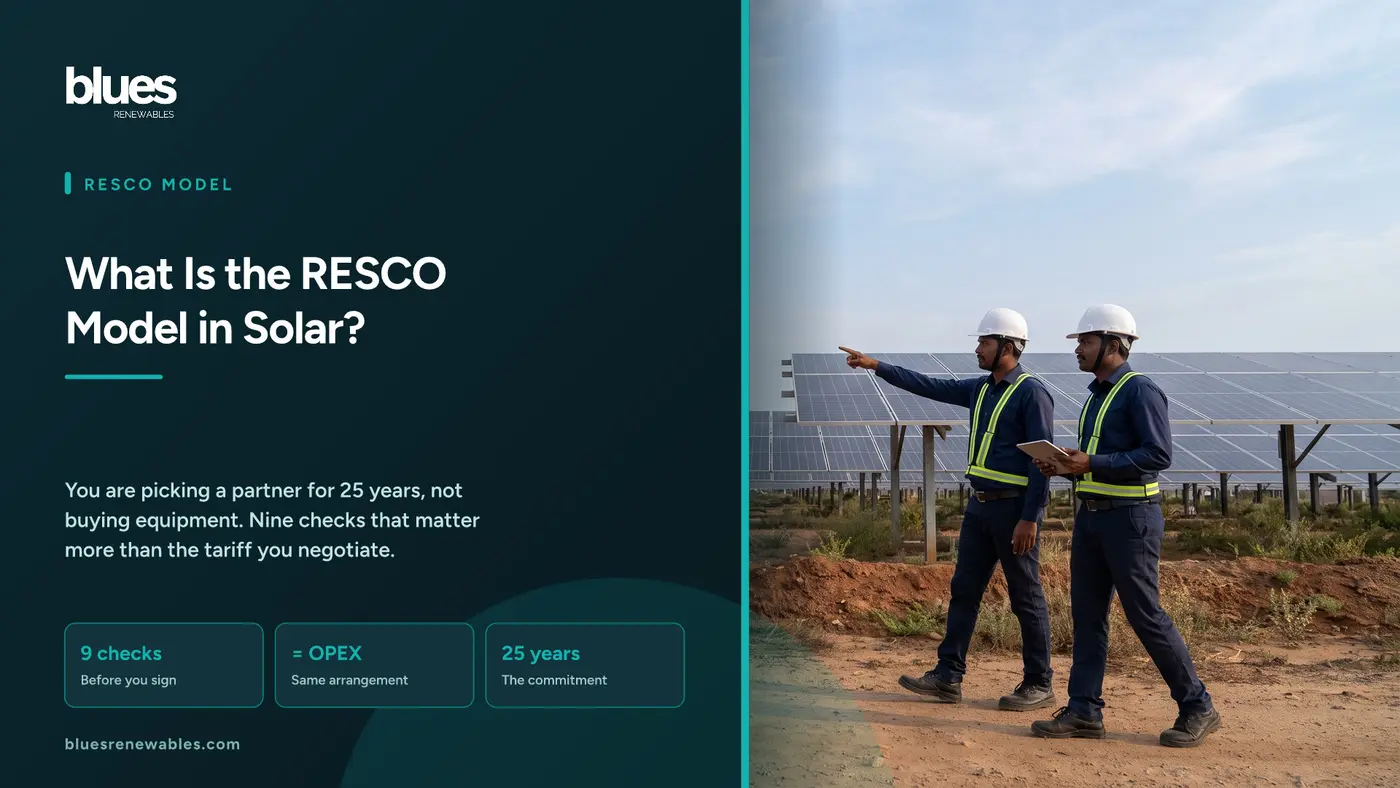
Signing a RESCO deal means picking a business partner for twenty five years. Most buyers spend their energy negotiating the tariff and almost none checking whether the company quoting it will still exist in 2040.
That is the wrong way round. Understanding the RESCO model in solar starts with understanding that you are not buying equipment. You are buying a quarter century of somebody else's operational competence, secured against a plant bolted to your own roof.
This guide explains what a RESCO is, why it means much the same thing as OPEX, how a RESCO earns its money, and the nine checks that separate a developer worth signing from one worth avoiding.
Key takeaways
- RESCO stands for Renewable Energy Service Company. It funds, builds, owns, operates and insures the solar plant, then sells you the electricity under a long term contract.
- RESCO and OPEX describe the same arrangement. OPEX names the model from the customer's side; RESCO names the company on the other side of it.
- You pay nothing upfront beyond a deposit, commonly around 10 percent, and buy units at roughly ₹3.50 to ₹5.50 on a rooftop contract.
- The RESCO keeps the depreciation, the subsidy eligibility and the residual asset, which is how it earns a return on capital it put at risk.
- Developer solvency is the risk nobody prices. A failed RESCO leaves a disputed asset attached to your building and an O&M contract nobody is performing.
- Nine checks matter more than the tariff: track record, funding, in-house O&M, generation guarantee, insurance, step-in rights, roof liability, independent metering, and who holds the DISCOM approval.
What is the RESCO model in solar
The RESCO model in solar is an arrangement in which a Renewable Energy Service Company finances, installs, owns, operates and maintains a solar plant at your premises, and sells you the electricity it generates at an agreed rate per unit under a power purchase agreement. You provide the roof and the demand. The RESCO provides everything else.
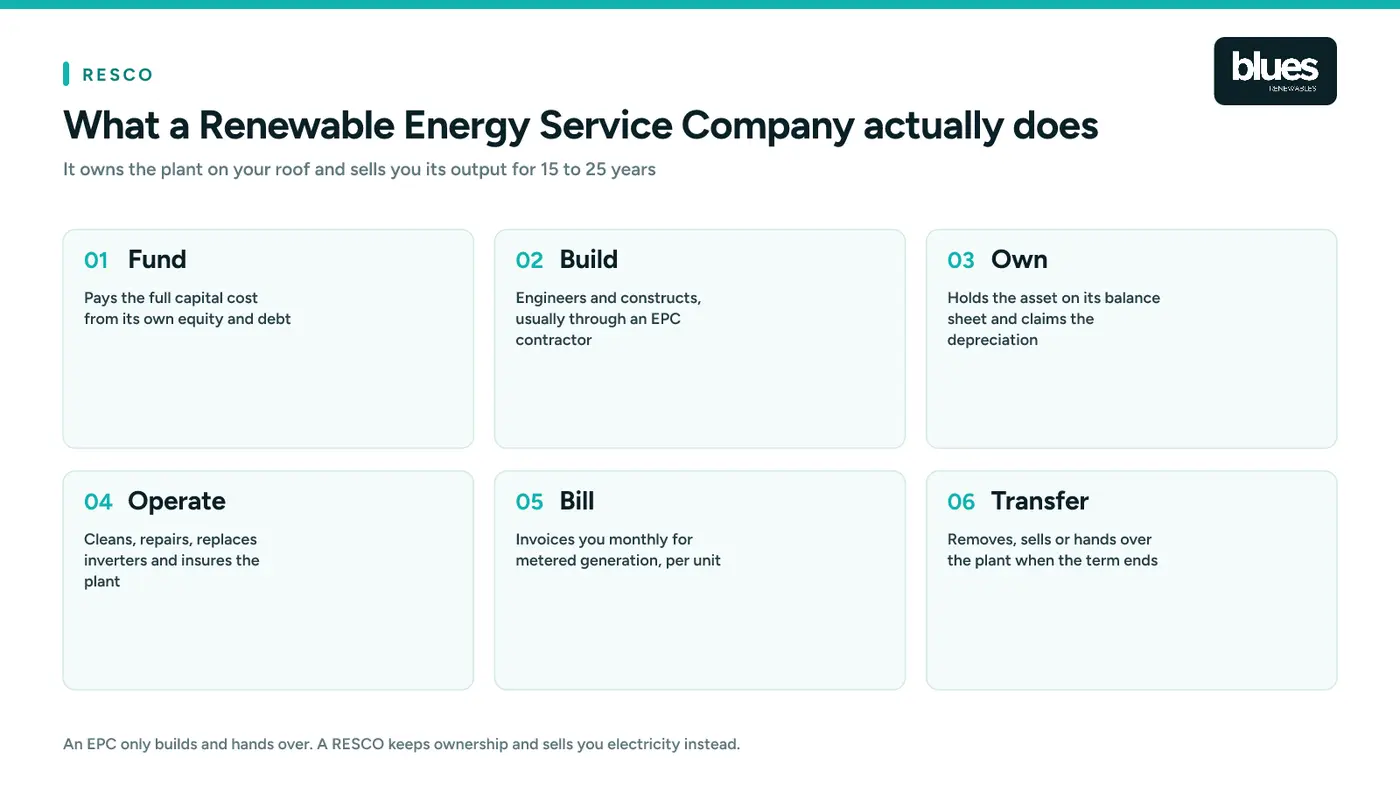
The label describes a role, not a technology. A RESCO can be a large independent power producer, the financing arm of an EPC, an infrastructure fund's portfolio company, or a small regional developer working on a handful of rooftops. All of them do the same six things:
- Fund the plant from equity and debt.
- Build it, usually through an EPC contractor.
- Own it for the contract term, holding it on their balance sheet.
- Operate and maintain it, including cleaning, repairs and inverter replacement.
- Bill you monthly for metered generation.
- Decommission or transfer it when the contract ends.
RESCO and OPEX are the same model
Here is the answer to the question everyone asks, stated plainly. The Indian solar industry uses RESCO and OPEX interchangeably, and no meaningful commercial difference separates them.
Where the words do differ is in perspective.
- What the word names - OPEX: The commercial model, RESCO: The counterparty
- Whose view it takes - OPEX: Yours, the buyer, RESCO: The industry's, the supply side
- Where you see it used - OPEX: Your finance team's language, because the cost is operating expenditure, RESCO: Tender documents, developer websites, policy papers
- Cash position - OPEX: No capital outlay, per-unit billing, RESCO: No capital received, per-unit revenue
So a quotation headed "OPEX/RESCO model" is not offering two options. It is naming one arrangement twice. Treat any vendor who invents a distinction between them, especially one that costs you money, as a vendor to question closely. Compare both against ownership in what the OPEX model in solar is and what the CAPEX model in solar is.
How a RESCO makes money on your roof
Understanding the developer's economics tells you which parts of the contract they will flex and which they cannot.
A RESCO earns from four sources.
- The margin between its cost of capital and your tariff. This is the core return, and it is why longer tenures price cheaper per unit.
- Accelerated depreciation. Because the RESCO owns the asset, it claims the 40 percent depreciation rate on solar. That tax shield is real money, and a RESCO with taxable profits can price more keenly than one without.
- Operations and maintenance efficiency. A developer running 200 MW across a state maintains each site far cheaper than a developer running two.
- The residual asset. After 25 years the plant still works. Whoever owns it then owns the remaining output.
Notice that item two is the same deduction you would have claimed yourself under CAPEX. Under RESCO you hand it over in exchange for not spending the capital. That trade is the entire model, and it is a fair one for the right buyer.
Nine checks before you sign with a RESCO
Tariff is easy to compare. These are harder, and they matter more.
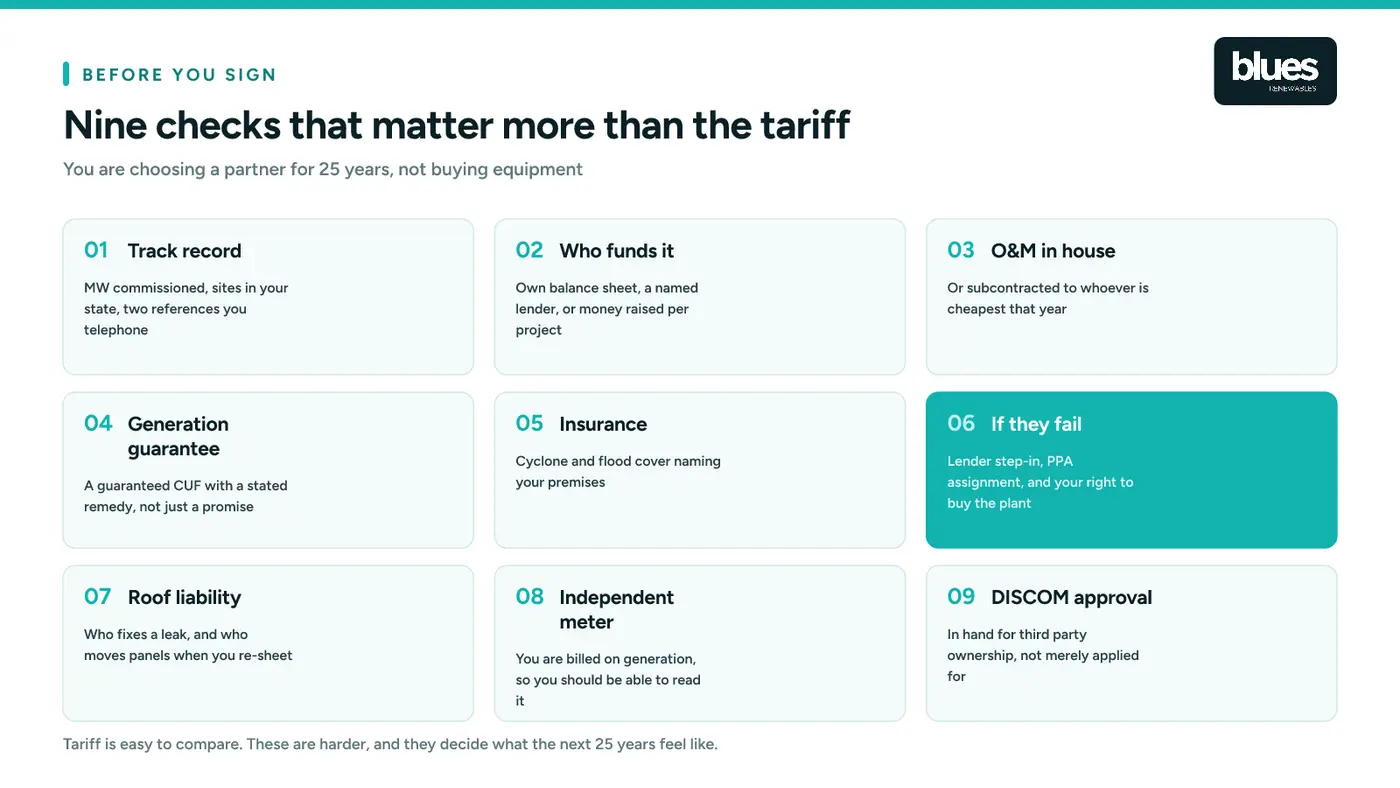
1. Track record you can verify. Ask for MW commissioned, sites in your state, and two customer references on comparable systems who you actually telephone. Commissioning dates beat capacity claims.
2. Who funds the plant. A developer using its own balance sheet, or backed by a named infrastructure fund or lender, behaves very differently from one raising money per project. Ask directly, and ask whether financial close on your site is complete.
3. In-house or subcontracted maintenance. A RESCO that subcontracts O&M to whichever vendor is cheapest that year gives you a chain of accountability with a weak link in it. Ask who physically cleans the panels and how often.
4. A generation guarantee with teeth. Look for a guaranteed annual output or CUF, with compensation if the plant underperforms. A guarantee that promises performance but specifies no remedy is a sentence, not a clause.
5. Insurance on the asset and third party liability. Chennai sits in a 50 metre per second basic wind zone under IS 875 Part 3. Confirm the policy covers cyclone and flood, and that it names your premises.
6. What happens if the RESCO fails. This is the check most often skipped. Ask for step-in rights for the lender, an assignment mechanism so the PPA transfers to a competent successor, and your own right to buy the plant at a defined price if operations stop. Without them, an insolvent developer's asset sits on your roof inside a process you cannot control.
7. Roof rights and structural liability. Fix in writing who repairs a leak caused by mounting penetrations, who removes panels when you re-sheet the roof, and what notice each side gives.
8. Independent metering and data access. You are billed on metered generation, so you should be able to read that meter and the monitoring portal yourself. Insist on it.
9. Who holds the DISCOM approval. Third party owned systems need the distribution licensee's sanction under the applicable state regulations, and in Tamil Nadu the TNERC grid interactive solar framework governs how the connection and metering are set up. Confirm the approvals are actually in hand before construction, not merely applied for.
Where RESCO works well in Tamil Nadu
RESCO arrangements suit large daytime loads on owned or securely leased premises. Factories, hospitals, hotels, cold storage and IT campuses fit the profile, because their consumption is high, steady and concentrated in daylight hours.
The model works less well on small systems. Below roughly 50 kW, the developer's fixed costs of contracting, approvals and site visits stop making sense, so many RESCOs simply will not quote. That is also why residential RESCO is rare in India, and it would be a poor idea anyway: PM Surya Ghar central financial assistance of up to ₹78,000 requires the consumer to own the system, so a third party owned home installation forfeits it.
For sector-specific sizing, see solar for hospitals in Chennai and industrial solar in Chennai. To compare all three funding routes in one place, read CAPEX vs OPEX vs RESCO solar.
Frequently asked questions
What is the RESCO model in solar? It is an arrangement where a Renewable Energy Service Company pays for, owns, operates and maintains a solar plant at your site, and sells you its output at a fixed per-unit rate under a long term power purchase agreement. You invest no capital and take on no maintenance.
What does RESCO stand for? Renewable Energy Service Company. The term describes the developer that owns and runs the plant, as distinct from an EPC contractor, which only builds it and hands it over.
What is the difference between RESCO and OPEX in solar? None in substance. OPEX names the commercial model as your accounts see it, and RESCO names the company delivering it. Quotations frequently write "OPEX/RESCO" because the two words point at the same arrangement.
What is the difference between a RESCO and an EPC? An EPC engineers, procures and constructs the plant, then hands ownership to whoever paid for it. A RESCO retains ownership and sells you electricity instead. Many companies do both, offering CAPEX through the EPC arm and RESCO through a separate entity.
How much does RESCO solar cost per unit? Rooftop contracts in India typically run ₹3.50 to ₹5.50 per unit, with 0 to 3 percent annual escalation over a 15 to 25 year term. Larger systems, longer tenures and stronger credit ratings all pull the rate down.
What happens if the RESCO goes bankrupt? That depends entirely on what your contract says. With lender step-in rights, PPA assignment provisions and a defined buyout price, the plant transfers to a new operator or to you. Without them, you face a disputed asset on your roof and no clear route to fix it.
Is RESCO solar eligible for subsidy in India? Not for residential PM Surya Ghar assistance, which requires consumer ownership. Some state and central tenders do procure rooftop solar in RESCO mode for government and institutional buildings, so check the specific scheme rather than assuming either way.
What is the meaning of RESCO? RESCO means Renewable Energy Service Company. In solar it describes a developer that funds, owns, operates and maintains a plant on your roof or land, then sells you the electricity it makes. You are buying units, not equipment. The term is used interchangeably with OPEX in the Indian market.
Is the RESCO model better than buying solar outright? It depends on which you value more, cash or control. RESCO removes the capital cost, the maintenance and the performance risk, and in exchange you give up the asset, the accelerated depreciation and the PM Surya Ghar subsidy, which requires the consumer to own the system. Buying outright costs more on day one and returns more across twenty five years.
Where this fits
A RESCO is the counterparty in an OPEX arrangement, so read what the OPEX model in solar is for the economics and what a solar PPA is for the contract that binds you both. The ownership alternative is set out in what the CAPEX model in solar is, and the fixed-rental variant in what a solar lease is. For loads too large for one roof, open access solar and captive solar plants come next.
Blues Renewables has installed solar across Chennai since 2020, for homes, schools, businesses and factories. We are happy to be measured against the nine checks above, and we will run them over any competing quotation you have received.
Call +91 98841 07170 and we will tell you whether the RESCO model in solar suits your load, or whether owning the plant outright would simply pay you more.
Sources
- Tamil Nadu Electricity Regulatory Commission, Grid Interactive Solar Energy Generating Systems Regulations and subsequent amendments
- MNRE, Guidelines for implementation of PM Surya Ghar: Muft Bijli Yojana, on eligibility of RESCO and third party owned systems
- Income Tax Act 1961, Section 32; Income Tax Rules, Appendix I depreciation schedule
- Press Information Bureau, Ministry of New and Renewable Energy, "GST on Renewable Energy Devices Rationalised to 5%", 17 September 2025
- IS 875 Part 3, wind loads for building design