Accelerated Depreciation on Solar in India: Rate, Rules and Who Can Claim
Learn what accelerated depreciation in solar means, discover the 40% rate that actually applies, and read why it shifts tax rather than cutting your bill.



Accelerated depreciation is the most misunderstood number in Indian solar. Salespeople quote 80 percent. Blogs repeat it. Both are years out of date, and the figure was never a discount on your purchase price in the first place.
Here is the honest version. Accelerated depreciation in solar lets you claim a large slice of the plant's cost against taxable profit in its first year rather than spreading it evenly across two decades. It shifts when you get the deduction, and creates no money at all.
This guide covers what the benefit actually is, the rates that apply in 2026, how the written down value method plays out year by year, what it is worth in rupees at your tax rate, and who cannot claim it at all.
Key takeaways
- The rate for solar is 40 percent, not 80 percent. The higher figure was withdrawn years ago and survives only in stale sales decks.
- Accelerated depreciation shifts tax, it does not cancel it. You would deduct the full cost eventually anyway. The benefit is getting the deduction sooner, which is worth real money but far less than the headline suggests.
- A manufacturer outside the 22 percent regime can reach 60 percent in year one by adding 20 percent under Section 32(1)(iia). Most other businesses get 40 percent.
- Commission before 30 September or lose half. A plant used for fewer than 180 days in the year gets half the rate that year.
- On a ₹1 crore plant, year one depreciation of ₹40 lakh saves about ₹10 lakh in tax for a company on the 22 percent regime. That is the real number.
- Only taxpaying businesses benefit. Households, trusts and loss-making firms get nothing from it.
What is accelerated depreciation in solar
Accelerated depreciation in solar is a tax provision that lets a business write off a solar power plant faster than its physical life, by claiming depreciation at a high rate in the early years. Solar power generating systems sit in a 40 percent depreciation block under Appendix I of the Income Tax Rules, claimed under Section 32 of the Income Tax Act 1961.
Compare that with an ordinary office building at 10 percent, or general plant and machinery at 15 percent. Solar gets a deliberately generous rate because the government wanted to pull private capital into renewables.
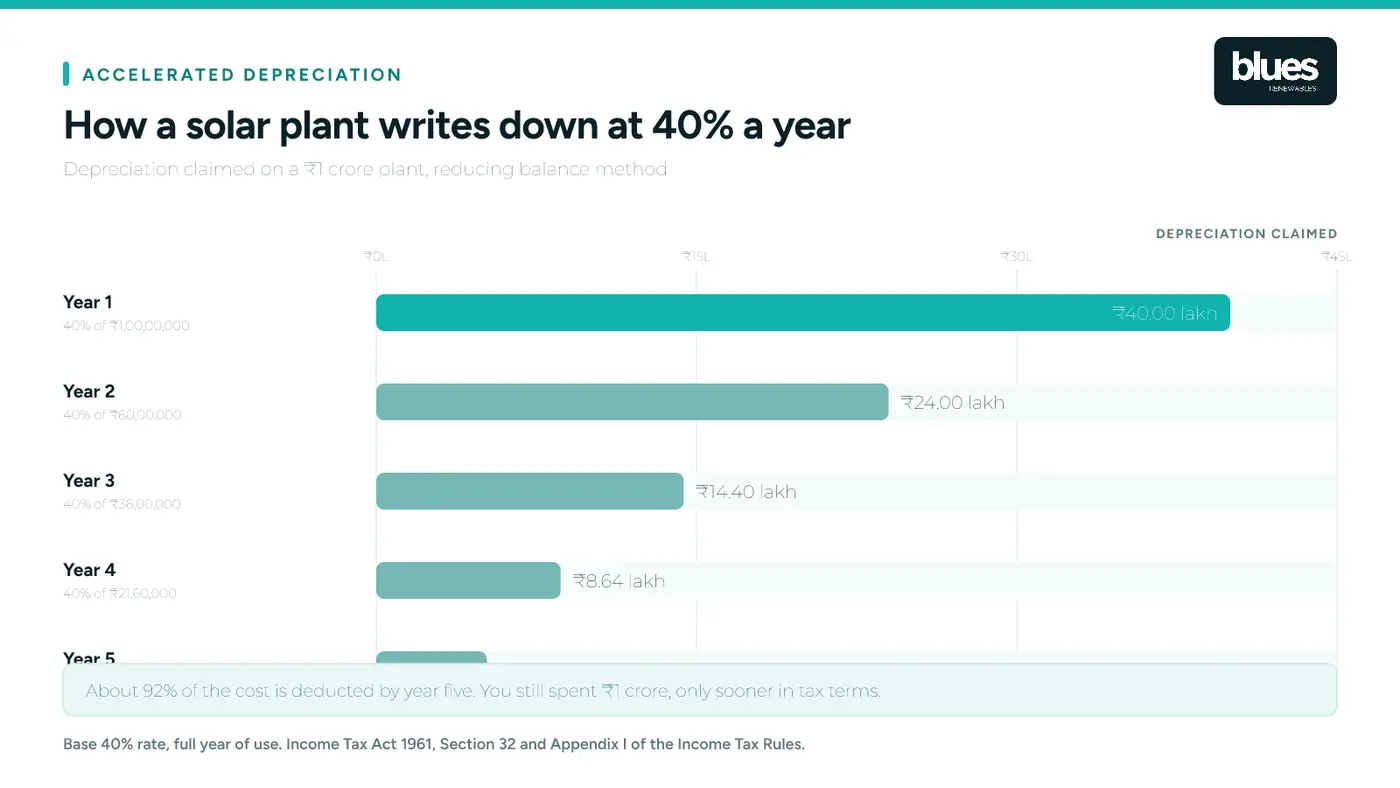
The word "accelerated" is doing the important work here. Your plant will last 25 years. The tax system lets you deduct most of its cost within five or six. That mismatch is the entire benefit.
How accelerated depreciation works, step by step
India uses the written down value method for most assets, including solar. Each year you claim 40 percent of whatever value remains, not 40 percent of the original cost.
On a ₹1 crore plant commissioned early in the financial year, the schedule runs like this.
- 1 - Opening value: ₹1,00,00,000, Depreciation at 40%: ₹40,00,000, Closing value: ₹60,00,000
- 2 - Opening value: ₹60,00,000, Depreciation at 40%: ₹24,00,000, Closing value: ₹36,00,000
- 3 - Opening value: ₹36,00,000, Depreciation at 40%: ₹14,40,000, Closing value: ₹21,60,000
- 4 - Opening value: ₹21,60,000, Depreciation at 40%: ₹8,64,000, Closing value: ₹12,96,000
- 5 - Opening value: ₹12,96,000, Depreciation at 40%: ₹5,18,400, Closing value: ₹7,77,600
By year five you have deducted roughly 92 percent of the cost. The remainder keeps shrinking inside your block of assets in later years.
Notice what the table does not show: any reduction in what you paid. You spent ₹1 crore, and you will deduct ₹1 crore over time. Accelerated depreciation only decides how quickly.
Depreciation is claimed on a block, not per asset
Section 32 works on blocks of assets grouped by rate. Your solar plant joins every other 40 percent asset you own. Additions during the year increase the block, disposals reduce it, and depreciation applies to the block's closing balance. This matters when you sell or scrap the plant: there is usually no separate capital gain, the sale proceeds simply reduce the block.
The 180-day rule decides your first year
If the plant is put to use for fewer than 180 days in the financial year, you claim half the rate that year, with the balance carrying forward into later years.
A plant energised in August claims the full 40 percent. The same plant energised in December claims 20 percent. Nothing is lost permanently, but a year of tax shield is deferred, which on a large project is worth several lakh rupees. Where commissioning is close to the line, pushing to energise before 30 September is worth real effort.
To run these numbers for your own plant, including a half-rate first year, see our guide on how to calculate accelerated depreciation for solar in India.
The rates that actually apply in 2026
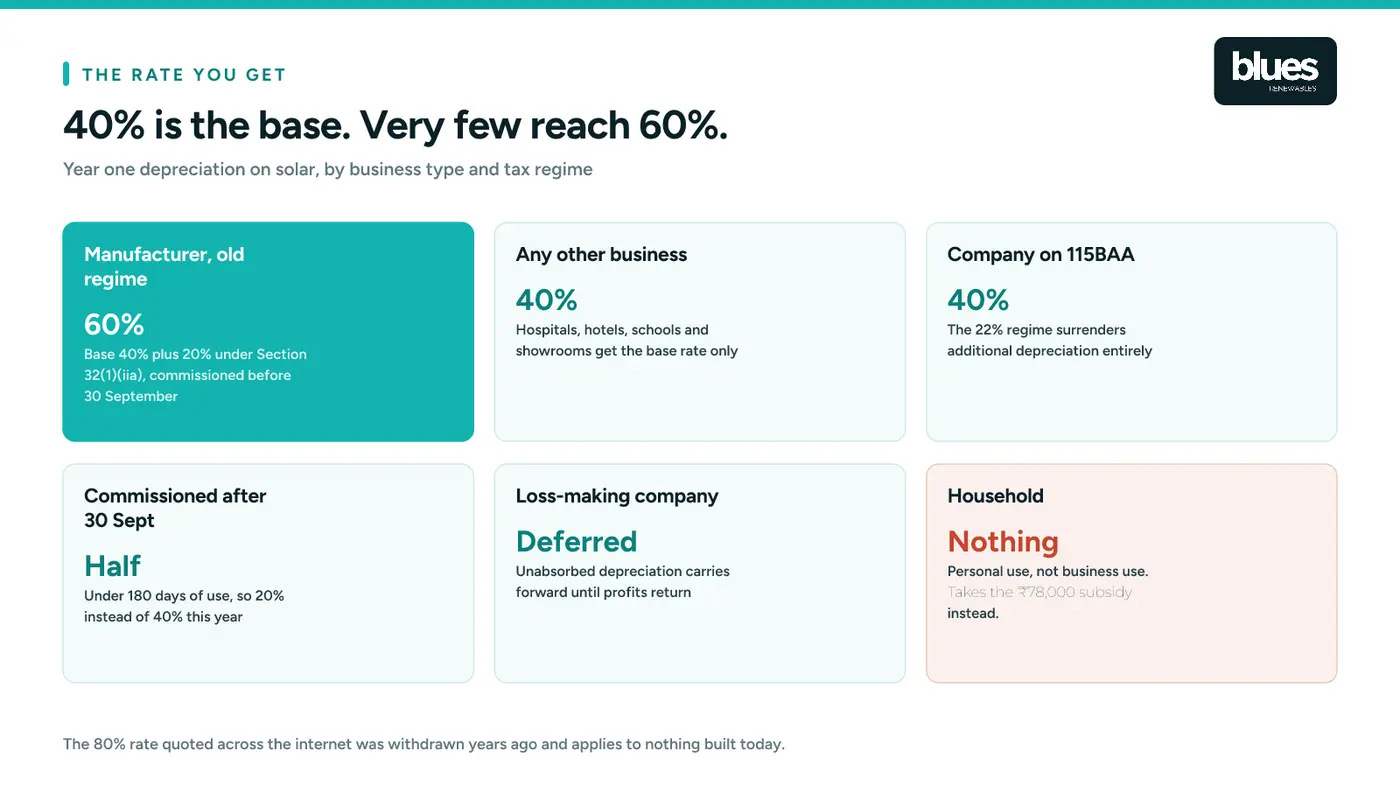
The base rate is 40 percent for every business that owns a solar plant and uses it for business purposes.
An additional 20 percent is available under Section 32(1)(iia) in the first year, taking year one to 60 percent. Two conditions bite hard, and most articles mention neither.
- It applies only to businesses engaged in manufacturing or production. A hospital, hotel, school or retail chain gets the base 40 percent and nothing more.
- Companies that opted into the concessional 22 percent regime under Section 115BAA cannot claim it. Additional depreciation is one of the deductions surrendered in exchange for the lower headline rate, and a great many Indian companies have made that switch.
- Manufacturer, old regime, commissioned before 30 September - Year one: 60%
- Manufacturer, old regime, commissioned after 30 September - Year one: 30%
- Any business, old or 115BAA, before 30 September - Year one: 40%
- Any business, after 30 September - Year one: 20%
- Household or non-taxpaying entity - Year one: Nothing
What it is actually worth
A deduction is not a refund. Its value equals the depreciation claimed multiplied by your marginal tax rate.
Take that ₹1 crore plant with ₹40 lakh of year one depreciation.
- Section 115BAA company - Effective rate: about 25.17%, Year one tax saved: about ₹10.07 lakh
- Old regime, large company - Effective rate: about 34.94%, Year one tax saved: about ₹13.98 lakh
- Section 115BAB manufacturer - Effective rate: about 17.16%, Year one tax saved: about ₹6.86 lakh
So a company on the 22 percent regime saves roughly ₹10 lakh of tax in year one on a ₹1 crore plant. That is a genuinely useful number, and it is the one to put in a board paper.
It is also emphatically not "40 percent off your solar plant", which is how the benefit gets sold. The true economic gain is the time value of receiving deductions early rather than late, typically worth somewhere between 8 and 15 percent of project cost in present-value terms, depending on your tax rate and cost of capital.
Being straight about this matters, because a business case built on the wrong number falls apart at the first audit committee meeting.
Who can claim it, and who cannot
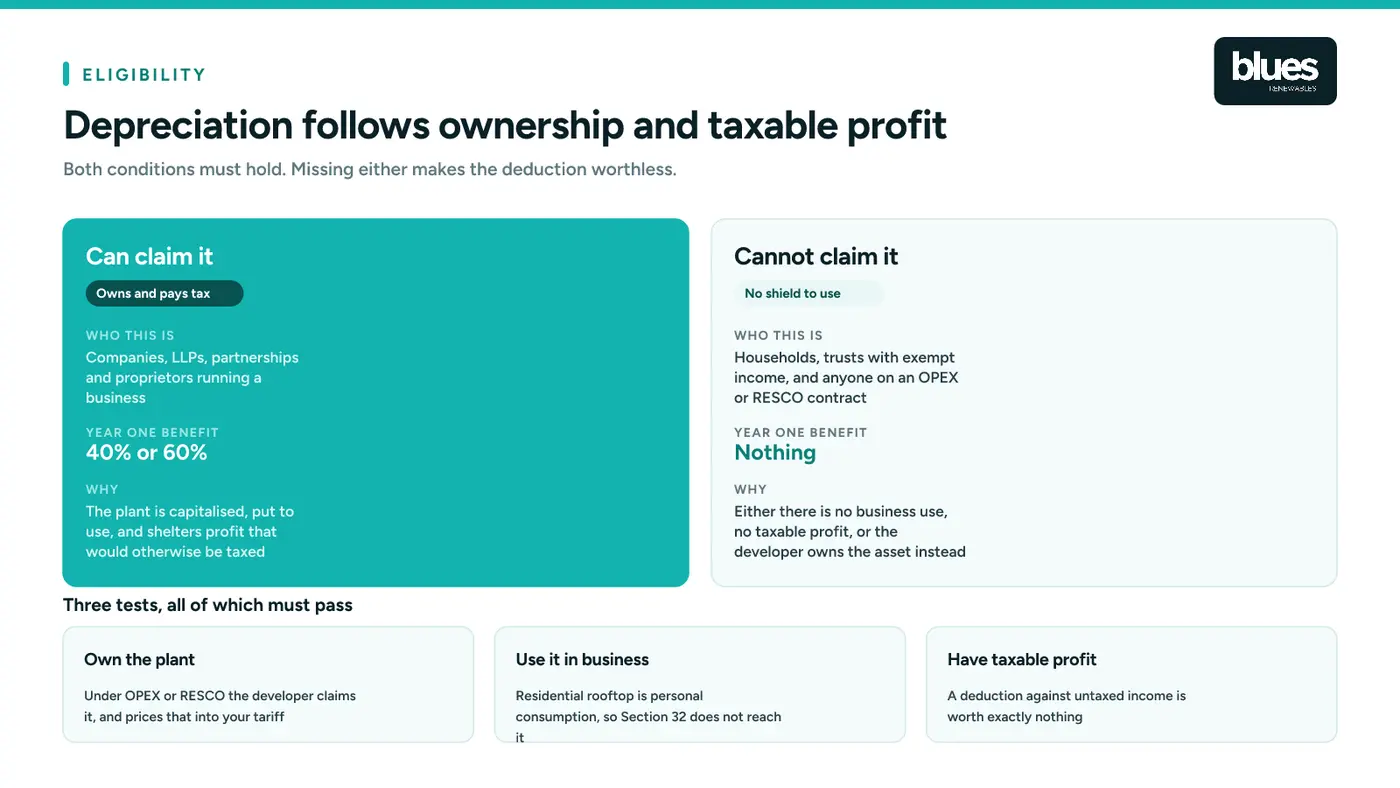
You can claim it if you own the plant, use it for your business, and pay tax on profits. Companies, LLPs, partnerships and proprietors running a business all qualify. The plant must be capitalised in your books and actually put to use, not merely purchased.
You cannot claim it if any of the following apply.
- You are a household. Residential rooftop is personal consumption, not business use. Households get the PM Surya Ghar subsidy of up to ₹78,000 instead, which is covered on our PM Surya Ghar subsidy page.
- You do not own the plant. Under an OPEX or RESCO arrangement the developer owns the asset and claims the depreciation. That trade is explained in what the OPEX model in solar is.
- You have no taxable profit. A loss-making company can carry the depreciation forward, but the cash benefit waits until profits arrive.
- You are a trust or society with exempt income. No tax liability means no tax shield.
That third bullet quietly decides the CAPEX versus OPEX question for a lot of businesses. If you cannot use the depreciation, a large part of ownership's advantage disappears, as set out in CAPEX vs OPEX vs RESCO solar.
Four mistakes that cost real money
Believing the 80 percent figure. It was withdrawn. Any quotation still using it is either careless or hoping you will not check.
Forgetting the 115BAA restriction. Finance teams sometimes model 60 percent for a company that gave up additional depreciation years ago. That overstates year one by half.
Commissioning in the last week of March. Under 180 days of use halves the rate. A February energisation and an April energisation are worth very different amounts.
Treating the deduction as a cash grant. It is worth your marginal tax rate applied to the deduction, nothing more. Model it that way and the project still looks good.
Confirm your own position with your auditor. Tax treatment turns on facts specific to your company, so treat this article as general guidance rather than tax advice.
A rooftop plant is plant and machinery
This point carries more weight than it first appears. A solar array is bolted to a building, which raises the question of whether it becomes part of the immovable property.
For tax purposes it does not. A rooftop solar plant is treated as plant and machinery, an apparatus fixed to the earth rather than a building or civil structure. That classification is what puts it in the 40 percent block instead of a building's 10 percent, and the same reasoning has been applied in GST rulings to allow input tax credit on rooftop systems used captively, which we cover in GST on a solar power plant.
Why homes cannot claim it, and what they get instead
Residential rooftop is personal consumption. Section 32 depreciation requires an asset used for the purposes of a business or profession, and running your own air conditioner is neither.
Households are not left out, though. They receive something that is in many ways better: PM Surya Ghar central financial assistance of up to ₹78,000, paid as ₹30,000 per kW for the first 2 kW and ₹18,000 for the third.
Compare the two on a like-for-like basis and the household does well.
- System cost - 3 kW home, CAPEX: about ₹2,10,000, 3 kW on a business roof: about ₹2,10,000
- Subsidy - 3 kW home, CAPEX: up to ₹78,000, 3 kW on a business roof: Not available
- Year one depreciation - 3 kW home, CAPEX: Not available, 3 kW on a business roof: ₹84,000 at 40%
- Year one cash benefit - 3 kW home, CAPEX: ₹78,000, 3 kW on a business roof: about ₹21,140 at 25.17%
The subsidy arrives as cash, once, and covers over a third of the system. Depreciation is worth a quarter of the deduction and only defers tax. A home gets the better deal, which is exactly how the scheme was designed. See our PM Surya Ghar subsidy page for the slabs and paperwork.
One consequence follows directly: a household should never take an OPEX or RESCO arrangement, because third-party ownership forfeits the subsidy and the household could not have used depreciation anyway.
What it is worth on a real rooftop
Chennai commercial rooftop pricing runs about ₹55,000 per kW at 100 kW scale, falling as systems grow. Here is the year one deduction and its cash value at both common tax positions.
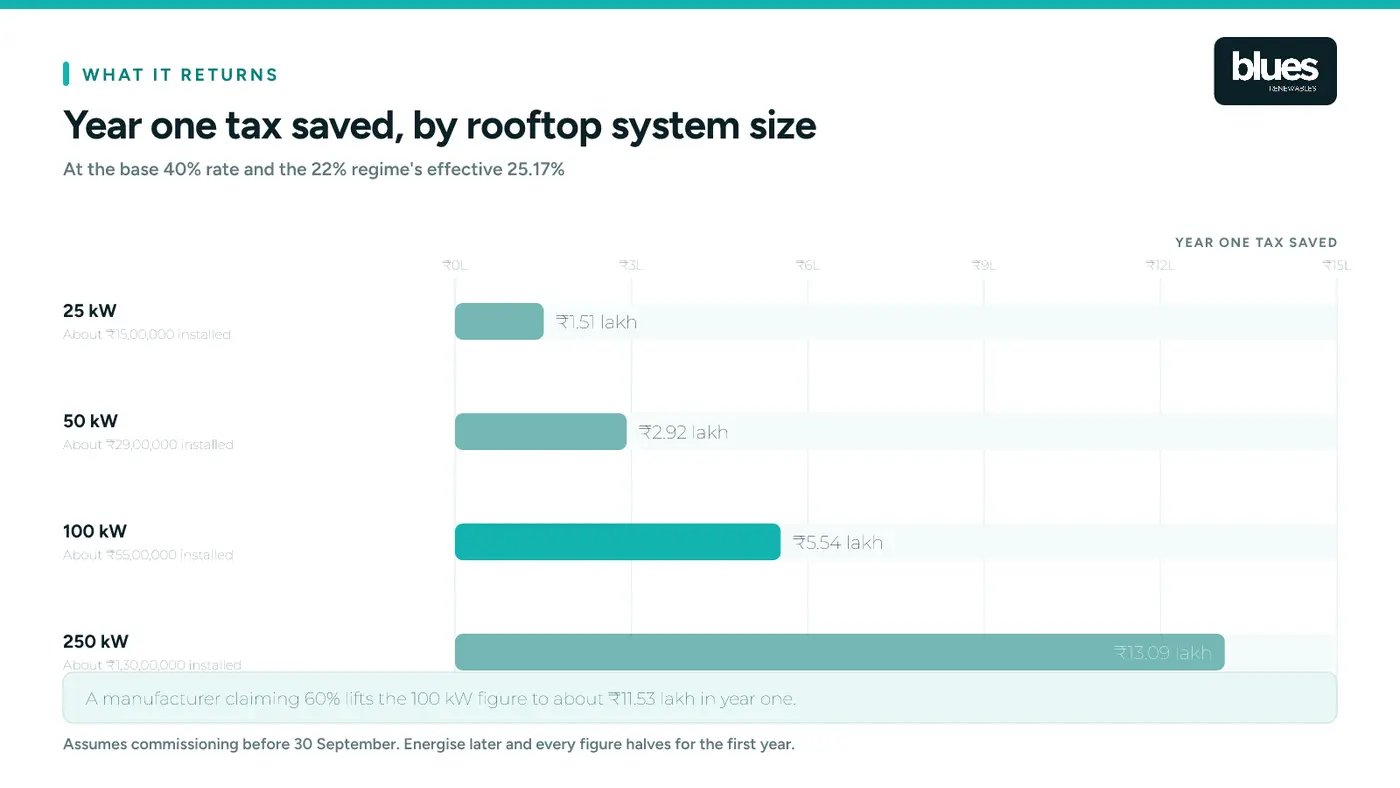
- 25 kW - Indicative cost: ₹15,00,000, Year one depreciation at 40%: ₹6,00,000, Saved at 25.17%: ₹1,51,000, Saved at 34.94%: ₹2,10,000
- 50 kW - Indicative cost: ₹29,00,000, Year one depreciation at 40%: ₹11,60,000, Saved at 25.17%: ₹2,92,000, Saved at 34.94%: ₹4,05,000
- 100 kW - Indicative cost: ₹55,00,000, Year one depreciation at 40%: ₹22,00,000, Saved at 25.17%: ₹5,54,000, Saved at 34.94%: ₹7,69,000
- 250 kW - Indicative cost: ₹1,30,00,000, Year one depreciation at 40%: ₹52,00,000, Saved at 25.17%: ₹13,09,000, Saved at 34.94%: ₹18,17,000
A manufacturer outside the 115BAA regime claims 60 percent rather than 40 in year one, lifting the 100 kW figure to ₹33,00,000 of deduction and about ₹11.53 lakh of tax saved.
Assumes commissioning before 30 September, so the full rate applies. Energise after that date and every figure halves for the first year.
Four rooftop-specific traps
Commissioning slips past September. Rooftop projects are quick to build but slow to energise, because the DISCOM inspection and metering stage runs four to eight weeks and is outside your control. A project that starts in August often energises in November. Work backwards from 30 September, not forwards from your purchase order.
You do not own the building. A tenant can still own and depreciate the plant, but you need roof rights for the asset's life and a clear agreement on what happens at lease end. Without that, the landlord effectively owns your asset.
The invoice bundles everything. Depreciation applies to the plant. Unrelated civil works, roof repairs or waterproofing carried out at the same time belong in different blocks at different rates. Ask your EPC to itemise.
You capitalised it as a building. A rooftop plant recorded under buildings sits in the 10 percent block instead of 40 percent. Check the fixed asset register wording, because this quietly costs three quarters of the first-year deduction.
Frequently asked questions
What is accelerated depreciation in solar? It is a tax provision letting a business deduct a solar plant's cost quickly, at 40 percent a year on the written down value, instead of spreading it across the asset's 25 year life. It reduces taxable profit in the early years, so tax is deferred rather than eliminated.
What is rooftop solar accelerated depreciation? It is the accelerated 40 percent depreciation a business claims on a solar plant installed on its own roof, under Section 32 of the Income Tax Act. It reduces taxable profit sharply in the early years, and applies to the full installed system cost.
How does accelerated depreciation work for solar in India? You capitalise the plant, add it to your 40 percent block of assets under Section 32, and claim 40 percent of the block's value each year. Manufacturers outside the 115BAA regime add 20 percent in year one. A plant used under 180 days in its first year claims half the rate.
Is accelerated depreciation on solar 40 percent or 80 percent? Forty percent. The 80 percent rate was withdrawn and no longer applies to any solar plant commissioned today, whatever older articles say.
What is the depreciation rate on solar panels? Forty percent a year on a written down value basis. The rate applies to the solar block as a whole rather than to the panels on their own, so modules, inverters, mounting structure and the balance of system all sit under the same figure. Half that rate applies in the first year if the plant runs for fewer than 180 days.
How much tax will I actually save? Multiply the depreciation by your effective tax rate. On a ₹1 crore plant, year one depreciation of ₹40 lakh saves about ₹10.07 lakh for a company on the 22 percent regime, or about ₹13.98 lakh at the old 34.94 percent rate.
Can I claim accelerated depreciation on a residential solar system? No. Residential rooftop is personal use, not business use. Households claim the PM Surya Ghar subsidy instead, worth up to ₹78,000.
Does accelerated depreciation apply under the OPEX or RESCO model? Not to you. Depreciation follows ownership, so the developer that owns the plant claims it. That is part of how a RESCO prices its tariff, as explained in what a RESCO is.
What happens to depreciation if my company makes a loss? Unabsorbed depreciation carries forward indefinitely and can be set against future profits. The deduction is not lost, but the cash benefit is postponed until the company is profitable again.
Do I get accelerated depreciation and the GST benefit together? They are separate. Depreciation is an income tax deduction; GST is an indirect tax where the question is input tax credit. Both can apply to the same plant, and we cover the second in GST on a solar power plant.
Where this fits
To put actual numbers against your own project, read how to calculate accelerated depreciation for solar in India. For the rooftop-specific position, including why homes are excluded, see the rooftop sections above. Depreciation only exists if you own the plant, so start with the CAPEX model in solar, and see how the whole investment stacks up in how to calculate solar payback period.
Blues Renewables has installed solar across Chennai since 2020, for homes, schools, businesses and factories. We build the tax case using the rate your company can genuinely claim, not the one that makes the quotation look best.
Call +91 98841 07170 and we will model what accelerated depreciation in solar is worth against your actual tax position, alongside the generation your roof can support.
Sources
- Income Tax Act 1961, Section 32 and Section 32(1)(iia)
- Income Tax Rules 1962, Appendix I, depreciation rate schedule for renewable energy devices
- Income Tax Act 1961, Section 115BAA and Section 115BAB, concessional corporate tax regimes
- MNRE, Guidelines for implementation of PM Surya Ghar: Muft Bijli Yojana
- Press Information Bureau, Ministry of New and Renewable Energy, "GST on Renewable Energy Devices Rationalised to 5%", 17 September 2025