What Is CAPEX Model in Solar? Costs, Tax and Payback Explained
CAPEX means you fund and own the plant, so every unit saves the full retail tariff. GST is now 5 percent and accelerated depreciation is 40, not 80.


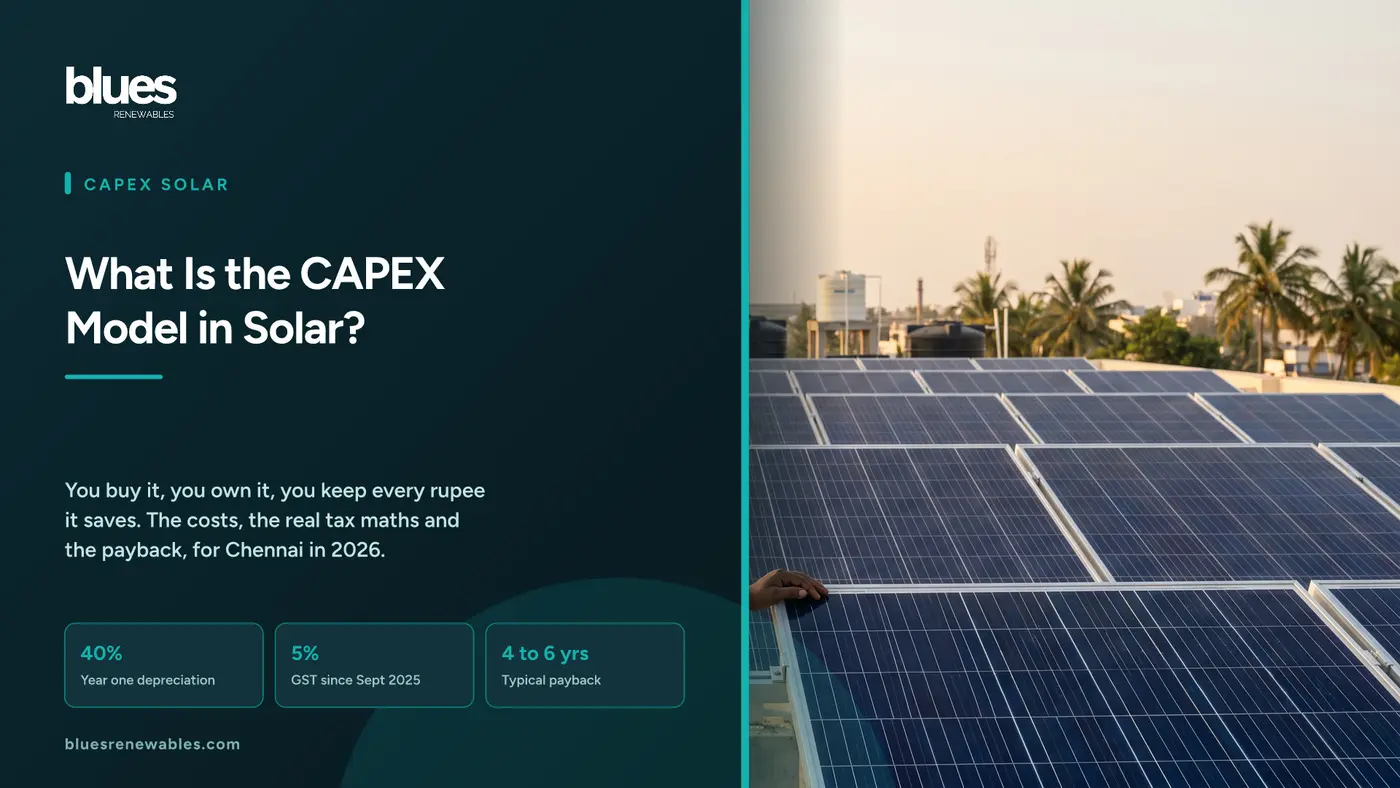
You buy it, you own it, you keep every rupee it saves. That is the whole idea behind the CAPEX model in solar, and it still produces the best returns of any route into solar for a business with the cash and the tax position to use it.
Two things changed recently that most articles on this topic have not caught up with. GST on solar dropped from 12 percent to 5 percent in September 2025. And accelerated depreciation is not the 80 percent figure still quoted all over the internet, nor is the extra 20 percent available to every company that wants it.
Below you will find what CAPEX actually means, what a system costs after the new GST rate, how the depreciation maths really works, what payback looks like in Chennai, and the three situations where CAPEX is the wrong answer.
Key takeaways
- CAPEX means you fund and own the solar plant outright. Every unit it generates belongs to you, so the saving is the full retail tariff rather than a discount on it.
- GST on solar fell from 12 percent to 5 percent on 22 September 2025. A typical 3 kW rooftop system got roughly ₹9,000 to ₹10,500 cheaper overnight.
- Accelerated depreciation on solar is 40 percent, not 80 percent. The extra 20 percent under Section 32(1)(iia) reaches only manufacturing businesses that stayed out of the 22 percent tax regime.
- PM Surya Ghar subsidy is available only under CAPEX. A third party owned system is expressly excluded, so a household choosing OPEX gives up ₹78,000.
- Typical payback in Chennai runs 4 to 6 years on a 25 year asset, which is why owner-occupiers with taxable income usually land here.
- CAPEX suits you badly if you rent your building, expect to move, or have no taxable profit to absorb the depreciation.
What is the CAPEX model in solar
The CAPEX model in solar is an arrangement where the consumer pays the full capital cost of the solar plant and owns it from commissioning onward. CAPEX is short for capital expenditure. You buy the panels, the inverters, the mounting structure and the installation, either from your own funds or through a loan, and the asset then sits on your balance sheet for its 25 year life.
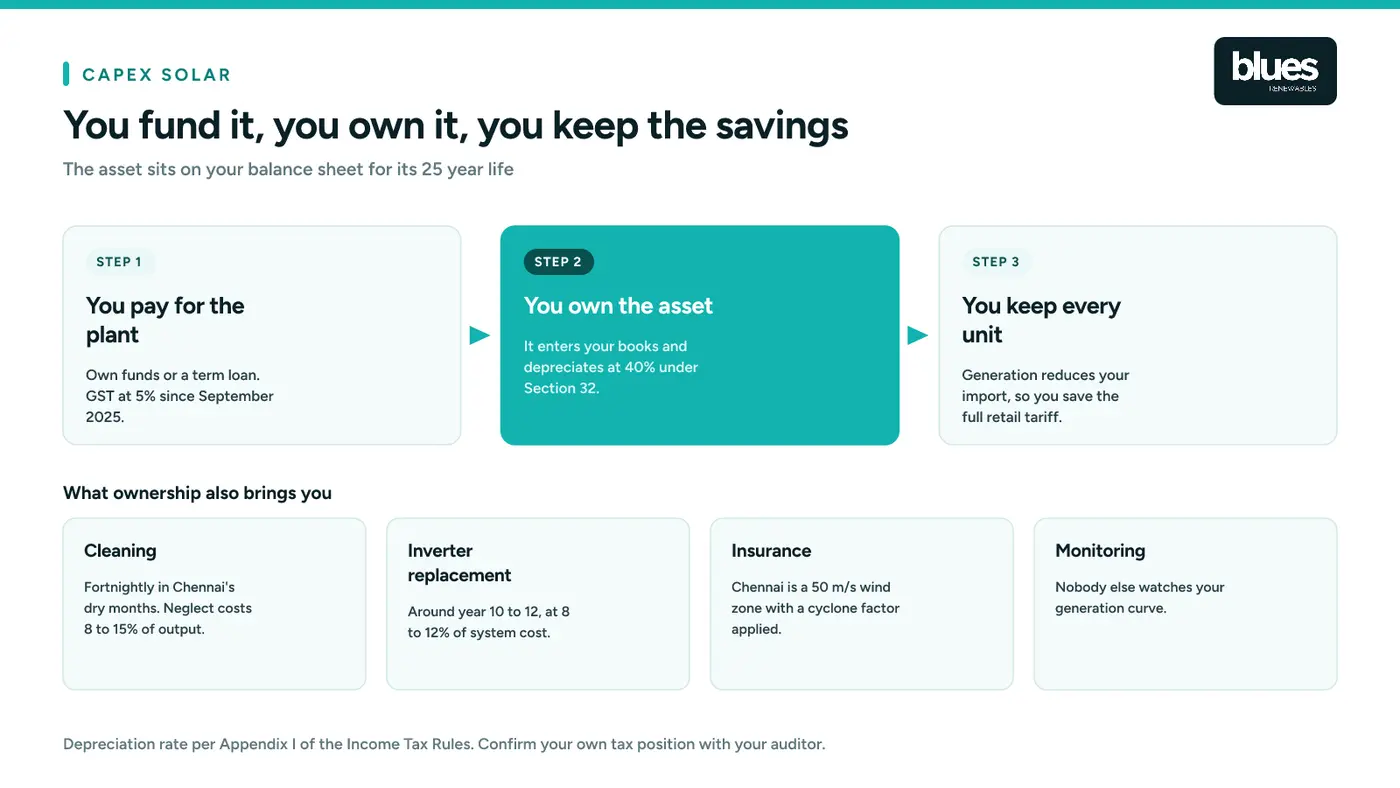
Because you own the plant, nobody sells you the electricity. The units simply appear on your meter and reduce what you import. Your saving per unit therefore equals your full retail tariff, not a negotiated discount on it.
That single fact explains why CAPEX beats every other model on pure returns. It also explains the catch. You carry the capital, the performance risk and the maintenance for a quarter of a century.
What a CAPEX solar system costs in 2026
GST reform reset these numbers. At its 56th meeting on 3 September 2025, the GST Council cut the rate on renewable energy devices from 12 percent to 5 percent, effective 22 September 2025. The Ministry of New and Renewable Energy put the saving at about ₹9,000 to ₹10,500 on a 3 kW rooftop system, and ₹20 to ₹25 lakh per MW on utility scale projects costing ₹3.5 to ₹4 crore per MW.
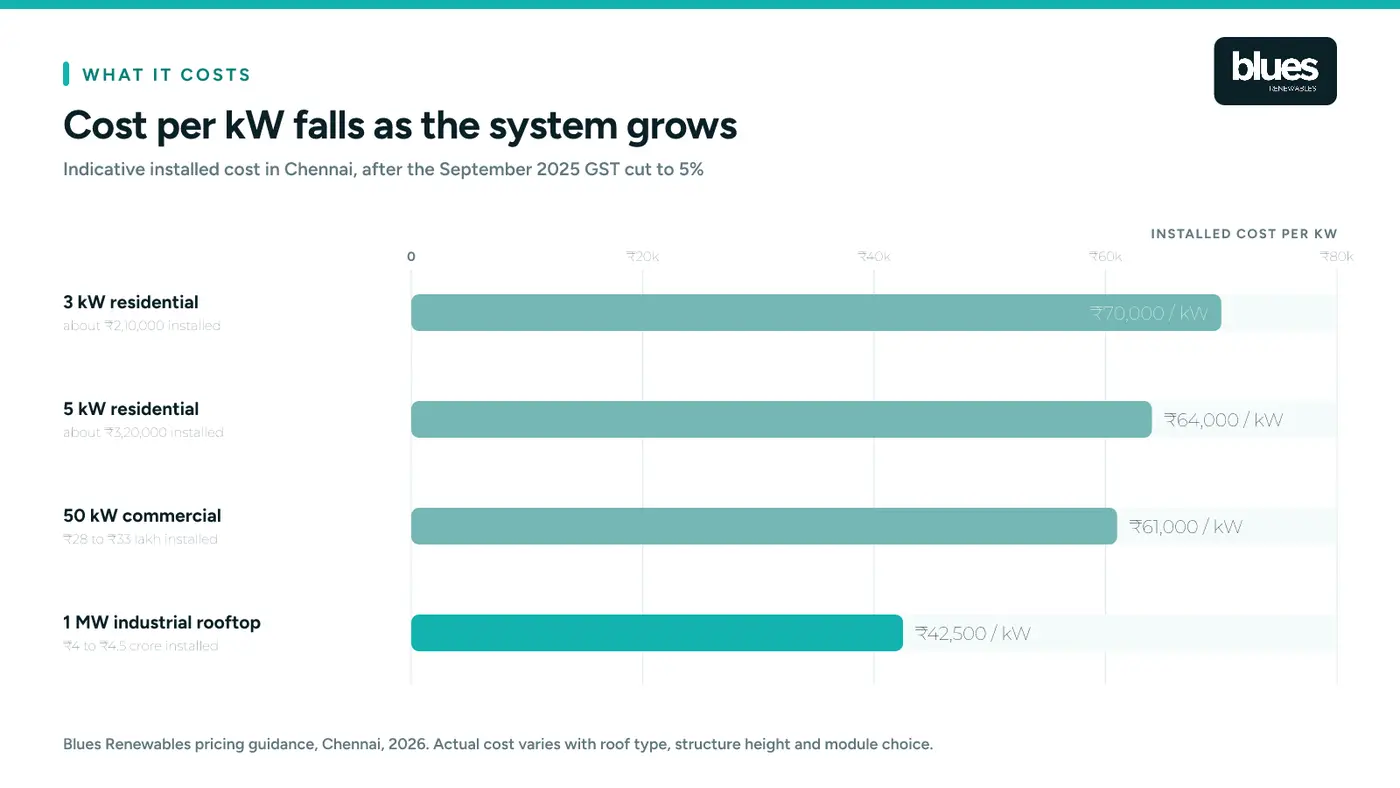
Here is what that looks like across common sizes in Chennai, installed and commissioned.
- 3 kW residential - Indicative installed cost: about ₹2,10,000, Roughly generates: 14 units a day, Suits: An independent house with a ₹2,500 to ₹3,500 monthly bill
- 5 kW residential - Indicative installed cost: about ₹3,20,000, Roughly generates: 24 units a day, Suits: A larger home running air conditioning
- 50 kW commercial - Indicative installed cost: ₹28 to ₹33 lakh, Roughly generates: 240 units a day, Suits: A school, showroom or clinic
- 1 MW industrial rooftop - Indicative installed cost: ₹4 to ₹4.5 crore, Roughly generates: 4,800 units a day, Suits: A factory with matching daytime load
Sizing assumes Chennai's 5.3 peak sun hours and about 4.8 units per kW per day across the year. Roof area works out at roughly 50 square feet per kW. You can check current pricing by size on our solar panel price in Chennai page.
The tax maths, done properly
This is where most CAPEX articles go wrong, and where the money actually sits for a business.
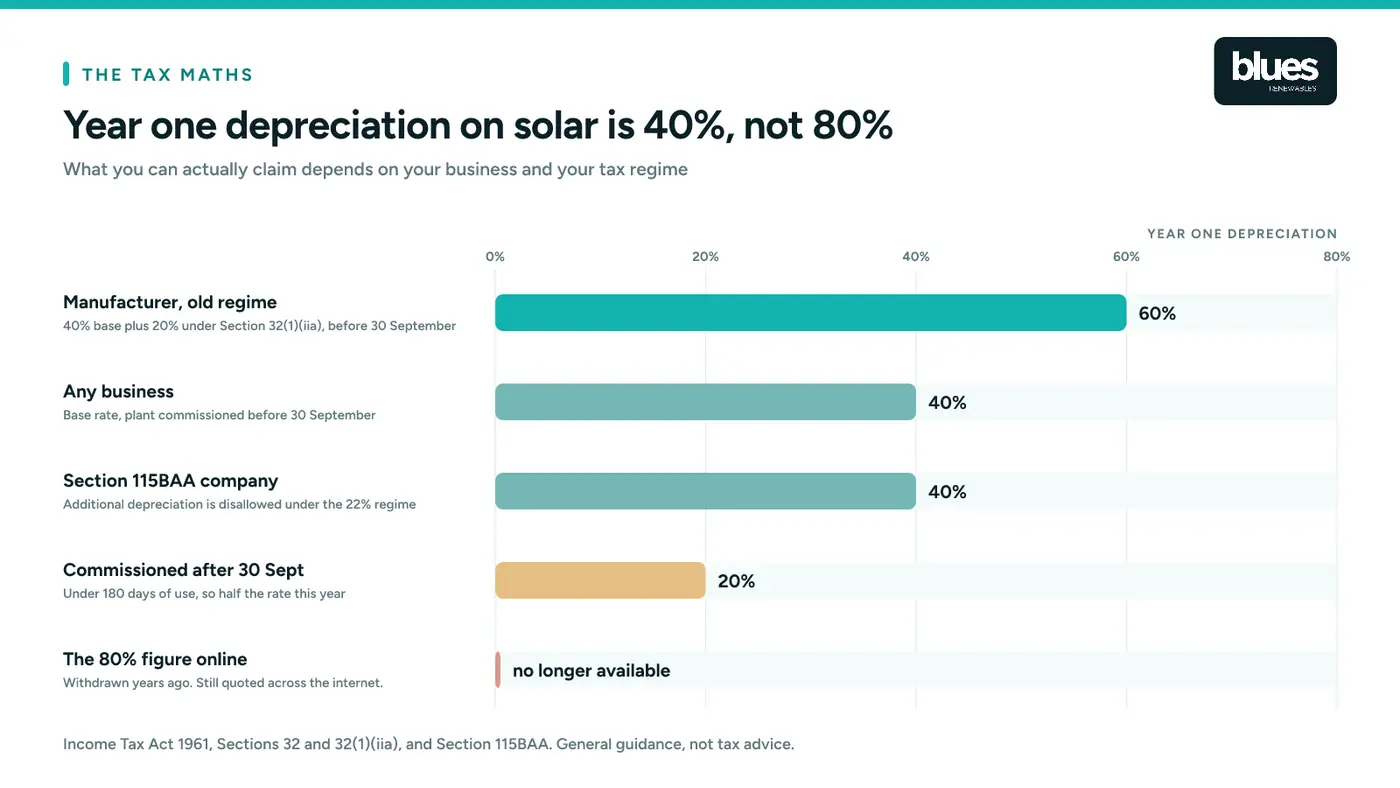
Accelerated depreciation is 40 percent
Solar power generating systems attract a 40 percent depreciation rate under Appendix I of the Income Tax Rules, claimed under Section 32. The 80 percent figure you will still find quoted was cut years ago. Anyone repeating it is working from stale copy.
The extra 20 percent has conditions
Section 32(1)(iia) allows an additional 20 percent in the first year, which would take year one to 60 percent. However, it carries two real restrictions.
- It applies to businesses engaged in manufacturing or production. A hospital, school or retail showroom does not qualify for the additional allowance, though all of them still get the base 40 percent.
- Companies that opted into the concessional 22 percent regime under Section 115BAA cannot claim it at all. A great many Indian companies moved to that regime for the lower headline rate, and additional depreciation is one of the deductions they surrendered in exchange.
Commissioning date changes the number
Where the plant runs for fewer than 180 days in the financial year, you claim half the rate that year. A plant energised in August gets the full 40 percent. The same plant energised in December gets 20 percent, with the balance carrying forward. Once the capital is already committed, pushing commissioning past 30 September becomes an expensive way to lose a year of tax shield.
- Manufacturer, old tax regime, commissioned before 30 September - Year one depreciation: 60%
- Any business, commissioned before 30 September - Year one depreciation: 40%
- Any business, commissioned after 30 September - Year one depreciation: 20%
- Section 115BAA company, commissioned before 30 September - Year one depreciation: 40%
Confirm your own position with your auditor before building a business case on it. Tax treatment turns on facts specific to your company, so treat this article as general guidance rather than tax advice.
What CAPEX returns actually look like
For a business paying ₹8 to ₹9.50 per unit on an HT connection, a rooftop CAPEX plant typically returns 18 to 25 percent IRR and pays back in four to six years. Residential payback in Chennai lands in the same range once the PM Surya Ghar subsidy is counted.
That subsidy matters more than people expect. It pays ₹30,000 per kW for the first 2 kW and ₹18,000 for the third, capped at ₹78,000 for systems of 3 kW and above. Crucially, it reaches the consumer 30 to 45 days after commissioning as a reimbursement rather than a discount at the quotation stage, so you fund the full amount first. Our PM Surya Ghar subsidy page walks through the slabs and the paperwork.
One point deserves emphasis, because it quietly settles the CAPEX question for most households. MNRE guidelines exclude RESCO and third party owned systems from the scheme. Choose OPEX for your home and you forfeit up to ₹78,000 of central assistance. No amount of PPA discount recovers that on a residential system.
What ownership actually costs you
CAPEX is not a one-time payment. Owning the asset means owning its obligations.
- Cleaning. Chennai dust and a coastal salt load make this a fortnightly job in the dry months. Neglect it and you lose 8 to 15 percent of output.
- Inverter replacement. Budget for one replacement around year 10 to 12, at roughly 8 to 12 percent of the original system cost.
- Insurance. Chennai sits in a 50 metre per second basic wind zone under IS 875 Part 3, with a cyclone importance factor applied to the structure design. Insure the asset accordingly.
- Performance monitoring. Nobody else watches your generation curve. A failed string can sit unnoticed for months.
Good EPCs bundle the early years of this into the contract. Blues includes maintenance in the installation package, and we set out what to look for in a maintenance clause under solar EPC companies in Chennai.
When CAPEX is the wrong choice
Three situations turn the model's strengths into liabilities.
You do not own the building. A 25 year asset bolted to a roof you lease for five years is a negotiation waiting to happen. Either secure a matching roof rights agreement, or use an arrangement your landlord signs instead.
You have no taxable profit. Depreciation shelters income. With no income to shelter, much of the CAPEX advantage simply evaporates, and the OPEX route closes most of the remaining gap.
Capital is scarce and better used elsewhere. If your business earns more than 20 percent on working capital, solar competes poorly against your own operations. That is a genuine reason to let somebody else fund it, which is exactly what the OPEX model in solar exists to do.
For a side by side view of both routes against your own numbers, read our comparison of CAPEX vs OPEX vs RESCO solar.
Frequently asked questions
What is the CAPEX model in solar? It is the arrangement where you pay the full capital cost of a solar plant and own it outright from day one. You keep all the electricity it generates, claim the depreciation and any subsidy, and take on maintenance for the plant's 25 year life.
What is the difference between CAPEX and OPEX in solar? Under CAPEX you buy and own the plant, so your saving is the full tariff you avoid. Under OPEX a developer owns it and sells you the units at an agreed rate, so your saving is only the gap between that rate and your grid tariff. CAPEX returns more; OPEX needs no capital.
How much does a solar CAPEX system cost per kW in India? Residential rooftop runs about ₹64,000 to ₹70,000 per kW in Chennai after the September 2025 GST cut. Larger commercial and industrial rooftops fall to roughly ₹40,000 to ₹45,000 per kW at megawatt scale, because fixed costs spread further.
What is the payback period for CAPEX solar? Four to six years is typical in Tamil Nadu, on an asset warranted for 25 years. Businesses on higher HT tariffs, and homes using most of their generation during the day, sit at the shorter end.
Can I claim 80 percent depreciation on solar? No. The rate for solar power generating systems is 40 percent. Manufacturing businesses outside the Section 115BAA regime can add 20 percent under Section 32(1)(iia) in year one, and anyone whose plant ran for under 180 days claims half the rate that year.
Is PM Surya Ghar subsidy available on CAPEX? Yes, and effectively only on CAPEX. The scheme requires the consumer to own the system, so RESCO and third party owned installations fall outside central financial assistance.
Can I take a loan and still call it CAPEX? Yes. CAPEX describes ownership, not the funding source. A bank-financed system is still yours, still depreciates on your books, and still qualifies for subsidy. Only the cash timing changes.
Where this fits
CAPEX is one of three ways to fund a solar plant. To see the alternative where a developer carries the cost, read what the OPEX model in solar is and what a RESCO is. The contract governing that route is covered in what a solar PPA is. Where your load runs beyond what your own roof can carry, open access solar is the next step up.
Blues Renewables has installed solar across Chennai since 2020, for homes, schools, businesses and factories. We model both routes against your actual bills and your actual tax position, then tell you plainly which one wins. Sometimes it is not the one that pays us more upfront.
Call +91 98841 07170 and we will run the CAPEX model in solar against your last twelve months of consumption, including the depreciation your company can genuinely claim.
For the two arrangements that avoid capital outlay altogether, read solar lease vs PPA.
Sources
- Press Information Bureau, Ministry of New and Renewable Energy, "GST on Renewable Energy Devices Rationalised to 5%", 17 September 2025
- GST Council, 56th meeting decisions dated 3 September 2025, effective 22 September 2025
- Income Tax Act 1961, Section 32 and Section 32(1)(iia); Income Tax Rules, Appendix I depreciation schedule
- Income Tax Act 1961, Section 115BAA concessional corporate tax regime
- MNRE, Guidelines for implementation of PM Surya Ghar: Muft Bijli Yojana
- IS 875 Part 3, wind loads for building design