What Is OPEX Model in Solar? Zero Investment Solar Explained
Learn what the OPEX model in solar means, discover the per-unit rates and savings to expect, and read the four clauses that decide whether it pays off.


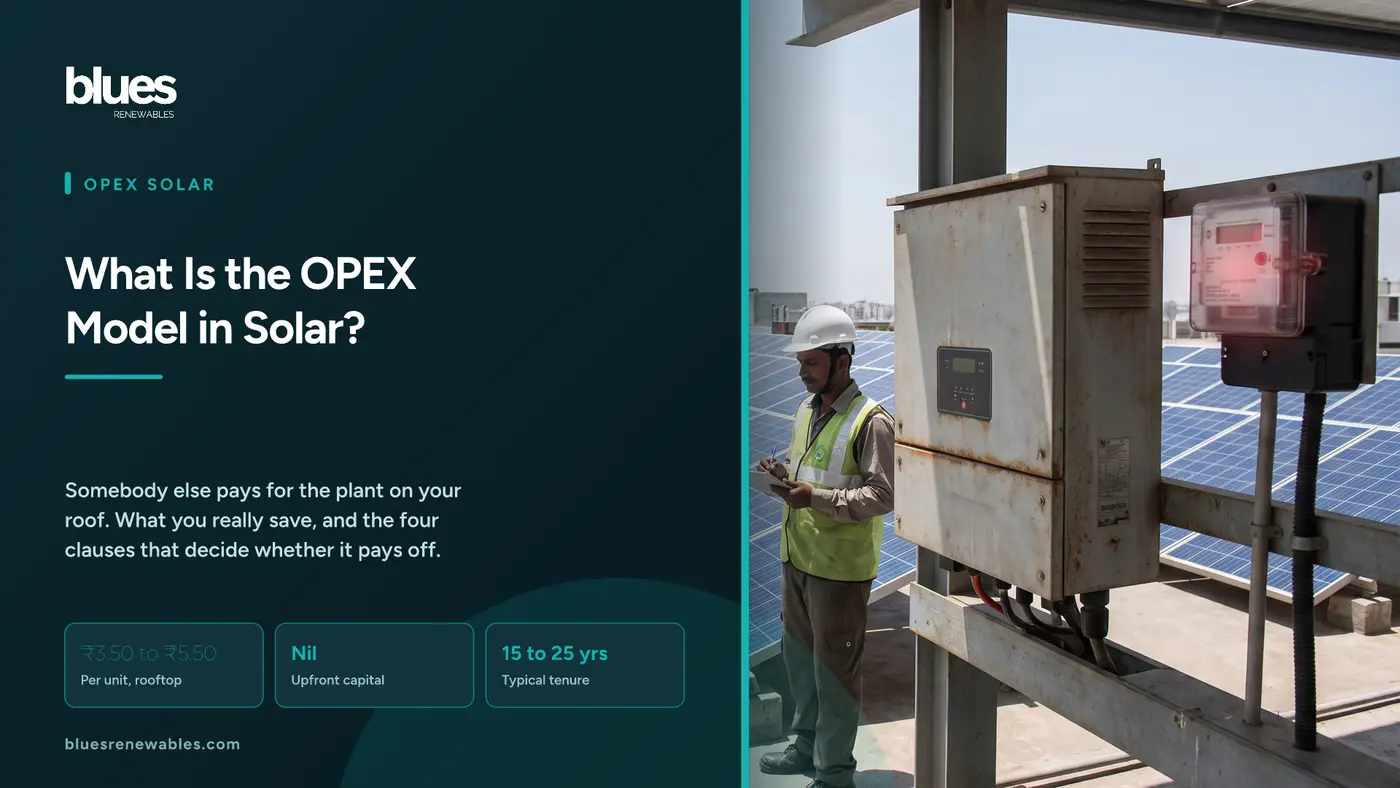
Somebody else pays for the plant on your roof. You pay only for the units it makes. That trade is the OPEX model in solar, and for a business short on capital it turns a ₹4 crore decision into a signature.
The trade is real, though, and it is not free. You give up the tax shield, the subsidy and the long tail of savings after payback. In return you give up the capital risk too. Whether that swap favours you comes down to four contract clauses that most quotations never mention.
This guide covers how OPEX works, what per-unit rates look like in 2026, what you genuinely save against CAPEX, the clauses that decide the outcome, and who should walk away from it.
Key takeaways
- OPEX means a developer funds, owns and operates the plant, and bills you per unit consumed. Your upfront cost is usually a security deposit of around 10 percent, sometimes nil.
- Rooftop OPEX tariffs run about ₹3.50 to ₹5.50 per unit on a 15 to 25 year contract, typically 20 to 40 percent below your grid tariff.
- You forfeit accelerated depreciation and the PM Surya Ghar subsidy, because both require you to own the system.
- Minimum offtake and deemed generation clauses carry the real risk. Many contracts oblige you to pay for 80 to 90 percent of expected output whether you use it or not.
- Calling OPEX "off balance sheet" is often wrong. Under Ind AS 116 an on-site plant dedicated to you can meet the definition of a lease and come back onto your books.
- OPEX fits tenants, capital-constrained firms and businesses with no taxable profit. It fits owner-occupiers with cash and tax liability far less well.
What is the OPEX model in solar
The OPEX model in solar is an arrangement where a developer pays for the solar plant, installs it on your roof or land, owns it, maintains it, and sells you the electricity it generates at an agreed rate per unit. OPEX is short for operating expenditure, which is exactly how the payment lands in your accounts: a recurring energy bill rather than a capital purchase.
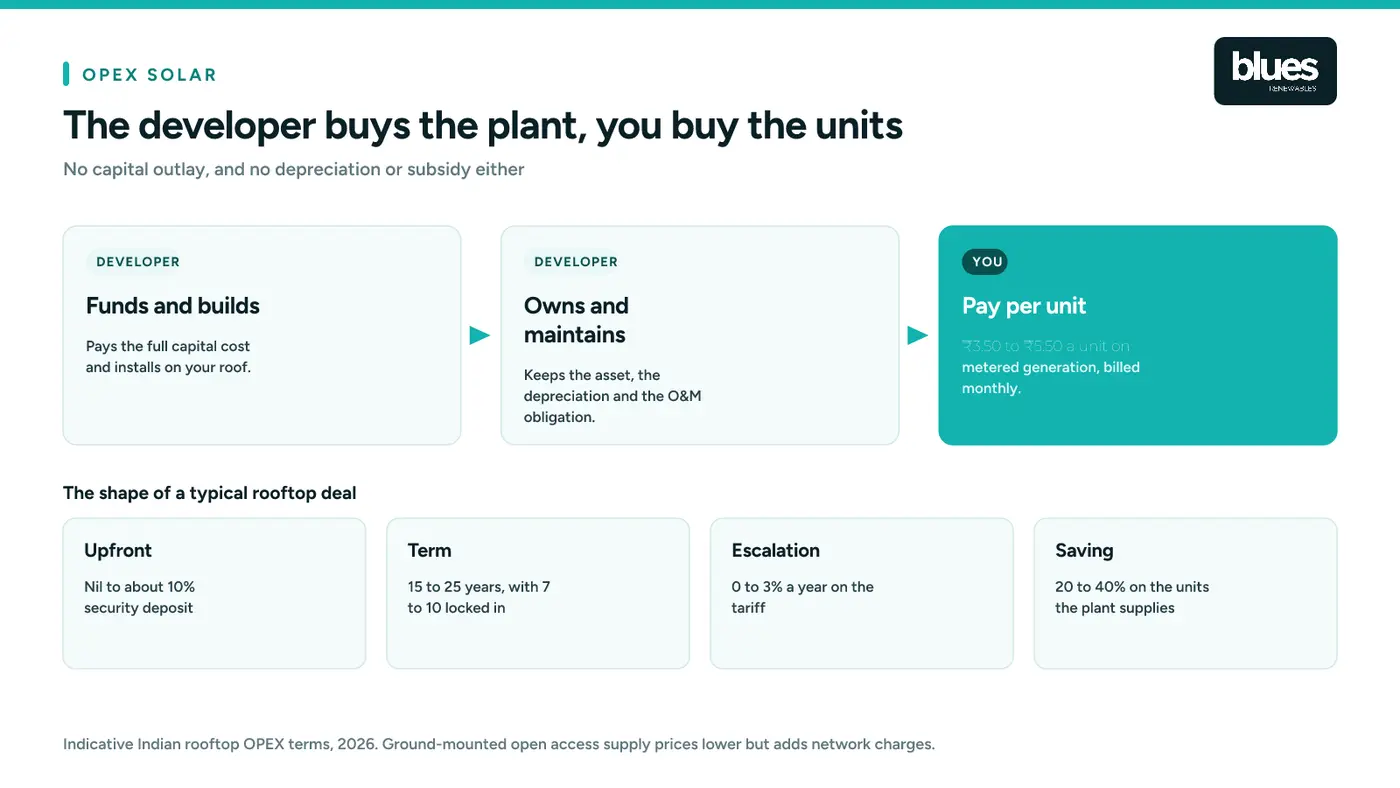
Nothing about the hardware changes. Same panels, same inverters, same roof. Only the ownership and the billing differ. Instead of your generation reducing your import, the developer meters what the plant produces and invoices you for it monthly.
Because the developer carries the capital, the developer also takes the return. That is the honest summary of the model. You are not getting solar for nothing; you are renting the savings and paying the financier a margin for waiting.
Zero capex is the same model under another name
Developers sell this arrangement as zero capex, and buyers search for it that way, but nothing about it differs from OPEX. Zero capex describes the same thing from the customer's side of the table: no capital expenditure, because the developer carries it. OPEX describes it from the accounting side, where the cost moves from capital to operating expense.
So a zero capex solar proposal, a solar OPEX model and a RESCO offer can all describe one structure. What you buy in every case is electricity at an agreed tariff from a plant somebody else owns, insures and maintains on your roof.
The naming matters only when comparing quotations. A zero capex proposal and an OPEX proposal for the same roof should be judged on the same four clauses: the tariff, the escalation, the deemed generation terms and what happens at the end of the contract. If two developers use different words for an identical structure, the words are not the difference worth pricing.
What OPEX solar actually costs
Two numbers matter: the tariff you sign, and the tariff you avoid.
Rooftop OPEX tariffs in India currently run about ₹3.50 to ₹5.50 per unit. Ground-mounted open access supply prices lower, around ₹2.50 to ₹3.50, because scale and land change the economics. Rooftop sits higher because smaller systems cost more per watt, maintenance access is harder, and contract tenures are shorter.
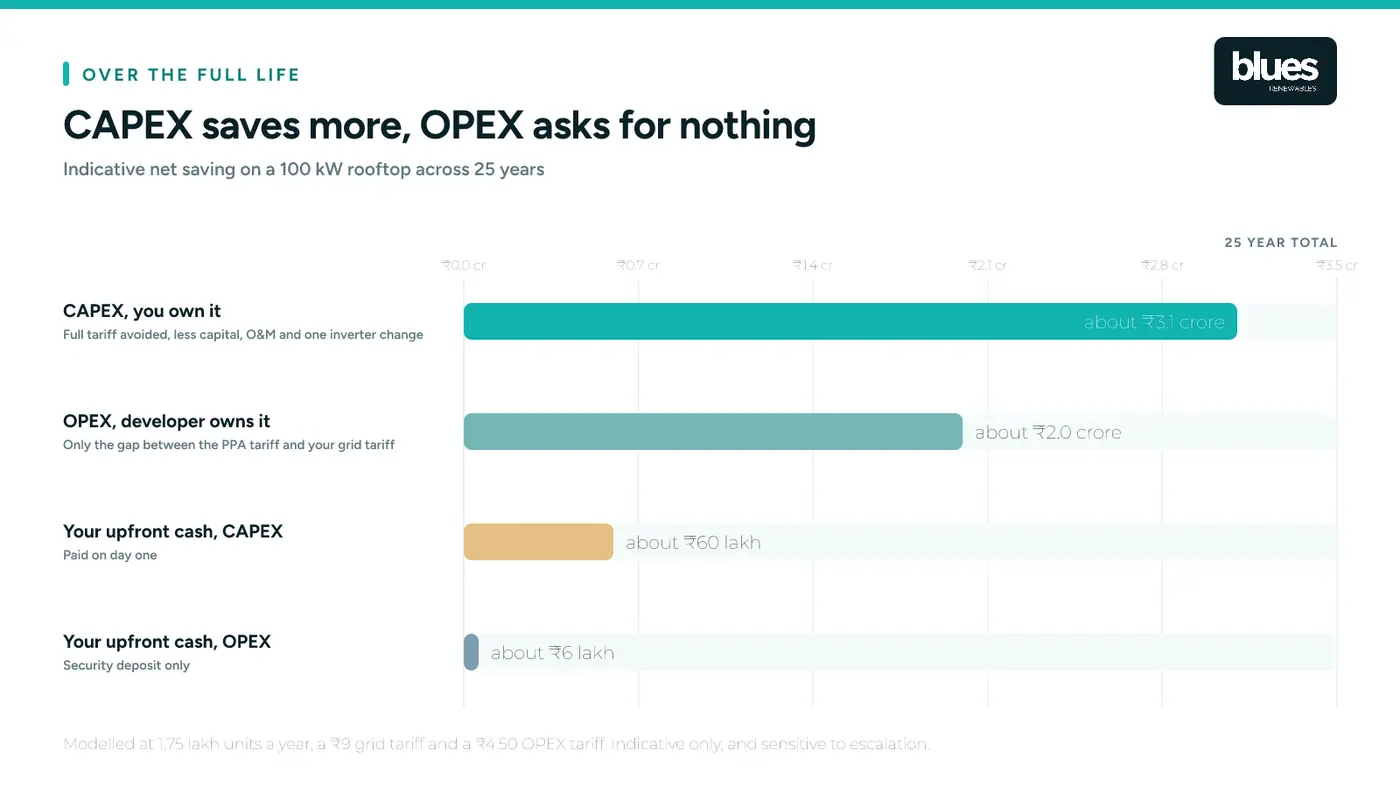
Set that against a Tamil Nadu HT industrial tariff of roughly ₹8 to ₹9.50 per unit, and the saving is immediate. It is also smaller than the saving a CAPEX plant would give you, because a CAPEX plant avoids the whole tariff rather than a slice of it.
- Upfront cost - CAPEX: Full system cost, OPEX: Nil to about 10% deposit
- You pay per unit - CAPEX: Nothing, OPEX: ₹3.50 to ₹5.50
- Saving vs a ₹9 grid tariff - CAPEX: About ₹9 a unit, OPEX: About ₹4 a unit
- Accelerated depreciation - CAPEX: Yours, at 40%, OPEX: The developer's
- PM Surya Ghar subsidy - CAPEX: Available, OPEX: Not available
- Maintenance - CAPEX: Yours, OPEX: The developer's
- After payback, roughly year 6 - CAPEX: Free power for 19 more years, OPEX: You keep paying the tariff
The last row is the one people underestimate. A CAPEX plant stops costing anything around year five or six and then delivers close to free electricity for another two decades. An OPEX plant bills you every month for 25 years. Over the full life, CAPEX wins on total rupees saved by a wide margin.
That is not an argument against OPEX. It is an argument for being clear about what you are buying: certainty and zero capital, not maximum savings.
Tariff escalation changes the whole picture
Most OPEX contracts carry an annual escalation, commonly 0 to 3 percent. Grid tariffs in India have historically risen faster, around 5 to 7 percent a year, so even an escalating PPA usually widens its advantage over time.
Still, push for the lowest escalation you can get. On a 25 year contract, the difference between 0 percent and 3 percent compounds into a very large number.
- 0% - Year 1 tariff: ₹4.50, Year 15 tariff: ₹4.50, Year 25 tariff: ₹4.50
- 2% - Year 1 tariff: ₹4.50, Year 15 tariff: ₹5.94, Year 25 tariff: ₹7.24
- 3% - Year 1 tariff: ₹4.50, Year 15 tariff: ₹6.81, Year 25 tariff: ₹9.15
Notice the bottom right cell. At 3 percent escalation, a tariff that started as a bargain has reached today's grid rate by year 25. Whether that still looks cheap depends entirely on where grid tariffs have gone by then, which nobody can promise you.
The four clauses that decide the deal
Read these before the price. A good rate wrapped in bad terms costs more than a fair rate wrapped in clean ones.
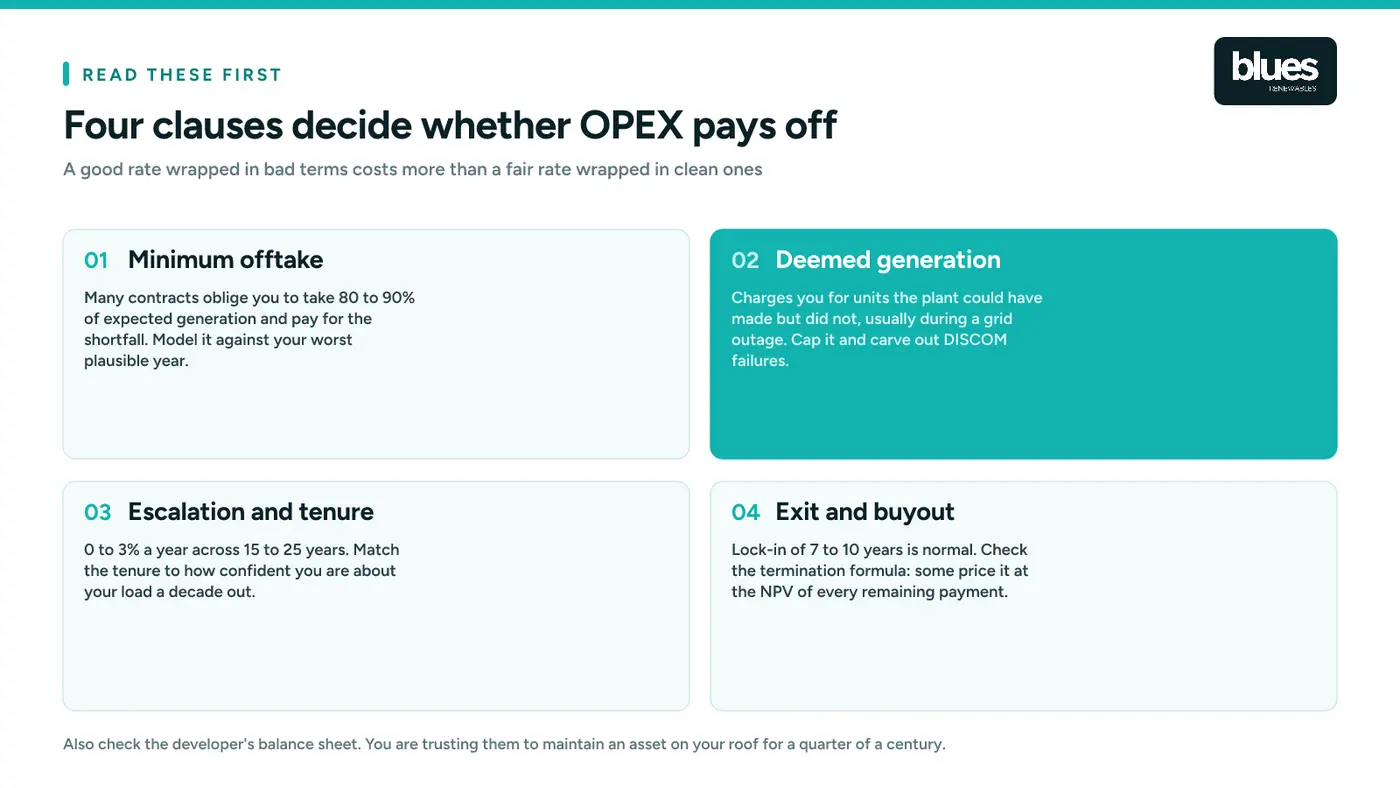
Minimum offtake. Many contracts require you to consume 80 to 90 percent of expected generation, and to pay for the shortfall if you do not. That is fine while your load is steady. It becomes painful if you cut a shift, install efficient machinery, or shrink.
Deemed generation. This clause charges you for units the plant would have produced but could not, usually because the grid went down or you shut the plant out. Grid outages are common on Indian industrial supplies, and a broadly drafted deemed generation clause makes you pay for the DISCOM's failure. Negotiate a cap, and carve out grid unavailability.
Escalation and tenure. Fifteen to twenty five years is standard. Shorter tenures cost more per unit but leave you less exposed. Match the tenure to how confident you are about your load a decade out, not to the lowest headline rate.
Exit and buyout. Expect a lock-in of seven to ten years, after which a buyout at depreciated book value is common. Check what early termination costs. Some contracts price it at the net present value of every remaining payment, which is effectively no exit at all.
Add one more check that sits outside the contract: the developer's balance sheet. You are trusting this company to maintain an asset on your roof for a quarter of a century. If it fails, the plant becomes an asset in an insolvency process, attached to your building. How to assess that is covered in what a RESCO is.
The off balance sheet claim, examined
Sales decks routinely describe OPEX as off balance sheet. Treat that as a question for your auditor rather than a feature.
Under Ind AS 116, an arrangement is a lease where it conveys the right to control the use of an identified asset for a period in exchange for consideration. A rooftop plant built specifically for your site, dedicated to your load, with you taking substantially all its output for 25 years, can satisfy that test. Where it does, a right-of-use asset and a lease liability appear on your balance sheet, and the "capital-free" framing collapses.
It does not always meet the test. Much depends on whether the developer retains genuine substitution rights and can sell the output elsewhere. The point is simply that the accounting outcome is a matter of fact, not a marketing claim.
Who OPEX suits, and who it does not
Choose OPEX if you lease your premises, your capital earns more inside your own business, your company has little taxable profit to shelter, or your board will not approve a 25 year asset purchase. Trusts, societies and other organisations that cannot use depreciation at all fit here too.
Think twice if you own your building, hold cash, pay tax, and expect stable operations. In that position the CAPEX route returns far more, as set out in what the CAPEX model in solar is.
Avoid it at home almost always. Residential systems are small, the PM Surya Ghar subsidy of up to ₹78,000 is excluded under third party ownership, and payback on a ₹2,10,000 CAPEX system already sits near five years. Our PM Surya Ghar subsidy page explains the slabs.
For a structured comparison against your own bills, see CAPEX vs OPEX vs RESCO solar, and for factory-scale specifics see industrial solar in Chennai.
Frequently asked questions
What is the OPEX model in solar? It is an arrangement where a developer funds, owns, installs and maintains the solar plant, then sells you its electricity at an agreed per-unit rate under a long term contract. You pay no capital cost, and the plant never appears on your asset register.
What is zero capex solar? Zero capex solar is the OPEX model named from the customer's side: the developer funds, owns and maintains the plant, and you pay only for the units it generates. There is no separate zero capex product to weigh against OPEX or RESCO, so judge any such proposal on the tariff, the escalation, the deemed generation clause and the end of contract terms.
Is the OPEX model the same as RESCO? Effectively yes. OPEX describes the commercial model from your side, and RESCO describes the company on the other side of it. The Indian solar industry uses the two words interchangeably, which is why quotations often say "OPEX/RESCO".
How much can I save with OPEX solar? Typically 20 to 40 percent on the units the plant supplies. Against a ₹9 per unit HT tariff, an OPEX rate of ₹4.50 saves roughly half on solar generation, though solar covers only your daytime load, so the saving on the total bill is smaller.
Do I get any subsidy or tax benefit under OPEX? No. Accelerated depreciation belongs to whoever owns the asset, so it goes to the developer. PM Surya Ghar central financial assistance is expressly unavailable for third party owned systems.
What happens at the end of an OPEX contract? Three outcomes are common: the developer removes the plant, you buy it at a nominal or depreciated value, or you renew at a renegotiated tariff. Fix which one applies in the contract rather than leaving it to a future conversation.
Can I exit an OPEX contract early? Usually only after a lock-in of seven to ten years, and usually by buying the plant out. Check the exact termination formula before signing, because some contracts charge the present value of all remaining payments.
Is a security deposit required for OPEX solar? Often, yes. Around 10 percent of project cost is common, refundable or adjustable against billing. Some developers waive it for strong credits and charge more per unit instead.
Where this fits
OPEX is one of three funding routes. Compare it against ownership in what the CAPEX model in solar is, meet the counterparty in what a RESCO is, read the contract itself in what a solar PPA is, and see how a fixed rental differs in what a solar lease is. Where your load outgrows your roof entirely, open access solar is the next structure to look at.
Blues Renewables has installed solar across Chennai since 2020, for homes, schools, businesses and factories. We build both cases from your actual consumption data, then show you the year-by-year cash difference rather than a headline percentage.
Call +91 98841 07170 to see the OPEX model in solar priced against ownership for your own roof, with the offtake and escalation clauses spelled out before you commit.
Sources
- Press Information Bureau, Ministry of New and Renewable Energy, "GST on Renewable Energy Devices Rationalised to 5%", 17 September 2025
- MNRE, Guidelines for implementation of PM Surya Ghar: Muft Bijli Yojana, on eligibility of RESCO and third party owned systems
- Income Tax Act 1961, Section 32; Income Tax Rules, Appendix I depreciation schedule
- Ind AS 116, Leases, on identifying a lease within a service arrangement
- Tamil Nadu Electricity Regulatory Commission, Tariff Order No.6 of 2025 dated 30 June 2025