What Is a Solar PPA? Power Purchase Agreement Clauses Explained
A solar PPA buys electricity at an agreed rate for 15 to 25 years from a plant the developer owns. The twelve clauses, and the red flags before signing.



A solar PPA is the only part of a zero-investment solar deal you can still change. Panels are commodity hardware. Inverters come out of a catalogue. Yet the contract is where twenty five years of your money gets decided, and it is the one document most buyers skim.
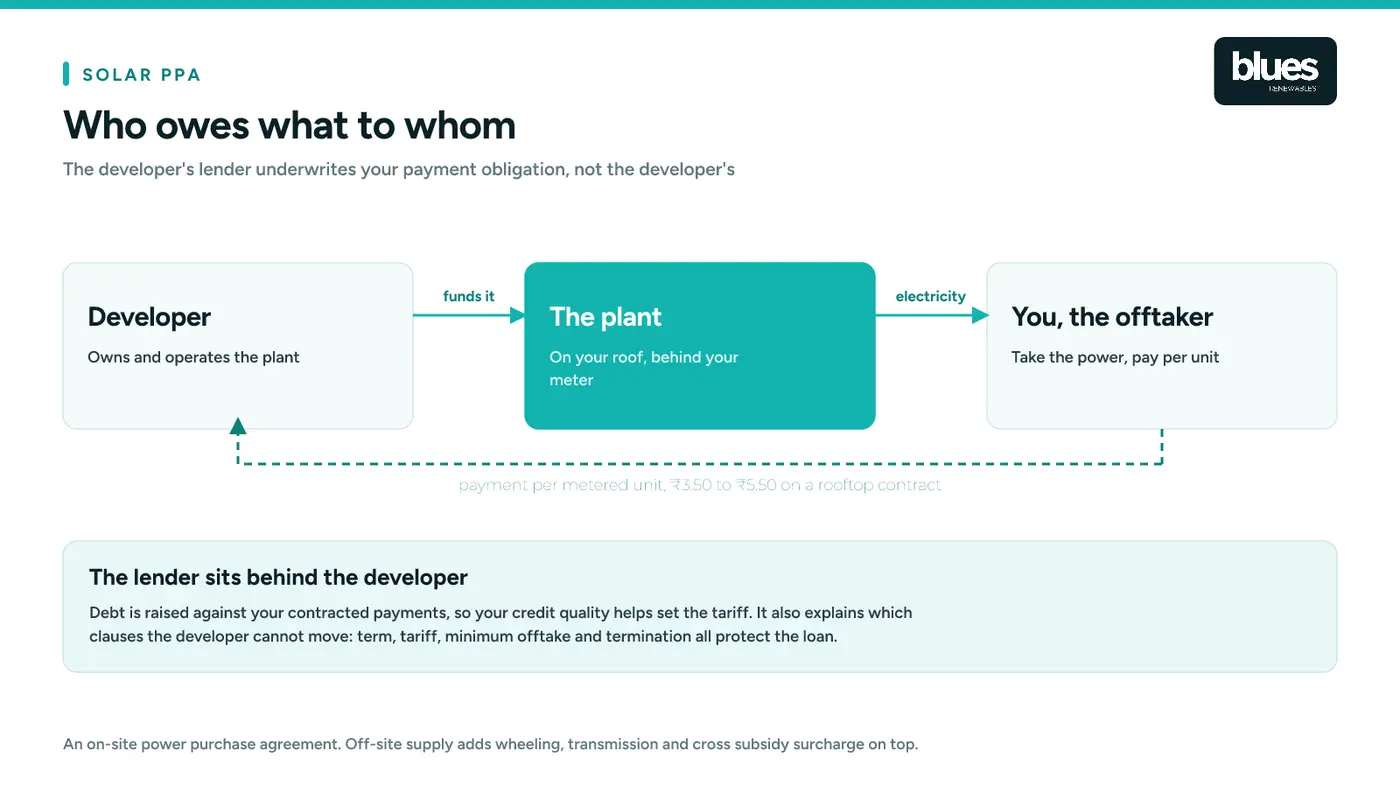
So what is a solar PPA, exactly? A power purchase agreement is the contract under which a developer sells you the electricity from a plant it owns. It is also the mechanism that makes PPA solar financing work at all, because the developer's lender is really lending against your signature on it.
Below you will find what a solar PPA covers, the two forms it takes in India, the twelve clauses that decide what it costs, how tariff structures compare over the full term, and the red flags worth walking away from.
Key takeaways
- A solar PPA is a long term contract to buy electricity at an agreed rate, typically 15 to 25 years, from a plant the developer owns and operates.
- India uses two forms: on-site and off-site. On-site sits behind your meter on your roof. Off-site delivers through the grid under open access and attracts wheeling and surcharge costs.
- Tariffs run about ₹3.50 to ₹5.50 per unit on rooftop and ₹2.50 to ₹3.50 on ground-mounted open access supply, with 0 to 3 percent annual escalation.
- Minimum offtake and deemed generation clauses do the real damage. They can oblige you to pay for power you never consumed, including during grid outages.
- The PPA is the financing. Lenders fund the developer against your payment obligation, which is why they resist changes to term, tariff and termination.
- Twelve clauses decide the outcome. Tariff and escalation are only two of them.
What is a solar PPA
A solar PPA is a legally binding agreement in which one party generates solar electricity and another party agrees to buy it, at a defined price, for a defined period. The generator owns the plant. Its buyer, called the offtaker, pays only for metered units delivered.
Three features distinguish a PPA from simply buying a solar system.
- You buy energy, not equipment. Nothing appears on your asset register, and no depreciation accrues to you.
- The price is contracted, not market-set. You know your solar tariff for the whole term, which is precisely what a grid tariff never gives you.
- The obligation runs both ways. The developer commits to generate and maintain; you commit to take and pay.
That last point is where most disputes begin. People read a PPA as an option to buy cheap power. It is not. Really it is a commitment to buy, and the developer's bank is counting on it.
The two kinds of solar PPA in India
The word covers two quite different arrangements, and the costs diverge sharply.
- Where the plant sits - On-site PPA: Your roof or your land, Off-site PPA: A remote solar farm
- How power reaches you - On-site PPA: Directly, behind your meter, Off-site PPA: Through the state grid under open access
- Typical tariff - On-site PPA: ₹3.50 to ₹5.50 a unit, Off-site PPA: ₹2.50 to ₹3.50 a unit
- Extra network charges - On-site PPA: None, Off-site PPA: Wheeling, transmission, cross subsidy surcharge
- Scale that works - On-site PPA: 50 kW to a few MW, Off-site PPA: 1 MW and above
- Approvals - On-site PPA: DISCOM sanction for third party ownership, Off-site PPA: Full open access approval
The cheaper headline tariff on an off-site PPA is misleading until you add the network charges. In Tamil Nadu those charges can add roughly ₹2 or more per unit for a third party arrangement, which is why the landed costs often converge. Our guides to solar power wheeling charges in TANGEDCO and cross subsidy in solar power set out the actual numbers.
For most Chennai businesses with usable roof space, the on-site PPA wins simply because rooftop generation avoids every one of those charges.
The twelve clauses that decide what a PPA costs
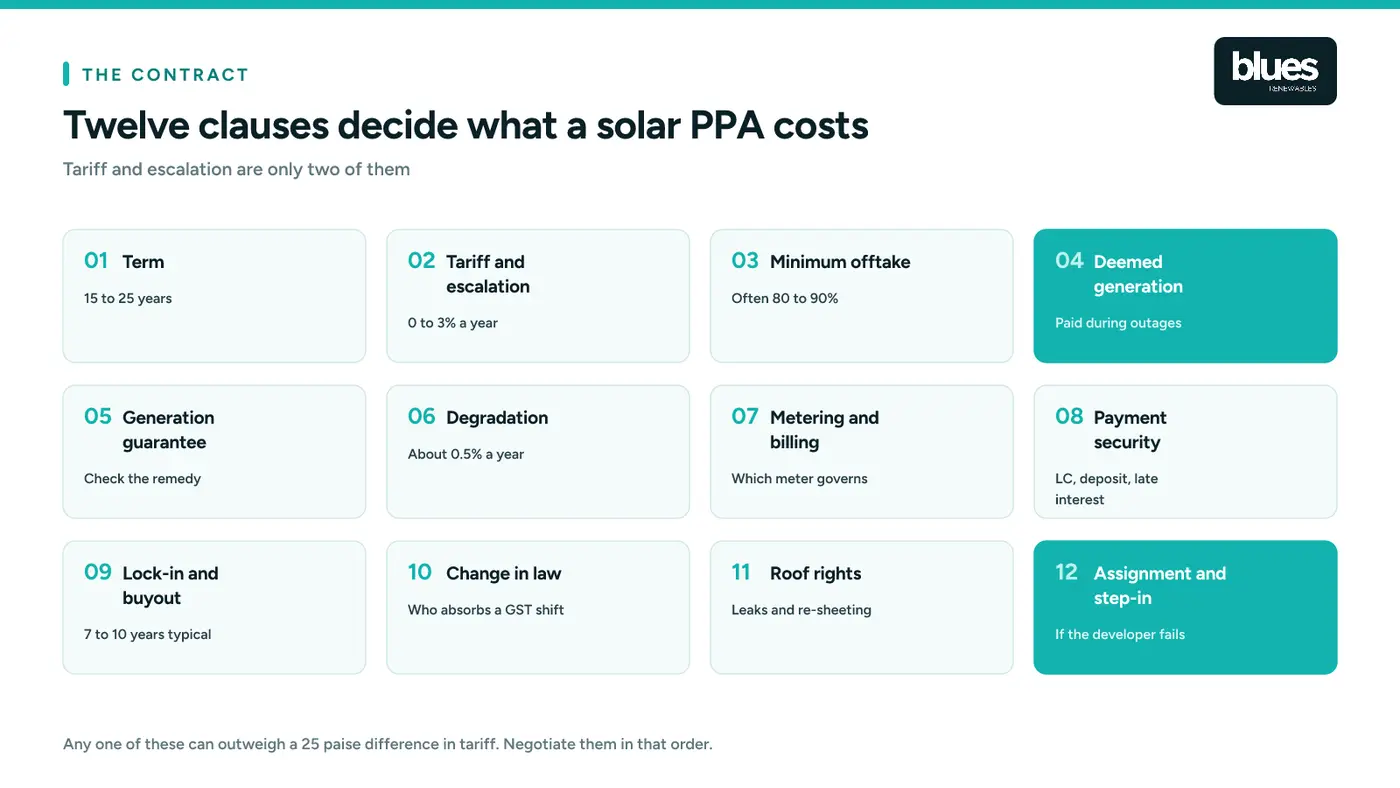
1. Term. Fifteen to twenty five years is standard. Longer terms buy a lower tariff and sell you less flexibility.
2. Tariff and escalation. The headline number, plus whatever it climbs by each year. Push for zero, accept one, question three.
3. Minimum offtake. Many contracts require you to take 80 to 90 percent of expected generation and pay for any shortfall. Model this against your worst plausible year, not your current one.
4. Deemed generation. This charges you for units the plant could have produced but did not, most often because the grid was down. Indian industrial supply sees outages routinely, so cap this clause and carve out DISCOM failures.
5. Generation guarantee. The developer's promise of annual output, usually expressed as a CUF. Check the remedy, not just the promise.
6. Performance ratio and degradation. Panels lose roughly 0.5 percent output a year. A PPA should state the expected degradation curve so underperformance is measurable.
7. Metering and billing. Which meter governs, who reads it, when invoices land, and what you can see independently.
8. Payment security. Expect a letter of credit or a security deposit, plus interest on late payment. Negotiate the interest rate, because the default is often punitive.
9. Lock-in and buyout. Typically seven to ten years locked, then a buyout at depreciated book value. Read the early termination formula carefully. Some price it at the net present value of every remaining payment, which is not really an exit.
10. Change in law. Who absorbs a GST change, a new duty, or a regulatory shift. GST on solar moved from 12 percent to 5 percent in September 2025, which shows these changes are not hypothetical.
11. Roof rights and access. Duration, structural liability, leak repairs, and what happens when you need to re-sheet the roof.
12. Assignment and step-in. Whether the developer can sell the contract, whether its lender can step in, and what you may do if the developer stops performing.
Any one of these can outweigh a 25 paise difference in tariff. Negotiate them in that order.
How tariff structures compare over the full term
Three structures dominate Indian solar PPAs.
Fixed tariff. One rate for the whole term. Simplest to model, usually priced slightly higher at the start.
Escalating tariff. Starts lower, rises 1 to 3 percent a year. Attractive on the first invoice, expensive by year twenty.
Discount to grid tariff. You pay a fixed percentage below whatever the DISCOM charges. Savings feel guaranteed, but you never lock in a price, so you keep full exposure to tariff volatility in both directions.
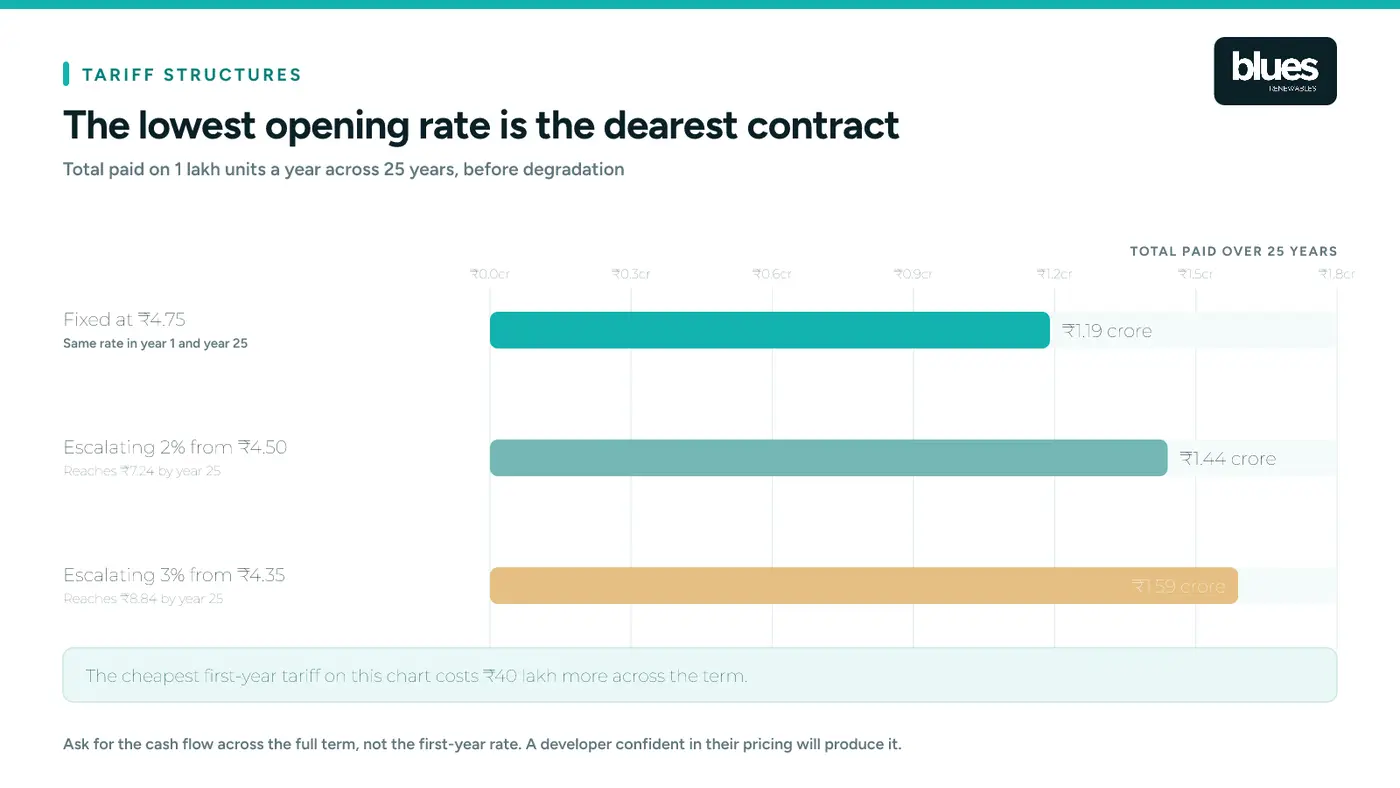
- Fixed at ₹4.75 - Year 1: ₹4.75, Year 15: ₹4.75, Year 25: ₹4.75, Total paid on 1 lakh units a year: ₹1.19 crore
- Escalating 2% from ₹4.50 - Year 1: ₹4.50, Year 15: ₹5.94, Year 25: ₹7.24, Total paid on 1 lakh units a year: ₹1.44 crore
- Escalating 3% from ₹4.35 - Year 1: ₹4.35, Year 15: ₹6.58, Year 25: ₹8.84, Total paid on 1 lakh units a year: ₹1.59 crore
Modelled on a flat 1 lakh units a year for 25 years, before degradation. The lowest opening tariff is the most expensive contract on this table by ₹40 lakh.
Always ask for the cash flow across the full term, not the first-year rate. A developer confident in their pricing will produce it.
Why a PPA counts as financing
The phrase "PPA solar financing" confuses people, because no money is lent to you. Here is what is really happening.
The developer borrows against the PPA. Your contracted payment obligation is the revenue stream the lender underwrites, so your credit quality, not the developer's, largely sets the cost of that debt. A strong offtaker earns a cheaper tariff for exactly this reason.
Two consequences follow, and both are worth knowing before you negotiate.
- The clauses the lender cares about are the hardest to move. Term, tariff, offtake and termination protect the loan. Roof access and reporting are far more negotiable.
- Your own balance sheet may still be affected. Under Ind AS 116, an arrangement conveying the right to control an identified asset can qualify as a lease. A dedicated rooftop plant supplying substantially all its output to you can meet that test, so ask your auditor rather than accepting the phrase "off balance sheet".
Red flags worth walking away from
- No generation guarantee, or one with no compensation attached.
- Deemed generation covering grid outages without a cap.
- Termination priced at the net present value of all remaining payments.
- No step-in or assignment rights protecting you if the developer fails.
- An unnamed O&M subcontractor, or a maintenance obligation described only as "as required".
- Roof liability left silent. If the contract does not say who fixes a leak, you do.
- A tariff quoted without the escalation rate in the same sentence.
If your counterparty resists fixing these, that tells you what the next 25 years will feel like. The nine developer checks in what a RESCO is cover the company behind the paperwork.
Frequently asked questions
What is a solar PPA? A solar power purchase agreement is a long term contract under which a developer that owns a solar plant sells you its electricity at an agreed per-unit rate. You pay for metered units only, invest no capital, and never own the plant.
What is the difference between a solar PPA and a solar lease? A PPA charges you per unit generated, so you pay for output. A lease charges a fixed periodic rent for the equipment, so you pay whether the sun shines or not. PPAs dominate the Indian market; true equipment leases are rare here.
How long does a solar PPA run? Fifteen to twenty five years is normal. Rooftop contracts sit at the shorter end, ground-mounted open access contracts at the longer. Shorter terms cost more per unit because the developer recovers its capital faster.
What is a good solar PPA rate in India? Rooftop PPAs commonly land between ₹3.50 and ₹5.50 a unit, and ground-mounted open access supply between ₹2.50 and ₹3.50 before network charges. Judge the rate against your own grid tariff and the escalation clause together, never on its own.
Can I get out of a solar PPA early? Usually only after a lock-in of seven to ten years, and normally by buying the plant at a depreciated value. Check the termination formula before signing, because some contracts make early exit effectively impossible.
Who maintains the plant under a PPA? The developer does, for the whole term. Cleaning, repairs, inverter replacement and insurance sit with them, which is one of the model's genuine advantages.
Does a solar PPA affect my balance sheet? It can. Under Ind AS 116, a dedicated on-site plant whose output you substantially take may be treated as a lease, bringing a right-of-use asset and a liability onto your books. Confirm the treatment with your auditor before relying on an off balance sheet claim.
What happens at the end of a solar PPA? One of three things: the developer removes the plant, you buy it at a nominal or depreciated price, or you renew at a renegotiated tariff. Settle which applies in the contract rather than deferring it.
What is a PPA tariff? The PPA tariff is the rate per unit you pay the developer for the electricity the plant produces. Indian solar PPAs use one of three structures: a fixed tariff held for the whole term, an escalating tariff that starts lower and rises 1 to 3 percent a year, or a discount to the grid tariff that tracks whatever the DISCOM charges. The third never locks in a price, so it leaves you fully exposed to tariff revisions.
Where this fits
A solar PPA is the contract that delivers the OPEX arrangement, so read what the OPEX model in solar is for the economics and what a RESCO is for how to vet the counterparty. The ownership alternative is the CAPEX model in solar, and the fixed-rent alternative is a solar lease. For off-site supply, start with open access solar. All three funding routes are compared side by side in CAPEX vs OPEX vs RESCO solar.
Blues Renewables has installed solar across Chennai since 2020, for homes, schools, businesses and factories. We will read a draft PPA you have been offered by somebody else and mark up the clauses above, because a bad contract on good panels still costs you money.
Call +91 98841 07170 before you sign, and we will price what a solar PPA would actually cost you across the full term against owning the same plant.
A PPA and a lease are not the same instrument, and the choice changes who carries a poor solar year. read solar lease vs PPA.
Sources
- Electricity Act 2003, Sections 9 and 42, on captive generation and open access
- Tamil Nadu Electricity Regulatory Commission, Tariff Order No.6 of 2025 dated 30 June 2025
- TNERC, Terms and Conditions for Green Energy Open Access Regulations 2025
- Press Information Bureau, Ministry of New and Renewable Energy, "GST on Renewable Energy Devices Rationalised to 5%", 17 September 2025
- Ind AS 116, Leases, on identifying a lease within a service arrangement