Solar Lease vs PPA: Why the Lease Barely Exists in India
A lease charges fixed rent; a PPA charges per unit, so it carries the risk of a poor solar year. In India the PPA is standard at ₹3.50 to ₹5.50 a unit.


Search this comparison and you will get an American answer. Sunrun, EnergySage, Palmetto, all explaining a choice that Indian buyers are almost never actually offered.
Here is the version that matters here. In India, solar lease vs PPA is rarely a live decision for a business, because one of the two is standard and the other barely exists in the form those articles describe. Knowing which is which saves you from negotiating against a phantom.
This guide gives you the real differences, what each costs across 25 years on the same system, which versions are genuinely on offer in India, and the roof-lease question that Indian building owners actually face instead.
Key takeaways
- A lease pays fixed rent. A PPA pays per unit generated. That single difference decides who carries the risk of a poor solar year.
- The PPA is the Indian standard for commercial rooftop. The American-style lease is effectively unavailable, and equipment leases are uncommon.
- A lease usually ends in ownership after 5 to 10 years. A PPA runs 15 to 25 years and never does. Over the full life that gap is worth crores.
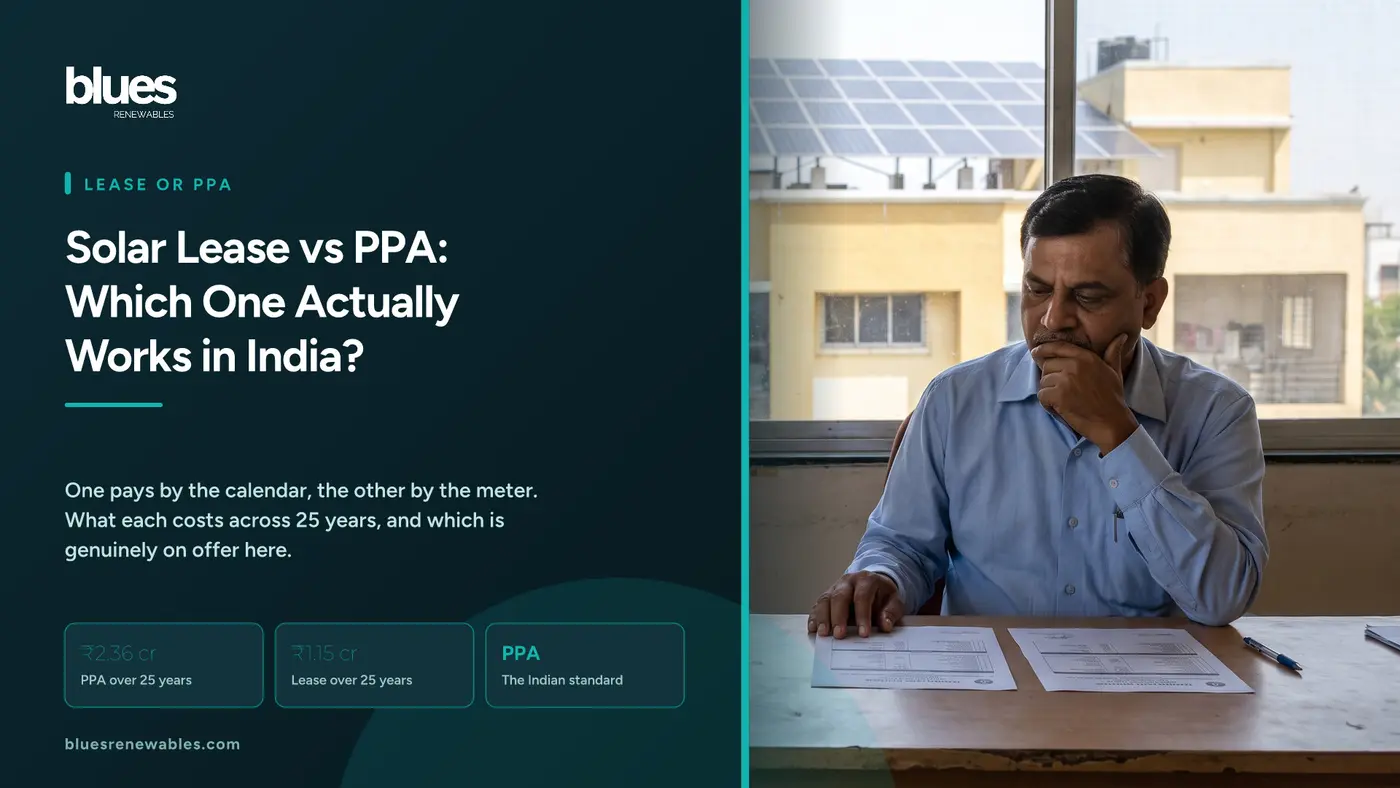
- On a 100 kW system, 25 year cost runs about ₹2.36 crore under a PPA and ₹1.15 crore under an equipment lease, against ₹6.51 crore of grid power avoided.
- Maintenance incentives differ sharply. A PPA developer earns only when the plant generates. A lessor collects rent either way.
- For most Indian building owners the real choice is roof lease versus on-site PPA, and it turns on whether you can use the power yourself.
Solar lease vs PPA: the core difference
A solar lease is an agreement to pay a fixed, recurring rent for the use of a solar system somebody else owns. Its counterpart, the power purchase agreement, commits you instead to buy the electricity that system produces, at an agreed rate per unit. Under a lease your payment stays the same whatever the weather, while a PPA rises and falls with generation.
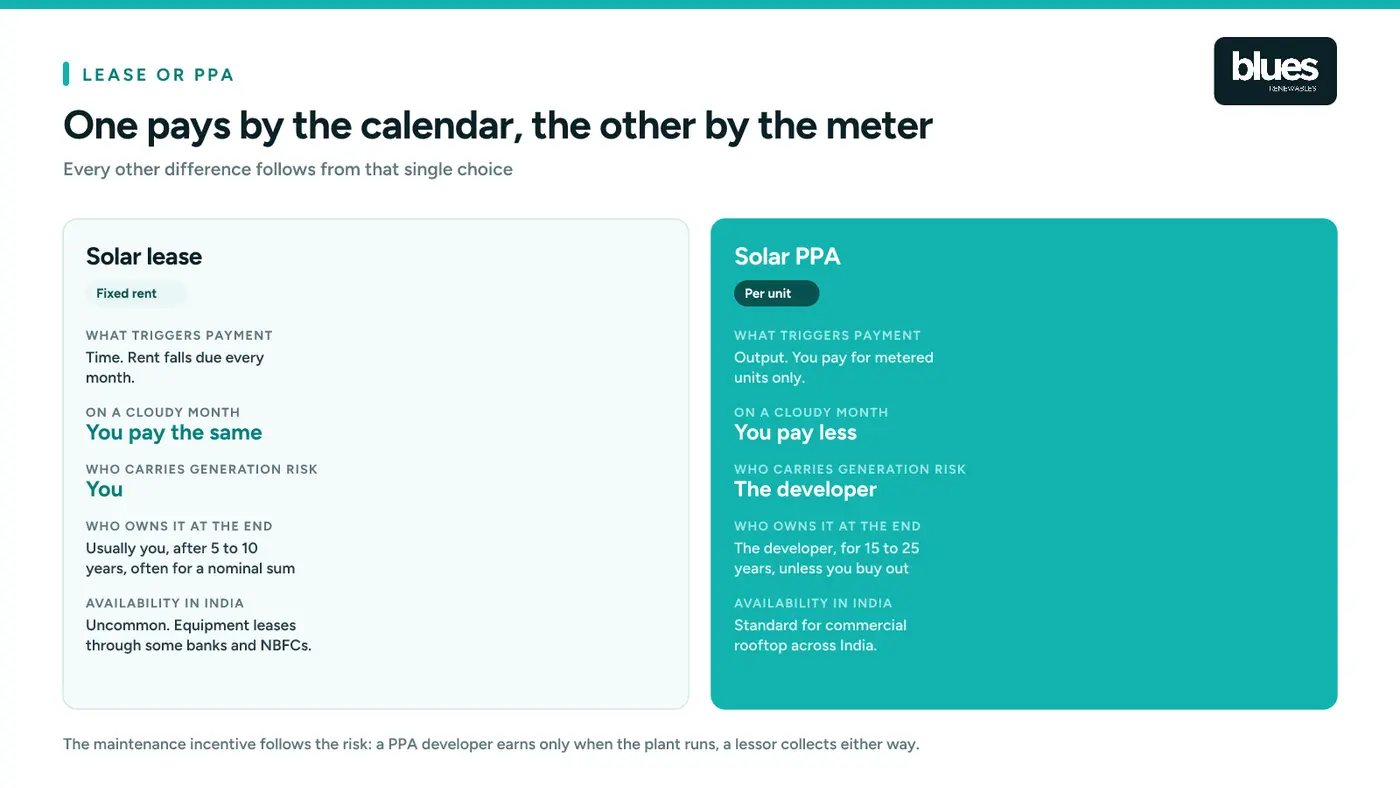
Everything else follows from that.
- What triggers payment - Solar lease: Time. Rent falls due monthly., Solar PPA: Output. You pay per unit metered.
- A cloudy month - Solar lease: You pay the same, Solar PPA: You pay less
- Who carries generation risk - Solar lease: You, Solar PPA: The developer
- Incentive to maintain the plant - Solar lease: Weak, rent arrives regardless, Solar PPA: Strong, revenue tracks output
- Typical term in India - Solar lease: 5 to 10 years, equipment lease, Solar PPA: 15 to 25 years
- Who owns it at the end - Solar lease: Usually you, often for a nominal sum, Solar PPA: The developer, unless you buy it out
- Who claims depreciation - Solar lease: The lessor, during the lease, Solar PPA: The developer, throughout
- Availability in India - Solar lease: Uncommon, Solar PPA: Standard for commercial rooftop
Look at the maintenance row, then the ownership row. Those two do most of the work in the sections below.
What each costs across 25 years
Take one 100 kW commercial rooftop in Chennai, costing about ₹55 lakh installed and generating 1,75,200 units in year one, fading 0.5 percent a year.

- Grid supply only - 25 year cost: ₹6.51 crore, Capital you provide: Nil, Saved against grid: Nothing
- Solar PPA at ₹4.50, 2% escalation - 25 year cost: ₹2.36 crore, Capital you provide: Nil, Saved against grid: ₹4.15 crore
- Equipment lease, 7 years, then you own it - 25 year cost: ₹1.15 crore, Capital you provide: Nil, Saved against grid: ₹5.36 crore
- Buy outright - 25 year cost: ₹0.60 crore, Capital you provide: ₹55 lakh, Saved against grid: ₹5.91 crore
Grid modelled at ₹8.50 a unit escalating 5 percent a year. Lease modelled at a commercial rate over seven years, after which you own the asset and pay only maintenance. Purchase shown net of input tax credit and the depreciation shield. All figures are undiscounted rupees, so applying a cost of capital narrows the gaps considerably.
Two conclusions fall out of that table, and both are useful.
Every solar route beats grid supply by a wide margin. The worst of them saves ₹4.15 crore over 25 years. Arguing about which is best should not stop you doing any of them.
The lease beats the PPA on total rupees, purely because it ends in ownership. After year seven the leased plant is yours and costs only maintenance, while the PPA keeps invoicing you for another eighteen years. That is the same arithmetic that makes buying beat renting in CAPEX vs OPEX vs RESCO solar.
What the table does not show is risk. Under the PPA the developer carries generation shortfall, equipment failure and maintenance for the whole term. With a lease you carry all three from day one, and keep carrying them for eighteen years after the lease ends. That is what the extra ₹1.2 crore buys.
Which of these is actually offered in India
This is where the American guides stop being useful.
The PPA is standard. Nearly every zero-investment commercial solar proposal you receive in India will be a PPA, delivered under the OPEX model by a RESCO. Rooftop rates run ₹3.50 to ₹5.50 a unit with 0 to 3 percent annual escalation. Clause by clause detail sits in what a solar PPA is.
The equipment lease exists but is uncommon. Some banks and NBFCs offer it, particularly to MSMEs. It rarely wins on the numbers for one specific reason: depreciation follows ownership, so the lessor claims the 40 percent accelerated depreciation rather than you. A plain term loan keeps the asset, the depreciation and the subsidy eligibility on your side and usually costs less. See what accelerated depreciation in solar is.
The American residential lease is effectively absent. It runs on a transferable federal tax credit that India does not offer households. What we have instead is PM Surya Ghar assistance of up to ₹78,000, and MNRE guidelines require the consumer to own the system to claim it. Lease your home system and you forfeit the subsidy outright. Our PM Surya Ghar subsidy page sets out the slabs.
So for a household the comparison collapses entirely: buy, and claim the subsidy. For a business it narrows to a PPA against a term loan, with the equipment lease a distant third.
The comparison Indian building owners actually face
There is a genuine lease-versus-PPA decision in India, and it is not the one the search results describe.
You own a large roof. A developer wants it. You can lease the roof out and collect rent while they sell the power elsewhere, or you can take an on-site PPA and buy the power yourself at a discount. Both cost you nothing upfront.
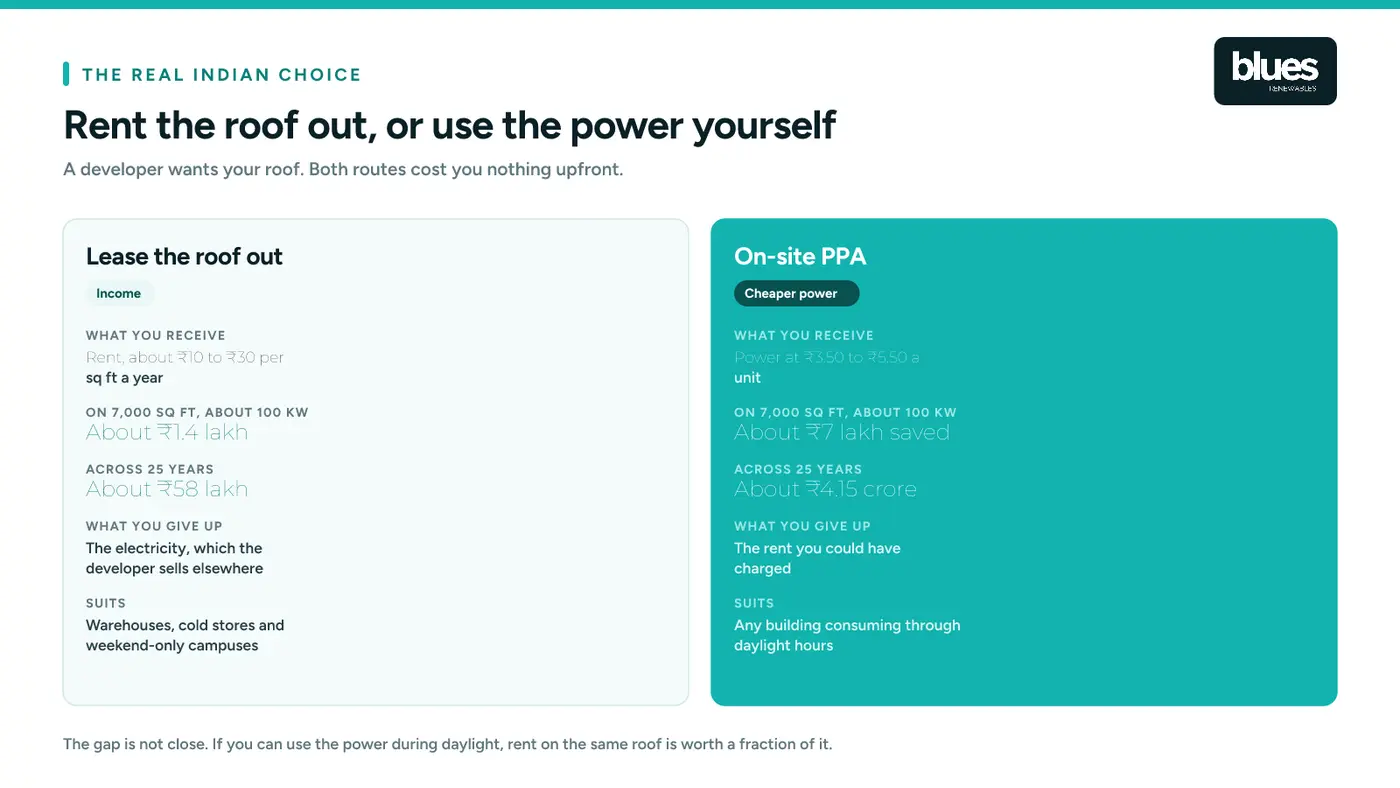
- What you get - Lease your roof out: Rent, about ₹10 to ₹30 per sq ft a year, On-site PPA: Power at ₹3.50 to ₹5.50 a unit
- What you give up - Lease your roof out: The power, which goes to someone else, On-site PPA: The rent
- On 7,000 sq ft, roughly 100 kW - Lease your roof out: About ₹1.4 lakh a year, On-site PPA: About ₹7 lakh a year saved
- Over 25 years, escalated - Lease your roof out: About ₹58 lakh of income, On-site PPA: About ₹4.15 crore of avoided cost
- Suits - Lease your roof out: Buildings with little daytime load, On-site PPA: Buildings that consume during daylight
The gap is not close, and it decides the question cleanly. If you can use the power during daylight, take the PPA. Rent on the same roof is worth a fraction of the electricity you would otherwise buy.
Roof leasing earns its place in one situation: a large roof over a low daytime load. Warehouses, cold stores, godowns, marriage halls and weekend-only campuses fit. There the roof is genuinely idle, and rent turns a dead asset into income.
Before signing a roof lease, fix five things in writing: structural liability for leaks, who moves panels when you re-sheet, rent escalation of 3 to 5 percent, what happens when you sell the building, and whose insurance covers the plant.
Tax and GST treatment is not the same
Three differences worth checking before you compare headline numbers.
Depreciation. Under an operating lease the lessor claims it, and under a PPA the developer does. Either way it is not yours, which is one reason ownership routes win on total cost.
GST on the payment. Leasing goods attracts the same rate as supplying them, so a solar equipment lease should follow the 5 percent rate applying since 22 September 2025. Renting immovable property for commercial use is taxed differently, so a roof lease is not treated the same way as an equipment lease. Confirm the rate on the quotation rather than assuming.
Input tax credit. Under a PPA you are buying electricity, which is exempt from GST, so there is no credit to claim on the power itself. Owning the plant changes that, and the position then depends on whether you consume captively, which we set out in GST on a solar power plant.
Treat all three as questions for your auditor. This article is general guidance, not tax advice.
Which one fits you
- Business, owns the building, has cash and taxable profit - Take this: Buy it. See the CAPEX model
- Business, no capital, strong daytime load - Take this: An on-site PPA
- Business wanting ownership but spreading the cost - Take this: A term loan, not an equipment lease
- Large roof, little daytime load - Take this: Lease the roof out
- Tenant with a short remaining lease - Take this: A PPA, with roof rights matched to your term
- Household - Take this: Buy, and claim the ₹78,000 subsidy
Frequently asked questions
What is the difference between a solar lease and a PPA? A lease charges fixed rent for the equipment regardless of how much it generates, while a PPA charges a rate per unit actually produced. That makes the generation risk yours under a lease and the developer's under a PPA.
Is a solar lease or a PPA better in India? For most Indian businesses the question does not arise, because PPAs are what developers offer and equipment leases are uncommon. Where both are genuinely available, a lease ending in ownership costs less across 25 years, while a PPA carries less risk and no maintenance burden.
Which is cheaper over 25 years? On a 100 kW system, an equipment lease that transfers ownership after seven years works out around ₹1.15 crore against roughly ₹2.36 crore for a 25 year PPA, undiscounted. Buying outright beats both at about ₹0.60 crore.
Can I get a solar lease for my home in India? Not in the American sense, and you should not want to. PM Surya Ghar central financial assistance of up to ₹78,000 requires you to own the system, so leasing forfeits it.
Who maintains the system under each? Under a PPA the developer maintains it for the full term, because their revenue depends on output. With an equipment lease, maintenance usually falls to you, which is a real cost most comparisons leave out.
Can I buy the system during a PPA? Usually after a lock-in of seven to ten years, at a depreciated value. Check the termination formula before signing, since some contracts price early exit at the present value of every remaining payment.
Does a lease or PPA affect my balance sheet? Both can. Under Ind AS 116 an arrangement conveying the right to control an identified asset may be treated as a lease, which brings a right-of-use asset and a liability onto your books. Ask your auditor rather than accepting an off balance sheet claim.
What is the difference between a roof lease and a PPA? Under a roof lease you rent your roof to a developer and receive income, but the power goes elsewhere. An on-site PPA reverses that: discounted power, no rent. If you can use the electricity, the PPA is worth far more.
Where this fits
For the definitions behind this comparison, read what a solar lease is and what a solar PPA is. The funding models underneath them are CAPEX and OPEX, with the counterparty covered in what a RESCO is. To test any of it against your own numbers, use how to calculate solar payback period. For factory-scale roofs, see industrial solar in Chennai.
Blues Renewables has installed solar across Chennai since 2020, for homes, schools, businesses and factories. We will model a PPA, a lease and outright purchase against the same roof and the same bills, then tell you which wins on your numbers rather than on ours.
Call +91 98841 07170 and we will settle the solar lease vs PPA question for your building with a side by side cash flow across the full twenty five years.
Sources
- MNRE, Guidelines for implementation of PM Surya Ghar: Muft Bijli Yojana, on consumer ownership requirements
- Press Information Bureau, Ministry of New and Renewable Energy, "GST on Renewable Energy Devices Rationalised to 5%", 17 September 2025
- Income Tax Act 1961, Section 32; Income Tax Rules, Appendix I depreciation schedule
- Ind AS 116, Leases, on identifying a lease within a service arrangement
- Tamil Nadu Electricity Regulatory Commission, Tariff Order No.6 of 2025 dated 30 June 2025
- Blues Renewables installation and pricing data, Chennai, 2020 to 2026