What Is GST on Solar Power Plant? Rates and ITC Explained
Learn what GST applies to a solar power plant, discover why a turnkey contract costs 8.9% not 5%, and read when you can claim ITC on solar energy.


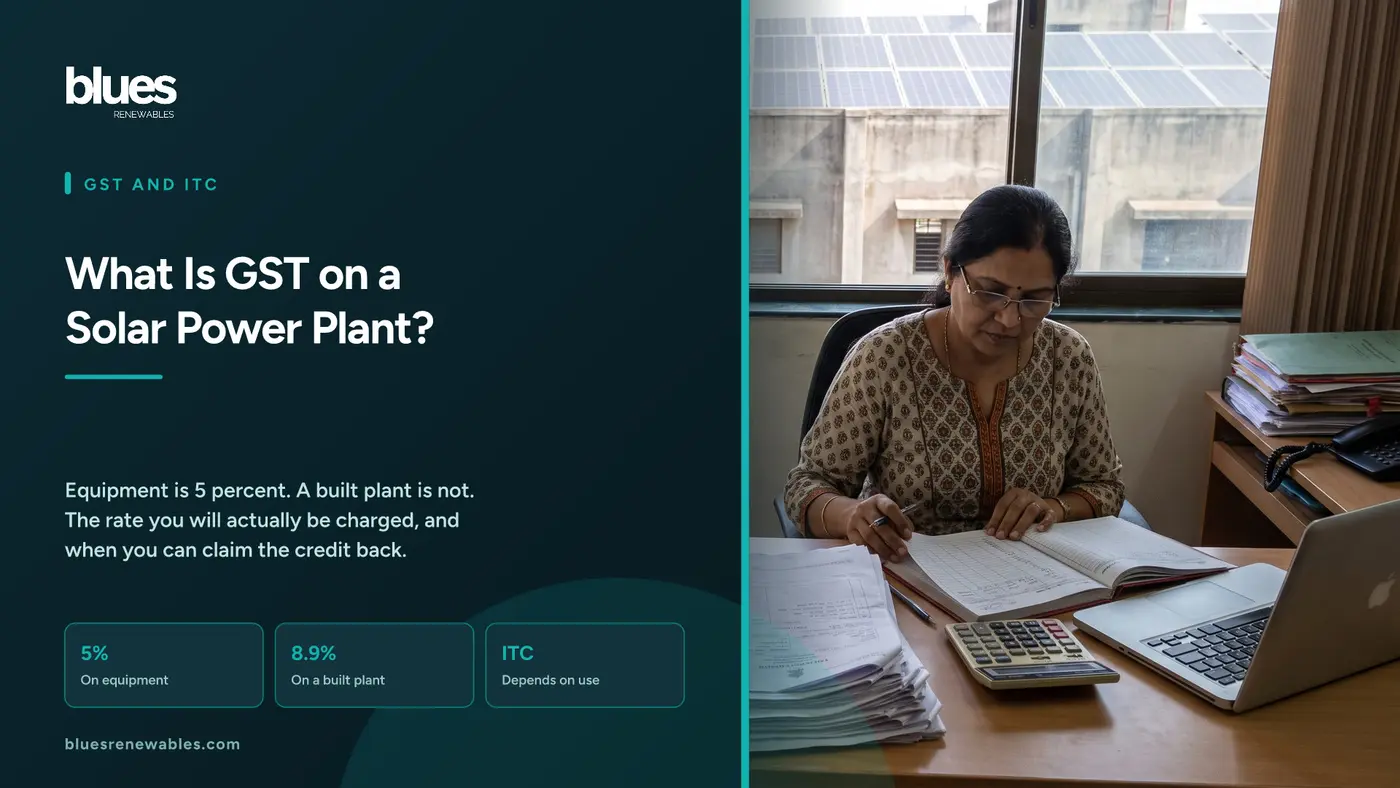
"GST on solar is 5 percent now." You will read that everywhere, and it is only half true. Buy panels and inverters as equipment and yes, 5 percent. Order a complete plant installed and commissioned on your roof, however, and your invoice will most likely show an effective 8.9 percent.
The gap catches finance teams out at the worst moment, when the quotation lands and the number does not match the budget.
GST on a solar power plant has two separate questions inside it. What rate you pay, and whether you can claim it back. This guide answers both, including the input tax credit position, which is genuinely contested and where the money is largest.
Key takeaways
- Solar equipment attracts 5 percent GST since 22 September 2025, cut from 12 percent at the 56th GST Council meeting.
- A turnkey EPC contract works out at about 8.9 percent effective, because a notified rule splits the contract 70 percent goods at 5 percent and 30 percent services at 18 percent.
- The old effective rate was 13.8 percent, so a full plant genuinely got cheaper, just not to 5 percent.
- ITC is generally available where you consume the power captively in a business making taxable supplies, and the plant is capitalised as plant and machinery.
- ITC is not available where you sell the electricity, because electricity is an exempt supply, which triggers reversal under Section 17(2) and Rule 43.
- Exporting surplus under net metering creates mixed use and can force a proportionate reversal, which surprises people who assumed the whole credit was safe.
What is GST on a solar power plant
GST on a solar power plant is the indirect tax charged on the equipment and the installation services that make up the plant. Two notifications govern it: the rate schedule that puts renewable energy devices at 5 percent, and a valuation rule that decides how a bundled supply-and-install contract is taxed.
Equipment on its own: 5 percent
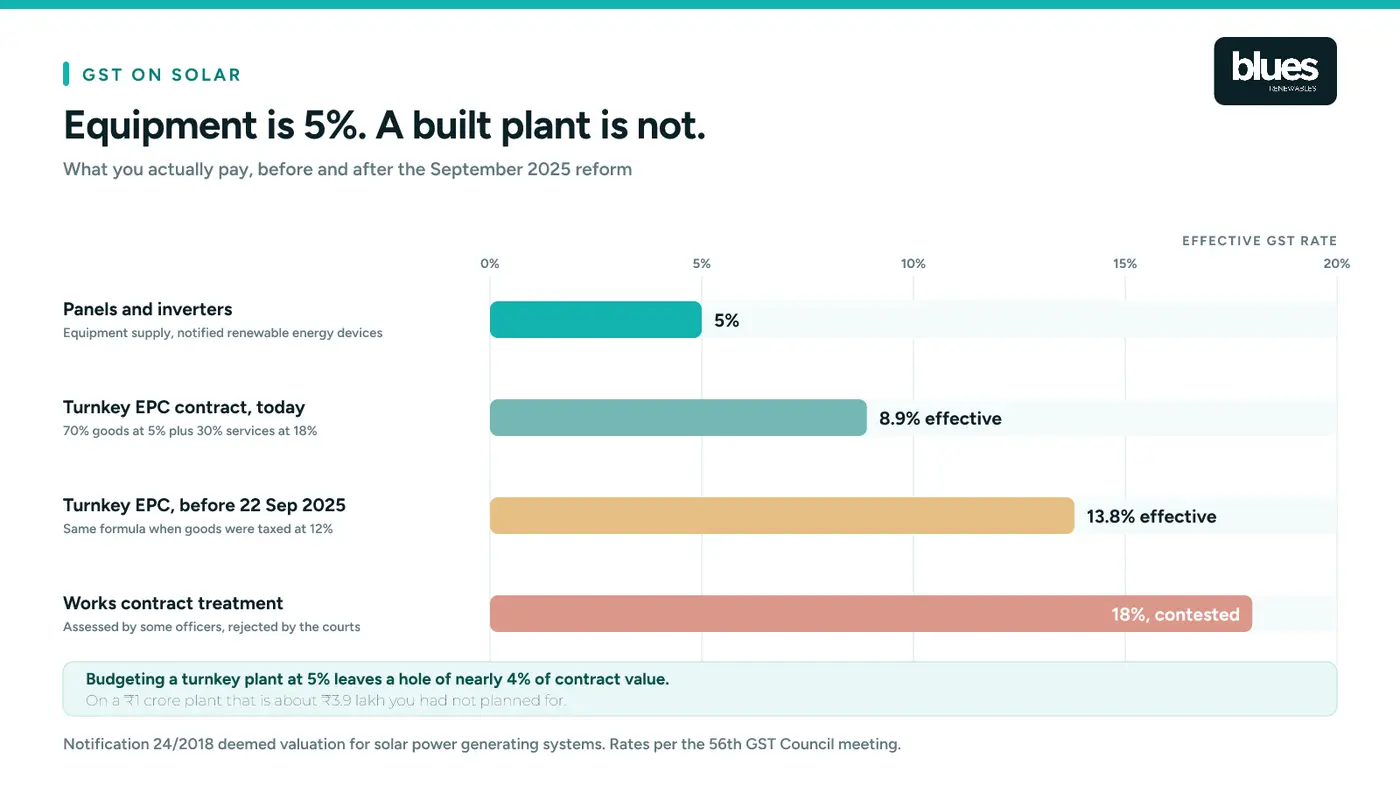
Solar modules, cells, inverters, and other notified renewable energy devices attract 5 percent GST. The GST Council cut this from 12 percent at its 56th meeting on 3 September 2025, effective from 22 September 2025.
MNRE quantified the effect: about ₹9,000 to ₹10,500 off a typical 3 kW rooftop system, and ₹20 to ₹25 lakh per MW on utility scale projects costing ₹3.5 to ₹4 crore per MW.
A complete installed plant: about 8.9 percent
Here is the part the headlines skip. When you buy a solar power generating system as a single supply-and-install contract, a deemed valuation rule applies. Seventy percent of the gross contract value is treated as supply of goods at the concessional rate, and the remaining thirty percent as supply of services at 18 percent.
Run the arithmetic at today's rates:
- Deemed goods - Share of contract: 70%, Rate: 5%, Contribution: 3.5%
- Deemed services - Share of contract: 30%, Rate: 18%, Contribution: 5.4%
- Effective - Share of contract: , Rate: , Contribution: 8.9%
Before 22 September 2025, with goods at 12 percent, the same formula produced 13.8 percent. So the reform did cut your cost meaningfully, from 13.8 to 8.9 percent of contract value. On a ₹1 crore plant that is roughly ₹4.9 lakh saved.
The 18 percent claim, and why it usually fails
Some tax officers have assessed solar EPC contracts as works contracts at 18 percent, on the argument that the plant becomes immovable property. Courts have pushed back. The Andhra Pradesh High Court has held that solar EPC contracts are composite supplies attracting the concessional treatment, setting aside an 18 percent assessment in favour of the 70:30 formula, and has confirmed that issuing separate invoices for goods and services does not defeat that treatment.
This remains an actively litigated area. If a vendor quotes you 18 percent flat, ask them to justify it, because the weight of authority does not support it.
Can we claim ITC of GST on solar energy
This is where the real money sits, and where the honest answer is "it depends on what you do with the electricity."
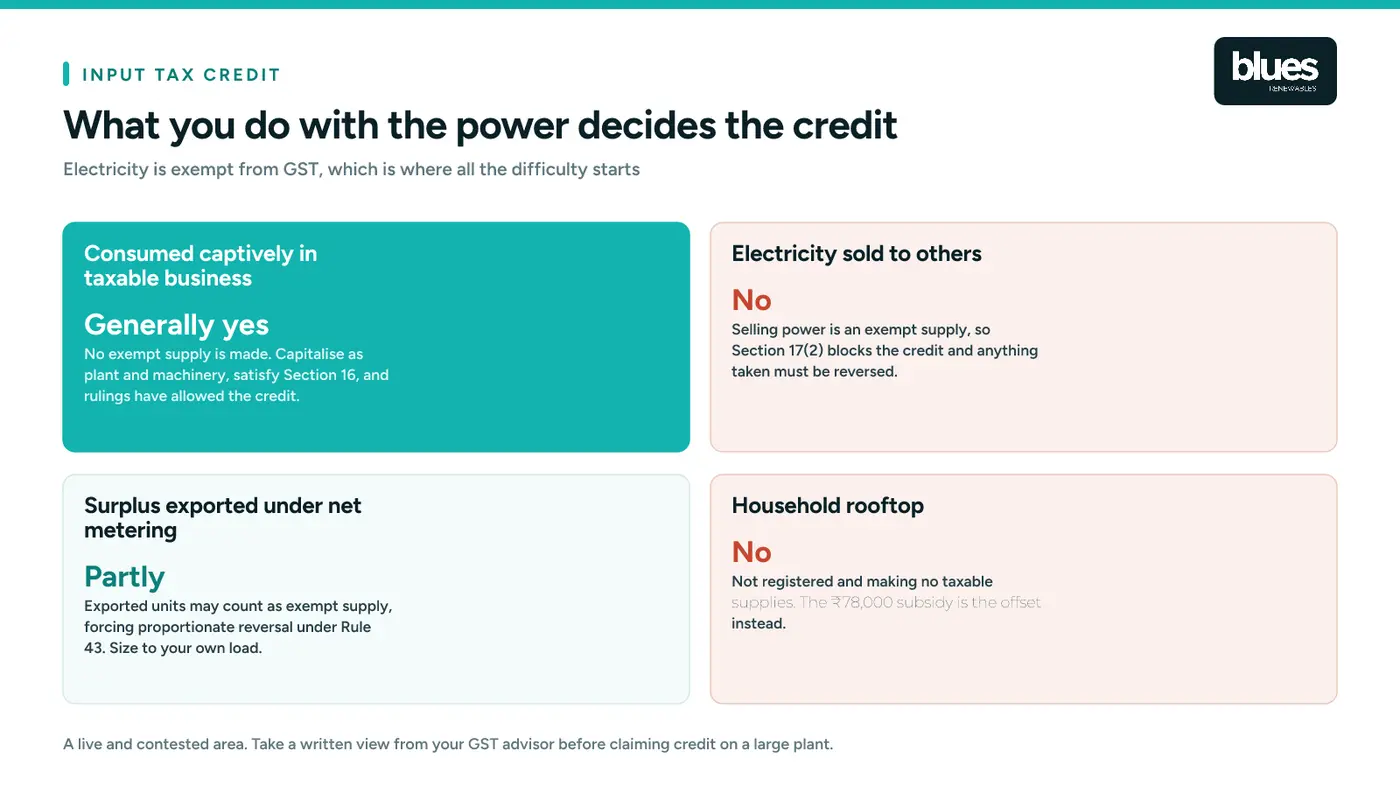
The complication is simple to state. Electricity is exempt from GST. Under Section 17(2) of the CGST Act, credit is not available on inputs used to make exempt supplies, and Rule 43 requires proportionate reversal for capital goods used partly for exempt purposes.
Where ITC is generally available
You consume the power captively, in a business making taxable supplies. A factory running its machinery on its own rooftop solar is not making any exempt supply of electricity. It is using the power as an input to taxable manufacturing. On that reasoning, advance rulings have allowed the credit, including a Rajasthan AAR decision on a 620 kW rooftop plant for a manufacturer.
That ruling attached conditions worth writing down.
- The plant is capitalised as plant and machinery in the fixed asset register, not as a building.
- The electricity is consumed in the business, not sold.
- The usual Section 16 conditions and Rule 43 apportionment are satisfied.
Where ITC is not available
You sell the electricity. Selling power is an exempt supply, so the credit on the plant that generates it is blocked, and any credit taken must be reversed with interest. Independent power producers and RESCOs live with this, and it is priced into the tariff they quote you under the OPEX model.
You are a household. Residential consumers are not registered and make no taxable supplies, so there is no credit to claim. The 5 percent is simply part of the price, offset instead by the PM Surya Ghar subsidy of up to ₹78,000 covered on our PM Surya Ghar subsidy page.
The awkward middle: net metering
Most commercial rooftop systems export surplus units to the grid under net metering. Departments have argued that those exported units are an exempt supply, which makes the plant partly used for exempt purposes and triggers proportionate reversal under Rule 43.
Rulings have gone both ways, and the outcome turns on the factual characterisation of how the electricity actually flows. Where power is banked through the grid and drawn at a different location, authorities have been notably less willing to accept it as captive consumption.
Two practical consequences follow.
- Size the system to your own daytime load rather than maximising export. That improves your ITC position and your economics at the same time, since exported units are usually worth less than the tariff you avoid.
- Document the captive use clearly, with generation and consumption data, before the question is ever asked.
The Section 17(5)(d) question
Section 17(5)(d) blocks credit on goods and services used for constructing immovable property. Does a plant bolted to your roof fall into it?
Generally no. The explanation to Section 17(5) defines plant and machinery as apparatus, equipment and machinery fixed to earth by foundation or structural support, while expressly excluding land, buildings and other civil structures. A rooftop solar array sits on the right side of that line, which is why the AAR treated it as eligible rather than blocked.
One development is worth knowing. Following the Supreme Court's 2024 decision in Safari Retreats, which read "plant or machinery" broadly, the Finance Act 2025 retrospectively substituted "plant and machinery" with effect from 1 July 2017, narrowing that reading. The amendment mainly affects buildings claimed as plant. Solar equipment already met the statutory definition of plant and machinery, so its position is largely unchanged, but it is a reminder that this area moves.
Given how contested this is, take a written view from your GST advisor before claiming credit on a large plant. This article is general guidance rather than tax advice.
What to check on your quotation
- Is the GST shown as 5 percent flat on the whole contract? If so, ask whether the 70:30 valuation has been applied. An under-charged supplier can come back to you later for the difference.
- Is it 18 percent? Ask for the reasoning, and point to the composite supply treatment.
- Are goods and services split on the invoice? That is fine and does not by itself change the treatment.
- Does your budget use the effective 8.9 percent? Budgeting at 5 percent leaves a hole of nearly 4 percent of contract value.
- Have you decided your ITC position before signing? It changes the depreciable cost of the asset too, as explained in how to calculate accelerated depreciation for solar in India.
Frequently asked questions
What is GST on a solar power plant? Solar equipment attracts 5 percent GST since 22 September 2025. A complete supply-and-install contract for a solar power generating system is taxed under a 70:30 deemed valuation, giving an effective rate of about 8.9 percent.
Why is my solar quotation showing 8.9 percent and not 5 percent? Because a turnkey contract bundles goods and services. The notified rule deems 70 percent of the value to be goods at 5 percent and 30 percent to be services at 18 percent, which blends to 8.9 percent.
Can we claim ITC of GST on solar energy? Generally yes, where you consume the power captively in a business making taxable supplies and capitalise the plant as plant and machinery. The answer turns to no once you sell the electricity, because electricity is an exempt supply and Section 17(2) blocks the credit.
What was the GST rate on solar before September 2025? Twelve percent on equipment, giving an effective 13.8 percent on a turnkey contract under the same 70:30 formula. The reduction to 5 percent brought that down to 8.9 percent.
Does exporting power under net metering affect my ITC? It can. Exported units may be treated as an exempt supply, requiring proportionate reversal under Rule 43. Sizing the system to your own daytime consumption reduces both the exposure and the argument.
Is a rooftop solar plant blocked under Section 17(5)(d) as immovable property? Generally not. It is treated as plant and machinery, which the explanation to Section 17(5) defines as apparatus fixed to earth, excluding buildings and civil structures.
Can a household claim GST back on rooftop solar? No. Households are not registered and make no taxable supplies. The offset for a home is the PM Surya Ghar subsidy of up to ₹78,000 instead.
Does GST paid form part of the cost I depreciate? Only where you could not claim the credit. If you reclaimed the GST as input tax credit, exclude it from the asset value for depreciation.
Where this fits
The income tax side of the same plant is covered in what accelerated depreciation in solar is and rooftop solar accelerated depreciation. Since credit and depreciation both depend on owning the plant, compare the CAPEX model in solar with the OPEX model. Then put the net cost into how to calculate solar payback period.
Blues Renewables has installed solar across Chennai since 2020, for homes, schools, businesses and factories. We quote the GST treatment openly, with the 70:30 split shown on the face of the proposal, so nothing moves between quotation and invoice.
Call +91 98841 07170 and we will set out exactly what GST on your solar power plant will be, and what your business can realistically reclaim.
Sources
- Press Information Bureau, Ministry of New and Renewable Energy, "GST on Renewable Energy Devices Rationalised to 5%", 17 September 2025
- GST Council, 56th meeting decisions dated 3 September 2025, effective 22 September 2025
- Notification No. 24/2018-Central Tax (Rate), 70:30 deemed valuation for solar power generating systems
- CGST Act 2017, Sections 16, 17(2) and 17(5), and the explanation defining plant and machinery
- CGST Rules 2017, Rule 43, apportionment of credit on capital goods
- Supreme Court of India, Chief Commissioner v. Safari Retreats Pvt Ltd, October 2024; Finance Act 2025 retrospective amendment to Section 17(5)(d)
- Andhra Pradesh High Court, Sterling and Wilson Pvt Ltd, on composite supply treatment of solar EPC contracts
- Rajasthan Authority for Advance Ruling, on ITC for a rooftop solar plant used for captive consumption