How to Calculate Accelerated Depreciation for Solar in India
Learn how to calculate accelerated depreciation for solar in India step by step, discover what belongs in the asset cost, and read three fully worked examples.



The calculation itself is simple arithmetic. Four inputs, one multiplication, repeat annually. Yet finance teams routinely get two of those inputs wrong, and both errors run in the same direction: they overstate the benefit.
This guide shows how to calculate accelerated depreciation for solar in India properly. You will get the five-step method, the rules on what actually belongs in the asset cost, three fully worked examples at different scales and tax positions, and a schedule you can copy straight into a spreadsheet.
Key takeaways
- Depreciation equals the block's written down value multiplied by your rate, which is 40 percent for solar, recalculated on the reducing balance each year.
- GST you reclaimed as input tax credit does not go into the asset cost. Include it only when you could not claim the credit.
- Any capital subsidy is deducted from cost before you depreciate, under Explanation 10 to Section 43(1).
- Under 180 days of use halves your first-year rate, and for manufacturers the unclaimed half of the additional 20 percent moves into year two.
- Convert the deduction to cash by multiplying it by your effective tax rate, roughly 25.17 percent on the 22 percent regime or 34.94 percent on the old one.
- A ₹1 crore plant commissioned in July by an old-regime manufacturer yields about ₹20.96 lakh of year one tax saving.
How to calculate accelerated depreciation for solar in India
The method runs in five steps. Work through them in order, because step one changes every number that follows.
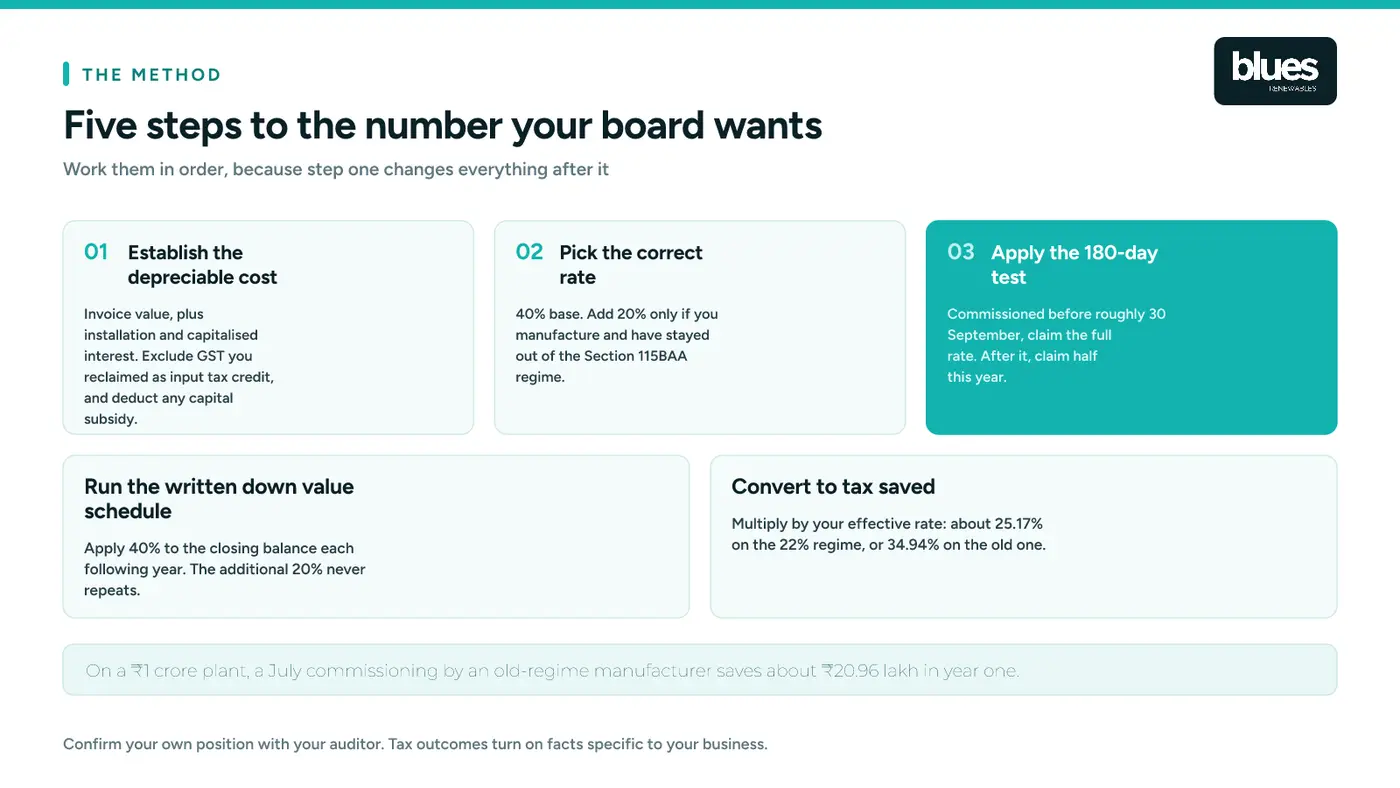
Step 1: Establish the depreciable cost
Start with the invoice, then adjust. This is where most errors creep in.
Include the modules, inverters, mounting structure, cabling, civil work for the array, transportation, installation and commissioning charges, and any interest on borrowing capitalised up to the date the plant is put to use.
Exclude two things in particular.
- GST you claimed as input tax credit. Where credit is available and taken, the tax never becomes a cost to you, so it stays out of the asset value. Where credit is blocked, for instance because your output is exempt, the GST does form part of cost and is depreciated with the rest. Which case applies is covered in GST on a solar power plant.
- Any capital subsidy or grant directly relatable to the asset, which reduces cost under Explanation 10 to Section 43(1).
A worked illustration. A plant quoted at ₹1,00,00,000 plus 5 percent GST invoices at ₹1,05,00,000. Claim the credit and your depreciable cost is ₹1,00,00,000. Fail the credit test and it is ₹1,05,00,000.
Step 2: Pick the correct rate
Solar sits in the 40 percent block under Appendix I of the Income Tax Rules.
Add 20 percent under Section 32(1)(iia) only if both of these hold: your business is engaged in manufacturing or production, and your company has not opted into the concessional 22 percent regime under Section 115BAA. Companies that made that switch surrendered additional depreciation as part of the bargain.
Step 3: Apply the 180-day test
Count the days from the date the plant was put to use to 31 March.
- 180 days or more, meaning commissioned on or before roughly 30 September: claim the full rate.
- Fewer than 180 days: claim half the rate this year.
For manufacturers, the half of the additional 20 percent you could not claim is not lost. Under the second proviso to Section 32(1)(iia) it becomes allowable in the immediately following year, on top of that year's normal depreciation.
Step 4: Run the written down value schedule
Each subsequent year, apply 40 percent to the closing value from the year before. The additional 20 percent is a first-year allowance only and never repeats.
Step 5: Convert the deduction into tax saved
Multiply by your effective rate, including surcharge and cess.
- Section 115BAA - Headline: 22%, Effective with surcharge and cess: about 25.17%
- Section 115BAB, new manufacturers - Headline: 15%, Effective with surcharge and cess: about 17.16%
- Old regime, large company - Headline: 30%, Effective with surcharge and cess: about 34.94%
Worked example one: a manufacturer, ₹1 crore, commissioned in July
An old-regime manufacturing company, plant invoiced at ₹1,00,00,000 plus GST with input tax credit claimed, energised 20 July.
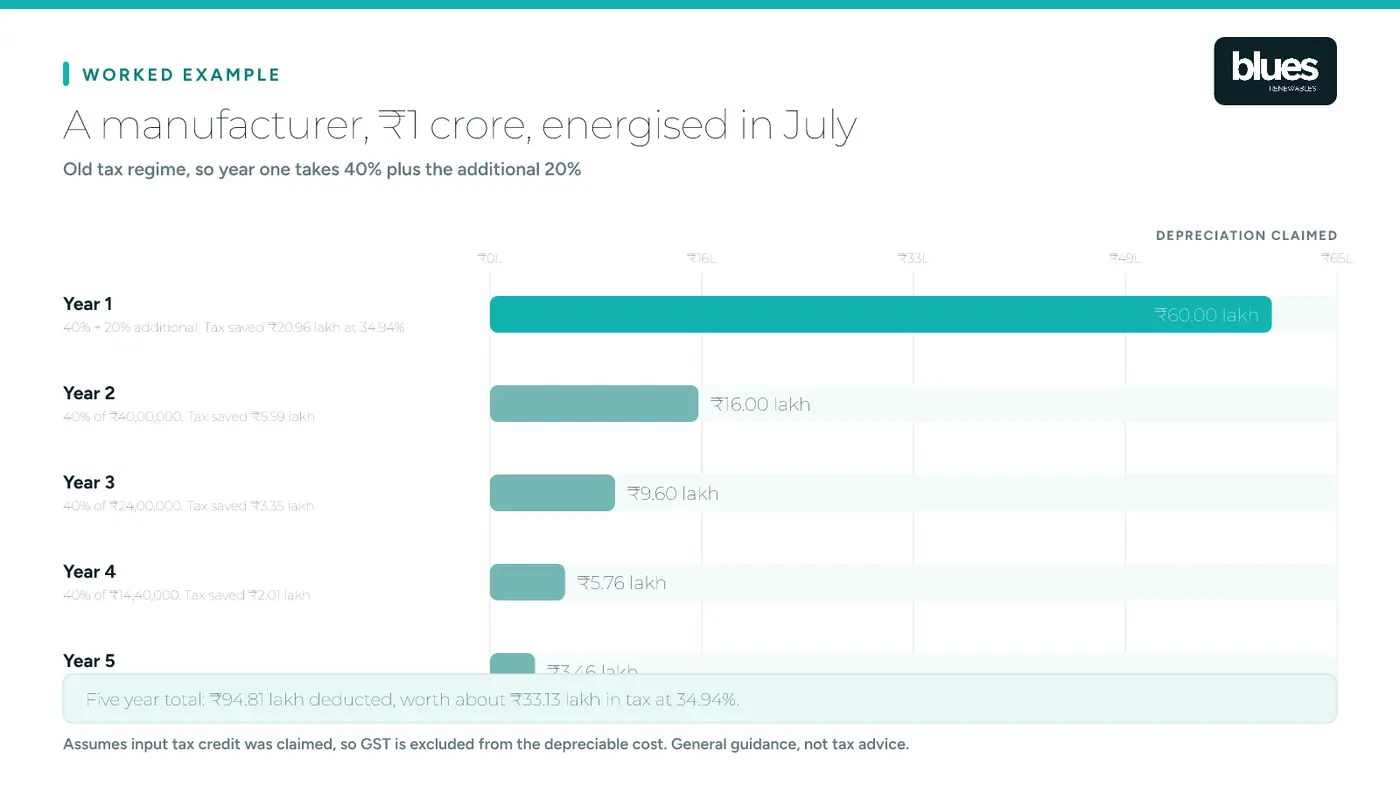
Days in use exceed 180, and the company is a manufacturer outside 115BAA, so year one takes the full 40 plus 20.
- 1 - Opening WDV: ₹1,00,00,000, Rate: 40% + 20%, Depreciation: ₹60,00,000, Closing WDV: ₹40,00,000
- 2 - Opening WDV: ₹40,00,000, Rate: 40%, Depreciation: ₹16,00,000, Closing WDV: ₹24,00,000
- 3 - Opening WDV: ₹24,00,000, Rate: 40%, Depreciation: ₹9,60,000, Closing WDV: ₹14,40,000
- 4 - Opening WDV: ₹14,40,000, Rate: 40%, Depreciation: ₹5,76,000, Closing WDV: ₹8,64,000
- 5 - Opening WDV: ₹8,64,000, Rate: 40%, Depreciation: ₹3,45,600, Closing WDV: ₹5,18,400
Year one tax saved at 34.94 percent: ₹60,00,000 × 34.94% = about ₹20.96 lakh.
Across the first five years the company deducts ₹94.81 lakh, worth roughly ₹33.13 lakh in tax at the same rate.
Worked example two: a hospital, ₹50 lakh, commissioned in November
A hospital company on the 115BAA regime, plant put to use on 12 November.
Two restrictions apply at once. Healthcare is not manufacturing, so no additional depreciation. The company is on 115BAA, which would block it regardless. And with fewer than 180 days of use, the base rate halves.
- 1 - Opening WDV: ₹50,00,000, Rate: 20%, being half of 40%, Depreciation: ₹10,00,000, Closing WDV: ₹40,00,000
- 2 - Opening WDV: ₹40,00,000, Rate: 40%, Depreciation: ₹16,00,000, Closing WDV: ₹24,00,000
- 3 - Opening WDV: ₹24,00,000, Rate: 40%, Depreciation: ₹9,60,000, Closing WDV: ₹14,40,000
Year one tax saved at 25.17 percent: ₹10,00,000 × 25.17% = about ₹2.52 lakh.
Had the same hospital energised in August instead, year one depreciation would have been ₹20,00,000 and the saving about ₹5.03 lakh. The hardware is identical. The commissioning date is worth ₹2.5 lakh. Sizing and timing for institutions are covered on our solar for hospitals in Chennai page.
Worked example three: an SME manufacturer, ₹25 lakh, commissioned in December
An old-regime manufacturing partnership, plant put to use on 5 December. Under 180 days, so both rates halve, and the deferred half of the additional allowance appears in year two.
- 1 - Component: Base, 40% halved to 20% of ₹25,00,000, Depreciation: ₹5,00,000
- 1 - Component: Additional, 20% halved to 10% of ₹25,00,000, Depreciation: ₹2,50,000
- 1 - Component: Year one total, Depreciation: ₹7,50,000
- 2 - Component: Base, 40% of WDV ₹17,50,000, Depreciation: ₹7,00,000
- 2 - Component: Balance additional depreciation carried into year two, Depreciation: ₹2,50,000
- 2 - Component: Year two total, Depreciation: ₹9,50,000
Year two exceeds year one. That result surprises people, and it is exactly what the second proviso to Section 32(1)(iia) produces after a late commissioning.
A schedule you can copy
For any cost C at the full 40 percent rate, with no additional depreciation:
- 1 - Depreciation: 0.400 × C, Cumulative: 40.0%
- 2 - Depreciation: 0.240 × C, Cumulative: 64.0%
- 3 - Depreciation: 0.144 × C, Cumulative: 78.4%
- 4 - Depreciation: 0.0864 × C, Cumulative: 87.0%
- 5 - Depreciation: 0.0518 × C, Cumulative: 92.2%
- 6 - Depreciation: 0.0311 × C, Cumulative: 95.3%
Multiply any row by your effective tax rate to get that year's cash benefit. Halve the year one figure if the plant ran for fewer than 180 days.
Three errors worth checking for
Depreciating the GST you reclaimed. It inflates the asset by 5 percent and the deduction along with it. Auditors catch this one.
Modelling 60 percent for a 115BAA company. Additional depreciation is unavailable there, so year one is 40 percent, not 60. The error overstates the first-year benefit by half.
Ignoring the subsidy adjustment. Where a capital subsidy is received against the asset, cost comes down before depreciation is applied.
Run your final numbers past your auditor. Tax outcomes depend on facts specific to your business, so treat this as general guidance rather than tax advice.
Frequently asked questions
How do I calculate accelerated depreciation for solar in India? Take the depreciable cost, apply 40 percent, add 20 percent in year one if you are a manufacturer outside the 115BAA regime, halve the rate if the plant ran under 180 days, then apply 40 percent to the reducing balance in later years. Multiply each year's deduction by your effective tax rate for the cash benefit.
What is the formula for written down value depreciation? Depreciation for the year equals opening written down value multiplied by the rate. Closing written down value equals opening value minus that depreciation, and becomes next year's opening figure.
Does GST form part of the cost I depreciate? Only where you could not claim input tax credit on it. If you claimed the credit, exclude the GST from the asset value.
What if I commission the plant in February? The plant runs under 180 days, so you claim half the rate that year. Nothing is permanently lost, and manufacturers recover the deferred half of the additional allowance in the following year.
Can I claim depreciation before the plant is commissioned? No. The asset must be put to use. Buying panels in March and energising in June means the deduction belongs to the later year.
How many years until the plant is fully depreciated? Under the written down value method a small residue always remains, but you reach about 92 percent by year five and 95 percent by year six. The block-of-assets rules absorb the remainder when the plant is eventually sold or retired.
Does accelerated depreciation reduce my project cost? No. It reduces taxable profit, so the cash benefit equals the deduction times your tax rate. On a ₹1 crore plant at 25.17 percent, year one is worth about ₹10.07 lakh, not ₹40 lakh.
Where this fits
For the concept behind these numbers, read what accelerated depreciation in solar is, and for the rooftop-specific position see rooftop solar accelerated depreciation. Depreciation requires ownership, so pair this with the CAPEX model in solar. Feed the result into how to calculate solar payback period, and check the indirect tax side in GST on a solar power plant.
Blues Renewables has installed solar across Chennai since 2020, for homes, schools, businesses and factories. We hand finance teams a year-by-year schedule built on their actual regime and commissioning date, not a generic 40 percent slide.
Call +91 98841 07170 and we will calculate accelerated depreciation for solar against your own plant cost, tax regime and target commissioning month.
Sources
- Income Tax Act 1961, Section 32, Section 32(1)(iia) and its second proviso
- Income Tax Act 1961, Section 43(1), Explanation 10, on subsidies reducing actual cost
- Income Tax Rules 1962, Appendix I, depreciation rate schedule for renewable energy devices
- Income Tax Act 1961, Sections 115BAA and 115BAB
- Press Information Bureau, Ministry of New and Renewable Energy, "GST on Renewable Energy Devices Rationalised to 5%", 17 September 2025