How Many Solar Panels for a House? Size It From Your Bill
How many solar panels required for a house: learn the count from your monthly units, discover why floor area tells you nothing, and read the table for every bill size.


Six panels. Or four, or eleven. The honest answer is that nobody can tell you from the outside of your house, and anyone who quotes a number before seeing a bill is guessing.
How many solar panels required for a house depends on one thing above all others: how many units you actually consume. Not your floor area, not your bedroom count, not the size of your roof. Two identical houses on the same street routinely differ threefold, because one runs two air conditioners and the other runs ceiling fans.
This guide gives you the calculation, a table covering every common bill size in Chennai, why floor area misleads, and what to do when your roof cannot hold what your consumption needs.
Key takeaways
- Size from your monthly units, not your house. Divide monthly units by 30, then by 4.8, to get the system size in kW.
- A typical Chennai home lands between 2 kW and 5 kW, which is four to ten panels of 550 W.
- 400 units a month needs about 2.8 kW, so a 3 kW system of six panels.
- Floor area tells you almost nothing. An 1,100 sq ft house might need 2 kW or 6 kW depending entirely on its air conditioning.
- Roof area sets a ceiling, not a requirement. Allow about 85 sq ft of roof per kW installed.
- Do not size for 100 percent offset by default. Generation you export earns less than the tariff you avoid, so the last kilowatt often pays worst.
How many solar panels are required for a house
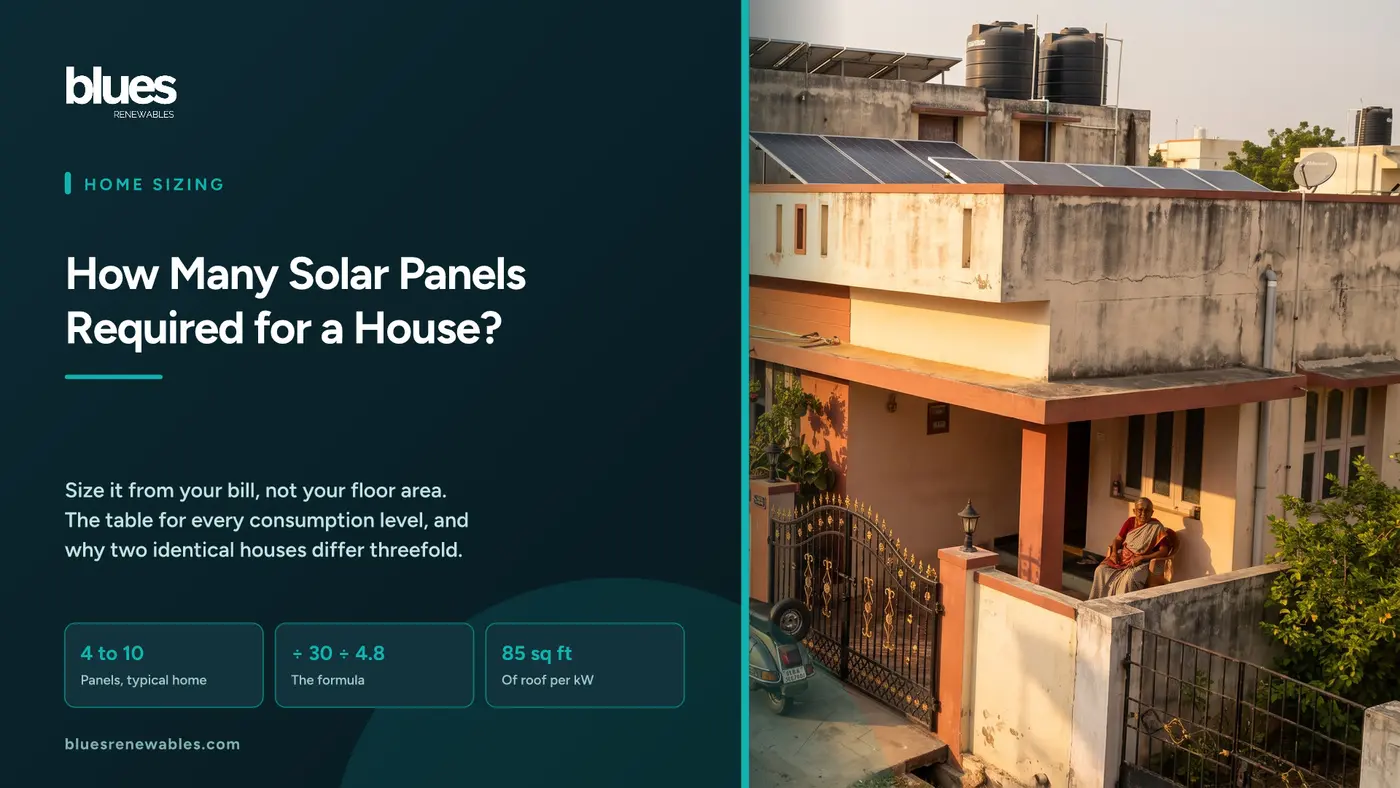
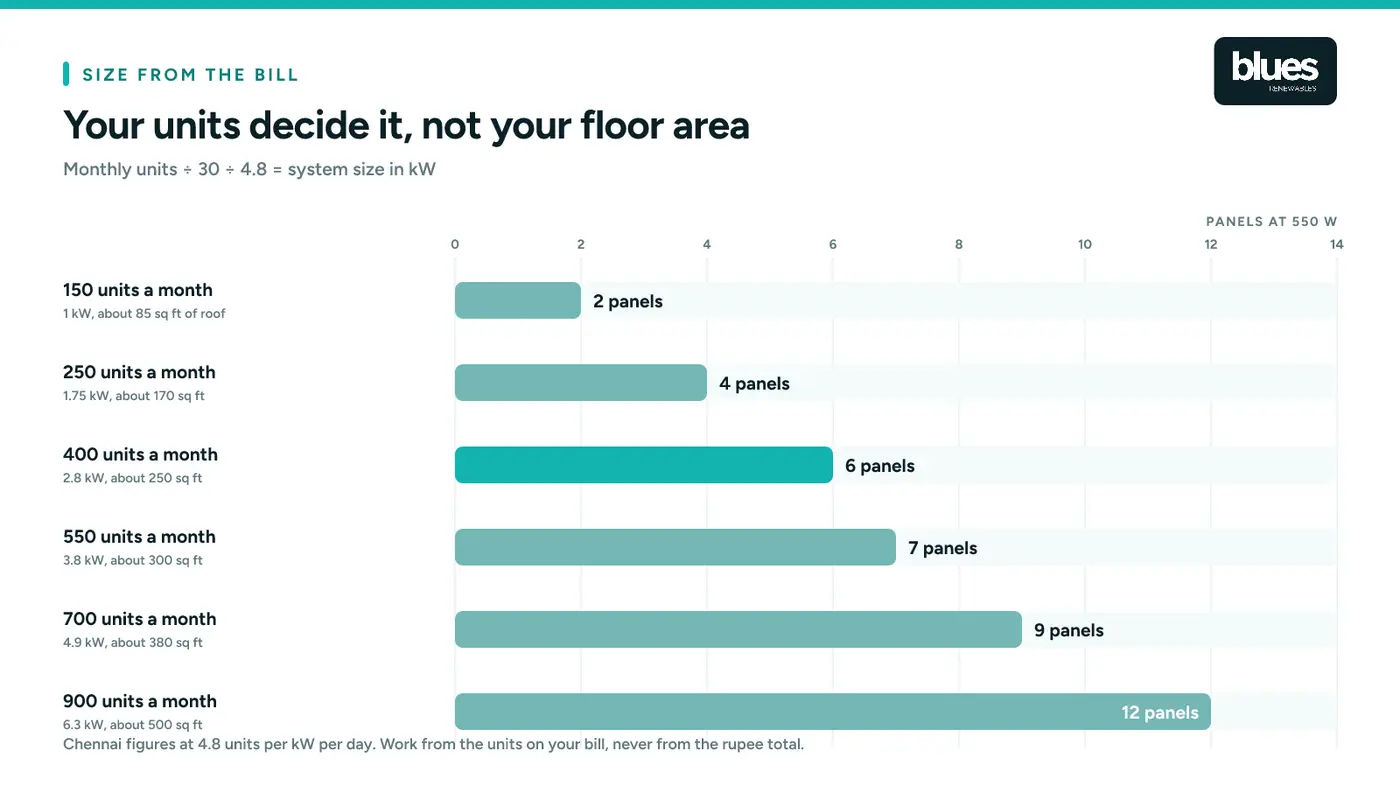
A typical Indian house requires four to ten solar panels of 550 W, which is a 2 kW to 5 kW system, depending on how much electricity it consumes. The precise count comes from your own consumption: divide your monthly units by 30 to get daily units, divide that by 4.8 to get the system size in kilowatts, then divide by your panel wattage.
The calculation, in three steps
Step 1. Find your monthly units. Take them from your electricity bill, not from the rupee amount. Average the last twelve months if you can, because summer and winter differ sharply in Chennai.
Step 2. Convert to system size.
System size in kW = monthly units ÷ 30 ÷ 4.8
The 4.8 is what a kilowatt of solar actually generates per day in Chennai, after temperature, dust, cabling and inverter losses are taken off the theoretical 5.3 peak sun hours.
Step 3. Convert to panels.
Panels = system size in watts ÷ panel wattage
At the 550 W modules standard in India in 2026, a 3 kW system is six panels and a 5 kW system is ten.
The table for every common bill
- 150 units - Typical Chennai bill: ₹900 to ₹1,200, System size: 1 kW, Panels at 550 W: 2, Roof footprint: about 85 sq ft
- 250 units - Typical Chennai bill: ₹1,500 to ₹2,000, System size: 1.75 kW, Panels at 550 W: 4, Roof footprint: about 170 sq ft
- 400 units - Typical Chennai bill: ₹2,500 to ₹3,200, System size: 2.8 kW, Panels at 550 W: 6, Roof footprint: about 250 sq ft
- 550 units - Typical Chennai bill: ₹3,500 to ₹4,500, System size: 3.8 kW, Panels at 550 W: 7, Roof footprint: about 300 sq ft
- 700 units - Typical Chennai bill: ₹4,500 to ₹5,800, System size: 4.9 kW, Panels at 550 W: 9, Roof footprint: about 380 sq ft
- 900 units - Typical Chennai bill: ₹6,000 to ₹7,500, System size: 6.3 kW, Panels at 550 W: 12, Roof footprint: about 500 sq ft
- 30 units a day - Typical Chennai bill: ₹6,000 to ₹7,500, System size: 6.25 kW, Panels at 550 W: 12, Roof footprint: about 500 sq ft
Rupee figures are indicative only. Tamil Nadu residential tariffs are slabbed, so two homes on the same units can pay different amounts. Always work from the units.
Why floor area tells you nothing
People search for the panel count for an 1,100 sq ft house, and it is an understandable question with an unhelpful answer.
Floor area does not consume electricity. Appliances do. Consider two 1,100 sq ft houses in the same Chennai neighbourhood.
- Occupants - House A: 2, House B: 5
- Air conditioners - House A: None, ceiling fans, House B: Two 1.5 ton units
- Water heating - House A: Solar water heater, House B: Electric geyser
- Monthly units - House A: about 220, House B: about 750
- System needed - House A: 1.5 kW, 3 panels, House B: 5.2 kW, 10 panels
Same floor area. More than three times the system. Any rule of thumb based on square footage will be wrong for one of these two houses, and possibly both.
Where floor area does matter is as a ceiling. A larger house usually has a larger roof, and roof area caps what you can install. Allow roughly 85 sq ft of roof per kW, including the mounting frame and walking space. An 1,100 sq ft house with 700 usable sq ft of terrace can therefore take about 8 kW, which is far more than most such homes need.
What each system size actually runs
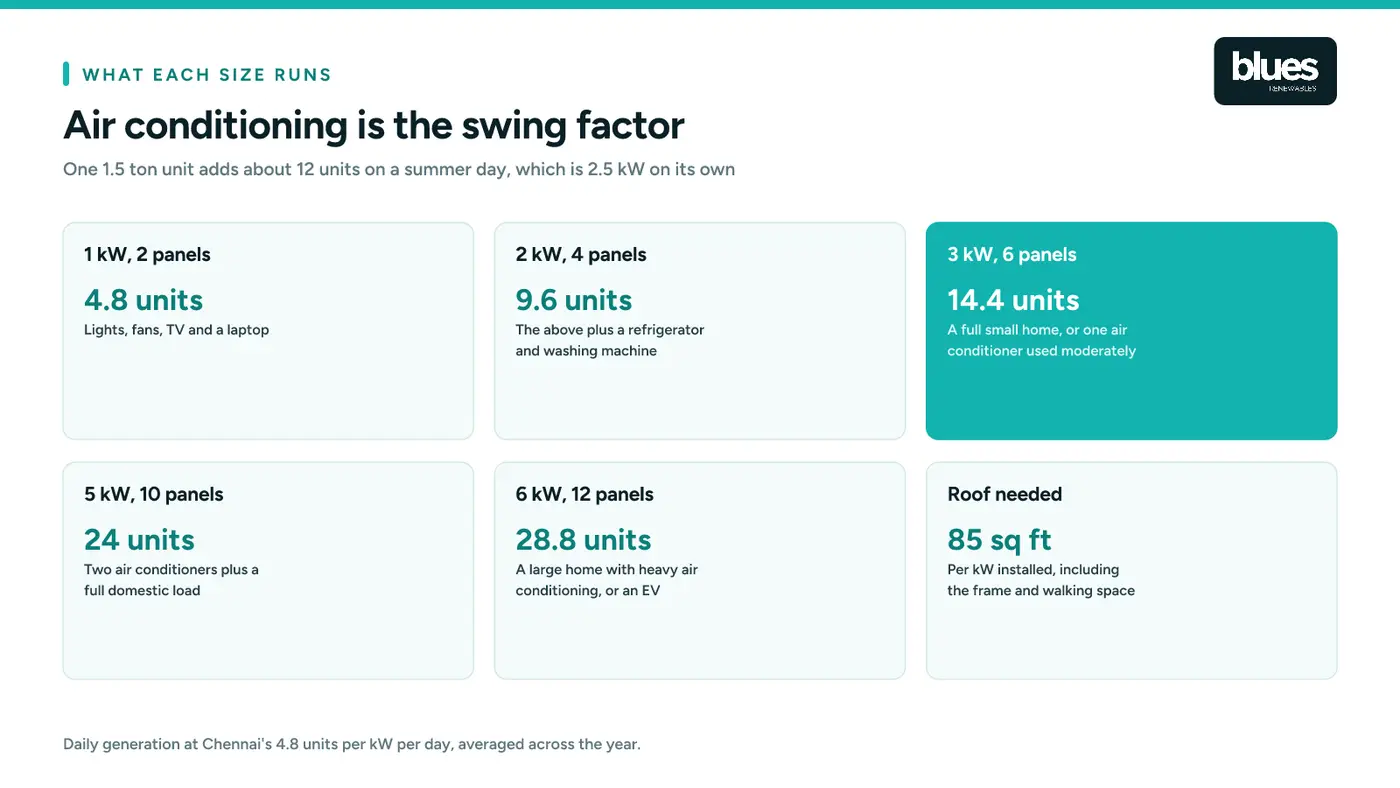
- 1 kW - Panels: 2, Daily units: 4.8, Comfortably runs: Lights, fans, TV, laptop
- 2 kW - Panels: 4, Daily units: 9.6, Comfortably runs: The above plus refrigerator and washing machine
- 3 kW - Panels: 6, Daily units: 14.4, Comfortably runs: A full small home, or one air conditioner used moderately
- 5 kW - Panels: 10, Daily units: 24, Comfortably runs: Two air conditioners plus a full domestic load
- 6 kW - Panels: 12, Daily units: 28.8, Comfortably runs: A large home with heavy air conditioning, or an EV
Air conditioning is the swing factor in almost every Indian home. One 1.5 ton unit adds roughly 12 units on a summer day, which is 2.5 kW of solar on its own. That single appliance is covered in detail in how many solar panels required for 1.5 ton AC. For a smaller home, the 2 kW price page sets out what that size costs with the ₹60,000 subsidy.
Should you cover 100 percent of your bill?
Usually not, and this is where a good installer earns their fee.
Solar generates during daylight. Whatever you consume at that moment replaces a unit you would have bought, worth your full marginal tariff. The rest is exported, and under net metering it earns a credit worth considerably less.
So the value of each additional kilowatt falls as your system grows past your daytime load. A house that is empty from nine to six exports most of its midday generation, which is why the last kilowatt often pays worst.
Two practical consequences.
- Size to your daytime consumption first, then extend only if the economics still work.
- Shift what you can into daylight. Running the washing machine, water heater and pump between ten and four is worth more than adding panels.
The full treatment, including how self-consumption changes payback by years, is in how to calculate solar payback period.
When your roof cannot hold what you need
Three options, in the order they usually make sense.
Fill what you have. A partial system still cuts the expensive top slab of your bill, which is where solar saves most.
Use a raised structure. Mounting the array about seven feet above the terrace keeps the space underneath usable and often unlocks area that looked unavailable.
Deal with shading properly. A water tank, parapet or neighbouring building can cost 10 to 20 percent of output. Surveying the shadows across a full year, rather than glancing at the roof on the day, sometimes recovers more capacity than adding panels would.
For apartments, where the roof is shared and the decision is collective, see solar for apartments in Chennai.
Frequently asked questions
How many solar panels are required for a house? Four to ten panels of 550 W for a typical Indian home, which is a 2 kW to 5 kW system. The exact count comes from your monthly units: divide by 30, then by 4.8, to get the kilowatts you need.
How many solar panels are required to power a house completely? Enough capacity to match your annual consumption, which for a 700 unit a month home is about 4.9 kW, or nine panels. Covering 100 percent of annual units still means importing at night and exporting at midday, since solar and household demand do not line up in time.
How many kW are required for a house using solar panels? Between 1 kW and 6 kW for most Indian homes. Take your monthly units, divide by 30 and then by 4.8. A 400 unit home needs about 2.8 kW.
How many solar panels required for 400 units of electricity? About 2.8 kW, which is six panels of 550 W. Most installers would quote this as a 3 kW system, covered in how many solar panels required for 3kW.
How many solar panels required for an 1100 sqft house? Floor area does not determine it. Two 1,100 sq ft houses can need 1.5 kW and 5.2 kW depending on air conditioning and occupancy. Size from the bill instead. Floor area only matters as a ceiling on roof space.
How many solar panels are required to get 30 kWh a day? About 6.25 kW, which is twelve panels of 550 W, at Chennai's 4.8 units per kW per day.
Can solar run a house at night? Not directly. A grid-connected system exports surplus by day and draws from the grid at night, with net metering settling the difference. Running independently at night needs batteries, which rarely pay where grid supply is reliable.
How much roof do I need for a house solar system? About 85 sq ft per kW including the frame and walkways, so roughly 250 sq ft for 3 kW and 420 sq ft for 5 kW.
Getting the sizing right
For specific system sizes, see 1 kW, 3 kW and 5 kW. The underlying method, including how to size from appliances rather than bills, is in how to calculate how many solar panels are required. What the installation involves is set out in how to install solar panels on your home, and the subsidy in PM Surya Ghar subsidy.
Blues Renewables has installed solar across Chennai since 2020, for homes, schools, businesses and factories. We size from twelve months of your bills and a shadow survey of your roof, then quote the size that actually pays rather than the largest one that fits.
Call +91 98841 07170 and we will tell you how many solar panels are required for a house like yours, using your real consumption rather than a rule of thumb.
Sources
- MNRE, Guidelines for implementation of PM Surya Ghar: Muft Bijli Yojana
- Tamil Nadu Electricity Regulatory Commission, Tariff Order No.6 of 2025 dated 30 June 2025
- Tamil Nadu Electricity Regulatory Commission, Grid Interactive Solar Energy Generating Systems Regulations
- Module dimensions and ratings from current mono PERC and TOPCon datasheets in Indian residential supply
- Blues Renewables installation data, Chennai, 2020 to 2026, for generation and consumption ranges