How Many Solar Panels Required for 1.5 Ton AC? Four to Six
How many solar panels required for 1.5 ton AC: four to six 550 W panels. Learn the units an AC really uses, and discover why running it at night changes nothing.


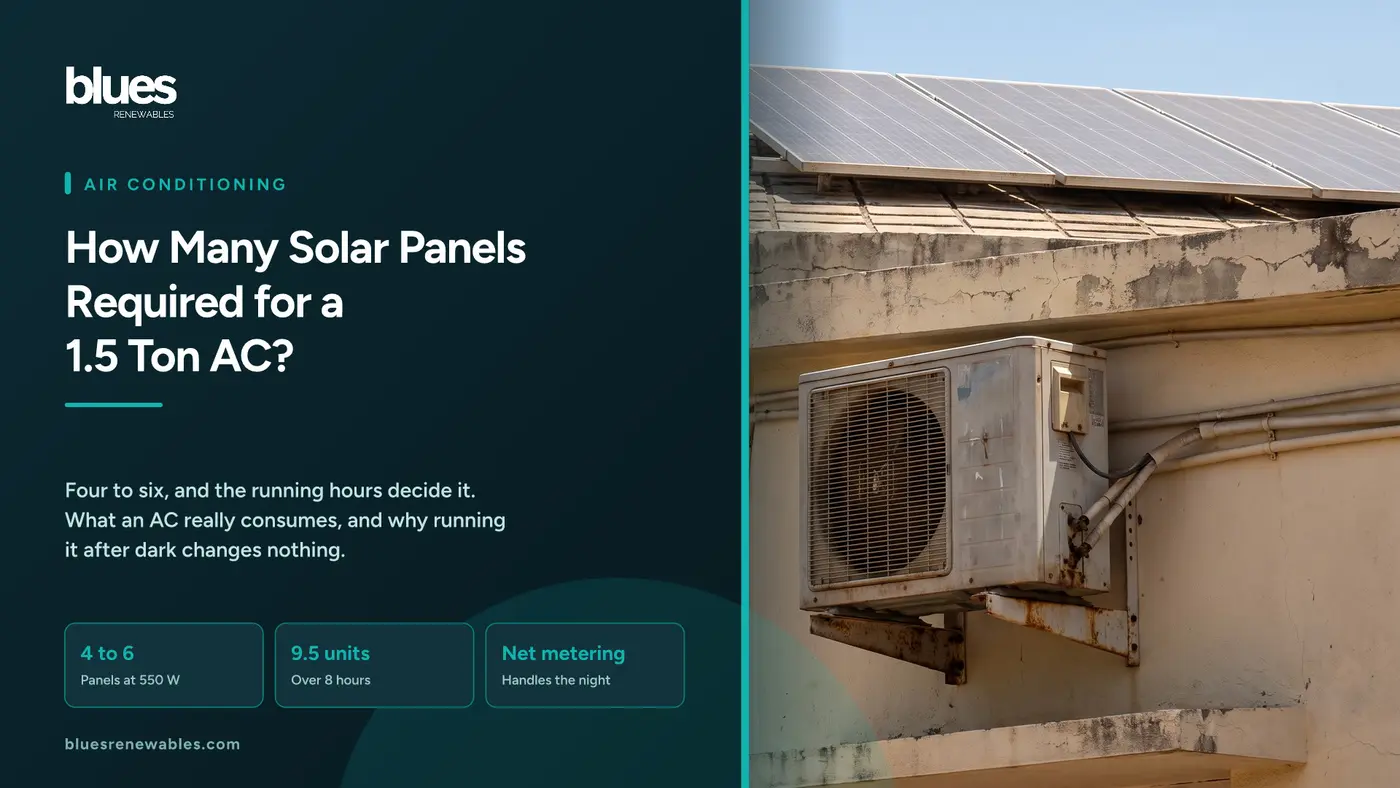
Four to six panels, and the range is wide for a reason that has nothing to do with the air conditioner.
The number depends almost entirely on how many hours you run it. A 1.5 ton unit on for six hours a night and the same unit on for twelve need very different arrays, which is why how many solar panels required for 1.5 ton AC has no single answer.
There is a second thing worth settling early. Your air conditioner runs mostly after dark. Solar generates only in daylight. Those two facts do not stop this working, but they change what "running your AC on solar" actually means, and most articles gloss over it.
This guide gives the panel count by running hours and AC type, the units an air conditioner genuinely consumes, why night running is fine on a grid-connected system, and what changes if you want to run without the grid.
Key takeaways
- A 1.5 ton inverter AC needs about four to six panels of 550 W, which is 2.2 kW to 3.3 kW, depending on daily running hours.
- Expect 8 to 14 units a day from a 1.5 ton unit in a Chennai summer, not the 20 or more that older articles assume.
- Your AC runs at night and solar generates by day. That is fine. A grid-connected system with net metering offsets the energy across the billing cycle.
- Inverter ACs suit solar far better than fixed-speed units, because they draw a lower, steadier load rather than cycling hard.
- A 1 ton unit needs about three panels. A 2 ton unit needs about five.
- Running an AC genuinely off-grid needs batteries, and the battery, not the panels, becomes the expensive part.
How many solar panels are required for a 1.5 ton AC
A 1.5 ton air conditioner requires four to six solar panels of 550 W, which is 2.2 kW to 3.3 kW of capacity. Four panels cover a unit used around eight hours a day; six cover one used twelve hours or more. The count follows from daily consumption: divide the units your AC uses per day by 4.8 to get the kilowatts of solar needed, then divide by panel wattage.
What a 1.5 ton AC actually consumes
Start with the load, because this is where most estimates go wrong.
A 1.5 ton air conditioner is rated around 1,500 to 1,600 watts if it is a fixed-speed unit, and 1,100 to 1,500 watts for an inverter model. But it does not draw that continuously. Once the room reaches temperature, a fixed-speed unit cycles off and on, while an inverter unit throttles down to a fraction of its peak.
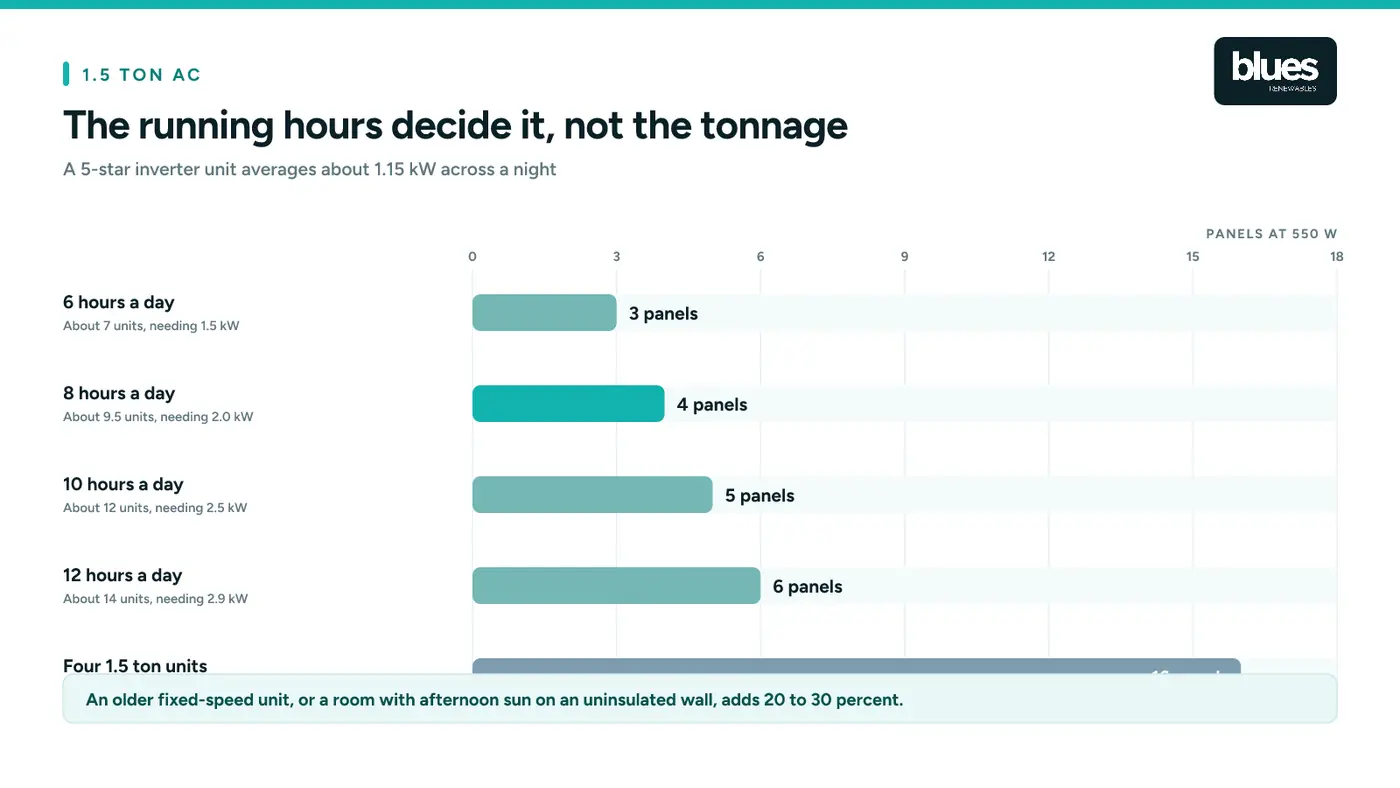
Averaged across a night, a modern 5-star inverter 1.5 ton unit in Chennai draws roughly 1.1 to 1.2 kW.
- 6 hours - Units per day: about 7 units, Solar capacity needed: 1.5 kW, Panels at 550 W: 3
- 8 hours - Units per day: about 9.5 units, Solar capacity needed: 2.0 kW, Panels at 550 W: 4
- 10 hours - Units per day: about 12 units, Solar capacity needed: 2.5 kW, Panels at 550 W: 5
- 12 hours - Units per day: about 14 units, Solar capacity needed: 2.9 kW, Panels at 550 W: 6
An older fixed-speed unit, or a poorly insulated room, can add 20 to 30 percent to those figures. A room that gets afternoon sun on an uninsulated west wall is the single biggest variable after running hours.
Panel count for other AC sizes
- 1 ton - Average draw: about 0.8 kW, 8 hours a day: about 6.5 units, Panels at 550 W: 3
- 1.5 ton - Average draw: about 1.15 kW, 8 hours a day: about 9.5 units, Panels at 550 W: 4
- 2 ton - Average draw: about 1.6 kW, 8 hours a day: about 13 units, Panels at 550 W: 5
- Four 1.5 ton units - Average draw: about 4.6 kW, 8 hours a day: about 38 units, Panels at 550 W: 16
That last row answers a question we get often. Running four air conditioners on solar means roughly 8 kW of capacity, or sixteen panels of 550 W, which needs about 680 sq ft of roof. That is a serious installation, not an add-on.
Your AC runs at night. Here is why that is fine.
This is the part worth understanding properly.
A grid-connected rooftop system does not power your air conditioner directly at eleven at night. What it does is export surplus generation during the day and draw it back after dark, with net metering settling the difference across the billing cycle.
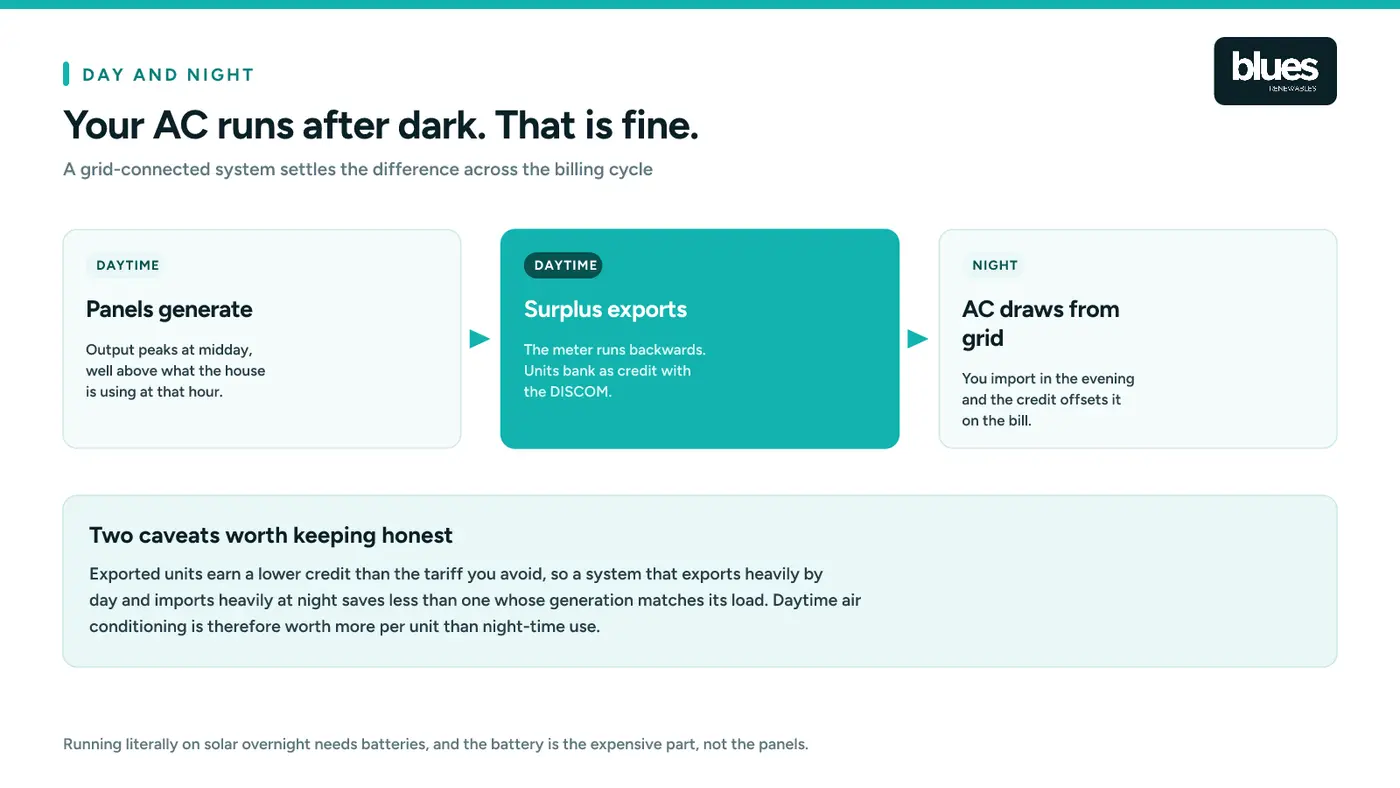
So the question is not whether the sun is shining when the compressor runs. It is whether your monthly generation covers your monthly consumption. On that basis, four to six panels genuinely do offset a 1.5 ton air conditioner.
Two caveats keep this honest.
Exported units are worth less than the units you avoid. Under net metering arrangements the credit for exported energy is typically below your retail tariff, so a system that exports heavily by day and imports heavily at night saves less than one whose generation matches its load. That is a reason to size sensibly rather than to give up.
Daytime AC use is worth more. If somebody is home during the day, or you run the AC in a home office from noon, those units are consumed directly and are worth your full tariff. The same panels save you more money.
How much this matters to your payback is set out in how to calculate solar payback period.
Inverter AC or fixed speed makes a real difference
If you are buying both together, buy the inverter AC.
A fixed-speed unit runs its compressor at full power until the room is cold, switches off, then restarts. Each restart draws a heavy surge. Total consumption is higher, and the load is spiky.
An inverter unit varies compressor speed, settling into a low steady draw once the room is at temperature. It uses 20 to 30 percent less energy over a night, and it presents a gentler load.
On a grid-connected system the surge does not matter much, since the grid absorbs it. Off-grid and hybrid systems are a different story, because the battery inverter must then be sized for the starting current rather than the running current.
Also check the ISEER rating. A 5-star 1.5 ton unit can use meaningfully less than a 3-star one over a season, and reducing the load is always cheaper than adding panels to feed it.
Running an AC without the grid
Possible, and rarely worth it in a city.
To run a 1.5 ton AC for eight hours after dark you need roughly 9.5 units of usable storage. Allowing for depth of discharge and round-trip losses, that means a substantial battery bank plus an inverter rated for the compressor's starting surge.
The panels are the cheap part of that arrangement. Storage is not, and it needs replacing well before the panels do. Where grid supply is reliable, net metering does the same job at a fraction of the cost.
If you genuinely have no dependable grid, our off grid solar system in Chennai page covers what that build involves, and how many solar panels are required to charge a 200Ah battery covers the charging side.
Sizing your whole house, not just the AC
An air conditioner is rarely your only load. Add it to everything else before deciding.
- Small home, no AC - Typical total: 250 units a month, System: 1.75 kW, Panels: 4
- Small home, one 1.5 ton AC - Typical total: 550 units a month, System: 3.8 kW, Panels: 7
- Family home, two 1.5 ton ACs - Typical total: 800 units a month, System: 5.6 kW, Panels: 11
In other words, adding one 1.5 ton air conditioner to a household typically moves it from a 2 kW system to a 4 kW one. The full method is in how many solar panels required for a house.
Frequently asked questions
How many solar panels are required for a 1.5 ton AC? Four to six panels of 550 W, which is 2.2 kW to 3.3 kW. Take four for a unit run about eight hours a day, and six for twelve hours or more.
How many solar panels are required to run 1.5 ton AC for 8 hours? Four panels of 550 W, giving 2.2 kW. A 1.5 ton inverter unit uses roughly 9.5 units over eight hours, and 2.2 kW of solar generates about 10.5 units a day in Chennai.
How many solar panels are required for a 1 ton AC? Three panels of 550 W, about 1.65 kW, for eight hours of daily use. A 1 ton unit averages roughly 0.8 kW and uses about 6.5 units in that time.
1.5 ton AC wattage requires how many solar panels? The nameplate is 1,500 to 1,600 W for a fixed-speed unit and 1,100 to 1,500 W for an inverter model, but it never draws that continuously. Size from daily units rather than nameplate watts: four to six panels covers normal use.
Can solar panels run an AC at night? Not directly. On a grid-connected system your daytime surplus is exported and drawn back after dark, with net metering settling the difference. Running literally on solar overnight requires batteries.
How many solar panels to run 4 air conditioners? About sixteen panels of 550 W, roughly 8 kW, for four 1.5 ton units used eight hours a day. That needs around 680 sq ft of roof.
Do I need a battery to run an AC on solar? Not where the grid is reliable. Net metering does the job far more cheaply. Batteries only earn their place where supply is genuinely unreliable, and the inverter must then be sized for compressor starting current.
Does an inverter AC need fewer solar panels? Yes, usually 20 to 30 percent fewer, because it draws a lower steady load instead of cycling at full power. Reducing the load is always cheaper than adding panels.
Getting the sizing right
Size the whole household, not the appliance alone, using how many solar panels required for a house and how to calculate how many solar panels are required. For the common system sizes that result, see 3 kW and 5 kW. How net metering works in Tamil Nadu is covered on our on grid solar system in Chennai page.
Blues Renewables has installed solar across Chennai since 2020, for homes, schools, businesses and factories. We size air conditioning from your actual running pattern, because the difference between six hours and twelve is two panels and about ₹40,000.
Call +91 98841 07170 and we will work out how many solar panels are required for a 1.5 ton AC in your home, alongside everything else you run.
Sources
- Bureau of Energy Efficiency, ISEER star rating framework for room air conditioners
- Tamil Nadu Electricity Regulatory Commission, Grid Interactive Solar Energy Generating Systems Regulations, on net metering
- MNRE, Guidelines for implementation of PM Surya Ghar: Muft Bijli Yojana
- Module dimensions and ratings from current mono PERC and TOPCon datasheets in Indian residential supply
- Blues Renewables installation data, Chennai, 2020 to 2026, for air conditioning consumption ranges