How Many Solar Panels Required for 1kW? Two, and Here Is Why
How many solar panels required for 1kW: two 550 W panels in 2026. Learn the count for every panel wattage, discover the roof area, and read why 1 kW rarely pays.


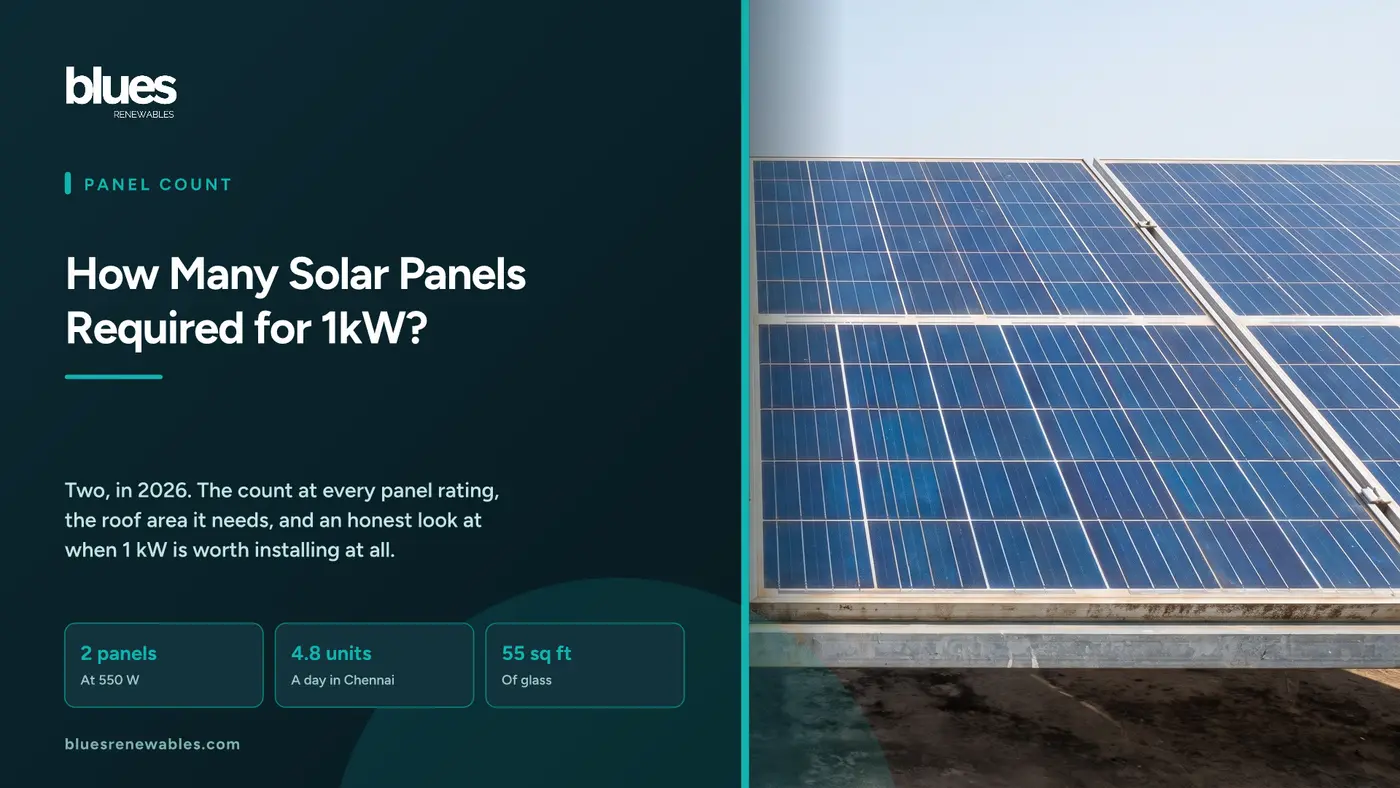
Two panels. That is the whole answer in 2026, and it would have been three or four not long ago.
The count is the easy part of how many solar panels required for 1kW. What deserves your attention is that 1,000 watts almost never divides cleanly into a real panel, and that 1 kW is small enough to sit awkwardly against India's subsidy slabs and installation costs.
This guide gives the count at every common panel rating, the roof area it needs, what 1 kW actually generates and runs, the difference between 1 kW and 1 kWh, and an honest view of when a 1 kW system is worth installing at all.
Key takeaways
- Two panels of 550 W make a 1 kW system, giving 1.10 kW of real capacity. At 330 W you need three.
- You cannot land on exactly 1.00 kW, so decide whether to round up or down before you compare quotations.
- 1 kW needs about 50 to 56 sq ft of glass, or roughly 85 sq ft of roof once you allow for the mounting frame and access.
- Expect about 4.8 units a day in Chennai, which is roughly 144 units a month.
- 1 kW is not 1 kWh. To generate one unit a day you need only about 210 W of panel, not 1,000 W.
- A standalone 1 kW system rarely pays well, because the inverter, structure, net meter and paperwork cost nearly the same as they do at 3 kW.
How many solar panels are required for 1 kW
A 1 kW solar system requires two panels of 550 W, which gives 1.10 kW of actual capacity and is the standard build in India in 2026. The count changes entirely with panel wattage: three panels at 400 W or 330 W, and four at 320 W. Divide 1,000 by the panel rating, then decide which way to round.
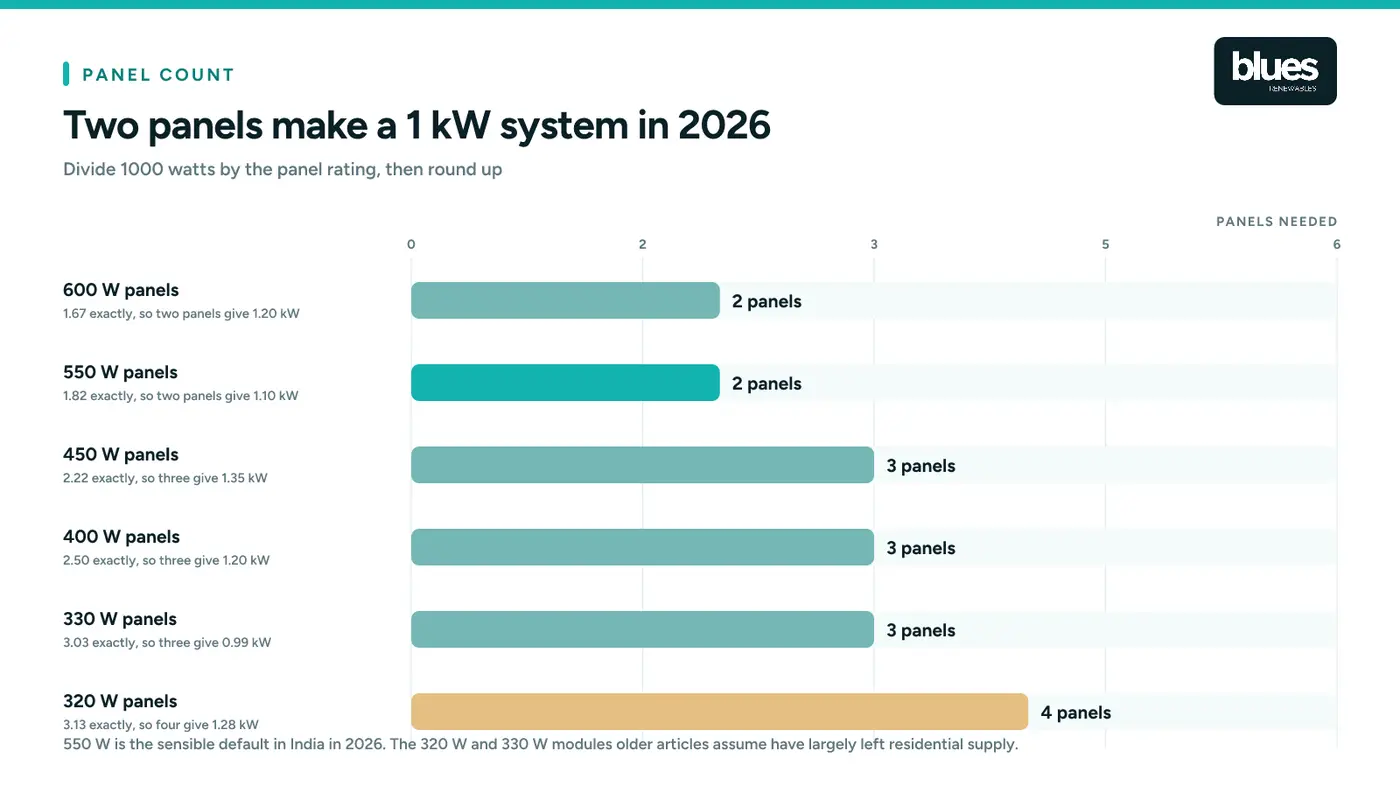
Divide 1,000 watts by the panel wattage
Number of panels = 1,000 ÷ panel wattage
Two points matter before you run that sum.
The wattage on the datasheet is a peak rating under standard test conditions, meaning 1,000 W/m² of irradiance at a 25 degree cell temperature. Your roof rarely sees both together, which is why a 1 kW array does not deliver 1 kW for most of the day.
Indian rooftop installations in 2026 overwhelmingly use 540 W to 600 W mono PERC or TOPCon modules. Unless a quotation says otherwise, 550 W is the sensible default. The 320 W and 330 W panels that older articles assume are now largely gone from residential supply.
Panel count by wattage
- 600 W - Exact division: 1.67, Panels needed: 2, Actual capacity: 1.20 kW
- 550 W - Exact division: 1.82, Panels needed: 2, Actual capacity: 1.10 kW
- 540 W - Exact division: 1.85, Panels needed: 2, Actual capacity: 1.08 kW
- 450 W - Exact division: 2.22, Panels needed: 3, Actual capacity: 1.35 kW
- 400 W - Exact division: 2.50, Panels needed: 3, Actual capacity: 1.20 kW
- 330 W - Exact division: 3.03, Panels needed: 3, Actual capacity: 0.99 kW
- 320 W - Exact division: 3.13, Panels needed: 4, Actual capacity: 1.28 kW
Notice the 330 W row. Three panels give 0.99 kW, which is a hair under 1 kW and the only combination on this table that lands almost exactly on target. Every other option overshoots.
That is not a problem. Round up rather than down. An extra 100 W of capacity costs very little on top of a fixed installation, generates for 25 years, and protects you against the slow output loss that every panel suffers.
How much roof space 1 kW needs
A 550 W panel measures roughly 2.28 m by 1.13 m, so about 27.7 sq ft of glass. Two of them come to about 55 sq ft.
That is the glass alone. In practice, allow more.
- Glass area, two 550 W panels - 1 kW: about 55 sq ft
- Array footprint with frame and walkway - 1 kW: about 85 sq ft
- On a raised structure - 1 kW: Terrace underneath stays usable
Eighty five square feet is roughly a 9 ft by 9 ft patch. Almost any Chennai terrace has that, which is why roof area is rarely the constraint at this size. Shading usually is: a single water tank, parapet or neighbouring wall can take a large bite out of a two-panel array, because with only two panels there is nowhere to move.
What 1 kW generates, and what it runs
Chennai gets about 5.3 peak sun hours a day. After temperature, dust, cable and inverter losses, size at 4.8 units per kW per day.
1 kW generates about 4.8 units a day, or roughly 144 units a month.
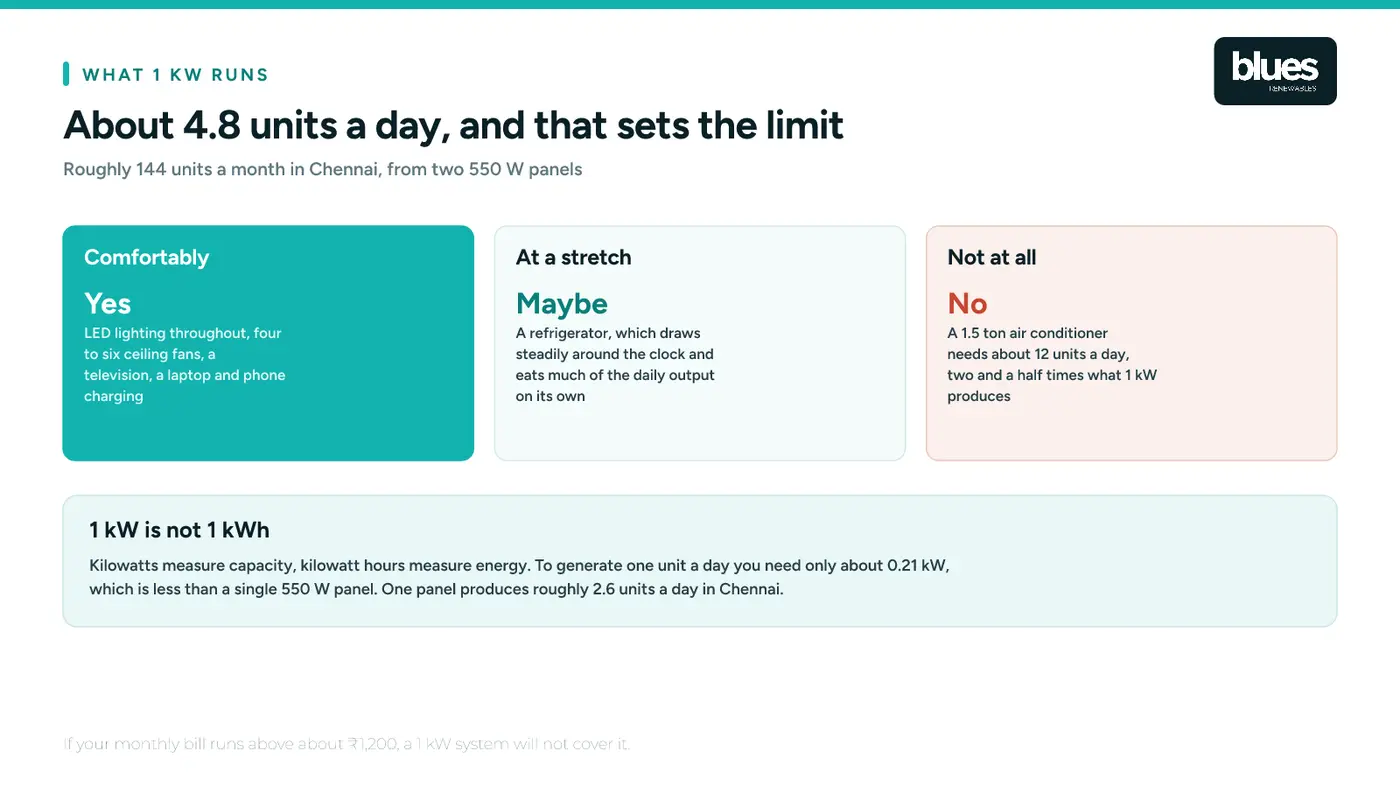
That covers a modest set of loads.
- Comfortably: LED lighting throughout a small home, four to six ceiling fans, a television, a laptop, and phone charging.
- At a stretch: a refrigerator, which draws steadily around the clock and will eat much of your daily output on its own.
- Not at all: an air conditioner. A single 1.5 ton unit needs roughly 12 units a day in summer, which is two and a half times what 1 kW produces. Sizing for that is covered in how many solar panels required for 1.5 ton AC.
If your monthly bill runs above about ₹1,200, 1 kW will not cover it.
1 kW is not 1 kWh, and the difference matters
This confuses a lot of people, and it changes the answer by a factor of five.
Kilowatts measure capacity. It is the maximum rate the array can produce, in ideal conditions, at one instant.
Kilowatt hours, or units, measure energy. It is what actually accumulates on your meter across a day.
So if your question is really "how many panels to generate 1 unit a day", the arithmetic runs the other way:
Capacity needed = daily units ÷ 4.8
One unit a day therefore needs about 0.21 kW, which is a single 550 W panel with capacity to spare. In practice that panel produces roughly 2.6 units a day in Chennai.
Turn that around and a useful rule falls out. Take your monthly consumption, divide by 30, then divide by 4.8, and you have the system size in kW. A house using 400 units a month needs about 2.8 kW, so 3 kW in practice. The full method sits in how to calculate how many solar panels are required.
What 1 kW costs, and why it rarely pays
Here is the part most articles skip.
A rooftop system's cost does not scale evenly with size. The inverter, mounting structure, cabling, earthing, net meter, DISCOM application and installation labour cost almost the same at 1 kW as they do at 3 kW. Only the panels scale.
- 1 kW - Indicative installed cost: ₹85,000 to ₹95,000, Cost per kW: about ₹90,000, Subsidy: ₹30,000, Net cost: about ₹60,000
- 2 kW - Indicative installed cost: ₹1,45,000 to ₹1,60,000, Cost per kW: about ₹76,000, Subsidy: ₹60,000, Net cost: about ₹92,000
- 3 kW - Indicative installed cost: about ₹2,10,000, Cost per kW: about ₹70,000, Subsidy: ₹78,000, Net cost: about ₹1,32,000
Look at the cost per kW column. You pay roughly 29 percent more per kilowatt at 1 kW than at 3 kW, for a system that generates a third as much.
PM Surya Ghar pays ₹30,000 per kW for the first 2 kW and ₹18,000 for the third, capped at ₹78,000. A 1 kW system therefore claims ₹30,000, while 3 kW claims ₹78,000. Our PM Surya Ghar subsidy page covers the slabs and the paperwork.
So when does 1 kW make sense? Three situations, honestly.
- A very small bill, under about ₹1,200 a month, where a larger system would export most of its output at a lower rate.
- A severely shaded or tiny roof with room for nothing more.
- A first phase, where you install 1 kW now on a structure sized for more, and extend later. Tell your installer at the survey, because retrofitting a bigger inverter costs more than buying it once.
For most Chennai homes, 2 kW or 3 kW returns considerably better. Current pricing by size sits on our solar panel price in Chennai page.
Frequently asked questions
How many solar panels are required for 1kW? Two panels of 550 W, giving 1.10 kW of actual capacity. At lower wattages you need more: three at 400 W or 330 W, and four at 320 W.
How many 320 Wp solar panels are required for 1kW? Four, giving 1.28 kW. Three would give 0.96 kW, slightly under target. Note that 320 W modules are largely obsolete in Indian residential supply, so check what the quotation actually offers.
How many solar panels required for 1kW in India? Two, at the 540 W to 600 W module ratings that dominate Indian rooftop supply in 2026. Older articles quoting three or four panels are working from 250 W to 330 W modules that are no longer standard.
How much area is required for a 1kW solar panel system? About 55 sq ft of glass, or roughly 85 sq ft of roof once the mounting frame and walking space are included. That is around a 9 ft by 9 ft patch.
How many units does 1kW solar generate per day? About 4.8 units a day in Chennai, or roughly 144 units a month, averaged across the year. Summer days run higher and monsoon days lower.
How many solar panels are required for 1 kWh? Only about 0.21 kW of capacity, which is less than one 550 W panel. A single panel generates roughly 2.6 units a day. Kilowatts measure capacity while kilowatt hours measure energy, so the two questions have very different answers.
Can 1kW solar run an air conditioner? No. A 1.5 ton air conditioner needs roughly 12 units a day in summer, against the 4.8 units a 1 kW system produces. You would need about 2.5 to 3 kW for one unit.
Is a 1kW solar system worth it? Only for a very small bill, a very small roof, or as a deliberate first phase. Because fixed costs do not scale down, 1 kW costs about 29 percent more per kilowatt than 3 kW while claiming far less subsidy.
Getting the sizing right
For the most installed size in India, read how many solar panels required for 3kW, and for a larger home how many solar panels required for 5kW. To size from your own bill rather than from a number, use how many solar panels required for a house and how to calculate how many solar panels are required. What the installation itself involves is set out in how to install solar panels on your home.
Blues Renewables has installed solar across Chennai since 2020, for homes, schools, businesses and factories. We size from your last twelve months of bills and your roof survey, and we will tell you plainly when a larger system would return more than the one you asked us to quote.
Call +91 98841 07170 and we will confirm how many solar panels are required for 1kW on your roof, and whether 1 kW is genuinely the right size for your consumption.
Sources
- MNRE, Guidelines for implementation of PM Surya Ghar: Muft Bijli Yojana, subsidy slabs and eligibility
- Press Information Bureau, Ministry of New and Renewable Energy, "GST on Renewable Energy Devices Rationalised to 5%", 17 September 2025
- Module dimensions and ratings from current mono PERC and TOPCon datasheets in Indian residential supply
- Blues Renewables installation data, Chennai, 2020 to 2026, for generation and pricing ranges