How Many Solar Panels Required for 5kW? Nine or Ten in 2026
How many solar panels required for 5kW: nine or ten 550 W panels. Learn the count by wattage, discover the roof area and output, and read why the subsidy stops at 3 kW.


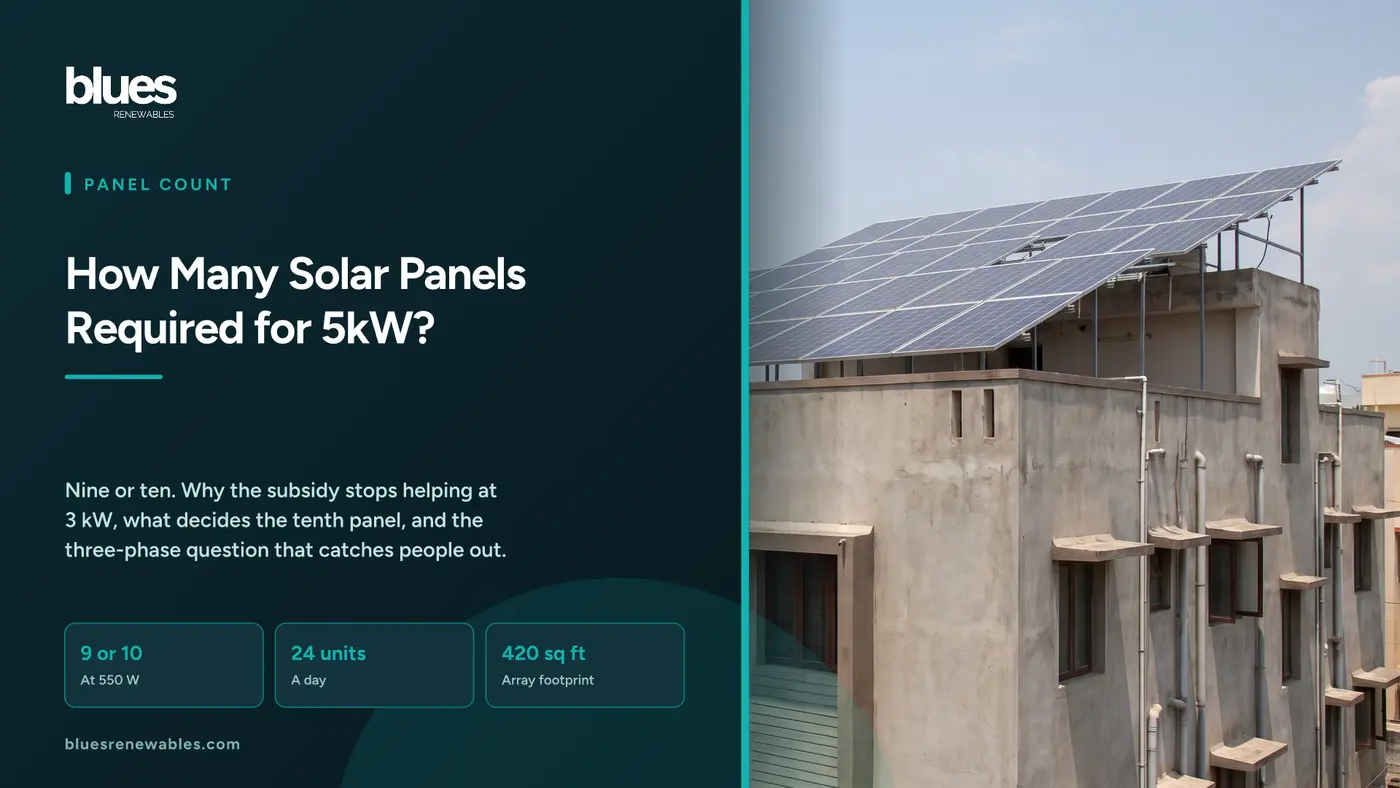
Nine or ten. Which of the two you end up with is not a rounding detail, because at 5 kW the subsidy has already stopped helping and the decision turns on your roof and your load instead.
That is the part worth knowing about how many solar panels required for 5kW. At 3 kW the extra panel wins you subsidy money. By 5 kW it wins you nothing but electricity, so the maths changes completely.
This guide gives the count at every panel wattage, the roof area, what 5 kW generates and runs, why the ₹78,000 ceiling matters here, and the three-phase question that catches Chennai homeowners out.
Key takeaways
- Ten panels of 550 W is the standard 5 kW build in 2026, giving 5.50 kW. Nine panels give 4.95 kW, which is fractionally under.
- The subsidy does not grow past 3 kW. PM Surya Ghar caps at ₹78,000, so the fourth and fifth kilowatts arrive with no central assistance at all.
- Because subsidy is flat, round on load and roof, not on slabs. That is the opposite of the advice at 3 kW.
- Expect about 275 sq ft of glass and 420 sq ft of array footprint.
- 5 kW generates roughly 24 units a day in Chennai, or about 720 units a month.
- Most 5 kW homes need a three-phase connection, and a single-phase service may have to be upgraded first.
How many solar panels are required for 5 kW
A 5 kW solar system requires ten panels of 550 W, giving 5.50 kW of actual capacity, or nine panels for 4.95 kW. Both are sold as 5 kW systems in India. At lower wattages the count rises: eleven or twelve panels at 450 W, thirteen at 400 W, and sixteen at 330 W.
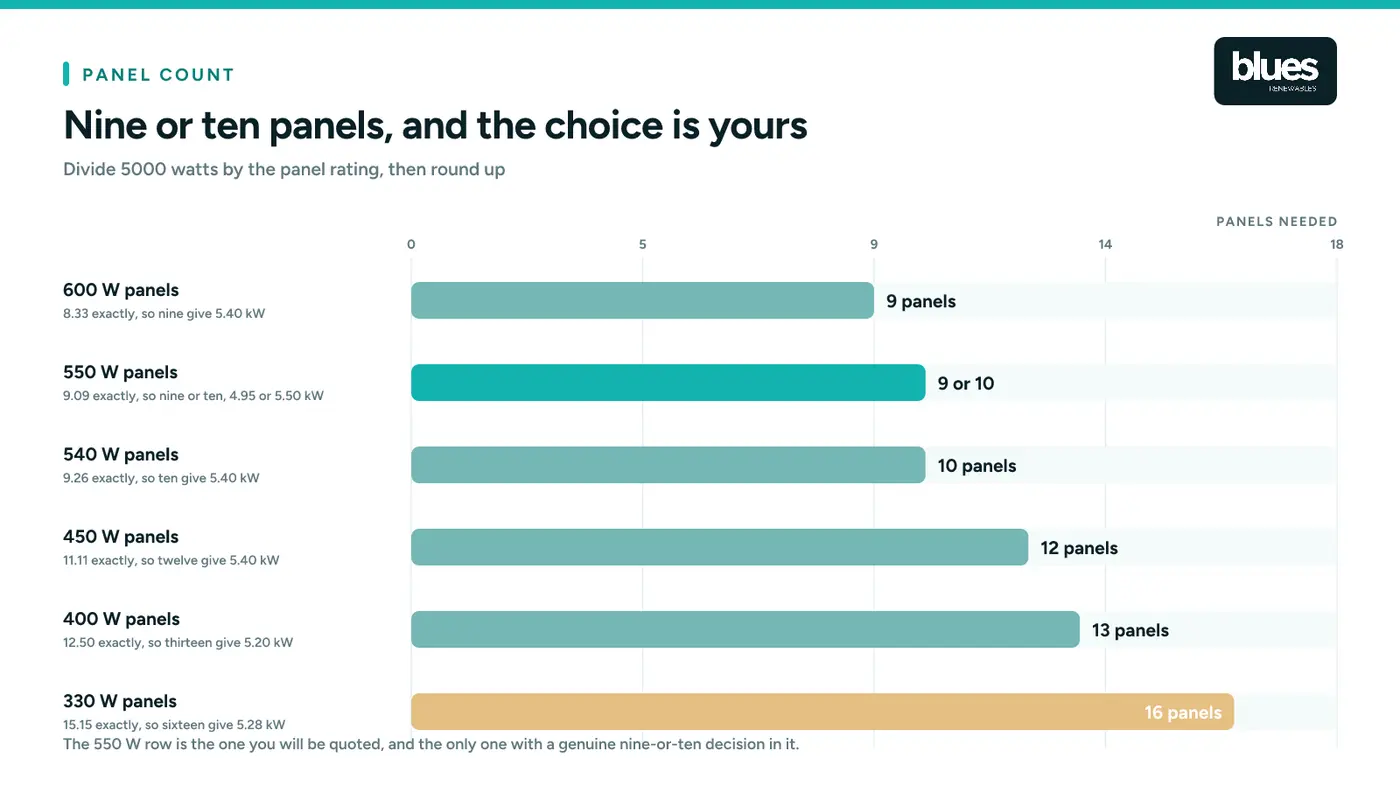
The arithmetic is simply 5,000 ÷ panel wattage, then a decision about rounding.
Remember that the wattage on a datasheet is a peak rating under standard test conditions, 1,000 W/m² at a 25 degree cell temperature. A real Chennai roof rarely delivers both at once, which is why a 5 kW array does not push 5 kW for most of the day.
Indian rooftop supply in 2026 runs on 540 W to 600 W mono PERC and TOPCon modules. Treat 550 W as the default unless a quotation states otherwise.
Panel count by wattage
- 600 W - Exact division: 8.33, Panels: 9, Actual capacity: 5.40 kW
- 550 W - Exact division: 9.09, Panels: 9 or 10, Actual capacity: 4.95 or 5.50 kW
- 540 W - Exact division: 9.26, Panels: 10, Actual capacity: 5.40 kW
- 450 W - Exact division: 11.11, Panels: 12, Actual capacity: 5.40 kW
- 400 W - Exact division: 12.50, Panels: 13, Actual capacity: 5.20 kW
- 330 W - Exact division: 15.15, Panels: 16, Actual capacity: 5.28 kW
The 550 W row is the one you will actually be quoted, and it is the only row with a genuine choice in it.
Nine panels or ten? The subsidy will not decide for you
At 3 kW the answer is easy: round up, because the sixth panel unlocks the last slab of subsidy. By 5 kW that logic is gone.
PM Surya Ghar pays ₹30,000 per kW for the first 2 kW and ₹18,000 for the third, then stops. The ceiling is ₹78,000 and you reach it at 3 kW. A 4.95 kW system and a 5.50 kW system both receive exactly ₹78,000.
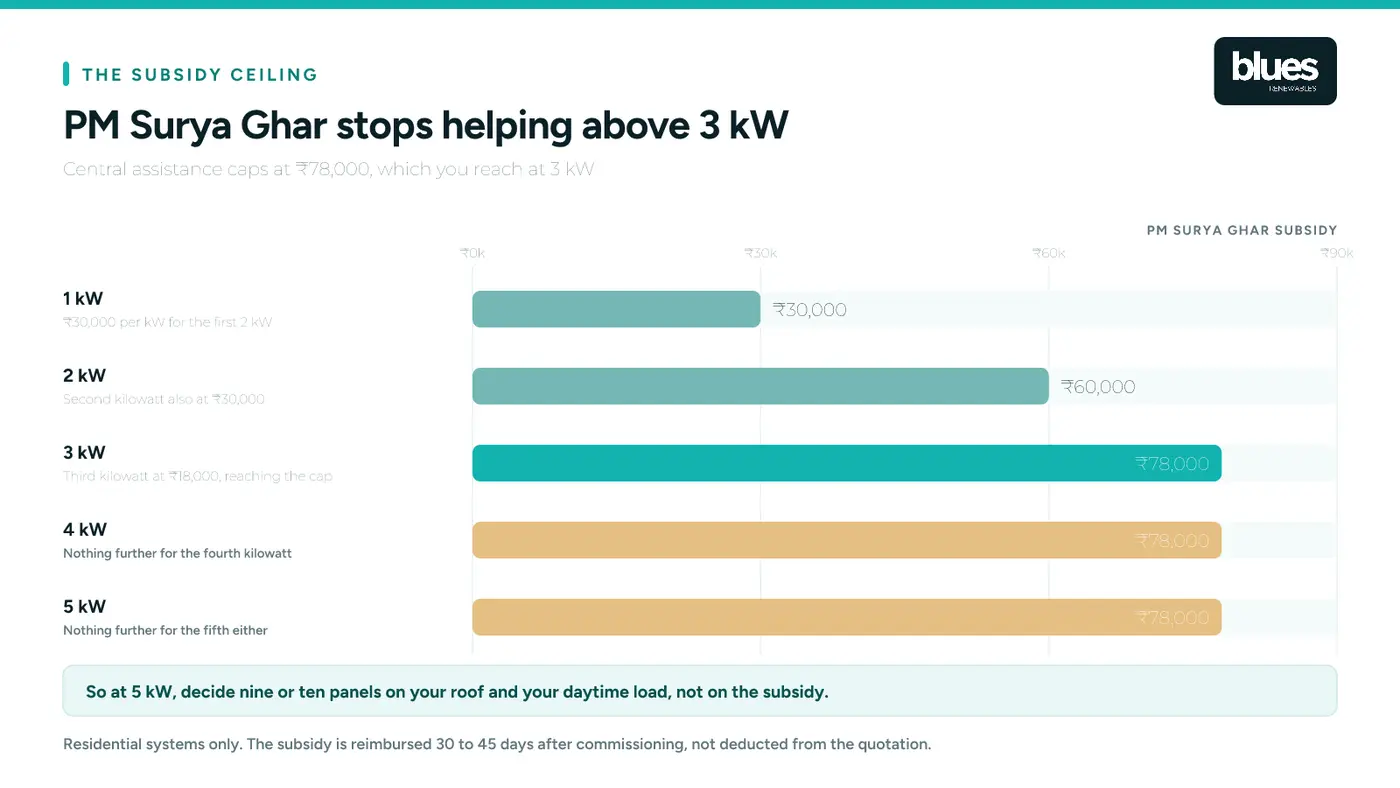
- 3.30 kW - Subsidy: ₹78,000, Extra subsidy for the extra capacity: —
- 4.95 kW - Subsidy: ₹78,000, Extra subsidy for the extra capacity: Nil
- 5.50 kW - Subsidy: ₹78,000, Extra subsidy for the extra capacity: Nil
So decide on the two things that do still vary.
Your daytime load. Generation you consume yourself is worth your full tariff, while anything exported earns a lower credit. If your household consumes most of its power in the evening, the tenth panel earns less than the ninth.
Your roof. Ten panels need about 420 sq ft of footprint against 380 for nine. On a tight terrace that difference decides it.
Where both allow it, ten is usually the better buy. The marginal panel adds roughly 2.6 units a day for 25 years on top of an installation you are already paying for. Our PM Surya Ghar subsidy page sets out the slabs in full.
How much roof space 5 kW needs
A 550 W panel is roughly 2.28 m by 1.13 m, about 27.7 sq ft of glass.
- Glass area - 9 panels: about 250 sq ft, 10 panels: about 277 sq ft
- Array footprint with rows and walkways - 9 panels: about 380 sq ft, 10 panels: about 420 sq ft
Four hundred and twenty square feet is roughly 20 ft by 21 ft. That is a real constraint on a typical Chennai terrace once you subtract the staircase head room, water tanks and setbacks.
A raised structure solves most of it. Mounting the array about seven feet up keeps the terrace usable underneath for drying, storage or a seating area, and it improves airflow under the panels, which lifts output slightly in summer.
What 5 kW generates and runs
Size at 4.8 units per kW per day in Chennai, after real-world losses.
5 kW generates about 24 units a day, or roughly 720 units a month.
That is a genuinely capable system for an independent house.
- Two 1.5 ton air conditioners running a normal summer pattern, alongside the rest of the home.
- A full domestic load: refrigerator, washing machine, water heater, pumps, lighting and fans.
- An electric two-wheeler, and a car with careful scheduling. A typical electric car needs 10 to 15 units for a useful daily range, which 5 kW can supply if you charge during daylight.
If your bill runs ₹4,000 to ₹6,000 a month, 5 kW is usually the right size. Below about ₹3,000, look at 3 kW instead.
The three-phase question
This catches people out and it is worth raising before you sign anything.
Most Chennai homes on modest loads have a single-phase service connection. Larger systems generally require a three-phase connection, and 5 kW usually sits on the wrong side of that line. If your service is single-phase, expect a connection upgrade as part of the project, with its own application, charges and waiting time.
Ask two questions at the survey. What is my current service type and sanctioned load, and does this system need it changed? An installer who has not checked before quoting has not really quoted.
What 5 kW costs
- Indicative installed cost - 5 kW: about ₹3,20,000
- PM Surya Ghar subsidy - 5 kW: ₹78,000
- Net cost - 5 kW: about ₹2,42,000
- Monthly generation - 5 kW: about 720 units
- Typical payback - 5 kW: 4 to 5 years
Subsidy reaches you 30 to 45 days after commissioning as a reimbursement, so you fund the full amount first. GST on solar equipment fell to 5 percent on 22 September 2025, which took roughly ₹15,000 off a system this size. To work out payback on your own numbers rather than ours, use how to calculate solar payback period. Current pricing by size sits on our 5kW solar panel price page.
Frequently asked questions
How many solar panels required for 5kW? Ten panels of 550 W, giving 5.50 kW, or nine for 4.95 kW. Both are sold as 5 kW systems. At 400 W you would need thirteen panels, and at 330 W sixteen.
How many solar panel required for 5 kw at 540 W? Ten, giving 5.40 kW. Nine 540 W panels would give 4.86 kW, which most installers treat as short of a 5 kW system.
How much area is required for a 5kW solar system? About 277 sq ft of glass for ten panels, or roughly 420 sq ft of array footprint once rows and walkways are allowed for. That is about 20 ft by 21 ft.
How many units does a 5kW solar system generate per day? About 24 units a day in Chennai, or roughly 720 units a month averaged across the year. Summer runs higher, monsoon lower.
Do I get more subsidy for 5kW than 3kW? No. PM Surya Ghar caps central assistance at ₹78,000, reached at 3 kW. A 5 kW system receives exactly the same ₹78,000, so the extra capacity is funded entirely by you.
How many air conditioners can 5kW run? Two 1.5 ton units on a normal summer pattern, together with the rest of a household. Sizing specifically for air conditioning is covered in how many solar panels required for 1.5 ton AC.
Does a 5kW system need three-phase? Usually yes. Most Chennai homes on a single-phase service need a connection upgrade for a system this size, which carries its own application and charges. Confirm your service type at the survey.
Is 9 or 10 panels better for 5kW? Ten, where your roof and daytime load allow it. Since the subsidy is identical either way, the tenth panel is judged purely on the extra 2.6 units a day it produces against its cost.
Getting the sizing right
For the most installed size in India, see how many solar panels required for 3kW, and for the base unit that every calculation builds on, how many solar panels required for 1kW. To size from your bill instead of from a target number, read how many solar panels required for a house and how to calculate how many solar panels are required. Our solar for independent house in Chennai page covers what a home installation involves.
Blues Renewables has installed solar across Chennai since 2020, for homes, schools, businesses and factories. We check your service type and shading before quoting a 5 kW system, because both change the answer and neither shows up on a phone call.
Call +91 98841 07170 and we will confirm how many solar panels are required for 5kW on your roof, and whether nine or ten is the better buy for your load.
Sources
- MNRE, Guidelines for implementation of PM Surya Ghar: Muft Bijli Yojana, subsidy slabs and the ₹78,000 ceiling
- Press Information Bureau, Ministry of New and Renewable Energy, "GST on Renewable Energy Devices Rationalised to 5%", 17 September 2025
- Tamil Nadu Electricity Regulatory Commission, Grid Interactive Solar Energy Generating Systems Regulations
- Module dimensions and ratings from current mono PERC and TOPCon datasheets in Indian residential supply
- Blues Renewables installation data, Chennai, 2020 to 2026