





Correction page · reviewed August 2026
Solar Power Plant Subsidy in India: What Actually Applies
Last reviewed August 2026 · PM Surya Ghar, PM-KUSUM, accelerated depreciation, state policy
There is no central capital subsidy for a MW-scale solar power plant in India. PM Surya Ghar is a residential rooftop scheme capped at ₹78,000 and does not apply. What does apply is accelerated depreciation for a taxpaying company, PM-KUSUM Component A for farmer-owned plants of 500 kW to 2 MW selling to a DISCOM, state solar policy benefits, and viability gap funding on specific central tenders only.
This page exists because the market gets this wrong constantly. Half the enquiries we receive at MW scale assume a subsidy that does not exist, and some of them have quotations showing it as a line item.
The short answer
Residential rooftop up to 10 kW: yes, up to ₹78,000. Farmer-owned 500 kW to 2 MW selling to the DISCOM: a scheme, but not a grant. Everything else at MW scale: no capital subsidy, and accelerated depreciation if you pay tax.
Read alongside
Where the confusion comes from
Three real schemes, one wrong conclusion
Nobody invented the idea of a solar subsidy. Three things that genuinely exist get combined into a belief that a MW-scale plant is subsidised, and it is not.
PM Surya Ghar is real, and residential
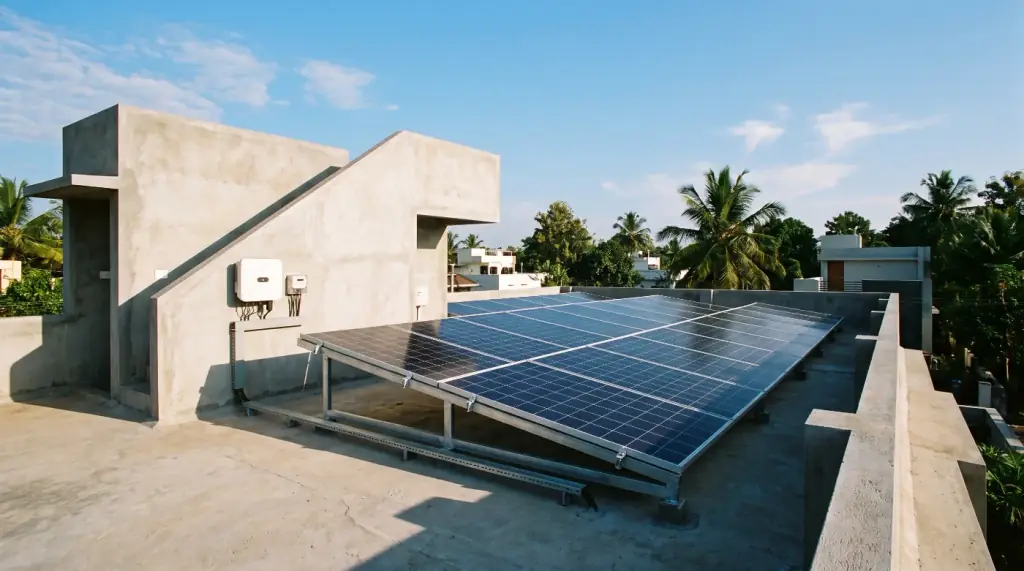
A genuine central scheme paying up to ₹78,000 to a household installing 3 kW or more on its own roof. It is capped, it is residential, and it stops there. Applying its logic to a ₹4 crore ground-mount plant is the single most common error in this market.
Accelerated depreciation gets renamed
Forty per cent depreciation on the written-down value is a tax deduction. Vendors call it a 40 per cent subsidy, which is not the same thing in cash, in timing, or in who can use it. A loss-making company or a trust gets nothing from it in the year it arises.
PM-KUSUM is a scheme, not a grant
Component A gives an eligible farmer-side owner a guaranteed buyer at a regulated tariff and access to cheap debt. Both are valuable. Neither is money towards the capital cost, and the eligibility is narrow.
Eligibility check
What actually applies to your project
Four inputs decide it: who owns the plant, how big it is, where it sits, and who consumes the power. Set them and the answer is specific rather than general.
PM-KUSUM Component A
The only MW-scale scheme, and it is narrow
Component A supports decentralised ground-mounted plants of 500 kW to 2 MW selling to the local DISCOM at a tariff set by the state regulator. Read it as a guaranteed market with cheap debt attached, not as money towards the plant.
What it gives you
- A guaranteed buyer for 25 years at a regulator-approved feed-in tariff.
- Access to concessional IREDA and NABARD-routed debt, historically 8.5 to 10.5 per cent.
- A defined tariff that does not depend on winning a competitive auction.
- A structure banks recognise, which shortens the financing conversation considerably.
What it does not give you
- Any payment towards the capital cost of the plant.
- Eligibility if you are a company or LLP building for your own consumption.
- Anything above 2 MW, whatever the ownership structure.
- Freedom on module sourcing: domestic content requirements apply.
The two conditions that decide it in practice
A substation within about five kilometres by route with spare capacity, and land of the right classification held by an eligible owner. Everything else in the application is administrative. Run the eligibility check on the 2 MW page, which tests all four conditions.
Accelerated depreciation
The real incentive, and who it is worthless to
Solar assets attract 40 per cent depreciation on the written-down value. For a company with taxable profits it is worth about ₹41 lakh in year one on a ₹4 crore plant. For a trust, a school or a loss-making SPV it is worth nothing in the year it arises.
| Year | Opening value | Depreciation at 40% | Tax saved |
|---|---|---|---|
| Year 1 | ₹4.05 cr | ₹1.62 cr | ~₹41 lakh |
| Year 2 | ₹2.43 cr | ₹97 lakh | ~₹24 lakh |
| Year 3 | ₹1.46 cr | ₹58 lakh | ~₹15 lakh |
| First three years | — | ₹3.17 cr | ~₹80 lakh |
It is a deduction, not a payment
Nothing arrives in your bank account. Your tax bill falls, which is only useful if you had one. Vendors describing this as a 40 per cent subsidy are describing a different thing.
The half-year rule matters
An asset commissioned in the second half of the financial year gets half the year one depreciation. Commissioning a week later can move ₹20 lakh of benefit by twelve months.
Non-taxpayers should look at RESCO
If you cannot use the shield, let someone who can own the plant and sell you units. That is the whole logic of the RESCO or OPEX model, and it is usually the right answer for schools and trusts.
Indicative and not tax advice. Confirm the current rate, your regime and your position with your auditor. CAPEX against OPEX and RESCO, compared properly.
State policy
Where the real money usually is
State solar policy rarely pays you anything directly. What it does is decide what you pay to move power, and those charges are worth far more over 25 years than any capital grant would be.
Banking
Whether you can bank surplus generation and draw it later, over what period, and at what charge. A generous banking provision can be worth several lakh a year on a 1 MW captive plant.
Wheeling and transmission charges
What you pay to move your own power from the plant to your premises. Set by the state regulator and revised periodically, which is a real 25-year risk to model.
Cross-subsidy surcharge
Payable on third-party open access sales and exempt for captive and group captive. Usually the largest single line in the open access charge stack.
Electricity duty exemption
Some states exempt captive solar consumption from electricity duty for a defined period. Worth checking, because it is a straightforward saving where it exists.
Net metering limits
The capacity ceiling for net metering, and whether the settlement is net metering, net billing or gross metering. This decides what a surplus unit is worth to you.
ISTS charge treatment
Waivers on interstate transmission charges for renewable projects have been phased down over time. If your model relies on one, verify the current position and the commissioning deadline attached to it.
Tamil Nadu specifics: state solar policy and what it means for a project here · the full open access charge stack · TANGEDCO net metering
Viability gap funding
Real, and almost certainly not available to you
Viability gap funding exists inside specific central schemes and is awarded through competitive bidding, usually to developers building at scale under a defined programme. It is not something an individual project applies for.
It comes through a tender
You bid a scheme, you win a capacity allocation, and the support is defined by the scheme document. There is no application route outside that process.
It is priced into the bid
Bidders compete the tariff down knowing the support exists, so the benefit largely passes to the buyer of the power rather than to the developer.
If a quotation mentions it, stop
A private EPC quotation for a 1 MW or 5 MW plant showing viability gap funding as a line item is either confused or dishonest. Neither is what you want in a contractor.
Reading a quotation
Five subsidy claims that should end the conversation
Every one of these appears in real quotations. Each is a reliable indicator that the rest of the document deserves scepticism.
01
A subsidy line reducing a MW-scale price
There is no central capital subsidy at MW scale. A quotation showing one is either describing accelerated depreciation dishonestly or inventing it.
02
PM Surya Ghar named on a commercial project
It is a residential rooftop scheme. Naming it on a factory or a ground-mount plant means the vendor has not read the scheme they are citing.
03
A 40 per cent subsidy
That is depreciation, and it is a deduction against tax you may not owe. Ask them to show it as a tax entry in a cash flow rather than as a price reduction.
04
Subsidy guaranteed, or approval assured
Nobody can guarantee a scheme outcome. Where a scheme does apply, the sanction comes from a government agency on its own timeline.
05
Viability gap funding on a private project
Only available through central tenders. On a private quotation it is a fabrication.
Where we fit, and where we do not
We will tell you when there is nothing to claim
Blues Renewables works at MW scale as a subcontract EPC and balance-of-system contractor inside other developer projects, and as a turnkey contractor at the rooftop and ground-mount sizes we have built. We file PM Surya Ghar applications for residential rooftop customers because that scheme is real and we do the paperwork. At MW scale, more often than not, the honest answer is that no subsidy applies.
What we will do at no cost
- Tell you which of the five support mechanisms, if any, your project can actually use.
- Read a quotation and identify a subsidy claim that will not survive contact with a scheme document.
- Check whether a PM-KUSUM Component A route is realistic for your ownership and your land.
- Say plainly when the answer is that the project has to work on its own economics.
What we will tell you to get elsewhere
- Tax advice, or a view on your depreciation position. That is your auditor.
- Scheme application filing at MW scale, or the DISCOM tender interface.
- Any promise about a sanction, a timeline or an outcome from a government agency.
- Bidding central tenders on your behalf.
Tell us the ownership and the capacity
That is usually enough to answer the subsidy question in one reply. If a scheme does apply we will say which one and what it requires; if none does, we will say that instead of leaving it vague.
If you have a quotation with a subsidy line in it, send that too. Understanding what the vendor thinks they are claiming tells you a great deal about the rest of the document.
Solar subsidy at MW scale, answered
Is there a subsidy for a 1 MW solar power plant in India?
No. There is no central capital subsidy for a 1 MW solar power plant. PM Surya Ghar, the scheme people are thinking of, is a residential rooftop programme capped at ₹78,000 for a household system, and it does not apply at MW scale or to businesses. What does apply at 1 MW is accelerated depreciation for a taxpaying company, PM-KUSUM Component A if you are a farmer, FPO, cooperative or panchayat selling to the DISCOM, state solar policy benefits, and viability gap funding on specific central tenders only.
What is the subsidy on a 2 MW solar plant?
None as a capital grant. Two megawatts is the ceiling of PM-KUSUM Component A, which is a procurement scheme rather than a subsidy: it gives an eligible owner a guaranteed offtake at a regulator-set feed-in tariff and access to concessional IREDA or NABARD finance. If you are a private company building 2 MW for your own consumption, you are outside it, and accelerated depreciation is the only meaningful incentive available.
Why do vendors quote a 40 per cent subsidy?
Because they are describing accelerated depreciation and calling it a subsidy. Solar assets attract 40 per cent depreciation on the written-down value in the first year, which is a tax deduction, not a payment. On a ₹4 crore plant it is worth roughly ₹41 lakh of tax saved in year one for a company that already has taxable profits, and nothing at all in that year for one that does not. A quotation that shows it as a subsidy line reducing the price is misleading.
Does PM Surya Ghar apply to commercial or industrial rooftops?
No. PM Surya Ghar Muft Bijli Yojana is for residential consumers, with central financial assistance capped at ₹78,000 for systems of 3 kW and above. Commercial, industrial and institutional rooftops are not eligible for it at any size, although they do get net metering, accelerated depreciation and in some states a policy concession. Group housing societies have a separate common-area provision with its own cap.
What is PM-KUSUM Component A?
A scheme for decentralised ground-mounted solar plants of 500 kW to 2 MW, developed by farmers, farmer groups, cooperatives, panchayats, farmer producer organisations or water user associations on barren, fallow or agricultural land, selling to the DISCOM at a tariff set by the state regulator. The support is a guaranteed buyer, concessional finance and in some states performance-based incentives to the DISCOM, not a capital grant to you. Land within about five kilometres of a substation with spare capacity is the practical qualifying condition.
Is accelerated depreciation still 40 per cent?
Solar assets have attracted 40 per cent depreciation on the written-down value since the earlier 80 per cent rate was reduced. It is a timing benefit: it front-loads deductions you would take anyway, and its value is the time value of the money plus any rate difference. Confirm the current rate and your applicable tax regime with your auditor before putting a number in a model, because the answer depends on your position rather than on the equipment.
Can a school, trust or hospital get a solar subsidy?
Generally no capital subsidy, and often no benefit from accelerated depreciation either, because a non-taxpaying entity has no tax to shelter. That combination makes the RESCO or OPEX route particularly attractive for schools, trusts and charitable hospitals: a developer owns the plant, claims the depreciation, and sells you units at a fixed tariff below your grid rate with no capital outlay from you.
What about viability gap funding?
Viability gap funding exists only within specific central schemes and tenders, and is awarded through a competitive bidding process rather than applied for by an individual project. If you are not bidding a central tender, it is not available to you. Treat any private quotation that includes viability gap funding as a serious warning about the vendor.