Solar Panel Price by Wattage in India (2026): 50 W to 600 W
Single solar panel (solar plate) prices in India, Oct 2026: 10 W to 700 W, price per watt, 12 V and flexible panels, and DCR vs non-DCR explained.

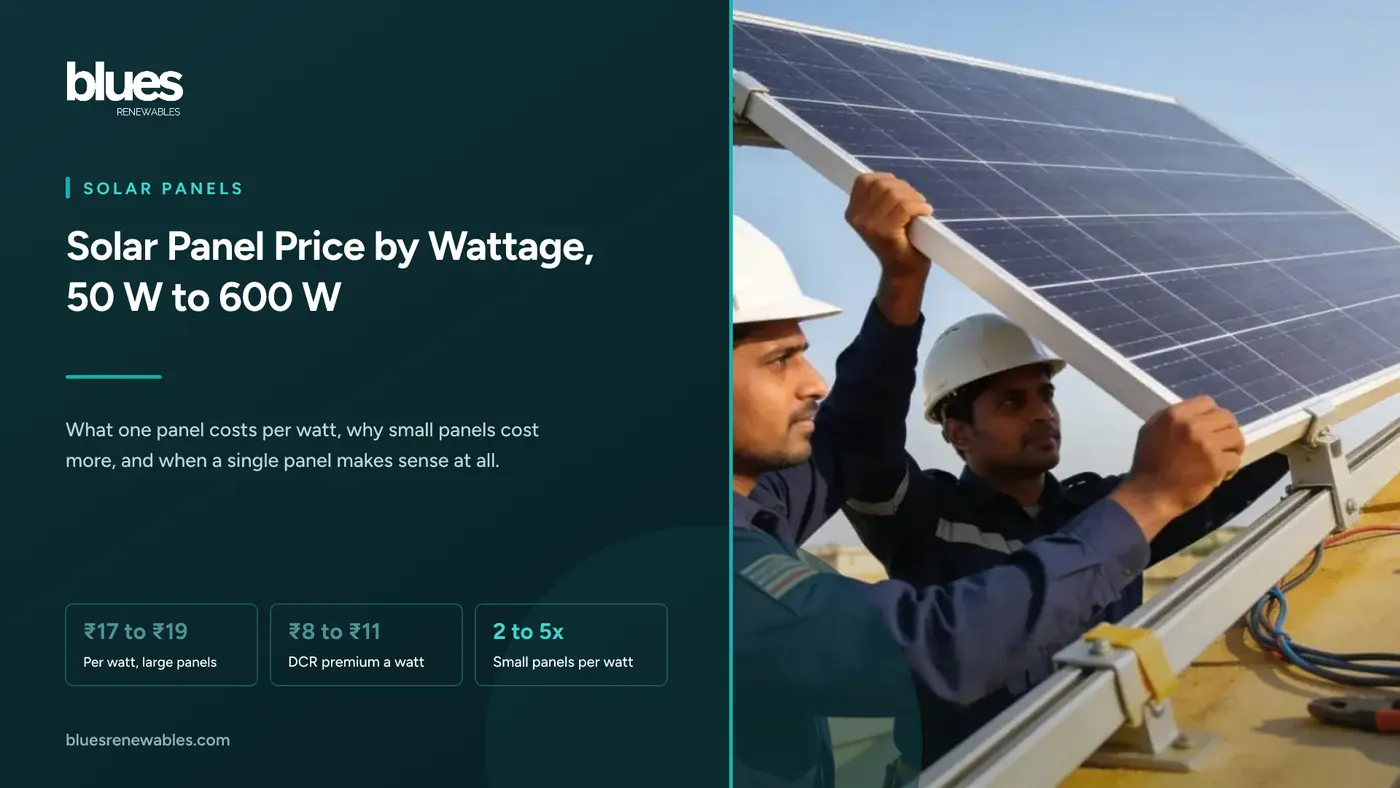
In the first week of October 2026, Waaree's own online store listed a 550 W panel at ₹10,299, about ₹19 a watt. The same store listed a 50 W panel at ₹3,399, which works out to ₹68 a watt. Same brand, same week, and the small panel costs more than three times as much for every watt it produces.
That gap is why "solar plate price" searches give such confusing answers: one page quotes ₹18 a watt, the next ₹60, and both can be right.
This guide prices single solar panels by wattage, from 10 W boards to 700 W rooftop modules, using prices listed on manufacturers' own stores and JMK Research's factory price tracker. It covers price per watt, mono vs poly vs TOPCon, DCR vs non-DCR, 12 V and flexible panels, and where a single panel makes sense. It does not price complete home systems; our system price pages, linked at the end, do that.
Key takeaways
- Large panels are the cheapest watts you can buy. Non-DCR 550 W to 700 W panels sold for about ₹17 to ₹19 a watt on Waaree's store in October 2026, and ₹18 to ₹25 on Loom Solar's.
- Small panels cost two to five times more per watt. A 100 W panel runs about ₹38 to ₹52 a watt, and a 10 W or 20 W panel ₹63 to ₹100.
- DCR panels cost about ₹8 to ₹11 a watt more, and only DCR panels installed by a registered vendor qualify for the PM Surya Ghar subsidy.
- Ignore the MRP. Every store we checked prints an MRP far above its sale price; compare sale price divided by watts.
- A single panel is for lights, batteries and small off-grid loads. To cut an electricity bill, a net-metered rooftop system is a different and far better purchase.
Solar panel price by wattage: the October 2026 table
The table below uses listed sale prices on four manufacturers' own online stores, viewed on 4 October 2026: Waaree, Loom Solar, UTL Solar (Fujiyama Power Systems) and Luminous. These are single-panel retail prices, not installer or factory prices. Some UTL items were out of stock, so those are last listed prices.
- 10 W, 12 V - Example listings (brand, sale price): Loom 10 Wp, ₹950, Price per watt: About ₹95
- 20 W, 12 V - Example listings (brand, sale price): Loom 20 Wp, ₹1,250; Waaree 20 Wp poly, ₹1,999, Price per watt: ₹63 to ₹100
- 40 to 60 W, 12 V - Example listings (brand, sale price): UTL 40 W, ₹1,270; Loom 55 W, ₹2,200; Waaree 50 W, ₹3,399; Waaree 60 W, ₹3,599, Price per watt: ₹32 to ₹68
- 100 to 150 W, 12 V - Example listings (brand, sale price): Waaree 100 W, ₹4,399; UTL 110 W, ₹4,860; UTL 130 W TOPCon bifacial, ₹6,760; UTL 150 W, ₹5,670, Price per watt: ₹38 to ₹52
- 240 to 300 W - Example listings (brand, sale price): UTL 240 W, ₹7,310; Loom 300 W 12 V, ₹18,000 for two, Price per watt: About ₹30
- 340 to 390 W - Example listings (brand, sale price): UTL 340 W, ₹13,190; UTL 390 W, ₹11,880, Price per watt: ₹30 to ₹39
- 540 to 600 W - Example listings (brand, sale price): Waaree 550 W, ₹10,299; Loom 550 W, ₹20,000 for two; Luminous 585 W TOPCon, ₹12,299 to ₹14,499; Loom 600 W TOPCon, ₹30,000 for two, Price per watt: ₹18 to ₹25
- 615 to 700 W - Example listings (brand, sale price): Waaree 615 W N-type, ₹11,499; Waaree 695 W N-type, ₹12,999; Waaree 700 W TOPCon, ₹13,099, Price per watt: About ₹19
Price per watt falls steeply up to about 500 W and then flattens. Brands also differ widely: UTL listed its 550 W bifacial panel at ₹16,750, about ₹30 a watt, against ₹19 for Waaree's 550 W. Brand-store prices are a ceiling, not a floor.
Older sizes such as 250 W, 330 W and 335 W were mostly polycrystalline, and the makers we checked now list few or none. If a shop offers one, ask whether it is old stock.
Why a small solar plate costs more per watt
A 100 W panel and a 550 W panel need much of the same hardware: an aluminium frame, tempered glass, a junction box, cables, connectors, a carton and a delivery. Those costs are charged per panel, not per watt, so the smaller the panel, the bigger their share of the price.
Warranty is the other difference. Waaree's 100 W panel carries a 5 year product warranty and a 10 year power output warranty. Its 550 W panel carries 12 years on the product and 27 years on power output. UTL's 100 W TOPCon panel, with a 27 year output warranty, is an exception worth looking for.
Price per watt by technology: mono, poly and TOPCon
At the factory gate, technology moves the price less than people expect. JMK Research's April 2026 tracker put domestic Mono PERC modules at ₹13.8 a watt and non-DCR TOPCon at ₹14.2, a gap of under half a rupee. Retail prices add GST (5% on solar modules), distribution and margin, which is how ₹14 at the factory becomes ₹18 to ₹25 on a store.
On the stores we checked:
- Polycrystalline now survives mainly in small 12 V panels, such as Waaree's 20 W and 100 W models. For a rooftop, it has been replaced.
- Mono PERC is the value choice. Waaree listed its 550 W Mono PERC at about ₹19 a watt and Loom its 550 W at about ₹18.
- TOPCon (N-type) ranged from about ₹19 a watt on Waaree's 700 W to ₹21 to ₹25 on Luminous's 585 W and ₹25 on Loom's 600 W bifacial.
See types of solar panels for how each works, and TOPCon vs Mono PERC for when the premium pays back.
DCR vs non-DCR panels: the ₹8 to ₹11 question
DCR (domestic content requirement) panels use Indian-made cells, are the only panels that qualify for PM Surya Ghar, and cost more. Across JMK Research's December 2025 to April 2026 data, DCR modules cost about ₹8 to ₹11 a watt more than non-DCR. JMK recorded DCR TOPCon at ₹22.3 a watt in April 2026, after which the price rose 9.4% in May, fell 1.6% in June and rose 3.17% in July, which puts it at about ₹24 to ₹25 a watt at the factory by July.
Waaree's store shows the same gap at retail:
- 550 W Mono PERC, non-DCR - Sale price: ₹10,299, Price per watt: About ₹19
- 540 W Mono PERC, DCR - Sale price: ₹15,199, Price per watt: About ₹28
- 590 W N-type bifacial, non-DCR - Sale price: ₹11,099, Price per watt: About ₹19
- 595 W N-type bifacial, DCR - Sale price: ₹17,099, Price per watt: About ₹29
On a 3 kW home, ₹9 a watt is about ₹27,000. Set that against the ₹78,000 central subsidy for 3 kW and above, plus up to ₹22,000 from Tamil Nadu for eligible homes registered on PM Surya Ghar from 5 August 2026. The subsidy also needs ALMM-listed modules and a vendor registered on the national portal, so panels bought loose online cannot claim it on their own. Our PM Surya Ghar subsidy guide has the full conditions.
12 V and 24 V solar panels: what the label means
"12 V" on a small panel describes the battery it is meant to charge, not its actual output. UTL's 100 W 12 V panel, for example, has a working voltage (Vmp) of 15.68 V and an open-circuit voltage (Voc) of 19.6 V. That extra voltage is what pushes charge into a 12 V battery.
Large rooftop panels are a different animal. Stores often label 500 W to 600 W panels "24 V", but UTL's 590 W TOPCon panel works at 44.27 V and reaches 51.52 V open circuit. Connect a panel like that to a cheap PWM controller on a 12 V battery and most of its power is thrown away. You need an MPPT controller, which our MPPT vs PWM charge controller guide explains.
Popular sizes, one by one
50 watt solar panel
About ₹2,200 to ₹3,400 on the stores we checked. Enough for a small LED light, a fan for a few hours, or topping up a vehicle battery.
100 watt solar panel
About ₹4,400 to ₹4,900 for a standard 12 V model. Waaree's 100 W panel measures 900 by 600 mm and weighs 6 kg; UTL's TOPCon version is 1,134 by 515 mm and 7.2 kg. In Chennai, at about 4.4 units per kW a day, a 100 W panel makes roughly 0.44 units on an average day, or about 160 units a year.
200 to 300 watt solar panel
Few current listings sit here: UTL's 240 W was about ₹7,310 and Loom's 300 W 12 V about ₹9,000 a panel in a pair.
500 watt solar panel
A modern 540 W to 550 W panel costs about ₹10,000 to ₹10,300 non-DCR and ₹15,000 to ₹15,200 DCR on Waaree's store. It measures about 2,272 by 1,133 mm and weighs 27.5 kg, so it is a two-person lift and needs a proper structure.
1000 watt solar panel
No mainstream single panel reaches 1,000 W. The largest we found listed were Waaree's 700 W TOPCon and Loom's 730 W to 750 W HJT, sold in bulk packs. A "1 kW solar panel" means two panels of about 550 W, which cost about ₹20,000 to ₹21,000 non-DCR.
Mini, small and flexible solar panels
Mini solar panels of 5 V to 6 V are hobby parts for garden lights, sensors and school projects, not energy equipment.
Small 10 W to 60 W panels charge single batteries and run gate lights. Price per watt is highest here, so buy only the wattage you need.
Flexible solar panels bend to fit boat decks, van roofs and curved sheds. Waaree's flexible range listed at ₹8,399 for 125 W (about ₹67 a watt), ₹14,199 for 250 W (about ₹57) and ₹21,999 for 500 W (about ₹44). The warranty is 5 years on the product and 15 years on power output, against 27 years on Waaree's rigid 550 W. They are glued or riveted flat, so they also run hotter with no air gap beneath. For a concrete terrace in Chennai, a rigid panel on a structure is the better buy every time.
Where a single panel makes sense, and where a rooftop system wins
A single panel earns its place when there is no grid to use, or the load is small and separate:
- Lights: gate, garden and street lights. See our solar street light page.
- Battery charging: an inverter battery, a boat or a camper. How many solar panels to charge a 200Ah battery works through the sizing.
- Small off-grid sites: a farm shed, a watchman's room or a pump house. Pumps need an array sized to the motor, covered in our solar pump subsidy guide.
To cut a home electricity bill, a system is the answer. A 3 kW net-metered system makes about 4,800 units a year in Chennai, exports what you do not use, and qualifies for both subsidies. Our on-grid solar system page explains how that works.
Solar plate connection: series or parallel
Wiring panels in series adds their voltages; wiring them in parallel adds their currents. Match the result to your controller's input limits. Our guide to rooftop solar components and wiring covers cable sizes and protection.
What to check before you buy a single panel
Sale price divided by watts, not the MRP.
Warranty years, product and power output separately. Five and ten is normal for small panels; twelve and twenty-seven or more for large ones.
Voc and Vmp against your controller or inverter's input range.
Technology and DCR status, printed on the label and datasheet.
The BIS registration number on the label, which solar modules sold in India must carry.
Size and weight, so you know what will hold it.
Frequently asked questions
What is the solar plate price per watt in India in 2026?
On manufacturers' stores in October 2026, non-DCR panels of 550 W to 700 W cost about ₹17 to ₹25 a watt, and small 12 V panels ₹30 to ₹100. DCR panels cost about ₹8 to ₹11 a watt more.
What is the price of a 500 watt solar panel?
A 540 W to 550 W panel cost about ₹10,000 to ₹10,300 non-DCR on Waaree's store, and about ₹15,000 to ₹15,200 for a DCR model.
What is the price of a 100 watt solar panel?
A standard 100 W 12 V panel costs about ₹4,400 to ₹4,900 on brand stores, or ₹44 to ₹49 a watt. It makes about 0.44 units on an average day in Chennai.
Is there a 1000 watt solar panel?
Not as a single mainstream panel. The largest listed panels are around 700 W to 750 W. A 1 kW setup normally uses two panels of about 550 W.
Are flexible solar panels worth it?
For boats, vans and curved roofs, yes. For a house roof, no: they cost ₹44 to ₹67 a watt and carry shorter warranties.
Should I buy DCR or non-DCR panels for my home?
If you are claiming PM Surya Ghar, DCR is required, and the ₹78,000 central subsidy for 3 kW is worth far more than the roughly ₹27,000 extra the DCR panels cost. For off-grid use, non-DCR is cheaper.
Can I connect a 24 V solar panel to a 12 V battery?
Only through an MPPT charge controller rated for the panel's open-circuit voltage. Large "24 V" panels reach about 50 V open circuit, and a basic PWM controller wastes most of their output.
Where this fits
This page prices single panels. For what a complete installation costs, see solar panel price in Chennai and the 3 kW, 5 kW and 10 kW price pages. To choose a maker, read best solar panel brands in India or the brand guides to Waaree, Tata Power Solar and Loom Solar. For batteries and inverters, see solar battery price and solar inverter price. To work out how many panels your home needs, try the solar panel size calculator.
Blues Renewables designs and installs complete rooftop solar systems across Tamil Nadu, for homes from 3 kW upwards and for apartments, businesses and factories. We do not sell loose panels, but if you are weighing a few panels against a proper system, we will show you what each would produce on your roof and what it would cost after both subsidies. Every installation uses DCR, ALMM-listed modules where the subsidy applies, an itemised quotation and two years of free maintenance.
Call +91 98841 07170.
Sources
- Waaree Energies, official online store (shop.waaree.com), solar module and small module listings, viewed 4 October 2026: sale prices for 20 W to 700 W panels, DCR and non-DCR listings, flexible panel prices and warranties, 100 W and 550 W warranties, dimensions and weights
- Loom Solar, official online store, solar panel collection, viewed 4 October 2026: sale prices for 10 W, 20 W, 55 W, 300 W, 550 W and 600 W panels, and bulk-pack listings for 730 W to 750 W HJT
- UTL Solar (Fujiyama Power Systems Limited), official online store, 12 V, Mono PERC and full panel listings, viewed 4 October 2026: sale prices and stock status for 40 W to 630 W panels; 100 W TOPCon datasheet values (Voc 19.6 V, Vmp 15.68 V, 1,134 x 515 mm, 7.2 kg, 27 year output warranty); 590 W TOPCon values (Vmp 44.27 V, Voc 51.52 V)
- Luminous Power Technologies, official solar panel product listing, viewed 4 October 2026: sale prices for 540 W to 590 W panels and their DCR status
- JMK Research, module price tracker as reported by SolarBytes, 18 May 2026: April 2026 prices of ₹13.8/Wp Mono PERC, ₹14.2/Wp TOPCon, ₹22.3/Wp DCR TOPCon
- JMK Research, monthly RE updates for May, June and July 2026 (via SolarBytes, 9 June 2026, and jmkresearch.com): month-on-month DCR TOPCon changes of +9.4%, minus 1.6% and +3.17%, non-DCR prices stable
- JMK Research, December 2025 to April 2026 price data: DCR premium of about ₹8 to ₹11 a watt
- Ministry of New and Renewable Energy, PM Surya Ghar: Muft Bijli Yojana guidelines: ₹78,000 subsidy for 3 kW and above, DCR and ALMM requirements, registered vendor requirement
- Government of Tamil Nadu, G.O. (Ms) No. 102, 19 September 2026: state top-up of up to ₹22,000
- GST Council, rate change effective 22 September 2025: 5% GST on solar modules
- Ministry of New and Renewable Energy, Solar Photovoltaics, Systems, Devices and Components Goods (Requirements for Compulsory Registration) Order, 2017: BIS registration of solar PV modules