Types of Solar Panels in India (2026): Mono PERC, TOPCon, HJT, Bifacial and Poly
Every type of solar panel sold in India in 2026, how a solar cell works, efficiency and heat loss by type, price per watt, and which suits a Chennai terrace.

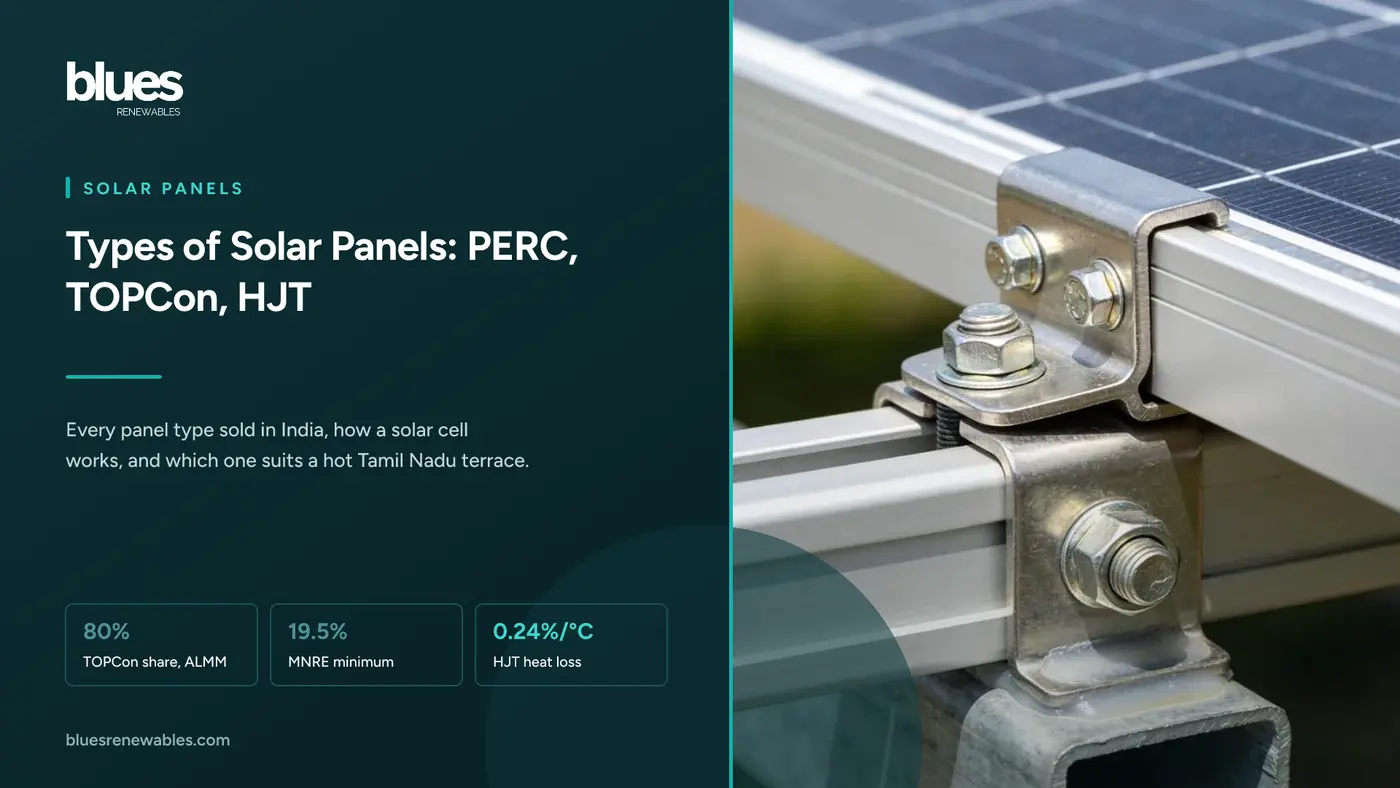
Four out of every five panels on India's approved module list are now one type. By June 2026, TOPCon made up 80% of all ALMM-listed module manufacturing capacity, according to Mercom India. Mono PERC had shrunk to 4%, and polycrystalline did not appear in the breakdown at all.
The words on your quotation, "mono", "PERC", "N-type", "bifacial", "HJT", are not even the same kind of word: some describe the cell, some the glass, and some are sales language.
This guide explains every type of solar panel offered in India in 2026, starting with what a solar cell is and how it works. It compares efficiency, heat loss and price per watt by type, and ends with which type suits a Chennai terrace. It does not price complete systems or compare brands; links to those pages are at the end.
Key takeaways
- TOPCon is now the default panel in India. It made up 80% of ALMM-listed module capacity in June 2026, against 4% for Mono PERC, 3% for HJT and 2% for thin film.
- Polycrystalline is finished for grid-connected roofs. At 15 to 17% efficiency it cannot meet the 19.5% minimum MNRE sets for rooftop modules on the approved list.
- Heat matters more than headline efficiency in Tamil Nadu. On Waaree's own datasheets, output falls 0.34% per °C for Mono PERC, 0.30% for TOPCon and 0.24% for HJT.
- Bifacial is a glass format, not a cell type. It only pays when light reaches the back of the panel, which on a flush terrace mount it mostly does not.
- The model number matters more than the type. A home subsidy needs a DCR module on the ALMM list, and that is checked model by model.
Types of solar panels sold in India
Every rooftop panel sold in India today is silicon. The differences come from three choices: how the silicon is grown (mono or poly), how the cell is built (PERC, TOPCon or HJT), and how the panel is packaged (monofacial, or bifacial with glass on both faces).
- Polycrystalline - What it is: Many silicon crystals per cell, P-type, Module efficiency: 15 to 17%, Output lost per °C above 25°C: Higher than mono, Status in India, 2026: Largely discontinued
- Mono PERC - What it is: Single-crystal P-type cell with a reflective rear layer, Module efficiency: 19 to 21%, Output lost per °C above 25°C: 0.34 to 0.35%, Status in India, 2026: Shrinking, still sold
- TOPCon - What it is: Single-crystal N-type cell with a tunnel oxide rear contact, Module efficiency: 21 to 23%, Output lost per °C above 25°C: 0.29 to 0.30%, Status in India, 2026: Mainstream
- HJT (heterojunction) - What it is: N-type wafer between thin amorphous silicon layers, Module efficiency: 22 to 25%, Output lost per °C above 25°C: About 0.24%, Status in India, 2026: Premium, small share
- Bifacial - What it is: PERC, TOPCon or HJT cells behind clear rear glass, Module efficiency: As the cell inside, plus rear gain, Output lost per °C above 25°C: As the cell inside, Status in India, 2026: Common on elevated and ground mounts
- Thin film (CdTe) - What it is: A thin non-silicon layer on glass, Module efficiency: Lower than silicon, Output lost per °C above 25°C: Low, Status in India, 2026: Utility-scale only
Efficiency bands match our solar panel price in Chennai page; temperature figures come from manufacturer datasheets listed under Sources.
What a solar cell is and how it works
A solar cell, also called a photovoltaic or PV cell, is a thin slice of semiconductor that turns sunlight directly into electricity. A solar panel, or solar module, is many cells wired together behind glass in a frame.
How a solar cell works
The working principle is the photovoltaic effect. The semiconductor absorbs sunlight and passes its energy to electrons, which can then flow as a current. The cell is built as a p-n junction: two silicon layers treated so that one has spare electrons and the other spare "holes". The junction pushes freed electrons one way, and the thin metal lines printed on the cell collect them as direct current.
One silicon cell gives only about 0.5 to 0.6 volts, so a panel strings many in series. Most rooftop panels now carry 108 to 144 half-cut cells, which adds up to a voltage an inverter can use.
Which element is used in solar cells?
Silicon. The US Department of Energy calls it by far the most common semiconductor in solar cells, and the second most abundant element on Earth after oxygen. Thin-film panels use other materials, chiefly cadmium telluride.
IV characteristics: the four numbers on a datasheet
A cell's IV curve plots current against voltage. Open-circuit voltage (Voc) and short-circuit current (Isc) tell your installer how to match panels to the inverter. Maximum power (Pmax) is the rated wattage, and the fill factor shows how close the curve comes to ideal. Brochures sometimes quote cell efficiency, which is higher: Premier Energies' TOPCon cells reach 25.2% but its modules 23.2%. Compare module efficiency.
Types of solar cells: silicon, thin film and what comes next
Crystalline silicon. Monocrystalline cells are cut from one continuous crystal, which lets electrons move freely and gives the even black look. Polycrystalline cells are cast from many crystals, cheaper but less efficient, with a speckled blue look. Within mono, P-type cells (used in PERC) commonly lose 2 to 2.5% of output in the first year, much of it to light-induced degradation. N-type cells (TOPCon, HJT) largely avoid it and usually stay under 1%.
Thin film. A semiconductor layer a few microns thick is deposited on glass. Cadmium telluride is the second most used PV material after silicon, the DOE says, and Tamil Nadu hosts a big plant: First Solar opened a 3.3 GW CdTe factory at Sriperumbudur in January 2024. Its modules serve mainly utility-scale farms, not terraces.
Perovskite and tandem. Laboratory perovskite cells rose from 3% efficiency in 2009 to 28% in 2026, the DOE reports. Stacked on silicon they go further: LONGi reported a perovskite-silicon tandem cell at 34.85%, certified by the US National Renewable Energy Laboratory, in April 2025. Durability over 25 years is unproven, and no perovskite panel is sold for Indian rooftops.
Each type of solar panel explained
Polycrystalline solar panels
Poly fails a basic test: MNRE's approved list (ALMM) requires crystalline modules for rooftops and solar pumps to reach 19.5% efficiency, and utility modules 20%. At 15 to 17%, poly cannot qualify for PM Surya Ghar or a net-metered system. A poly panel offered for a grid-connected roof in 2026 is old stock.
Monocrystalline and Mono PERC solar panels
"Monocrystalline" on a quotation today almost always means Mono PERC, Passivated Emitter and Rear Cell, where a reflective layer gives light a second pass. It is mature, cheap and sound. Its weaknesses are heat sensitivity and higher first-year loss.
TOPCon solar panels
TOPCon, Tunnel Oxide Passivated Contact, adds an ultra-thin oxide and doped polysilicon at the rear contact of an N-type cell, cutting electron losses. In two lines: TOPCon holds output better in heat and fades less in year one, so it usually wins on a hot Indian roof, while PERC can still win where roof space is plentiful and budget leads. The full head-to-head is in our TOPCon vs Mono PERC guide.
HJT solar panels
Heterojunction panels wrap an N-type wafer in very thin amorphous silicon layers on both faces, giving the lowest heat loss of any silicon panel and a high bifacial factor. Waaree's Plexus HJT datasheet lists 0.24% loss per °C, 85% bifaciality, a 12-year product warranty and a 30-year performance warranty holding 90.3% of rated output in year 30. HJT panels are large, often 700 W and above, and cost more. They suit a roof so small that every square foot must produce the maximum.
Bifacial solar panels
A bifacial panel swaps the opaque backsheet for clear glass so its rear can collect light reflected from below. Any cell can be bifacial. Waaree's datasheets put the rear at about 70% of the front for Mono PERC bifacial, 80% for TOPCon and 85% for HJT.
The rear only helps if light reaches it: little gain close to a dark terrace, real gain on an elevated structure over a white roof or a ground mount over pale soil. Dual-glass panels are also heavier.
Half-cut cells, multi-busbar and dual glass are construction features, not types. Flexible and small 12 V panels suit boats, vans and battery charging, not a grid-connected roof; solar panel price by wattage covers those.
Solar panel efficiency compared, and why heat changes the ranking
Panels are rated at a cell temperature of 25°C. On a Chennai terrace in May, cells run near 65°C, and the temperature coefficient decides what you lose:
- Mono PERC - Loss per °C (datasheet): 0.34 to 0.35%, Output lost at 65°C: About 14%, Rear-side factor (bifacial): About 70%
- TOPCon - Loss per °C (datasheet): 0.29 to 0.30%, Output lost at 65°C: About 12%, Rear-side factor (bifacial): About 80%
- HJT - Loss per °C (datasheet): About 0.24%, Output lost at 65°C: About 10%, Rear-side factor (bifacial): About 85%
Each step is worth about two percent of output at midday, when your units are worth most. That, more than watts per square foot, is why N-type panels earn their place in Tamil Nadu.
The bar is also rising. MNRE has proposed lifting the rooftop minimum from 19.5% to 20% from 2027 and 20.5% from 2028, which would push the weakest Mono PERC models off the list.
Solar panel price per watt by type
JMK Research's April 2026 domestic module prices put Mono PERC at ₹13.8 a watt, non-DCR TOPCon at ₹14.2 and DCR TOPCon at ₹22.3. The DCR premium, about ₹8 a watt, is bigger than the gap between cell types.
What a buyer pays for the panel alone, typical market range for October 2026:
- Mono PERC - Price per watt, panel only: ₹18 to ₹26
- TOPCon - Price per watt, panel only: ₹20 to ₹28
- Bifacial or dual glass - Price per watt, panel only: ₹24 to ₹35
- HJT - Price per watt, panel only: Above TOPCon; no Indian wholesale benchmark published
- DCR modules (any type) - Price per watt, panel only: About ₹23 to ₹26
On a 3 kW home, going non-DCR saves ₹24,000 to ₹33,000 and forfeits the ₹78,000 PM Surya Ghar subsidy, a bad trade for any home. Single panels are priced in solar panel price by wattage; complete systems in solar panel price in Chennai.
Which type of solar panel suits a Chennai terrace?
Start from your roof, not the brochure.
- Most Chennai homes: DCR TOPCon. Better in heat than PERC, less first-year fade, and the widest choice on the approved list.
- Large open terrace, tight budget: a good DCR Mono PERC, because extra panels cost less than better ones. Check it clears 19.5% and ask when it was made.
- Small terrace, high bill: the most efficient DCR model you can get, usually a top TOPCon, with HJT if the numbers work.
- Elevated structure over a light roof: bifacial TOPCon, and ask what rear gain the generation estimate assumes.
- Within a few kilometres of the sea: panels tested for salt mist (IEC 61701) and a hot-dip galvanised structure.
- Avoid: polycrystalline, panels with no datasheet, and any model not on the ALMM list.
Then size it: how many solar panels are required for a house explains the count, and the solar panel size calculator works it out from your bill.
Frequently asked questions
What are the main types of solar panels in India?
Polycrystalline, Mono PERC, TOPCon and HJT, which differ by cell, plus bifacial versions of each, which have clear rear glass. Thin-film CdTe panels go to utility-scale farms. In 2026, TOPCon is the mainstream rooftop choice.
Which type of solar panel is best for home use in India?
For most homes, a DCR TOPCon panel on the ALMM list, because it loses less output in heat and fades less in year one. Mono PERC still suits a large roof on a tight budget, and HJT a very small roof.
What is a solar cell and how does it work?
A thin semiconductor slice, almost always silicon, that converts sunlight into direct current through the photovoltaic effect. Light frees electrons, the p-n junction pushes them one way, and metal contacts collect them. Each cell gives about 0.5 to 0.6 volts.
Is a bifacial solar panel worth it on a rooftop?
Only if light reaches the back. On an elevated structure over a light-coloured roof, the rear adds useful output. Mounted close to a dark terrace, the gain is small and may not justify the heavier panel.
What is the difference between HJT and TOPCon solar panels?
Both are N-type. HJT adds thin amorphous silicon layers on both faces, giving lower heat loss, about 0.24% per °C against 0.30% for TOPCon, and a higher bifacial factor. HJT costs more and comes mostly in very large panels.
Which solar panel has the highest efficiency?
Among panels sold in India, HJT and top TOPCon models reach about 23 to 24% module efficiency. Perovskite-silicon tandem cells have passed 34% in the lab but are not sold for rooftops.
What is the solar panel price per watt by type?
JMK Research put April 2026 module prices at ₹13.8 a watt for Mono PERC, ₹14.2 for non-DCR TOPCon and ₹22.3 for DCR TOPCon. Retail panel prices in October 2026 typically run ₹18 to ₹26 for PERC and ₹20 to ₹28 for TOPCon.
Where this fits
For the head-to-head between the two most common types, read TOPCon vs Mono PERC. To choose a manufacturer, see best solar panel brands in India. Elevated frames for bifacial panels are covered in solar panel mounting structure, and cables, connectors and earthing in rooftop solar components.
Blues Renewables designs and installs rooftop solar across Tamil Nadu for homes from 3 kW, apartments, businesses and factories. We do not make panels, so we choose the type your roof justifies: we check area, shade and structure height, then quote DCR, ALMM-listed modules with the model number and datasheet in writing. Every system includes two years of free maintenance.
Call +91 98841 07170.
Sources
- Mercom India via PV Magazine, 25 September 2026, viewed 4 October 2026: technology mix of ALMM-listed module capacity, June 2026
- Renewable Watch, 9 May 2025, viewed 4 October 2026: ALMM minimum module efficiency by application, including CdTe
- Saur Energy, viewed 4 October 2026: MNRE draft to raise ALMM efficiency minimums from 2027 and 2028
- US Department of Energy, Solar Photovoltaic Cell Basics, viewed 4 October 2026: how a PV cell works, silicon and CdTe, perovskite at 28% in 2026
- PVEducation, Open-Circuit Voltage and IV Curve, viewed 4 October 2026: cell voltage and IV parameters
- Waaree Energies module datasheets, viewed 4 October 2026: temperature coefficients and bifaciality for Mono PERC bifacial, TOPCon bifacial and Plexus HJT (dated 10 January 2025), and the HJT warranty terms
- PV Magazine, 18 April 2025: LONGi tandem cell at 34.85%, NREL certified
- Mercom India and PV Tech, January 2024: First Solar's 3.3 GW CdTe plant at Sriperumbudur
- JMK Research April 2026 module prices, reported by SolarBytes, 18 May 2026, viewed 4 October 2026
- Premier Energies company profile: cell and module efficiency figures
- Blues Renewables, solar panel price in Chennai, October 2026: retail price and efficiency bands by type and the DCR premium