What Is Solar Lease? What It Means in India, and What It Does Not
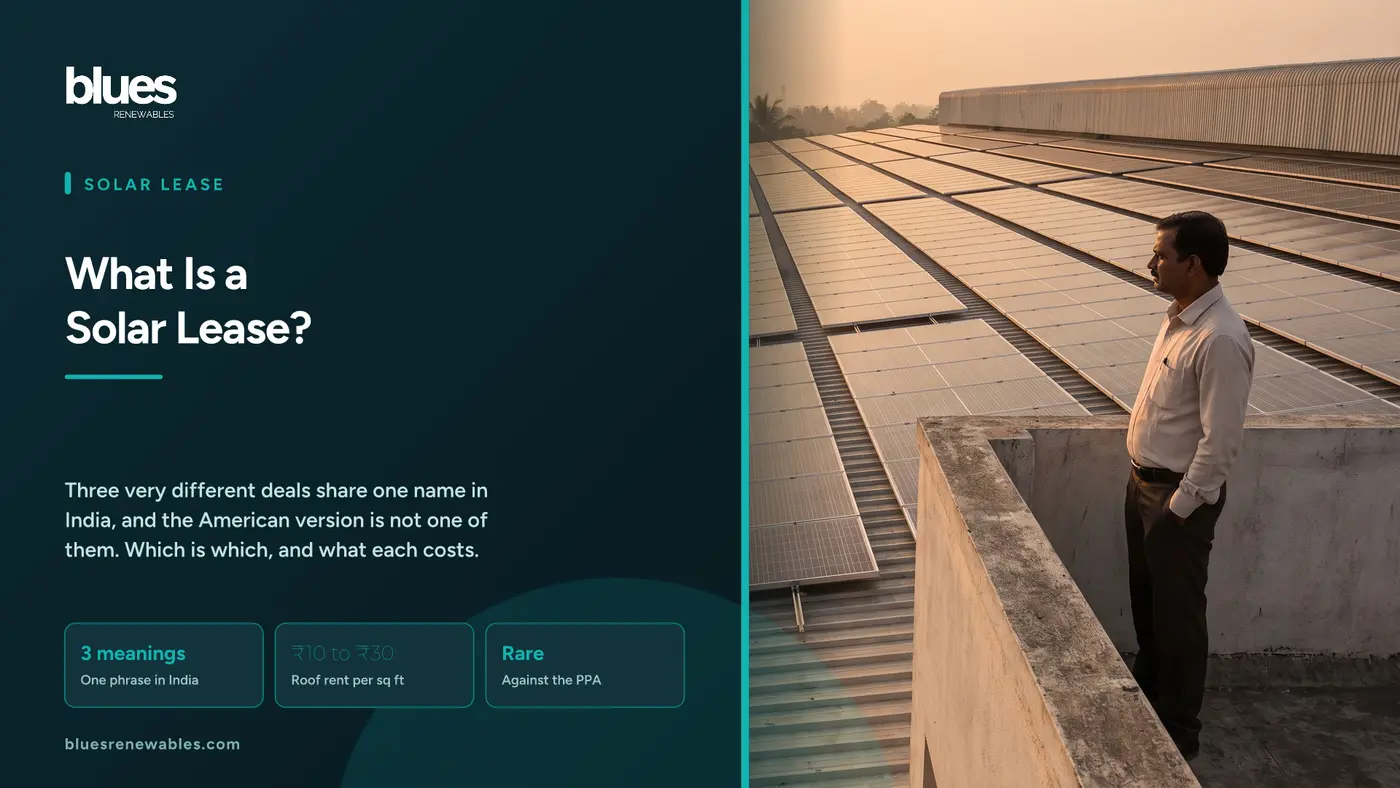
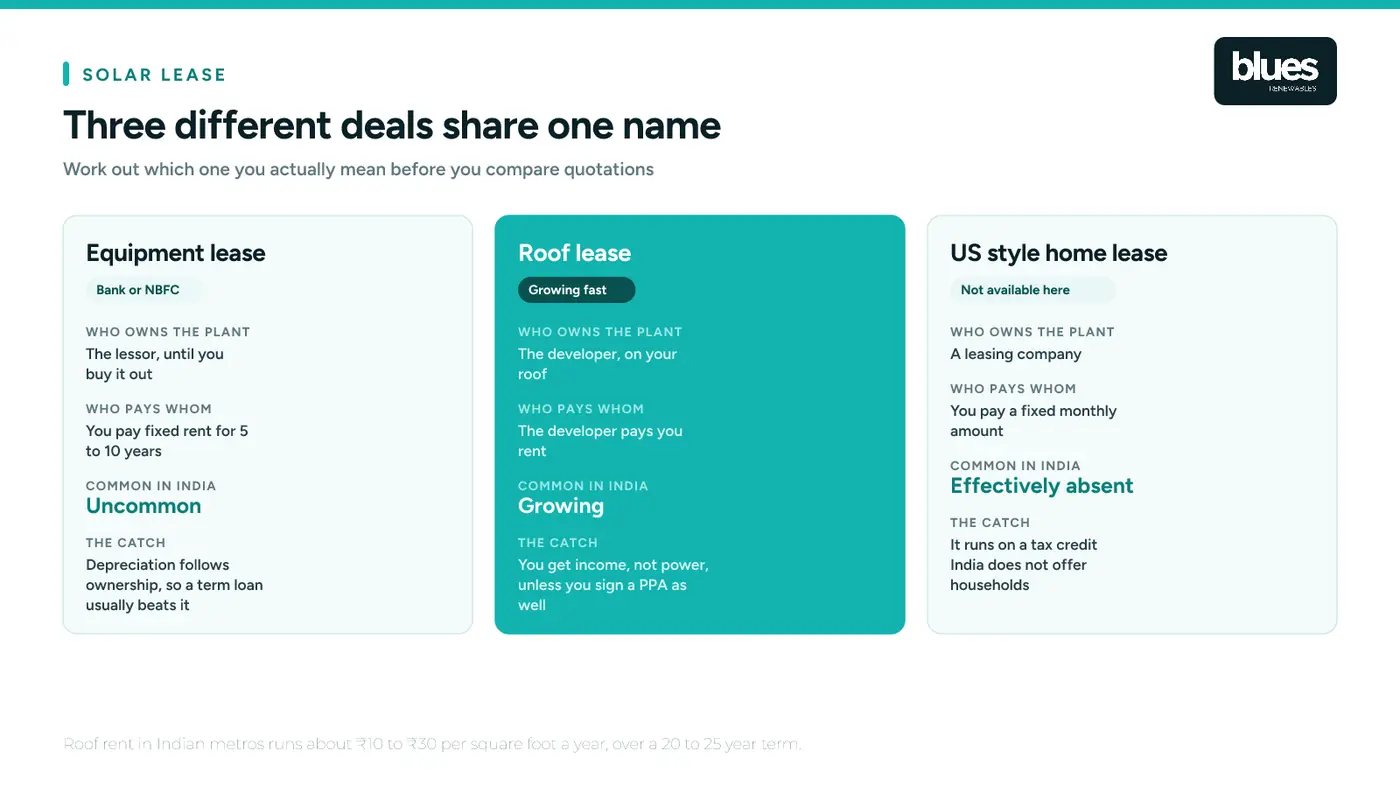
Solar lease means three different things in India: leasing equipment, renting out your roof, and the American-style lease that is effectively unavailable.


Search this question and almost every answer you find describes an American product. Sunrun, GoodLeap, tax credits, twenty year residential leases. None of it maps onto India, where the incentive that makes those deals work simply does not exist.
So what is a solar lease in the Indian context? The honest answer is that the phrase covers three quite different arrangements, and people asking the question usually want one of them without knowing which. One is common here. Another is growing fast. The third barely exists.
This guide separates the three, explains how a lease differs from a PPA, gives the roof rent figures developers actually pay, and shows which arrangement fits which situation.
Key takeaways
- "Solar lease" means three different things in India: leasing the equipment, leasing out your roof, and the American-style residential lease.
- The US-style residential solar lease is effectively absent here. It runs on a tax credit transfer that Indian rules do not offer, and the PM Surya Ghar subsidy requires you to own the system.
- A lease pays a fixed rent; a PPA pays per unit generated. Under a lease you carry the generation risk. Under a PPA the developer does.
- Leasing out your roof earns roughly ₹10 to ₹30 per square foot a year in Indian metros, varying with location, roof quality and tenure.
- A solar equipment lease exists through banks and NBFCs, but rarely beats an ordinary term loan once you account for depreciation.
- In India the PPA won. Almost every zero-investment solar deal you will be offered is a PPA, not a lease.
What is a solar lease
A solar lease is an arrangement in which one party pays a fixed, recurring rent for the use of a solar asset owned by another party. The defining feature is the fixed payment. It does not vary with how much electricity the plant produces.
That single feature is what separates a lease from a power purchase agreement, and it decides who carries the risk when the sun does not shine.
Meaning one: leasing the equipment
Here a bank, an NBFC or a leasing company buys the solar system and rents it to you for a fixed monthly amount, usually over five to ten years. You use all the power, and often buy the asset for a nominal sum at the end.
This exists in India and some financiers offer it, particularly for MSMEs. It rarely wins on the numbers, though, for one specific reason. Depreciation follows ownership. Under an operating lease the lessor claims the 40 percent accelerated depreciation on solar, not you. A plain term loan leaves the asset on your books, keeps the depreciation and the PM Surya Ghar eligibility with you, and usually costs less overall.
Check the GST treatment too. Leasing goods attracts the same rate as supplying them, so a solar equipment lease should follow the 5 percent rate that applies since 22 September 2025. Confirm it on the quotation rather than assuming.
Meaning two: leasing out your roof
This one runs the other way, and it is growing quickly in India. You own a large roof but do not need the power, or cannot use it during daylight. A developer leases your roof, installs a plant at its own cost, sells the electricity to somebody else, and pays you rent.
You invest nothing and receive a predictable income from an asset that was earning nothing. Warehouses, cold stores, godowns, marriage halls and educational campuses with weekend-only load fit this well. Karnataka has run a formal residential rooftop leasing scheme along exactly these lines, letting developers rent home rooftops and sell the output to the grid.
Typical roof rent in Indian metros runs about ₹10 to ₹30 per square foot per year, with tenures of 20 to 25 years. Location, roof condition, structural capacity and the availability of a nearby grid connection all move the number.
Before signing one, settle these five points in writing.
- Structural liability. Who repairs leaks caused by mounting penetrations, and who certifies the roof can carry the load.
- Re-roofing. Who removes and reinstates panels when the sheeting needs replacing, and who pays.
- Escalation. Roof rent should rise, commonly 3 to 5 percent a year, or it erodes badly over 25 years.
- Exit and sale. What happens if you sell the building. The lease will bind your buyer, which affects the price you get.
- Insurance and access. Whose policy covers the plant, and what notice the developer gives before visiting.
Meaning three: the American residential solar lease
This is the model dominating the search results, and it does not translate. In the United States a leasing company owns your home system, claims the federal investment tax credit, and passes part of that value back through a low fixed monthly payment.
India has no equivalent transferable credit for households. What we have instead is PM Surya Ghar central financial assistance of up to ₹78,000, and MNRE guidelines require the consumer to own the system to claim it. Lease the equipment and you forfeit the subsidy outright.
That is why residential solar leasing never took hold here, and why a 3 kW system bought outright for about ₹2,10,000 in Chennai, with subsidy, still beats every leasing structure on offer. Our PM Surya Ghar subsidy page sets out the slabs, and solar panel price in Chennai shows current pricing by size.
What a solar lease is not
Both let you use solar without buying it. The difference sits in what triggers the payment: a lease charges fixed rent whatever the weather, while a PPA charges only for the units actually generated.
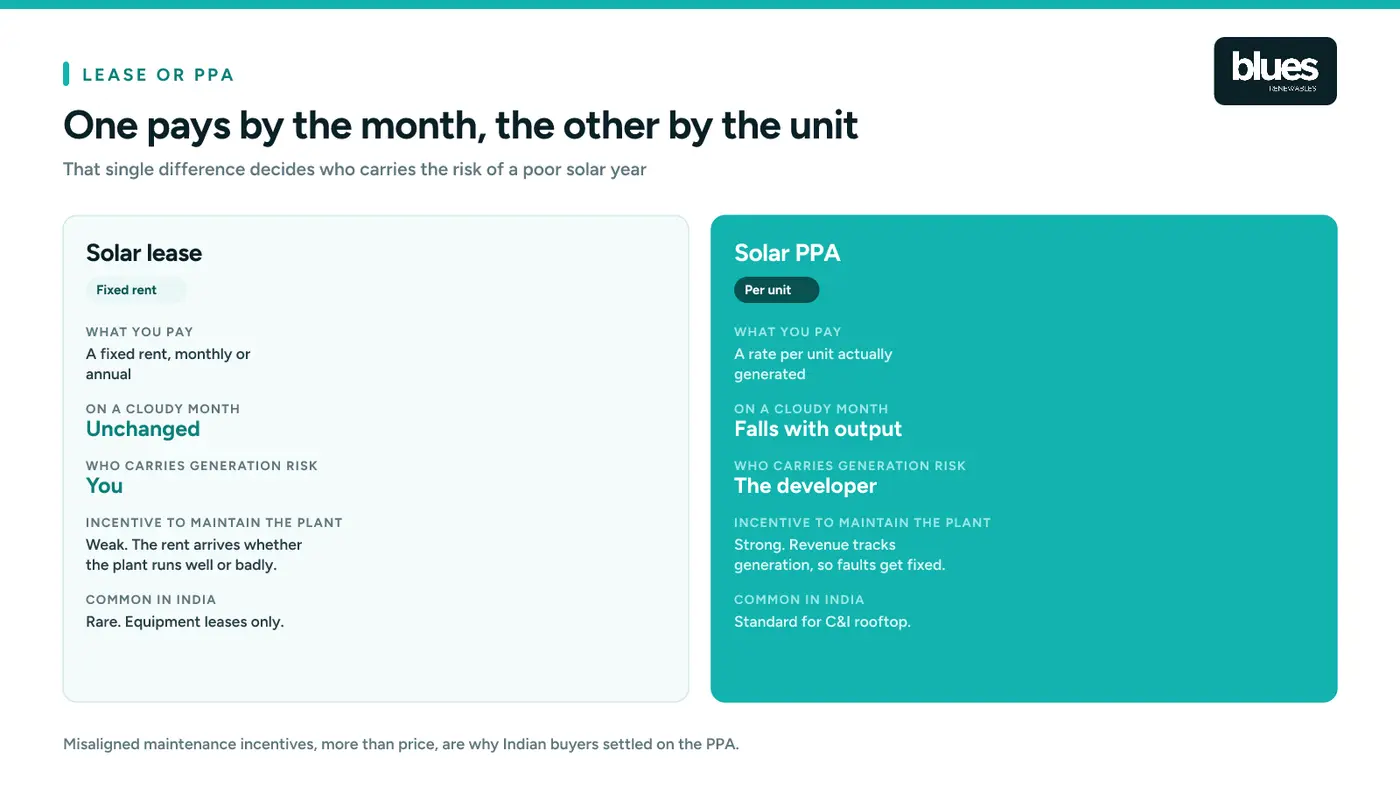
That one difference decides who carries the risk of a poor solar year, and it explains why Indian buyers settled on the PPA. Under a PPA the developer earns only when the plant produces, so cleaning, repairs and inverter faults get attended to promptly. With a lease, the rent arrives either way.
The full side by side, including what each costs across twenty five years, is in solar lease vs PPA. For the contract itself, read what a solar PPA is.
Which funding route fits you
- You own the roof, use the power, have cash and taxable profit - What to look at: Buy it. See the CAPEX model in solar
- You use the power but have no capital - What to look at: A PPA under the OPEX model in solar
- You have a large roof but little daytime load - What to look at: Lease the roof out and collect rent
- You want ownership but need to spread the cost - What to look at: A term loan, not an equipment lease
- You are a household - What to look at: Buy, and claim the subsidy
For a full side by side of the funding routes, read CAPEX vs OPEX vs RESCO solar. If your roof is large enough that a developer might want it, industrial solar in Chennai covers what makes a site attractive.
Frequently asked questions
What is a solar lease? It is an arrangement where you pay a fixed recurring rent to use a solar system owned by somebody else, rather than paying for the electricity it produces. In India the phrase is also used for the opposite deal, where a developer rents your roof and pays you.
What is the difference between a solar lease and a solar PPA? A lease charges a fixed amount regardless of generation, so you carry the risk of a poor solar year. A PPA charges per unit produced, so the developer carries it. PPAs are standard in India; equipment leases are uncommon.
Is solar leasing available in India? Equipment leasing exists through some banks and NBFCs, and roof leasing is growing quickly. The American style residential solar lease is effectively unavailable, because India has no transferable household tax credit and the PM Surya Ghar subsidy requires you to own the system.
How much rent do developers pay to lease a rooftop? Roughly ₹10 to ₹30 per square foot per year in Indian metros, over a 20 to 25 year term. Roof size, structural condition, shading, and how close a suitable grid connection sits all affect the offer.
Can I claim solar subsidy on a leased system? No. PM Surya Ghar central financial assistance requires the consumer to own the installation, so leased and third party owned systems fall outside it. For a household that is up to ₹78,000 given away.
Does leasing my roof stop me using solar power myself? Usually yes, unless you negotiate it. In a straight roof lease the developer sells the power elsewhere. Where you want the units too, you need a PPA alongside the lease, or an OPEX arrangement instead.
What happens if I sell a building with a solar lease on the roof? The lease normally binds the new owner, so it becomes part of what you are selling. Some buyers value the rental income; others treat the restriction as a discount. Read the assignment clause before you list the property.
Where this fits
A solar lease is one of several ways to reach solar without buying it outright. The mainstream Indian alternative is a solar PPA, delivered through the OPEX model in solar by a RESCO. Ownership is covered in the CAPEX model in solar. Where your load exceeds any roof you have, look at open access solar and captive solar power plants.
Blues Renewables has installed solar across Chennai since 2020, for homes, schools, businesses and factories. Where a lease genuinely suits you, we will say so. More often we find that owning the plant, or buying its output per unit, leaves you better off.
Call +91 98841 07170 and we will work out whether a solar lease, a purchase or a PPA gives your building the better twenty five years.
Sources
- MNRE, Guidelines for implementation of PM Surya Ghar: Muft Bijli Yojana, on consumer ownership requirements
- Press Information Bureau, Ministry of New and Renewable Energy, "GST on Renewable Energy Devices Rationalised to 5%", 17 September 2025
- Income Tax Act 1961, Section 32; Income Tax Rules, Appendix I depreciation schedule
- Government of Karnataka, residential rooftop solar leasing scheme for developer-rented rooftops
- Tamil Nadu Electricity Regulatory Commission, Grid Interactive Solar Energy Generating Systems Regulations