TNEB Solar Additional Load: How to Add Panels to an Existing System
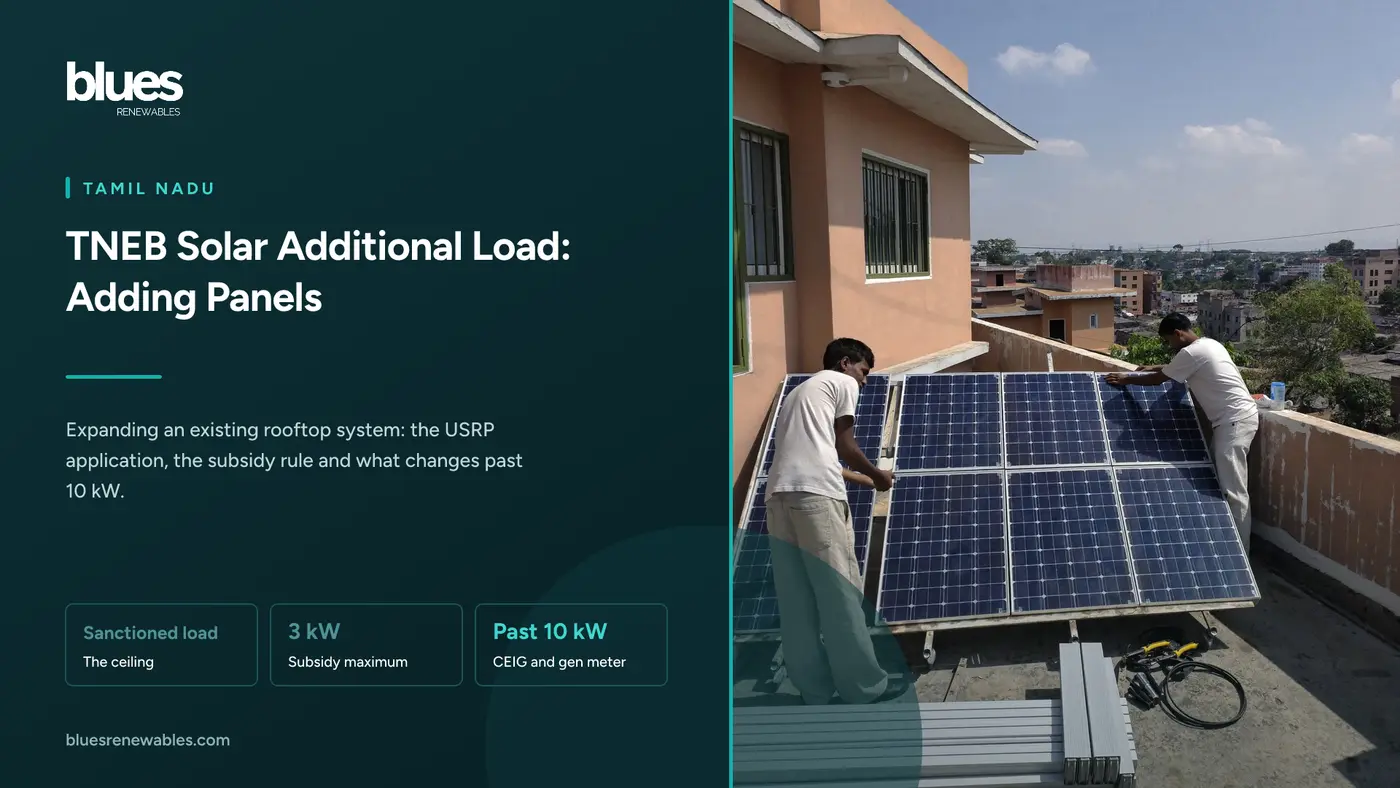
How to add solar panels to an existing TNEB connection: the USRP additional load service, the rules, subsidy on extra kW, inverter choices and the 10 kW line.

Tamil Nadu's solar portal has a separate button for this job, "Apply for Solar Additional Load", and its first screen asks for one detail: your consumer number with the region code. Behind it sit the rules that decide whether your extra panels are approved, whether they earn any subsidy, and whether your home gets pulled into a CEIG inspection.
The usual trigger is simple. A 3 kW system was the right size three years ago. Then an electric car arrived, and the bill crept back up.
This guide covers adding capacity to a connected rooftop system: the TNPDCL service, the rules in TNERC Order 8 of 2021, the PM Surya Ghar position on extra kilowatts, the hardware choices, and what changes at 10 kW. It does not re-explain the sanctioned load cap or how to raise your sanctioned load. Both have their own guides, linked below.
Key takeaways
- There is a dedicated USRP service for it. "Apply for Solar Additional Load" on tnebltd.gov.in/usrp starts with your consumer number and region code, not a new application.
- Your total solar, old plus new, must fit inside your sanctioned load, up to 999 kW, and TNPDCL still checks technical feasibility.
- A home that already received ₹78,000 for 3 kW gets no more central subsidy. Homes subsidised at 1 or 2 kW can claim only the balance up to 3 kW overall.
- A second inverter is usually the cleaner choice than replacing a working one, and new panels belong on their own string.
- Crossing 10 kW changes the costs around the system: CEIG inspection, a generation meter at your cost, the lower ₹3.37 feed-in band and higher network charges.
How TNEB solar additional load works
"Solar additional load" is TNPDCL's term for increasing the capacity of a solar plant already connected to your service. You are not applying for a new plant. You are asking TNPDCL to approve a larger total on the same connection.
The service sits in the "Apply Solar Services" menu on the Unified Solar Rooftop Portal, beside the subsidy and non-subsidy routes. Its first screen asks for your consumer number with the region code and a captcha. The neighbouring service pages link a region code lookup and send an OTP to the mobile number registered with TNPDCL, so update that number first if it has changed. For the portal itself, see our TNEB solar portal guide.
The portal publishes no separate fee or timeline for this service.
The four rules that apply
The TANGEDCO circular on TNERC Order 8 of 2021 sets out the conditions:
Total within the cap. Consumers may apply for additional loads "with total loads not exceeding the sanctioned load/contracted demand or 999 kW whichever is lower, subject to the technical feasibility." Our guide to the solar capacity limit and sanctioned load in Tamil Nadu explains how that cap works.
Old net metering survives. Consumers on net metering under the Tamil Nadu Solar Energy Policy 2012 may add capacity and keep net metering, within sanctioned load.
Capacity is AC. The plant is reckoned on the AC side. Extra DC panel capacity is left to your option, up to the approved AC capacity.
No arrears. Consumers with pending dues to the licensee are not eligible.
Feasibility now counts your old plant too
Feasibility is waived only up to 3 kW, so most additions get assessed. TNPDCL's feasibility report lists the solar "already connected" and "proposed" on your distribution transformer, and all solar on that transformer is capped at 90% of its capacity. On a street where many neighbours have gone solar, that cap, not your sanctioned load, can be what refuses an addition.
When you must raise your sanctioned load first
Add your existing AC capacity to the capacity you want. If the total is above the sanctioned load printed on your bill, raise the sanctioned load first, then apply for the solar addition against the new figure.
EV owners often hit this twice, because a 7.2 kW home charger alone can exceed a 5 kW connection. The procedure, documents and charges are in our guide to the TNEB additional load application. For sizing solar to your driving, see home solar for EV charging.
Does the PM Surya Ghar subsidy apply again?
Partly, and only up to 3 kW in total. MNRE's PM Surya Ghar guidelines deal with this under "Pre-existing RTS". A system that received central assistance under an earlier or current MNRE scheme and is later enlarged is eligible "only for the balance capacity up to 3 kW of overall RTS plant size." An installation is eligible for central assistance only once.
The guidelines' own example: a household that installed 1 kW under PM Surya Ghar, received ₹30,000, and later went to 4 kW in total can claim ₹48,000 more, ₹30,000 for the second kilowatt and ₹18,000 for the third. Nothing is paid beyond 3 kW.
- 1 kW - Central subsidy received: ₹30,000, Further central subsidy on adding capacity: Up to ₹48,000, for the 2nd and 3rd kW
- 2 kW - Central subsidy received: ₹60,000, Further central subsidy on adding capacity: Up to ₹18,000, for the 3rd kW
- 3 kW or more - Central subsidy received: ₹78,000, Further central subsidy on adding capacity: None
Any balance claim comes with conditions. The central subsidy is paid only through the PM Surya Ghar National Portal, so the addition goes through that portal and a registered vendor. The added modules must meet the Domestic Content Requirement, made in India from Indian cells. The guidelines also say non-DCR modules "in any form" make an installation ineligible, without saying what happens to a subsidy already paid, so add only DCR panels to a subsidised system.
The Tamil Nadu top-up has the same ceiling: its ₹22,000 maximum is reached at 3 kW, and it applies only to PM Surya Ghar registrations from 5 August 2026. The state has not published how it treats a balance claim. See PM Surya Ghar eligibility for the wider rules, and TNEB solar CFA vs non-CFA if the addition makes more sense without subsidy.
Technical choices: inverter, panels and warranty
Add an inverter, or replace with a larger one
A second inverter beside the first suits most homes. The existing inverter keeps working and keeps its warranty, the new panels get their own power point tracking, and a fault in one half does not stop the other. TNPDCL adds the AC ratings, so a 3 kW and a 2 kW inverter count as 5 kW.
A larger replacement inverter makes sense when the existing unit is old, out of warranty or faulty, or when you want a hybrid inverter with a battery. If storage is in the plan, read TANGEDCO hybrid inverter rules first.
Extra panels on the existing inverter are allowed by the order, but the gain is small. The inverter clips anything above its rating, and exports above the approved capacity count as inadvertent injection, which is not paid for. It suits a small top-up, not a 2 kW expansion, and must stay within the inverter's maximum DC input.
Mixing panel wattages and matching strings
Today's panels are larger and more powerful than those fitted a few years ago, and your old panels have lost some output since. Mix them carelessly and you lose generation:
- In a series string, the weakest panel sets the current for the whole string.
- Parallel strings on one input need similar voltage, which different models rarely have.
- Put new panels on their own string, on a spare MPPT input or on the new inverter.
Newer panels also have different dimensions, so check that the mounting structure can take them.
Warranty implications
Panel and inverter warranties come from their manufacturers and generally survive an addition installed within each manual's limits. The risk is the installer's cover. Under PM Surya Ghar, the vendor warrants the complete system for five years from commissioning, with five years of maintenance. If another company rewires the strings or swaps the inverter, the original vendor has grounds to refuse a later claim. Use the original installer, or get written confirmation of what stays covered. Our solar panel warranty claim guide explains who covers what.
Meter and inspection consequences
Your new total, not the size of the addition, decides which rules apply.
- Up to 3 kW - Feasibility: Waived, Inspection: AEE/O&M, Generation meter: Not required, Feed-in rate: ₹3.61, Domestic network charge: 20% of ₹1.53 per unit
- Above 3 kW to 10 kW - Feasibility: Checked, Inspection: AEE/O&M, Generation meter: Not required; generation taken as 21% CUF or inverter reading, whichever is lower, Feed-in rate: ₹3.61, Domestic network charge: 20% of ₹1.53 per unit
- Above 10 kW to 20 kW - Feasibility: Checked, Inspection: CEIG, Generation meter: Mandatory, at your cost, Feed-in rate: ₹3.37, Domestic network charge: 75% of ₹1.48 per unit
- Above 20 kW - Feasibility: Checked, Inspection: CEIG, Generation meter: Mandatory, plus a TNPDCL check meter, Feed-in rate: ₹3.37, Domestic network charge: 75% of ₹1.48 per unit
Network charges in this table follow TNPDCL's portal note. TNERC's Tariff Order 6 of 2025 sets the LT base at ₹1.60 for 2025-26, so the domestic figure up to 10 kW may be about ₹0.32 a unit.
The 10 kW line is the expensive one. A 9 kW home adding 3 kW becomes a 12 kW plant, which brings a CEIG inspection and safety certificate, a generation meter with demand recording, and the higher network charge on total generation. Where inverters sit in different places on the premises, the order asks for a generation meter on each inverter or set, with readings added together. It does not say how an existing agreement's feed-in rate is re-rated after an expansion.
Near 10 kW, compare stopping at 10 kW with going well past it. See CEIG approval for solar in Tamil Nadu and rooftop solar network charges for each cost.
Worked example: a 3 kW home adding 2 kW for an EV
Take a Chennai home with a 3 kW system installed under PM Surya Ghar, ₹78,000 central subsidy received, net metering in place and a sanctioned load of 4 kW. The family buys an electric car and expects to drive about 1,500 km a month.
Step 1: size the addition. At about 14 units per 100 km, 1,500 km needs roughly 210 units a month. In Chennai, 2 kW generates about 8 to 9.6 units a day, roughly 240 to 290 units a month, enough to cover charging losses too.
Step 2: check the cap. 3 kW plus 2 kW is 5 kW, above the 4 kW sanctioned load. The family raises the sanctioned load first, which also gives their planned 3.3 kW charger headroom.
Step 3: apply. They file "Apply for Solar Additional Load" on USRP for 2 kW. With the total above 3 kW, TNPDCL checks feasibility.
Step 4: choose the hardware. Their 3 kW inverter is two years old, under warranty, with no spare MPPT input. A separate 2 kW inverter with four new panels on their own string keeps that warranty intact.
- Solar capacity (AC) - Before: 3 kW, After: 5 kW
- Inspection - Before: AEE/O&M, After: AEE/O&M, still under 10 kW
- Generation meter - Before: Not required, After: Not required
- Central subsidy - Before: ₹78,000 received, After: No further subsidy
- State top-up - Before: Maximum reached at 3 kW, After: No further top-up
- Monthly generation, approx. - Before: 360 to 430 units, After: 600 to 720 units
The family stays below every costly threshold. If they charge at midday, while the panels generate, those units offset imports at the full retail tariff. At an illustrative ₹7 a unit, 250 units is worth about ₹1,750 a month. Run your own numbers with the solar savings calculator.
Frequently asked questions
Can I add more solar panels to my existing TNEB connection?
Yes. Use "Apply for Solar Additional Load" on the TNPDCL Unified Solar Rooftop Portal with your consumer number and region code. Your total solar must stay within your sanctioned load, up to 999 kW, subject to feasibility.
Will I get the PM Surya Ghar subsidy again when I add panels?
Only for the balance up to 3 kW in total. A home that received ₹78,000 for 3 kW gets nothing more. A 1 kW or 2 kW subsidised home can claim the difference, with DCR panels and a registered vendor.
Can I add panels to my existing inverter without changing its rating?
The order allows extra DC capacity up to the approved AC capacity. The inverter clips anything above its rating, so the gain is small, and you must stay within its DC input limits.
Will adding capacity change my net metering?
Consumers on net metering under the 2012 Solar Energy Policy keep it when they add capacity within sanctioned load. See net metering vs net feed-in for the other options.
What happens if my total goes above 10 kW?
You need a CEIG inspection and a generation meter at your cost, domestic network charges rise from 20% to 75% of the base rate, and the feed-in band drops from ₹3.61 to ₹3.37 per unit.
Can I mix new panels with my old ones?
Not in the same string, because the weakest panel limits the whole string's current. Put new panels on their own string, on a separate MPPT input or a second inverter.
Do I need to raise my sanctioned load first?
Only if your existing solar plus the addition exceeds it. Then apply for the load enhancement first, and the solar addition after.
Where this fits
The cap is explained in solar capacity limit and sanctioned load in Tamil Nadu, and raising it in the TNEB additional load application guide. For billing after the addition, see the TANGEDCO net metering application and solar export unit price in Tamil Nadu.
Blues Renewables has installed rooftop solar across Tamil Nadu from its Chennai base since 2020, in systems from 3 kW upward. For an addition, we check your sanctioned load, transformer feasibility and existing inverter at survey, design the new string so it does not drag down the old one, file the USRP additional load application, and follow it through inspection. Every installation includes two years of free maintenance from commissioning.
Call +91 98841 07170.
Sources
- TNPDCL, Unified Solar Rooftop Portal, "Apply for Solar Additional Load" page and service menu, last updated 24 September 2026, viewed 1 October 2026: the service name, the consumer number with region code field, the neighbouring subsidy and non-subsidy routes
- TNPDCL, USRP FAQ page, viewed 1 October 2026: feasibility waived up to 3 kW, AEE/O&M inspection up to 10 kW, CEIG above 10 kW
- TANGEDCO Technical Branch, salient features of TNERC Order 8 of 2021, circular signed 30 December 2021: additional loads within sanctioned load or 999 kW subject to feasibility, Solar Policy 2012 consumers retaining net metering, AC-side capacity and DC addition, inadvertent injection, arrears bar, 90% transformer cap and the feasibility report format, generation meter above 10 kW, check meter above 20 kW, 21% CUF assessment, per-inverter generation meters, feed-in bands, network charge percentages
- TNPDCL, "Policies adopted" note on USRP, viewed 1 October 2026: feed-in tariffs of ₹3.61 and ₹3.37, network charges of 20% of ₹1.53 and 75% of ₹1.48 per unit for domestic consumers
- Ministry of New and Renewable Energy, Guidelines for PM-Surya Ghar: Muft Bijli Yojana, Central Financial Assistance to Residential Consumers, viewed 1 October 2026: the CFA structure, the pre-existing RTS clause and its 1 kW to 4 kW example, CFA only once per installation, the DCR condition, payment only through the National Portal
- MNRE, model agreement between consumer and vendor under PM Surya Ghar (Annexure 2 of the guidelines): five-year system warranty and comprehensive maintenance by the vendor
- TNPDCL, USRP subsidy table, and Tamil Nadu Energy (E1) Department G.O. (Ms) No. 102, 19 September 2026: state top-up of ₹5,000, ₹10,000 and ₹22,000 and the 5 August 2026 cut-off
- Blues Renewables installation and generation data, Chennai, 2020 to 2026: generation of about 4 to 4.8 units per kW per day, EV planning figure of 14 units per 100 km