Net Metering vs Net Feed-in vs Gross Metering in Tamil Nadu, and How to Switch
Net metering, net feed-in and gross metering in Tamil Nadu compared: who qualifies, how each settles, a worked 3 kW example, and how to switch on USRP.

A 3 kW rooftop system in Chennai can export more than 500 units in a two-month billing cycle. Under net metering, any surplus still unused on 31 March simply lapses. Under net feed-in, TNPDCL credits each exported unit at ₹3.61 and pays out any year-end credit if you ask.
Which arrangement suits you depends on one question: over a year, does your home use more electricity than the panels make, or less? Most homeowners never ask it, because the mechanism was picked at application time, often by whoever filled in the form.
This guide compares Tamil Nadu's three metering mechanisms, who qualifies for each, a worked 3 kW example, and how a home switches on the USRP portal. The application process and the export rate have their own guides, linked below.
Key takeaways
- Homes can choose net metering or net feed-in. Other LT categories get net feed-in only; gross metering is for non-domestic HT systems and generators of 151 to 999 kW.
- Net metering settles in units, net feed-in settles in money. Surplus units lapse on 31 March under net metering; a net feed-in credit can be paid out or carried over.
- Net feed-in wins when you generate more than you use. In our example, a 3 kW home using 600 units per cycle is about ₹1,252 better off each cycle.
- Net metering wins when you use more than you generate. The same system in a home using 900 units per cycle saves about ₹1,104 more each cycle.
- Domestic consumers switch through "Apply for Scheme change" on USRP, using the consumer number with region code and an OTP to the registered mobile.
What net metering, net feed-in and gross metering mean in Tamil Nadu
All three come from TNERC's Generic Tariff Order No. 8 of 2021 (22 October 2021), which TNPDCL's "Policies adopted" note on the USRP portal says it still applies.
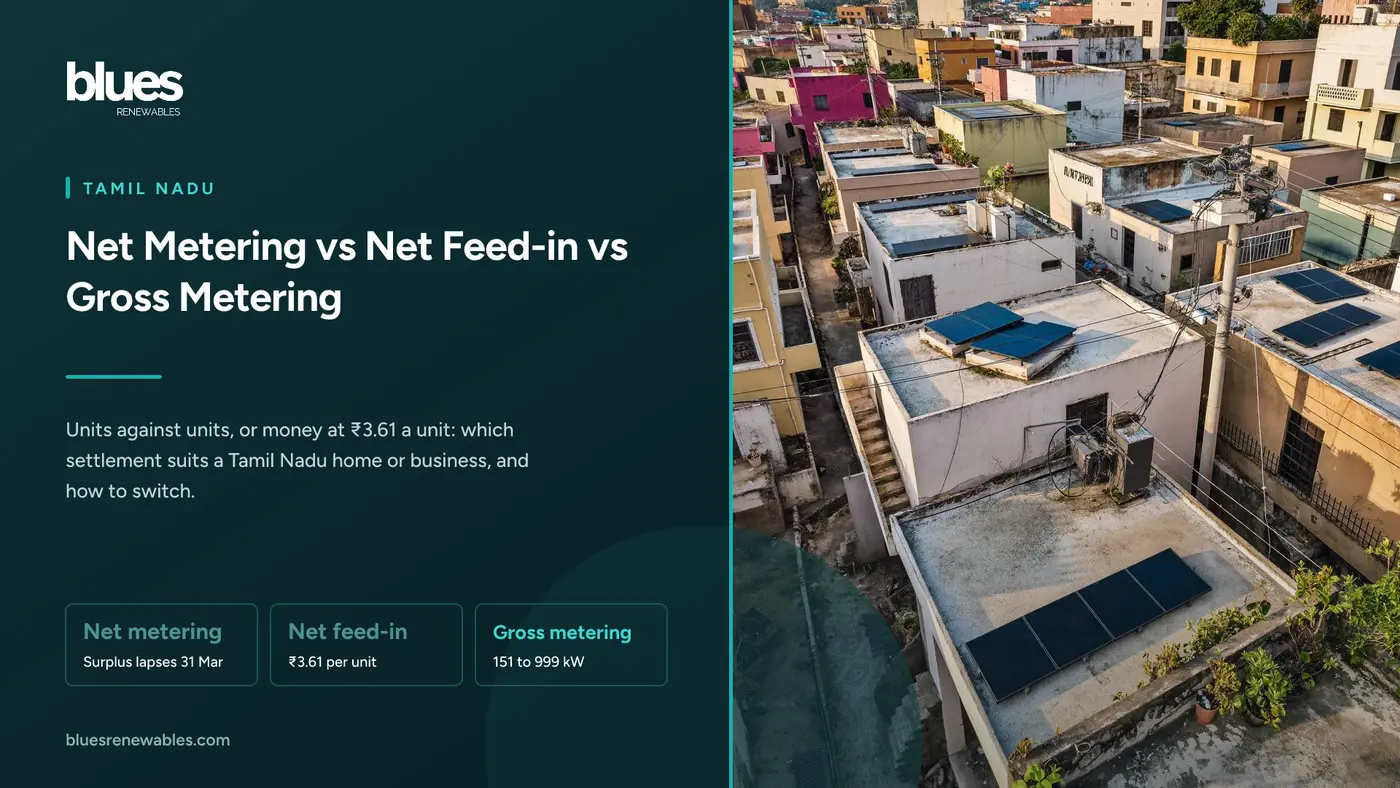
Net metering. Your bidirectional meter records imports and exports. Exported units are subtracted from imported units, and you pay for the net import at the domestic tariff. A surplus carries forward to the next cycle, but whatever is left on 31 March, the end of the settlement period, lapses unpaid.
Net feed-in, also called net billing. The same meter, settled in rupees. Imports are charged at your retail tariff, and exports are credited at the feed-in tariff, ₹3.61 per unit for 1 to 10 kW. A net credit carries forward, and on 31 March you can take payment or carry it over. TNPDCL must pay within two months of the invoice or add 1% per month. The full rate card is in our guide to the solar export unit price in Tamil Nadu.
Gross metering. You sell all generation to TNPDCL at ₹3.10 per unit and buy all consumption separately, billed at the HT industrial energy charge with no demand charge.
Above 1 MW, TNPDCL instead approves parallel operation with reverse power relays, which stop power flowing back into the grid. See parallel operation charges in Tamil Nadu.
Who is eligible for which mechanism
- Domestic LT, up to sanctioned load - Net metering: Yes, Net feed-in: Yes, by choice, Gross metering: No, Feed-in rate: ₹3.61 (1 to 10 kW), ₹3.37 (11 to 150 kW)
- Other LT categories (shops, offices, schools, small factories) - Net metering: No, Net feed-in: Yes, Gross metering: No, Feed-in rate: ₹3.61 or ₹3.37 by size
- HT consumers, 151 to 999 kW - Net metering: No, Net feed-in: Yes, Gross metering: Yes, Feed-in rate: ₹3.10
- Generators who are not consumers, 151 to 999 kW - Net metering: No, Net feed-in: No, Gross metering: Yes, Feed-in rate: ₹3.10
Hut and agriculture services are excluded, consumers with arrears are not eligible, and capacity cannot exceed the sanctioned load, measured on the AC side. Our post on the solar capacity limit and sanctioned load explains that cap.
Gross metering rules out most buildings. The owner must lay and maintain a separate service line to the nearest HT feeder at their own cost, provide automatic meter reading, and give the substation remote control of the plant's breaker.
Why some homes are still on net feed-in
Homes that applied before 25 March 2019 got net metering under the Solar Energy Policy 2012. Later applications went on net feed-in under TNERC Order No. 3 of 2019, until Order 8/2021 restored net metering for homes and let those households migrate. The USRP FAQ still describes the 2019 position, so check your bill or agreement.
How settlement works under each mechanism
- What is settled - Net metering: Units, Net feed-in: Rupees, Gross metering: Rupees
- Value of an exported unit - Net metering: Your retail tariff for that unit, Net feed-in: Feed-in tariff, Gross metering: Feed-in tariff, on all generation
- Surplus in a cycle - Net metering: Units carried forward, Net feed-in: Credit carried forward, Gross metering: Credited every cycle
- On 31 March - Net metering: Unused surplus lapses, Net feed-in: Paid out, or carried over if you choose, Gross metering: No year-end balance
- Evening export, 6 pm to 9 pm - Net metering: Offset within the same time slot for ToD consumers, Net feed-in: Valued 20% above the feed-in tariff, Gross metering: Valued 20% above the feed-in tariff
The evening bonus rarely matters, because panels produce little after 6 pm.
Network charges under each mechanism
Network charges are levied on solar generation, not exports, under net metering and net feed-in alike. Gross metering pays none.
- Domestic up to 10 kW, either mechanism - Network charge: 20% of ₹1.53 per unit, about ₹0.31
- Domestic above 10 kW, either mechanism - Network charge: 75% of ₹1.48 per unit
- LT non-domestic, net feed-in - Network charge: ₹1.53 per unit on total generation
- HT, net feed-in - Network charge: ₹0.96 per unit
- Gross metering - Network charge: Nil
These are the rates on TNPDCL's portal note. TNERC's Tariff Order 6 of 2025 sets the LT network charge at ₹1.60 for 2025-26, so a home's charge may be about ₹0.32 a unit rather than ₹0.31.
Because the domestic charge is identical under both mechanisms, it does not change which one a home should choose. Our guide to rooftop solar network charges in Tamil Nadu covers the rates and calculation in detail.
Worked example: a 3 kW home on net metering vs net feed-in
The assumptions, so you can swap in your own numbers:
- A 3 kW system in Chennai producing 4.4 units per kW per day: 3 x 4.4 x 60 = 792 units per two-month cycle.
- Domestic slabs as households pay them in 2026: ₹4.70 per unit for 101 to 400 units, ₹6.30 for 401 to 500, ₹8.40 for 501 to 600. The first 200 units are free on bills of 500 units or less; above 500, only the first 100.
- Slabs apply to net units under net metering and to imported units under net feed-in. Taxes are left out.
- Every cycle looks the same. Summer imports run higher, so treat yearly figures as an upper bound.
Home A: uses 600 units per cycle
Before solar, the bill is: 100 units free, 300 x ₹4.70 = ₹1,410, 100 x ₹6.30 = ₹630, 100 x ₹8.40 = ₹840. Total ₹2,880.
With solar, the family uses 250 units directly, so it exports 792 minus 250 = 542 and imports 600 minus 250 = 350.
- Net metering: 350 imported minus 542 exported = 192 surplus units. The energy bill is ₹0 and the surplus carries forward. If every cycle is similar, about 192 x 6 = 1,152 units lapse unused on 31 March.
- Net feed-in: a 350-unit import bill gets 200 free units, so 150 x ₹4.70 = ₹705 is charged. Exports earn 542 x ₹3.61 = ₹1,956.62. Net credit: about ₹1,252 per cycle, or about ₹7,510 a year payable on 31 March.
Net feed-in wins by about ₹1,252 per cycle. The imported units are cheap, partly free, so cancelling them is worth less than selling exports at ₹3.61.
Home B: uses 900 units per cycle
Same system. The family uses 300 units directly, so it exports 792 minus 300 = 492 and imports 900 minus 300 = 600.
- Net metering: 600 minus 492 = 108 net units. A bill of 108 units falls within the 200 free units, so the energy bill is ₹0.
- Net feed-in: 600 imported units cost ₹2,880, as in Home A's pre-solar bill. Exports earn 492 x ₹3.61 = ₹1,776.12, so the household pays about ₹1,104.
Net metering wins by about ₹1,104 per cycle, about ₹6,620 a year. Each exported unit cancels an import worth ₹4.70 to ₹8.40, more than the ₹3.61 feed-in rate.
In both homes the network charge is the same: generation is the lower of the inverter's 792 units and the 21% CUF figure of 907 units, so 792 x about ₹0.31 = roughly ₹242 per cycle.
The rule of thumb: make more than you use over a year, choose net feed-in; use more than you make, choose net metering. Our solar calculator estimates your yearly generation.
Decision table
- Home, yearly use clearly above yearly generation - Mechanism to choose: Net metering
- Home, yearly generation above yearly use, or a system sized ahead of future load - Mechanism to choose: Net feed-in
- Home on net feed-in from a 2019 to 2021 application, using more than it generates - Mechanism to choose: Consider migrating to net metering
- Shop, office, school or other LT non-domestic - Mechanism to choose: Net feed-in, the only option
- HT, 151 to 999 kW, using most of its own generation - Mechanism to choose: Net feed-in
- HT or generator, 151 to 999 kW, selling all output and able to lay a line to the HT feeder - Mechanism to choose: Gross metering
- HT plant above 1 MW - Mechanism to choose: Parallel operation approval
How a domestic consumer switches mechanism on USRP
The Unified Solar Rooftop Portal at tnebltd.gov.in/usrp/ has a service called "Apply for Scheme change", headed "Solar Scheme change for Domestic consumers". Other LT categories have nothing to switch to.
Open the portal and choose "Apply for Scheme change" from the services list.
Enter your consumer number with the region code. The page links to a region code list, and our TNEB solar portal guide explains the format.
Enter the OTP sent to the mobile number registered with TNPDCL for that connection. If that number is out of date, update it first.
Enter the captcha and submit the request.
TNPDCL publishes no fee, processing time or effective date. Order 8/2021 uses the same bidirectional meter for both mechanisms, so a new meter should not be needed, but the portal does not say whether a fresh agreement is required or what happens to banked units or credit at the switch. The Executive Engineer, O&M is the nodal officer for these services, so ask your section office first, especially if you hold a large surplus close to 31 March. To check your exports afterwards, see how to read your TNEB solar meter.
What the 2024 draft regulations proposed
In June 2024 TNERC published draft Grid Interactive Solar PV Energy Generating Systems Regulations proposing group net metering, virtual net metering, and switching between net metering and net feed-in twice a year for homes. These are proposals only; TNPDCL still applies Order 8/2021.
Frequently asked questions
What is the difference between net feed-in and net metering?
Net metering subtracts exported units from imported units and bills the balance; unused surplus lapses on 31 March. Net feed-in charges imports at your tariff and credits exports at ₹3.61 for systems up to 10 kW, and a year-end credit can be paid out.
Is net billing the same as net feed-in in Tamil Nadu?
Yes. TNERC's Order 8/2021 uses "net billing or net feed-in" for the same mechanism, where imports and exports are valued separately in rupees.
Can a home in Tamil Nadu use gross metering?
No. Gross metering is open only to non-domestic consumers and generators with systems of 151 to 999 kW, and LT consumers are not eligible.
Which is better for a home, net metering or net feed-in?
If you use more than you generate over a year, net metering usually wins. If you generate more, net feed-in pays for the surplus that net metering lets lapse.
How do I change from net feed-in to net metering?
Use "Apply for Scheme change" on the USRP portal with your consumer number, region code and the OTP sent to your registered mobile. Domestic consumers put on net feed-in under the 2019 order were given this option by Order 8/2021.
Can I switch mechanism twice a year?
That was proposed in TNERC's 2024 draft regulations, which are not in force. The portal publishes no limit on how often a home can apply.
Where this fits
For the application process and timelines, read the TANGEDCO net metering application guide. For why a bill rarely reaches zero, see electricity bill after solar not zero. Meter and registration fees are in TNEB net meter charges, and the wider framework is in the Tamil Nadu solar energy policy. Factories weighing net feed-in against gross metering can start with our commercial solar page.
Blues Renewables has installed rooftop solar across Tamil Nadu from its Chennai base since 2020, for homes from 3 kW upwards and for commercial buildings. Before sizing a system, we run your last year of bills under both net metering and net feed-in, tell you which to apply for, and help existing customers file a scheme change when their usage shifts. Every installation includes two years of free maintenance from commissioning.
Call +91 98841 07170.
Sources
- TNPDCL, "Policies adopted" note on the USRP portal (tnebltd.gov.in/usrp/files/policiesadopted.pdf), viewed 1 October 2026: Order 8/2021 still applied, eligibility by category, HT above 1 MW under parallel operation with reverse power relays, feed-in rates, network charges of 20% of ₹1.53, 75% of ₹1.48, ₹1.53 and ₹0.96, billing methodology for each mechanism
- TANGEDCO Technical Branch, salient features of TNERC Generic Tariff Order No. 8 of 2021, circular signed 30 December 2021: net metering and net feed-in settlement and the 31 March rule, gross metering conditions, ToD bonus, migration from Order 3 of 2019, metering, the 21% CUF basis, the two-month payment rule, the EE/O&M nodal officer
- TNPDCL, USRP "Apply for Scheme change" page, last updated 24 September 2026, viewed 1 October 2026: domestic-only service, consumer number with region code, OTP to registered mobile, captcha
- TNPDCL, USRP FAQ, viewed 1 October 2026: the 25 March 2019 cut-over between net metering and net feed-in under the earlier policies
- Citizen consumer and civic Action Group (CAG), "200 units free electricity scheme in Tamil Nadu", 9 June 2026: worked domestic bills of ₹94 for 220 units, ₹1,570 for 500 units and ₹2,124 for 510 units, from which the ₹4.70, ₹6.30 and ₹8.40 slab rates in the example are derived
- ANI and The Federal, 10 May 2026: the Tamil Nadu government's 200 free units per cycle for domestic bills up to 500 units, and 100 free units above that
- SolarQuarter, 15 June 2024, and the TNERC draft Grid Interactive Solar PV Energy Generating Systems Regulations, 2024: proposed group and virtual net metering and twice-yearly switching for domestic consumers