Solar Export Unit Price in Tamil Nadu 2026: What TNEB Pays per Unit
TNPDCL credits exported solar at ₹3.61, ₹3.37 or ₹3.10 per unit, plus 20% from 6 to 9 pm. What 100 surplus units are really worth, and when you get paid.

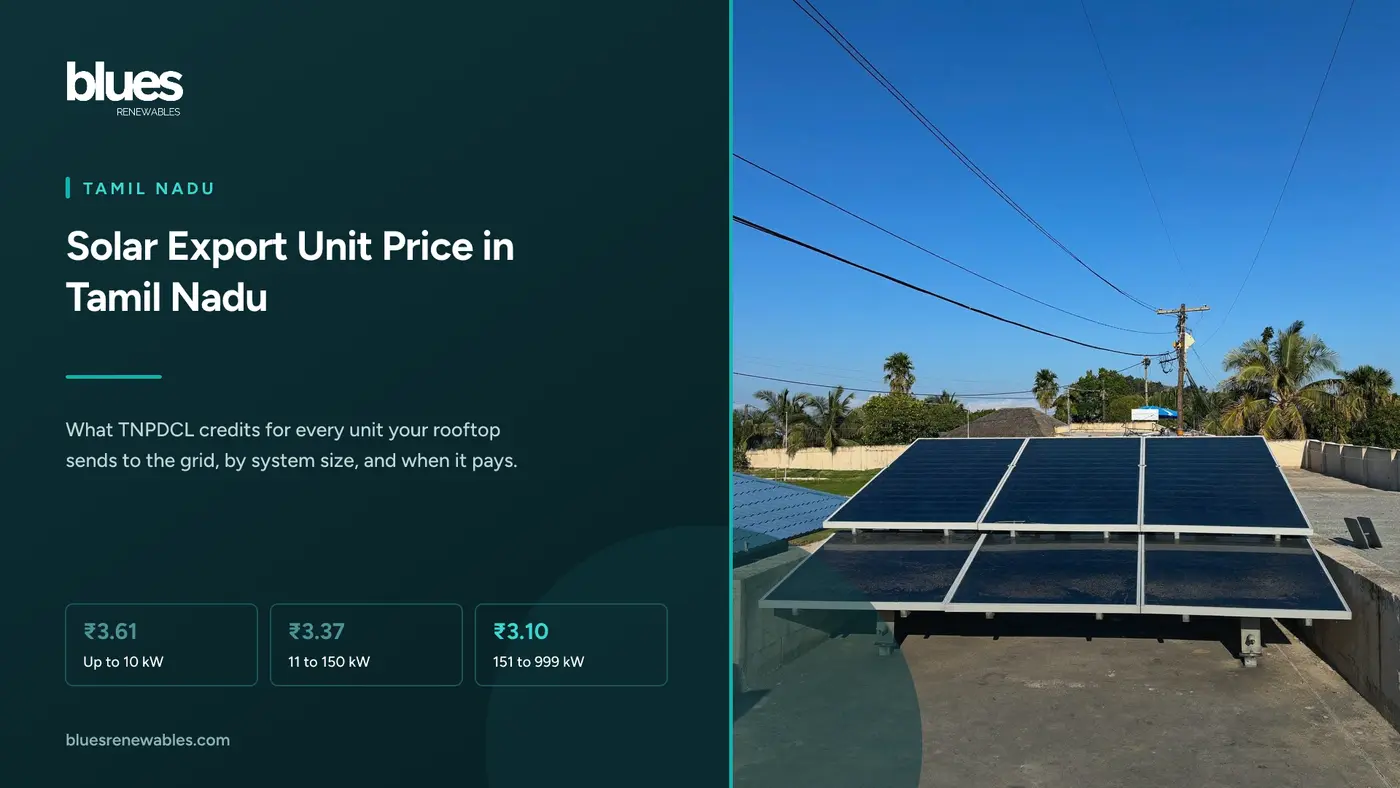
Tamil Nadu's export price for rooftop solar is ₹3.61 per unit for systems of 1 to 10 kW. TNERC fixed it in October 2021, and TNPDCL's note on its solar portal says it still applies. Meanwhile the price of grid power has risen, so the export rate now sits below what most homes pay for their dearest units.
That is why "how much does TNEB pay for my extra units?" has two answers. A home on net feed-in is credited the export price in rupees. A home on net metering, which is how most Tamil Nadu homes are connected, is never paid a per-unit price: its exported units cancel imported units, and are worth whatever those units would have cost.
This guide covers the rate table, the evening bonus, what 100 surplus units are really worth, and when TNPDCL pays. It does not re-explain network charges or compare the metering schemes in full; links to those guides are below.
Key takeaways
- The feed-in tariff is ₹3.61, ₹3.37 or ₹3.10 per unit, by plant capacity, under TNERC Order No. 8 of 2021, which TNPDCL says it is still adopting.
- Exports between 6 pm and 9 pm earn 20% more, but a rooftop system without a battery exports almost nothing after sunset.
- Net metering homes are not paid ₹3.61. Their exported units offset imported units at the retail slab rate, which can be worth more or less.
- Net feed-in credit can be paid out on 31 March. Net metering surplus left on 31 March lapses and earns nothing.
- A unit you use yourself is worth more than a unit you export, so size the system to your consumption, not to your roof.
What the solar export unit price in Tamil Nadu is
The solar export unit price, which TNERC calls the feed-in tariff, is the rate TNPDCL credits for each unit your plant sends to the grid under net feed-in or gross metering. TNERC set it in its Generic Tariff Order for Grid Interactive Solar PV Energy Generating Systems, Order No. 8 of 2021, dated 22 October 2021.
- 1 to 10 kW - Feed-in tariff per unit: ₹3.61, 6 pm to 9 pm rate (+20%): ₹4.33, Who usually falls here: Homes and small shops
- 11 to 150 kW - Feed-in tariff per unit: ₹3.37, 6 pm to 9 pm rate (+20%): ₹4.04, Who usually falls here: Large homes, shops, schools, small factories (LT)
- 151 to 999 kW - Feed-in tariff per unit: ₹3.10, 6 pm to 9 pm rate (+20%): ₹3.72, Who usually falls here: HT consumers on net feed-in or gross metering
Capacity means the inverter (AC) rating, not the panel total. Our guide to the solar capacity limit and sanctioned load explains how that cap works.
Is ₹3.61 still the rate in 2026?
Yes. TNPDCL's "Policies adopted" note on the Unified Solar Rooftop Portal says it is at present adopting Order No. 8 of 2021 and lists the same three rates. The order's control period formally ended on 31 March 2023, and plants commissioned within it keep the rate for 25 years. We found no newer TNERC generic tariff for rooftop solar.
Some websites quote ₹2 to ₹3 per unit for Tamil Nadu homes. Nothing TNPDCL or TNERC has published supports that. Your own rate is written into clause 6.1 of your solar connection agreement with TNPDCL.
The Time of Day bonus for 6 pm to 9 pm exports
Order 8/2021 values energy exported during the evening peak, 6 pm to 9 pm, 20% above the normal rate. For a 1 to 10 kW plant that lifts ₹3.61 to about ₹4.33.
Few rooftop systems earn it. The sun sets in Chennai close to 6 pm for most of the year, so a plain grid-tied system has almost nothing to export in that window. The bonus matters mainly to plants with storage; our guide to TANGEDCO hybrid inverter rules covers battery systems.
Net metering consumers on a Time of Day tariff follow a different rule: exports first offset imports in the same time slot, and any excess is counted as off-peak.
Why a net metering home is not paid ₹3.61
Order 8/2021 made net metering the default for domestic consumers; all other LT consumers use net feed-in.
Under net metering, TNPDCL does not buy your exported units. It subtracts them from the units you imported in the billing cycle and bills the net units at the domestic tariff. So each exported unit is worth the imported unit it cancels, usually at your highest slab.
Under net feed-in, every imported unit is debited at the retail tariff and every exported unit is credited at ₹3.61. Homes may choose net feed-in, but few gain from it. Our guide to net metering vs net feed-in in Tamil Nadu explains who should pick which, and how to switch.
What 100 surplus units are worth: a worked comparison
The table takes 100 exported units in one two-month billing cycle. Retail figures are the consumer-payable domestic energy charges after the state subsidy: ₹4.70 per unit for units 201 to 400, ₹6.30 for 401 to 500 and ₹8.40 for 501 to 600. Since 10 May 2026, homes using up to 500 units in a cycle get the first 200 units free; above 500, only the first 100 are free. The examples assume the net units are billed at the retail tariff, as Order 8/2021 states, and show energy charges only.
- Net metering, net units fall from 600 to 500 - Bill before export credit: ₹2,880, Bill after: ₹1,570, Value of 100 units: ₹1,310, Per unit: ₹13.10
- Net metering, net units fall from 400 to 300 - Bill before export credit: ₹940, Bill after: ₹470, Value of 100 units: ₹470, Per unit: ₹4.70
- Net metering, net units fall from 250 to 150 - Bill before export credit: ₹235, Bill after: ₹0, Value of 100 units: ₹235, Per unit: ₹2.35
- Net metering, surplus unused on 31 March - Bill before export credit: , Bill after: , Value of 100 units: ₹0, Per unit: ₹0
- Net feed-in, 1 to 10 kW, daytime export - Bill before export credit: , Bill after: , Value of 100 units: ₹361 credit, Per unit: ₹3.61
- Net feed-in, all exported 6 pm to 9 pm - Bill before export credit: , Bill after: , Value of 100 units: about ₹433 credit, Per unit: about ₹4.33
Crossing 500 units is expensive. The top row is extreme because those 100 units also bring the home under the 500-unit line, where 200 units are free instead of 100. On net feed-in, the same home would be billed for all 600 imported units, ₹2,880, less ₹361: ₹2,519, against ₹1,570 on net metering.
Net metering is not always better per unit. A small household already inside the free 200 units gains little from extra export, and its surplus carries forward only until 31 March.
Your own figures depend on your usage. The solar savings calculator gives a rough estimate.
When and how TNPDCL pays for exported units
Net metering. No cash. Surplus units carry forward from one cycle to the next until 31 March, then lapse. Our guide on why the electricity bill after solar is not zero covers the 31 March reset.
Net feed-in. The rupee value of exports is set against the rupee value of imports on each bill. A net credit carries forward. On 31 March you can take payment of the remaining credit or carry it into the next year.
Gross metering (151 to 999 kW, non-domestic). All generation is exported and credited at ₹3.10 on every bill.
Payment deadline. Order 8/2021 requires the licensee to pay within two months of receiving the invoice, or add a belated payment surcharge of 1% for every month of delay.
TNPDCL has not published a form for claiming the 31 March payout. Put the request in writing to your section office and to the Executive Engineer, O&M, whom the 2021 TANGEDCO circular names as nodal officer for solar metering, and keep a dated copy.
One rule can cut the credit: if the AC output in a billing cycle exceeds your sanctioned plant capacity, the matching share of exported units is treated as inadvertent injection and is not paid for.
Why an exported unit is worth less than one you use
A unit you use as it is generated never reaches the import register, so it saves your top slab rate in full. A unit you export earns ₹3.61 on net feed-in, or on net metering only what it can offset before 31 March. Both mechanisms also carry a charge on total generation, explained in our rooftop solar network charges guide.
Three rules follow:
Size the system to your consumption, not your roof. In Chennai a system makes about 4 to 4.8 units per kW per day, so a 3 kW plant produces roughly 720 to 860 units a cycle. If your home uses about that much, 3 kW fits. Extra panels mostly make units that earn ₹3.61 or lapse.
Move flexible loads into daylight. Running the washing machine, motor pump, iron or water heater between 10 am and 3 pm turns low-value exports into high-value self-use.
Do not oversize for the evening bonus. Without storage, a rooftop plant cannot export after sunset.
How the rate got here
TNERC's consultative paper of 17 August 2021 proposed ₹3.99 per unit for 1 to 10 kW systems, with lower rates for bigger plants. The final Order No. 8 of 2021, dated 22 October 2021, set ₹3.61 and the three bands above. It also restored net metering for homes, letting those placed on net feed-in under TNERC Order No. 3 of 2019 migrate back.
In June 2024, TNERC published draft Grid Interactive Solar PV Energy Generating Systems Regulations, proposing group net metering, virtual net metering and switching between net metering and net feed-in twice a year. That is a proposal only; until TNERC notifies final rules, the 2021 rates apply. Our Tamil Nadu solar energy policy overview has the wider picture.
Frequently asked questions
What is the solar export unit price in Tamil Nadu?
TNPDCL credits ₹3.61 per unit for plants of 1 to 10 kW, ₹3.37 for 11 to 150 kW and ₹3.10 for 151 to 999 kW, under TNERC Order No. 8 of 2021, which it says it is still adopting.
What is the net feed-in tariff in Tamil Nadu for a home?
₹3.61 per exported unit for a 1 to 10 kW system, or about ₹4.33 for units exported between 6 pm and 9 pm. Imports are billed separately at the domestic tariff.
Does TNEB pay cash for excess solar power?
Only on net feed-in, where you can take payment of the remaining credit on 31 March. On net metering, surplus units carry forward and lapse if still unused on 31 March.
Is net metering better than ₹3.61 per unit?
Usually, because each exported unit cancels an imported unit at your slab rate, often ₹4.70 to ₹8.40. It is worth less if your net use is already inside the free units, and nothing for surplus that lapses.
How long does TNPDCL take to pay for exported solar units?
Order 8/2021 allows two months from receipt of the invoice. After that, TNPDCL owes a surcharge of 1% for every month of delay.
Has the feed-in tariff changed since 2021?
No new rate has been notified. TNERC's June 2024 draft regulations are not in force, and TNPDCL still applies Order No. 8 of 2021.
Where this fits
To choose or switch mechanisms, read net metering vs net feed-in in Tamil Nadu. To check the export register behind your bill, see how to read your TNEB solar meter. The application and settlement process is in our TANGEDCO net metering application guide, and larger plants on gross metering should start with our commercial solar page.
Blues Renewables has installed rooftop solar across Tamil Nadu from Guindy, Chennai, since 2020. We size every system from your past year of bills, so most of what it generates replaces units you would have bought instead of going out at ₹3.61 or lapsing on 31 March. We handle the TNPDCL application and net meter, and every installation includes two years of free maintenance from commissioning. Send us your last six bills and we will tell you the right size.
Call +91 98841 07170.
Sources
- TNPDCL, "Policies adopted" note on the Unified Solar Rooftop Portal, viewed 1 October 2026: TNPDCL is adopting TNERC Order No. 8 of 2021; metering mechanism by category; the three feed-in tariffs; billing methods
- TANGEDCO Technical Branch, salient features of TNERC Order No. 8 of 2021, signed 30 December 2021: Time of Day rate for 6 pm to 9 pm; carry-forward, lapse and payout rules on 31 March; gross metering credit; two-month payment and 1% surcharge; inadvertent injection; AC-side capacity; control period and 25-year validity; Order 3/2019 migration; nodal officer; agreement clause 6.1
- Mercom India and Renewable Watch, August 2021: the ₹3.99 proposal in the 17 August 2021 consultative paper
- Mercom India and Renewable Watch, November 2021: the final ₹3.61 tariff
- SolarQuarter and DT Next, June 2024: TNERC's draft GISS Regulations, 2024
- TNERC Tariff Order No. 6 of 2025, from 1 July 2025, with the state subsidy: consumer-payable slab rates of ₹4.70, ₹6.30 and ₹8.40
- The Hindu and South First, 10 May 2026: 200 free units every two months for homes using up to 500 units; 100 free units continue above 500
- Citizen consumer and civic Action Group (CAG), 2026: example bills of about ₹1,570 for 500 units and ₹2,124 for 510 units, confirming the worked example's arithmetic
- Blues Renewables generation records, Chennai, 2020 to 2026: about 4 to 4.8 units per kW per day