TNEB Net Meter Charges 2026: Registration Fee, Meter Cost and Monthly Charges
What TNPDCL charges for a solar net meter in 2026: the ₹500 registration fee, net meter cost, monthly network charges, and totals for 3 kW and 15 kW.

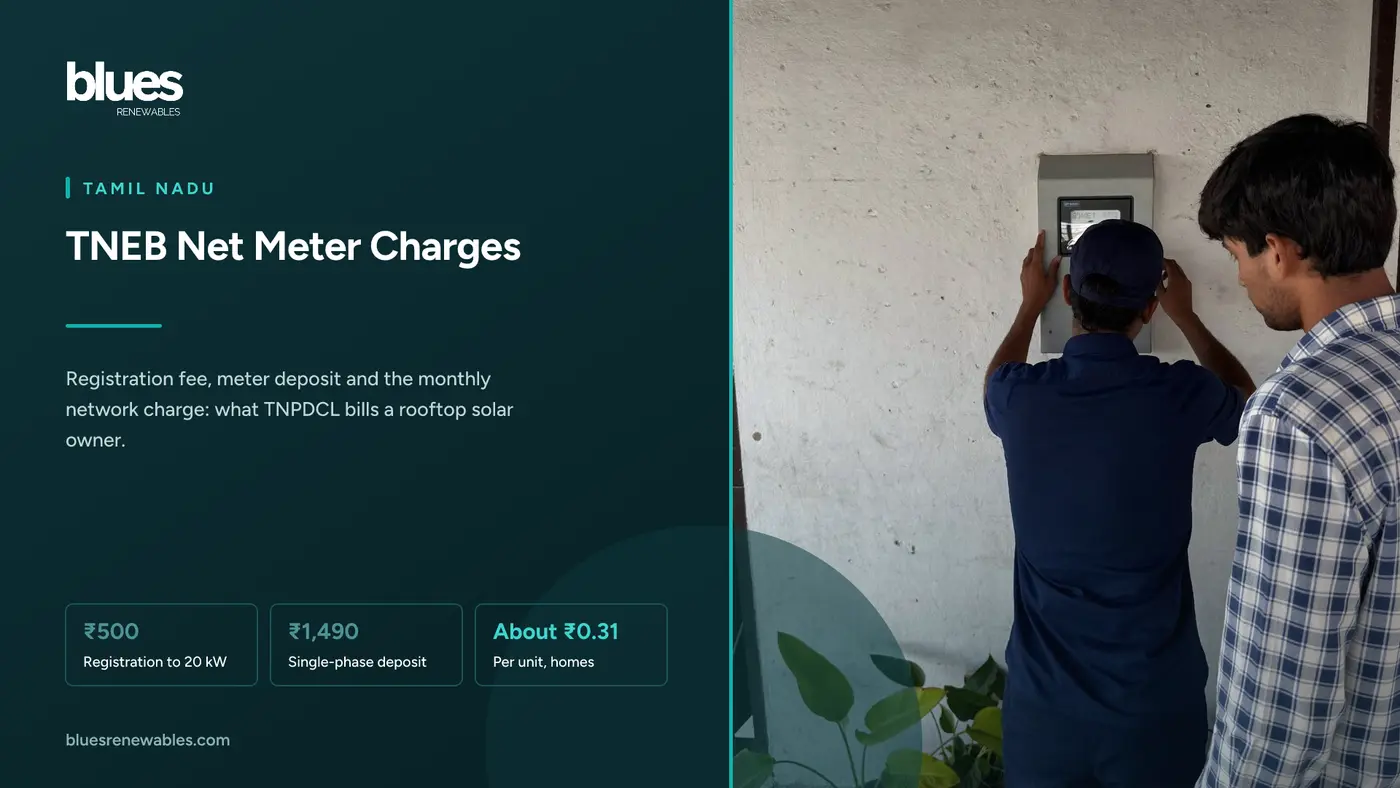
A home rooftop solar system in Tamil Nadu costs ₹500 to register with TNPDCL. That is the only one-time charge with a published price on TNPDCL's solar portal. The bills that follow are less clear: a one-time demand for the bidirectional meter, and a network charge on every bill after commissioning.
Most homeowners first see these on the TNPDCL estimate or their first solar bill, with no explanation, and installers quote different meter prices.
This guide sets out every charge TNPDCL can levy on a rooftop system, what it costs, which document sets it, and how you pay. For the application process itself, see our TANGEDCO net metering application guide.
Key takeaways
- Registration costs ₹500 up to 20 kW. Above 20 kW on LT, add ₹100 for every 20 kW or part of it. HT systems pay ₹5,000 or ₹10,000 plus GST.
- TNPDCL supplies, tests and fits the bidirectional meter, and the consumer pays for it. TNPDCL does not publish one price for it on the solar portal.
- The first installation test is free. TNERC's charges schedule also lists a ₹1,490 meter caution deposit for a single-phase solar meter.
- The monthly cost for a home is the network charge, about ₹0.31 per unit generated up to 10 kW. That works out to roughly ₹120 to ₹145 a month for a 3 kW system.
- Above 10 kW you also buy a generation meter, and businesses pay the full network charge on metered generation, so a 15 kW shop pays around ₹3,000 a month.
What TNEB net meter charges include
"Net meter charges" covers four kinds of payment, and only the first is a fixed published fee:
Registration fee, paid once on the Unified Solar Rooftop Portal (USRP).
Meter charges, paid once: the bidirectional meter, plus a generation meter above 10 kW and a check meter above 20 kW.
Inspection fees: the first TNPDCL test is free; CEIG charges its own fee above 10 kW.
Recurring charges after commissioning: network charges, plus fixed charges for non-domestic tariffs.
TNPDCL, formerly TANGEDCO, still follows TNERC Generic Tariff Order No. 8 of 2021 for rooftop solar, according to its "Policies adopted" note on USRP.
TNEB solar registration fee
TANGEDCO's circular on Order 8/2021 sets these registration fees:
- LT - Plant capacity: Up to 20 kW, Registration fee: ₹500
- LT - Plant capacity: Above 20 kW up to 150 kW, Registration fee: ₹500 for the first 20 kW, plus ₹100 for every further 20 kW or part of it
- HT - Plant capacity: Above 150 kW up to 500 kW, Registration fee: ₹5,000
- HT - Plant capacity: Above 500 kW up to 999 kW, Registration fee: ₹10,000
By our arithmetic from that formula, a 40 kW system pays ₹600, 60 kW pays ₹700, 100 kW pays ₹900 and 150 kW pays ₹1,200.
A TANGEDCO proceeding of 14 September 2023 adds GST to the HT fees and moved HT applications online, to the Superintending Engineer of your distribution circle.
The ₹100 fee in older articles dates from TANGEDCO's 2019 instructions and ended with Order 8/2021.
How to pay TNEB net meter charges online
Registration fee. The USRP FAQ says application charges are paid through TANGEDCO's payment portal after you register. Our TNEB solar portal guide walks through the screens.
Meter and estimate charges. TNPDCL's process guide on USRP says the Assistant Engineer prepares a cost estimate after registration, and the meter demand appears there. Any fee left unpaid is added to your next electricity bill.
HT applicants get a payment advice within three days of applying, and a separate demand for the bidirectional meter.
Recurring charges arrive on your normal electricity bill.
The bidirectional meter: who supplies it and what it costs
What the meter is
Order 8/2021 requires one bidirectional meter at the service connection point. It must be a digital four-quadrant meter, class 1.0 accuracy, with at least four import and four export Time of Day registers. It replaces your existing meter. Our guide to TNEB solar meter reading explains its display.
Your net meter matches your existing service: a single-phase service gets a single-phase meter, and a three-phase service gets a three-phase meter. Above 50 kW, LT services use CT-operated meters.
Who supplies it
TANGEDCO's 2019 working instructions say TANGEDCO will procure, test and install the meters, and that the consumer bears the cost of the meter and its installation and testing. A consumer may buy one only in an emergency, to TANGEDCO's specification and with prior approval from the Director/Distribution.
Today the Assistant Engineer fits whole-current meters and the MRT (Meter Relay Test) wing fits CT-operated ones, per TNPDCL's process guide.
Under PM Surya Ghar, the MNRE model agreement between you and your installer puts "net meter supply/procurement, testing and approvals" in the vendor's scope. Ask your installer whether the quote includes the TNPDCL meter demand or whether you pay it separately.
What it costs
TNPDCL does not publish a single net meter price on the USRP portal. Here is what the documents do say:
- Meter caution deposit, single-phase solar - Amount: ₹1,490, Source: TNERC Order 7 of 2025, from 1 July 2025
- Meter caution deposit, LT CT solar - Amount: ₹11,055, Source: Same order
- Meter caution deposit, three-phase static meter, 10 to 60 A - Amount: ₹2,215, Source: Same order (no separate three-phase solar line)
- First installation test and inspection - Amount: Free, Source: Same order
- Re-test after a fault in your installation - Amount: ₹165, Source: Same order
- Challenge test if you dispute meter accuracy - Amount: GESL or NABL lab rates, Source: Same order
- Net meter charge, single-phase - Amount: ₹2,764 (reported), Source: TANGEDCO circular of 18 May 2024, as reported by installers
- Net meter charge, three-phase - Amount: ₹5,011 (reported), Source: Same reports
Installers reported that the May 2024 circular cut these from ₹5,500 and ₹10,588 and dropped the testing fee. We could not find the circular on a TNPDCL or TNERC site, so treat the figures as a guide; the demand on your own estimate is what counts.
There is no monthly rent on an LT net meter. TNERC's schedule lists meter rent only for HT services (₹4,090 per service connection), waived when the consumer owns the meter.
Generation meter and check meter
Generation meter. Up to 10 kW you do not need one: TNPDCL takes generation as the lower of 21% CUF (5.04 units per kW per day) or your inverter reading. Above 10 kW, Order 8/2021 makes a generation meter with demand recording mandatory, "at the cost of the applicant". TNPDCL publishes no price for it, so it is a line in your installer's quote.
Check meter. Above 20 kW, TNPDCL installs a check meter; up to 20 kW it is optional. The order does not say who pays, so look for it on your estimate.
CEIG fees. Above 10 kW, Electrical Inspectorate approval, with its own fee, comes before the meter. Our guide to CEIG approval for solar in Tamil Nadu covers it.
Monthly charges after commissioning
Network charges
Network charges are the main recurring cost, levied on units generated, not units exported. TNPDCL's portal note gives these rates:
- Domestic up to 10 kW - Network charge: 20% of ₹1.53, about ₹0.31 per unit
- Domestic above 10 kW - Network charge: 75% of ₹1.48, about ₹1.11 per unit
- LT non-domestic (shops, offices, factories) - Network charge: ₹1.53 per unit on total generation
- HT, net feed-in - Network charge: ₹0.96 per unit
- Gross metering - Network charge: Nil
TNERC's Tariff Order 6 of 2025 sets the LT network charge at ₹1.60 for 2025-26, and DT Next reported TNPDCL billing ₹1.59 from July 2024, so your bill may use a slightly higher base. At 20%, that is about ₹0.32 per unit instead of ₹0.31.
Monthly charge for a home up to 10 kW, over 30 days. "Cap" is the 21% CUF figure; "typical" uses 4.4 units per kW per day, the middle of Chennai's usual 4 to 4.8.
- 3 kW, typical output - Units assessed per month: 396, At ₹0.31 per unit: about ₹121, At ₹0.32 per unit: about ₹127
- 3 kW, at the CUF cap - Units assessed per month: 454, At ₹0.31 per unit: about ₹139, At ₹0.32 per unit: about ₹145
- 5 kW, typical output - Units assessed per month: 660, At ₹0.31 per unit: about ₹202, At ₹0.32 per unit: about ₹211
- 5 kW, at the CUF cap - Units assessed per month: 756, At ₹0.31 per unit: about ₹231, At ₹0.32 per unit: about ₹242
Domestic bills are two-monthly, so double these per bill. A home system should never be charged above the cap; if yours is, ask the section office for the working. Our network charges guide covers the rates, the MSME reduction and the disputes in depth.
Fixed charges
Solar adds no fixed charge. Domestic (LT IA) consumers pay none under Tariff Order 6 of 2025; LT commercial consumers pay ₹110 per kW of contracted demand per month up to 50 kW, with or without solar. Our guide to why the bill is not zero after solar covers what else stays on the bill.
What you pay TNPDCL: 3 kW home vs 15 kW shop
- Registration fee - 3 kW home (domestic, net metering): ₹500, 15 kW shop (LT commercial, net feed-in): ₹500
- Bidirectional meter - 3 kW home (domestic, net metering): On TNPDCL's estimate; reported ₹2,764 single-phase or ₹5,011 three-phase, 15 kW shop (LT commercial, net feed-in): On the estimate; reported ₹5,011 (three-phase whole-current)
- First installation test - 3 kW home (domestic, net metering): Free, 15 kW shop (LT commercial, net feed-in): Free
- Generation meter - 3 kW home (domestic, net metering): Not required, 15 kW shop (LT commercial, net feed-in): Required, bought by you; no published price
- Check meter - 3 kW home (domestic, net metering): Not required, 15 kW shop (LT commercial, net feed-in): Optional up to 20 kW
- Inspection - 3 kW home (domestic, net metering): AEE/O&M, no separate fee listed, 15 kW shop (LT commercial, net feed-in): CEIG, with its own fee
- Network charges - 3 kW home (domestic, net metering): About ₹121 to ₹145 a month, 15 kW shop (LT commercial, net feed-in): About ₹3,030 a month at ₹1.53 (1,980 units), about ₹3,170 at ₹1.60
- Fixed charges - 3 kW home (domestic, net metering): Nil, 15 kW shop (LT commercial, net feed-in): Unchanged by solar: ₹110 per kW of contracted demand, at least ₹1,650 a month
For the home, TNPDCL's one-time charges come to roughly ₹3,300 to ₹5,500, plus about ₹1,450 to ₹1,750 a year in network charges. For the shop, the network charge alone is about ₹36,000 a year, which belongs in any commercial solar payback calculation.
Frequently asked questions
What is the TNEB solar registration fee?
₹500 for LT systems up to 20 kW. Above 20 kW up to 150 kW, add ₹100 for every further 20 kW or part of it. HT systems pay ₹5,000 up to 500 kW and ₹10,000 up to 999 kW, plus GST.
How much does a solar net meter cost in Tamil Nadu?
TNPDCL does not publish one price. Installers citing a May 2024 TANGEDCO circular quote ₹2,764 single-phase and ₹5,011 three-phase. TNERC also lists a ₹1,490 caution deposit for a single-phase solar meter. Your TNPDCL estimate shows the actual demand.
Can I buy my own bidirectional meter?
Normally no. TNPDCL procures, tests and installs it, and allows a consumer-bought meter only in an emergency, to its specification and with prior approval.
What are TNEB solar net metering charges per month?
For a home up to 10 kW, the network charge of about ₹0.31 per unit generated comes to roughly ₹121 to ₹145 a month for 3 kW and ₹202 to ₹242 for 5 kW. There is no domestic fixed charge.
How do I pay TNEB net meter charges online?
Pay the registration fee through TANGEDCO's payment portal after applying on USRP. The meter demand comes on TNPDCL's estimate; anything unpaid, and the network charges, appear on your electricity bill.
Is there a monthly rent for the net meter?
No. TNERC's charges schedule lists meter rent only for HT services, and not when the consumer owns the meter.
Do I need a generation meter for a 3 kW system?
No. Up to 10 kW, generation is assessed at 21% CUF or your inverter reading, whichever is lower. A generation meter is mandatory above 10 kW, at your cost.
Where this fits
The application, both meters and settlement are covered in the TANGEDCO net metering application guide. For billing methods, read net metering vs net feed-in in Tamil Nadu; for what exports earn, the solar export unit price in Tamil Nadu. Your system size is capped by your sanctioned load. For system prices, see the 3 kW and 5 kW price pages or the solar calculator. TNPDCL helplines are listed in PM Surya Ghar complaints.
Blues Renewables has installed rooftop solar across Tamil Nadu from its Chennai base since 2020. We file the USRP application, follow the TNPDCL estimate until the meter is fitted, and show every TNPDCL charge as its own line in our quote, so nothing arrives as a surprise. Every system comes with two years of free maintenance from commissioning. Call +91 98841 07170.
Sources
- TNPDCL, "Policies adopted" note on the USRP portal, viewed 1 October 2026: Order 8/2021 still applied; network charges of 20% of ₹1.53, 75% of ₹1.48, ₹1.53 and ₹0.96; no network charge under gross metering
- TANGEDCO Technical Branch (CE/NCES), salient features of TNERC Order No. 8 of 2021, signed 30 December 2021: LT and HT registration fees; meter specification; generation and check meter rules
- TANGEDCO, CMD Proceedings No. 198, 14 September 2023: HT applications online to the SE/EDC; HT fees plus GST; separate bidirectional meter demand
- TANGEDCO Chief Engineer/Commercial, working instructions for solar net feed-in, Memo dated 10 May 2019: TANGEDCO procures, tests and installs meters at the consumer's cost; emergency-only consumer procurement; the old ₹100 fee
- TNPDCL, "Apply for Rooftop Solar (PM Surya Ghar)" process guide on USRP, viewed 1 October 2026: AE cost estimate; meter fitted by AE (non-CT) or MRT (CT); unpaid fees added to the next bill
- TNPDCL, USRP FAQ, viewed 1 October 2026: application charges paid through TANGEDCO's payment portal; AEE and CEIG inspection thresholds
- MNRE model agreement between consumer and vendor, on USRP, viewed 1 October 2026: net meter supply, testing and approvals in the vendor's scope
- TNERC, Suo-motu Order No. 7 of 2025 (non-tariff miscellaneous charges), 30 June 2025, in force from 1 July 2025: meter caution deposits, test charges, HT-only meter rent
- TNERC, Tariff Order No. 6 of 2025, 30 June 2025: LT network charge of ₹1.60 per unit for 2025-26; no fixed charge for LT IA domestic; ₹110 per kW per month for LT V up to 50 kW. TNERC's 2026 order list, viewed 1 October 2026, shows no later revision
- DT Next, 19 October 2024: TNPDCL billing domestic network charges on ₹1.59 per unit from 1 July 2024, and the 5.04 units per kW per day assessment
- Installer reports of a TANGEDCO circular dated 18 May 2024, viewed 1 October 2026: net meter charges of ₹2,764 and ₹5,011, down from ₹5,500 and ₹10,588, testing fee dropped (circular not found on TNPDCL or TNERC sites)