TNEB Additional Load Application 2026: Apply Online, Charges and Status
How to raise your TNPDCL sanctioned load online in 2026: documents, charges per kW, single to three phase cost, timelines and how to track the status.

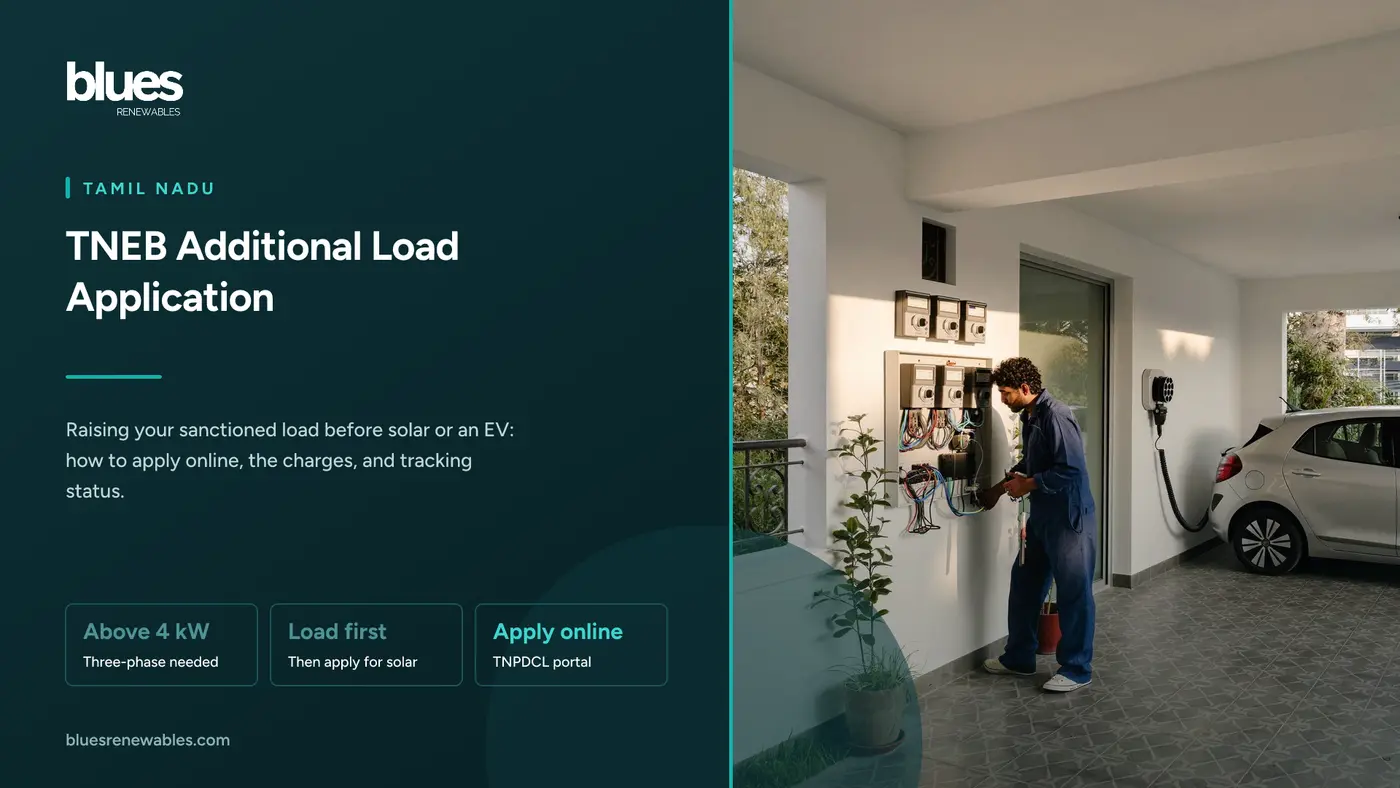
In Tamil Nadu, single-phase supply stops at 4,000 watts of connected load. Above that, TNPDCL connects you on three-phase only, and its own charges calculator refuses a single-phase request above 4 kW.
That catches many solar buyers: the quote says 5 kW, the bill says 4 kW, and the installer says to raise your load first.
This guide covers the TNEB additional load application: where to apply online, the documents, the 2026 charges, what a single-phase to three-phase change costs, the timelines and how to track status. Adding panels to an existing solar system is a different process, covered in TNEB solar additional load.
Key takeaways
- You apply online on TNPDCL's application portal, under Apply, Existing Service Connections, Additional Load.
- Charges come from TNERC Order 7 of 2025, in force since 1 July 2025: ₹2,215 per kW development charge for three-phase domestic supply from overhead lines, ₹5,525 per kW from underground cable.
- Going from 4 kW single-phase to 5 kW three-phase costs ₹20,310 upfront in TNPDCL's calculator on overhead lines, and ₹36,860 where the street main is underground.
- The regulator's deadline is 7 days when no line work is needed, and 60 or 90 days when lines or a transformer must be added.
- Raise the load before you apply for solar, because solar capacity is checked against the sanctioned load on record.
What a TNEB additional load application is
An additional load application asks TNPDCL to increase the sanctioned load, in kW, on an existing service connection. TANGEDCO's distribution business became TNPDCL in 2024, but most people still say TNEB.
TNERC applies the same development charges and supply deadlines as for a new connection. It is not the "Apply for Solar Additional Load" option on the solar rooftop portal, which raises solar capacity on a home that already has solar.
For domestic tariff LT IA, the current tariff order (TNERC Order 6 of 2025) has no per-kW fixed charge, so raising a home's load means one-time charges and deposits, not a higher monthly bill.
Why solar and EV buyers need a load increase
Your rooftop solar capacity cannot exceed your sanctioned load, measured on the inverter's AC side. We explain that cap in the solar capacity limit in Tamil Nadu.
The phase rule turns a small increase into a bigger job. Under the Tamil Nadu Electricity Distribution Code, single-phase supply covers a connected load up to 4,000 watts, and three-phase covers anything above it, up to 150 kW. So a 4 kW home that wants 5 kW of solar is not just adding 1 kW. It is converting to three-phase.
An electric car does the same, since a home charger alone can exceed a 4 kW connection, as our guide to solar for EV charging at home shows. If both are coming, raise the load once to cover both.
How to check your current sanctioned load and phase
Your sanctioned load in kW appears on your electricity bill, along with your service connection number, which is also on the SMS and the white meter card.
For the phase, look at the meter board. A three-phase service has a three-phase meter and three fuse cut-outs; a single-phase service has one. Most homes at 4 kW or below are single-phase, though the code lets a consumer choose either up to 4,000 watts. The Assistant Engineer (AE) at your section office can confirm both.
How to apply for additional load online
TNPDCL takes these applications on its Online Application Portal, reached from Online Services on the TNPDCL website. Its five-step guide:
Pick the type: Apply, then Existing Service Connections, then Additional Load.
Enter your service connection number with the region code.
Enter the load details: category, the phase you need (three-phase if the new total exceeds 4 kW) and the loads. The portal totals the connected load.
Upload the documents below.
Submit and pay. You get an Acknowledgement cum Demand Notice and an Application Reference Number. Pay on TNPDCL's payment portal, logging in with the reference number as username and your mobile number as password.
Aadhaar is mandatory for domestic applications. The AE checks the documents, inspects the site and issues a demand for the remaining charges; once you pay, TNPDCL does any line work and effects the higher load.
Documents required
- A recent photo of the applicant
- A certified copy of ownership proof: sale deed, partition deed, gift settlement, allotment letter, computer patta, an ownership certificate from revenue officials, a court judgement or a recent property tax receipt
- For joint property, consent letters from co-owners, or an indemnity bond with an enhanced security deposit
- For tenants, the owner's consent in Form 5, or proof of occupancy with an indemnity bond in Form 6
Domestic applicants need not submit hard copies or show originals.
Your side of the work
Since a 2023 Distribution Code amendment, the consumer provides the service wire from the pole or pillar box to the meter. For three-phase, your electrician rewires the meter board, and a licensed electrical contractor fills in TNPDCL's test certificate form, which you keep.
TNEB additional load charges in 2026
The charges come from TNERC Suo-motu Order No. 7 of 2025, dated 30 June 2025, effective 1 July 2025 and valid until the next order. TNERC's 2026 order list, viewed on 1 October 2026, shows no newer one, and TNPDCL's portal still cites it.
- Registration cum processing - Single-phase: ₹220, Three-phase: ₹220
- Development charge, overhead line - Single-phase: ₹3,095 per service, Three-phase: ₹2,215 per kW
- Development charge, underground cable - Single-phase: ₹7,735 per service, Three-phase: ₹5,525 per kW
- Service connection charge - Single-phase: ₹1,105, Three-phase: ₹1,660 (up to 50 kW)
- Security deposit (current consumption deposit) - Single-phase: ₹330 per service, Three-phase: ₹995 per kW
- Meter caution deposit, static meter - Single-phase: ₹825, Three-phase: ₹2,215 (10 to 60 A)
- Meter caution deposit, smart meter - Single-phase: ₹4,305, Three-phase: ₹6,520 (10 to 60 A)
The calculator adds a ₹165 testing fee and shows GST as nil. TNERC revises these each July by CPI inflation, capped at 6%, so check the calculator before paying.
Your street decides which development charge applies. In April 2024 TNERC told the board to stop charging underground rates where only overhead lines exist, DT Next reported, so query a cable rate on an overhead street.
Single phase to three phase charges
The Distribution Code says that on a single-phase to three-phase conversion, TNPDCL collects only the difference in development charges, if you paid the single-phase charge when you took the connection.
The calculator ignores that credit and charges on your full demand after the increase. TNPDCL's portal says the development charge is finalised at inspection and any excess is adjusted against your bills, so treat the calculator figure as the upfront maximum. A conversion also adds the ₹1,660 service connection charge.
The additional load charges calculator
Under Services, open Application Charges and choose Load Addition. We ran three domestic cases on 1 October 2026:
- Meter caution deposit - 4 kW single-phase to 5 kW three-phase, overhead: ₹2,215, Same, underground: ₹2,215, 5 kW three-phase to 7 kW, overhead: ₹2,215
- Current consumption deposit - 4 kW single-phase to 5 kW three-phase, overhead: ₹4,975, Same, underground: ₹4,975, 5 kW three-phase to 7 kW, overhead: ₹6,965
- Development charges - 4 kW single-phase to 5 kW three-phase, overhead: ₹11,075, Same, underground: ₹27,625, 5 kW three-phase to 7 kW, overhead: ₹15,505
- Testing fee - 4 kW single-phase to 5 kW three-phase, overhead: ₹165, Same, underground: ₹165, 5 kW three-phase to 7 kW, overhead: ₹165
- Service connection charge - 4 kW single-phase to 5 kW three-phase, overhead: ₹1,660, Same, underground: ₹1,660, 5 kW three-phase to 7 kW, overhead: Nil
- Registration cum processing - 4 kW single-phase to 5 kW three-phase, overhead: ₹220, Same, underground: ₹220, 5 kW three-phase to 7 kW, overhead: ₹220
- Total - 4 kW single-phase to 5 kW three-phase, overhead: ₹20,310, Same, underground: ₹36,860, 5 kW three-phase to 7 kW, overhead: ₹25,070
The two deposits are held, not spent, and earn interest at a rate TNERC sets yearly, most recently in Order 3 of 2026.
How long TNEB takes to sanction additional load
TNERC's LT time limits apply to additional load, under the Standards of Performance Regulations as amended from 21 February 2024:
- No extension or improvement of lines - Time limit: Preferably 3 days, at most 7 days
- Extension or improvement, no new distribution transformer - Time limit: 60 days
- Extension or improvement with a distribution transformer - Time limit: 90 days
You must pay a demand within 15 days, and time you take to pay or fix defects is not counted. If TNPDCL misses the deadline, the regulations entitle you to ₹200 a day, up to ₹2,000.
How to track your additional load application status
On the TNPDCL portal, open Status, then Application Status, and search by Application Reference Number or mobile number with region code. You can also pay pending charges there. The portal's FAQ covers the usual problems:
- Payment not showing, or you want to edit or cancel: contact the AE, Operation and Maintenance. Edits open only after the AE puts the application on hold.
- "An application is already pending for this service connection": the portal will not take a second online application on that connection. Ask the AE.
- Refund: cancelled additional load applications paid online, from 1 December 2022, are refunded online.
- Anything else: use Enter Grievance, or email nschelpdesk@tnebnet.org. The power support line is 94987 94987.
Planning solar: the order of steps
Check your sanctioned load and phase.
Set the target load, adding the solar size you want and any EV charger.
Apply for additional load and pay the demand promptly.
Wait until the new load and meter are in place.
Then apply for solar on the TNEB solar portal, via PM Surya Ghar for the subsidy.
Net metering follows commissioning, as our TANGEDCO net metering application guide explains.
Worked example: a 4 kW home planning 5 kW of solar
Take a single-phase Chennai home with a 4 kW sanctioned load on overhead lines that wants 5 kW of solar, roughly 20 to 24 units a day at 4 to 4.8 units per kW.
Stay at 4 kW, and the inverter is capped at 4 kW AC: about 120 to 144 fewer units a month.
Raise the load to 5 kW, and the change is a conversion to three-phase, because 5 kW exceeds 4,000 watts. TNPDCL's calculator puts it at ₹20,310 upfront, or ₹36,860 on an underground main.
Of that, ₹7,190 is deposits and ₹13,120 is charges, before any difference-rule credit at inspection. Budget separately for the electrician's rewiring and service cable. With no line work, the limit is 7 days from payment, and then you file the 5 kW solar application.
Central assistance tops out at ₹78,000 from 3 kW, so the subsidy does not change. A 5 kW system costs about ₹3,20,000 before subsidy (see our 5 kW solar panel price page), so the conversion adds a few percent for a fifth more generation. If an EV is likely, raise the load once for both.
Frequently asked questions
How do I apply for additional load in TNEB online?
On TNPDCL's Online Application Portal, choose Apply, Existing Service Connections, Additional Load. Enter your service connection number and load details, upload your photo and ownership proof, and pay the ₹220 registration fee.
What are TNEB additional load charges per kW?
For domestic three-phase supply, the development charge is ₹2,215 per kW from overhead lines and ₹5,525 per kW from underground cable, under TNERC Order 7 of 2025. The security deposit is ₹995 per kW, plus fixed amounts for registration, service connection and the meter deposit.
How much does single phase to three phase conversion cost in TNEB?
TNPDCL's calculator shows ₹20,310 from 4 kW single-phase to 5 kW three-phase on overhead lines, and ₹36,860 on underground cable. That includes refundable deposits, and the development charge can fall at inspection.
How long does TNEB take to approve additional load?
Up to 7 days when no line work is needed, 60 days when lines must be extended and 90 days when a transformer is needed. Time you take to pay is not counted.
How do I check my TNEB additional load application status?
Use Status, then Application Status, on the TNPDCL portal with your reference number or mobile number. For payment or document problems, contact the AE at your section office.
Will raising my sanctioned load increase my monthly bill?
Not on domestic tariff LT IA, which has no per-kW fixed charge in the current tariff order. You pay one-time charges and deposits, and the bill still depends on units used.
Where this fits
This guide raises the connection. For why sanctioned load limits solar, read the solar capacity limit in Tamil Nadu; to add panels to an existing system, see TNEB solar additional load. The subsidy choice is in TNEB solar CFA vs non-CFA.
Blues Renewables has installed rooftop solar across Tamil Nadu from its Chennai base since 2020, for systems from 3 kW upwards. We check your sanctioned load and phase at the survey, tell you whether a load increase is worth it, and sequence the load and solar applications so each is filed once. Every system includes two years of free maintenance from commissioning. Call +91 98841 07170.
Sources
- TNERC, Suo-motu Order No. 7 of 2025, Non-Tariff Miscellaneous Charges, 30 June 2025, viewed 1 October 2026: every charge in the tables, and the CPI revision capped at 6%
- TNERC, Tariff Order No. 6 of 2025, 30 June 2025: no per-kW fixed charge for domestic LT IA
- TNERC, 2026 tariff orders list, viewed 1 October 2026: no newer charges order; Order 3 of 2026 on deposit interest
- TNERC, Distribution Code, consolidated to 31 March 2024: the 4,000 watt single-phase limit, development charges on additional load, the conversion difference rule, the consumer-supplied service wire
- TNERC, Distribution Standards of Performance Regulations, consolidated to 31 March 2024: the 7, 60 and 90 day limits, 15-day payment window and ₹200 a day compensation
- TNPDCL Online Application Portal, viewed 1 October 2026: menus, five-step guide, documents, payment login, status search, FAQ, helpdesk, the inspection adjustment note
- TNPDCL Application Charges calculator, run 1 October 2026: the three itemised cases and the 4 kW single-phase block
- Tamil Nadu Single Window Portal, LT load addition procedure: scrutiny, inspection and demand sequence
- DT Next, 5 April 2024: TNERC's direction on underground development charges in overhead areas
- TANGEDCO Technical Branch, salient features of TNERC Order 8 of 2021, 30 December 2021: solar capacity within sanctioned load, AC side
- TNPDCL Unified Solar Rooftop Portal, viewed 1 October 2026: the separate solar additional load service and the ₹78,000 subsidy
- Blues Renewables data, Chennai, 2020 to 2026: generation per kW and the 5 kW price