



Capacity page · 2026 pricing
100 MW Solar Power Plant Cost in India
Last reviewed August 2026 · capex, land aggregation, 220 kV connectivity, tenders
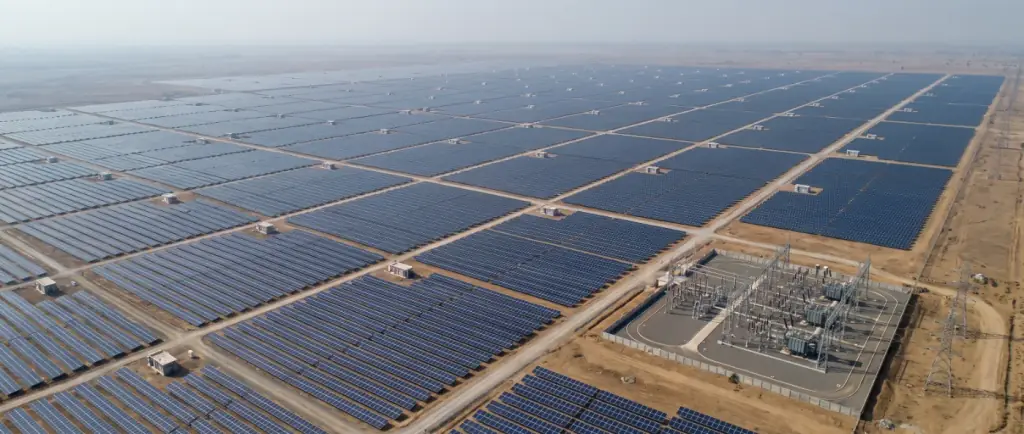
A 100 MW solar power plant costs ₹330 to ₹360 crore turnkey in 2026, excluding land. That is about ₹3.40 crore per MW, sixteen per cent below a 1 MW plant. It needs 400 to 500 acres, generates about 16.6 crore units a year in Tamil Nadu, connects at 220 kV into a pooling substation, and is built against a tender or a corporate PPA rather than a feed-in tariff.
At 100 MW the plant is the easy part. Land assembly and transmission connectivity take two to three years and decide whether the project exists at all. Construction is fourteen to twenty months of well-understood work.
Baseline on this page
100,000 kWp of non-DCR modules, fixed tilt, level terrain, a 220 kV pooling substation within five kilometres, land excluded, 18.9–19.6% CUF, O&M at ₹4.75 crore a year, degradation 0.5% a year.
Read alongside
Get a free feasibility read for your 100 MW site
Tell us the package and where the site is, or send the capex assumptions in your model and we will say whether they sit inside the market band.
Cost breakdown
₹340 crore, line by line
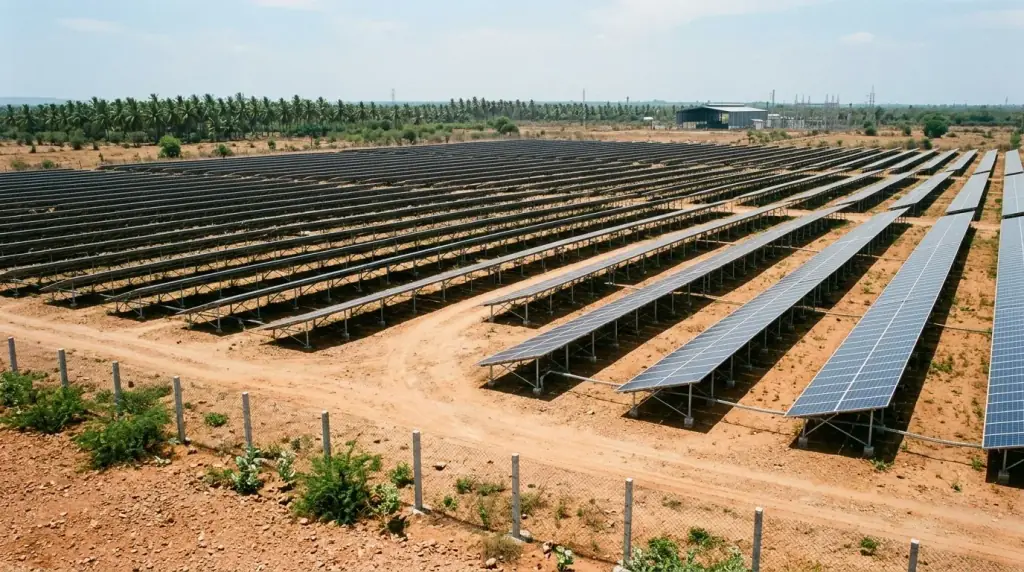
Baseline plant: 100,000 kWp of non-DCR modules on fixed tilt, level terrain, a 220 kV pooling substation within five kilometres, land excluded, GST treated separately. The midpoint of the band is ₹340 crore, which is ₹34 a watt.
| Line item | Cost | Share | What moves it |
|---|---|---|---|
| Modules, 100,000 kWp | ₹149 cr | 44% | Cell origin, contract timing and the delivery programme. Roughly 1,800 to 2,200 containers. |
| Inverters | ₹27 cr | 8% | Central inverters in ten to twelve blocks, or string inverters where the terrain is broken. |
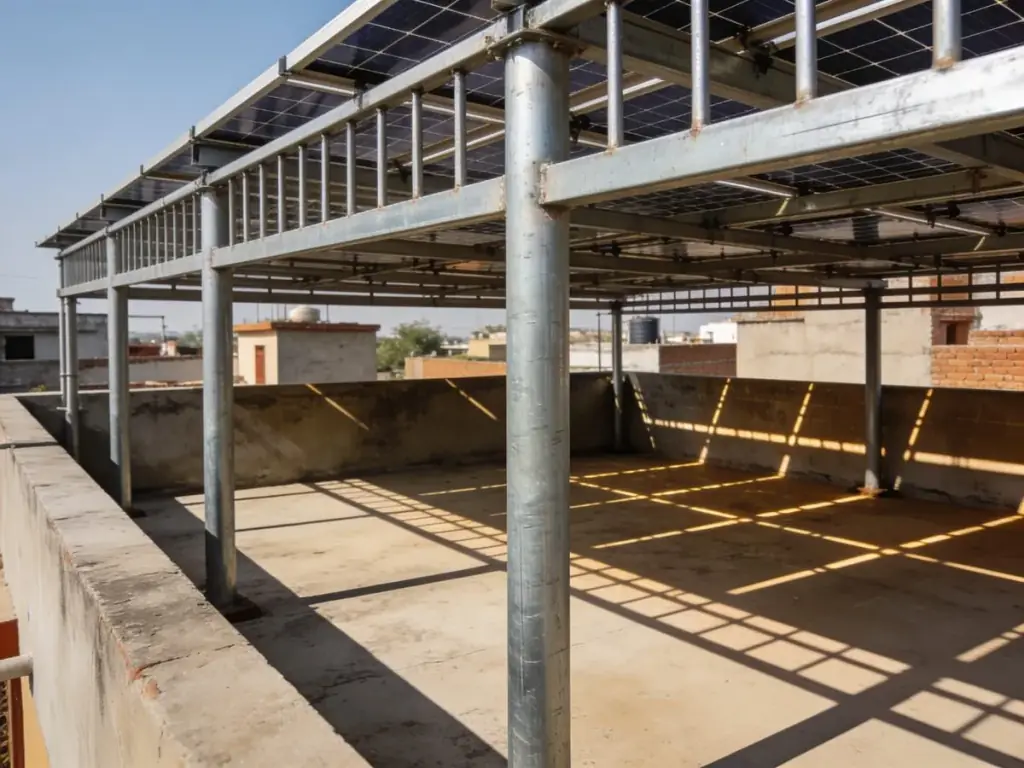
| Mounting structure | ₹41 cr | 12% | Steel price at the time of order, galvanisation specification and pile depth after the geotechnical survey. |
| DC and AC cabling, combiner boxes | ₹27 cr | 8% | Block layout. At this scale cable optimisation is a real engineering exercise worth crores. |
| Civil works, roads, drains, buildings | ₹24 cr | 7% | Internal roads across 450 acres, drainage, control rooms and the switchyard civil scope. |
| Pooling substation and 220 kV switchyard | ₹34 cr | 10% | Whether the pooling substation is yours alone or shared, and how much of the bay scope sits with the transmission utility. |
| SCADA, monitoring, weather, security systems | ₹4 cr | 1% | Plant controller, forecasting and scheduling capability, which is a regulatory requirement at this size. |
| Approvals, DPR, surveys, inspectorate | ₹6 cr | 2% | Diligence at institutional standard, including lender engineer scope and independent yield assessment. |
| Contractor margin, insurance, contingency | ₹28 cr | 8% | Programme risk, liquidated damages exposure and how the module price risk is allocated. |
| Turnkey total | ₹340 cr | ₹34/W | Band ₹330 cr to ₹360 cr on competent bids |
Excluded: land or lease, the transmission line beyond the pooling substation, GST, interest during construction of ₹18 to ₹30 crore, and the debt service reserve. Project cost as a lender sees it is typically ₹400 to ₹470 crore.
Cost per MW
The curve flattens, and then it stops
Per-MW cost falls from ₹4.05 crore at 1 MW to about ₹3.40 crore at 100 MW, and barely moves after that. Ninety per cent of the bill at this scale is a per-watt cost that no amount of volume changes.
| Capacity | Per MW | Against 1 MW | Evacuation |
|---|---|---|---|
| 1 MW | ₹4.05 cr | — | 11 kV |
| 2 MW | ₹3.90 cr | −4% | 33 kV |
| 5 MW | ₹3.75 cr | −7% | 33 kV |
| 10 MW | ₹3.60 cr | −11% | 33–110 kV |
| 25 MW | ₹3.50 cr | −14% | 110 kV |
| 100 MW | ₹3.40 cr | −16% | 220 kV |
Module price is a market, not a discount
A 100 MW order buys better terms and delivery priority, but the price is set by the global cell and wafer market. The difference between a 10 MW and a 100 MW module price is one to three per cent, not twenty.
Where scale genuinely pays
Fixed costs spread thin: one DPR, one connectivity process, one site establishment, one management team. Six crore of approvals on ₹340 crore is 2 per cent; ₹18 lakh on ₹4 crore is 4.5.
Where scale costs you more
A 220 kV pooling substation, forecasting and scheduling obligations, a site team of hundreds, and a supply chain that has to be managed rather than ordered. Some of these do not exist at all below 25 MW.
Connectivity
A 220 kV bay, and a queue you do not control
At 100 MW you are connecting to the transmission network rather than to a distribution feeder, which changes who you deal with, how long it takes, and what can go wrong.
A pooling substation
Yours alone or shared with other generators nearby. ₹30 to ₹40 crore of scope, and if it is shared, your commissioning date depends partly on other developers.
Long-term access, not just connectivity
Connectivity gives you a physical connection; long-term access gives you the right to use the network. Both are applications, both have queues, and the second one is where projects wait.
ISTS or state network
Interstate transmission changes the charge structure, the scheduling regime and the counterparty. If a model relies on a transmission charge waiver, verify the current position and any commissioning deadline attached to it.
Forecasting and scheduling
A plant of this size has to forecast and schedule its generation, with deviation settlement charges for getting it wrong. That is a system, a service contract and an operational discipline, not a formality.
The line beyond the substation
Every kilometre of 220 kV line is ₹60 to ₹70 lakh, plus way leave, plus any forest or railway crossing. Five kilometres is a ₹3.5 crore line; twenty is a project of its own.
Grid code compliance
Reactive power capability, low voltage ride through, protection coordination and metering at transmission accuracy class. All of it is testable and all of it is tested before charging.
Land aggregation
Four hundred and fifty acres, and everyone who owns a piece of it
This is the item that decides whether a 100 MW project happens. Extent is arithmetic; parcels and owners are a programme with a timeline of its own. Set your actual position and see what it implies.
This is why solar parks exist. Allotted land inside a park with a ready pooling substation removes both the aggregation programme and the connectivity queue, and developers pay a premium per acre for exactly that.
Generation
16.6 crore units a year, where a decimal point is worth crores
A 100 MW plant generates about 16.6 to 17.2 crore units a year in Tamil Nadu at 18.9 to 19.6 per cent capacity utilisation. At this scale a 0.3 percentage point difference in capacity utilisation is about ₹65 lakh of revenue a year at ₹2.60 a unit.
| State | CUF | Year one | 25-year revenue |
|---|---|---|---|
| Tamil Nadu | 19.0% | 16.6 crore units | ₹1,014 cr |
| Karnataka | 19.4% | 17.0 crore units | ₹1,039 cr |
| Andhra Pradesh | 19.8% | 17.3 crore units | ₹1,057 cr |
| Gujarat | 20.4% | 17.9 crore units | ₹1,094 cr |
| Rajasthan | 20.8% | 18.2 crore units | ₹1,112 cr |
Why the yield assessment is a serious document at this size
The difference between Tamil Nadu and Rajasthan on identical equipment is ₹98 crore of lifetime revenue. That is why 100 MW projects commission a full resource assessment with ground-measured data, model P50, P75 and P90 cases, and let the lender engineer review the methodology. At 1 MW a satellite dataset is adequate; at 100 MW it is not. How the unit figure is derived.
Offtake
Built against a contract, not a feed-in tariff
A 100 MW plant exists because somebody has agreed to buy 16.6 crore units a year. That agreement comes first, and it is usually a tender allocation or a corporate power purchase agreement.
Central and state auctions
Bid a capacity, win an allocation, sign a PPA at the discovered tariff, typically ₹2.40 to ₹2.90. The tariff is fine-margin, so the bid assumes a low capex and cheap debt, and there is no room for either to be wrong.
Corporate PPAs
Large consumers contracting directly for renewable supply, usually at a tariff above the auction rate and below their grid cost. Growing quickly, and it carries corporate credit risk instead of DISCOM payment risk.
Merchant and exchange sale
Selling into the power exchange without a long-term contract. Higher potential realisation, no revenue certainty, and very hard to finance at 70 per cent debt.
Group captive at scale
Several large consumers holding 26 per cent equity and taking 51 per cent of generation. Structurally efficient, administratively demanding, and the compliance has to hold every year for the life of the arrangement.
The financing consequence
At ₹2.60 a unit the project has almost no margin for error. Equity of ₹85 to ₹105 crore returns acceptably only if the capex lands inside the band, the debt is long and cheap, and the plant performs at its assessed yield. That is why 100 MW projects belong to institutions and infrastructure funds rather than to individual promoters. How the debt is structured.
Delivery
Who actually builds a plant this size
A handful of national EPC contractors and the construction arms of large developers. Understanding how the work is packaged is useful whether you are contracting it or working inside it.
Principal EPC or owner-managed packages
Large developers often keep engineering and procurement in house and contract construction in packages. A single turnkey EPC at 100 MW exists but the contractor list is short and the pricing reflects the risk transfer.
Module supply contracted directly
At 100 MW the developer almost always buys modules directly to control price and delivery, leaving the EPC scope as structure, civil, electrical and testing.
Balance of system subcontractors
Structure erection, DC and AC works, earthing and testing are subcontracted to regional contractors in blocks. This is where a company like ours works on a project of this size.
A site team of hundreds
Peak deployment on a 100 MW build is 600 to 1,200 people across piling, structure, module mounting, cabling and civil works, with the associated camp, safety and quality systems.
Quality systems that are audited
Incoming inspection, torque logs, string testing, thermography and documented punch lists. On an institutionally financed project the lender engineer audits all of it.
O&M contracted for five to ten years
₹4.5 to ₹5 crore a year with availability and performance ratio guarantees, spares holding, and a resident team. Negotiated with the EPC package, not afterwards.
Timeline
Thirty to forty-two months, and construction is the short part
Inside a solar park with allotted land and a ready pooling substation, 18 to 24 months. Outside one, land assembly and transmission access dominate everything.
Land and access · Months 0–18
Aggregation across 60 to 150 survey numbers, title diligence, registration, conversion where needed, and the connectivity and long-term access applications filed in parallel.
Contracts and finance · Months 12–26
Offtake allocation or corporate PPA, resource assessment with ground-measured data, DPR, lender engineer review, financial close and the module supply contract.
Construction · Months 20–38
Piling and structure across 450 acres, 1,800 to 2,200 containers of equipment, ten to twelve inverter blocks, the pooling substation and the 220 kV line.
Testing and COD · Months 38–42
Grid code compliance testing, protection coordination, charging permission, synchronisation, performance ratio demonstration and reconciliation against the resource assessment.
Where we fit, and where we do not
This is not our scale, and we will not pretend otherwise
Blues Renewables is a Tamil Nadu EPC contractor. We work at MW scale as a subcontract EPC and balance-of-system contractor inside other developer projects, and as a turnkey contractor at the rooftop and ground-mount sizes we have actually built. We are not a 100 MW principal contractor, we do not own plants, and we do not bid tenders. This page exists because the question is asked and deserves an accurate answer.
What we do on projects of this size
- Balance-of-system packages in blocks inside a principal EPC scope: structure erection, DC and AC works, earthing and testing.
- Regional execution support where a national contractor needs local crews and supervision.
- Technical review of a package scope or a bill of quantities before it goes out.
- An honest answer about which parts of a 100 MW scope we can and cannot take.
What you should go elsewhere for
- Principal EPC responsibility at 100 MW with a single-point performance guarantee.
- Land aggregation across 150 survey numbers, and the facilitation that requires.
- Transmission connectivity, long-term access and grid code compliance engineering.
- Tender bidding, resource assessment, and institutional project finance.
If you are building at this scale
Tell us which package you need covered and where the site is. We will say plainly whether it is inside our capability, and if it is not, we will say that rather than learning on your project.
If you are evaluating a 100 MW project rather than building one, the most useful thing we can do is confirm whether the capex assumptions in your model sit inside the market band. That takes a day and costs nothing.
100 MW solar plants, answered
How much does a 100 MW solar power plant cost in India?
A 100 MW solar power plant costs ₹330 to ₹360 crore turnkey in 2026, excluding land. That is ₹3.30 to ₹3.60 crore per MW, or about ₹34 a watt, roughly sixteen per cent below the per-MW cost of a 1 MW plant. Land, the pooling substation, the transmission line and interest during construction sit outside that figure and together add ₹60 to ₹120 crore depending on the site.
How much land is required for a 100 MW solar power plant?
Four hundred to five hundred acres on fixed tilt, and 600 to 780 acres with single-axis trackers. That is almost never one parcel: expect 60 to 150 survey numbers and 80 to 200 owners in a typical Indian aggregation, or a single allotment if you are inside a solar park, which is why solar parks exist and why most developers prefer them.
How many units does a 100 MW solar plant generate?
About 16.6 to 17.2 crore units a year in Tamil Nadu at 18.9 to 19.6 per cent capacity utilisation, and 17.9 to 18.2 crore units in Rajasthan or Gujarat. At a tariff of ₹2.60 a unit that is ₹405 to ₹470 crore of revenue over 25 years after degradation, which is the scale at which a tenth of a percentage point of capacity utilisation is worth arguing about.
What voltage does a 100 MW plant connect at?
Two hundred and twenty kilovolts, usually into a pooling substation shared with other generators, and often through the interstate transmission system rather than a state DISCOM network. That means a connectivity application to the transmission utility, a long-term access agreement, and a bay in a substation that may itself still be under construction. The connectivity timeline, not the construction timeline, sets the commissioning date.
Who actually builds 100 MW plants?
A small number of national EPC contractors and the in-house construction arms of large independent power producers. A project of this size is typically split into packages under a principal contractor, with module supply contracted directly by the developer, and it needs a site team of several hundred people and a supply chain that can absorb 2,000 containers. Regional contractors work inside these projects as subcontractors, which is exactly what we do.
Is a 100 MW plant financed differently?
Yes. It is project finance in the full sense: a special purpose vehicle, 70 to 75 per cent debt from institutions like PFC, REC or IREDA or a consortium of banks, a lender engineer, an independent yield assessment, an escrow waterfall, a debt service reserve and covenants tested quarterly. Equity is ₹85 to ₹105 crore, which usually means an infrastructure fund or a corporate balance sheet rather than a promoter.
How long does a 100 MW project take?
Thirty to forty-two months from land assembly to commercial operation, of which construction is 14 to 20 months. Land aggregation and transmission connectivity dominate the schedule. Inside a solar park with allotted land and a ready pooling substation the same plant can be built in 18 to 24 months, which is most of the reason developers pay a premium for park land.
What tariff do 100 MW plants sell at?
Recent central and state auctions have discovered tariffs in the ₹2.40 to ₹2.90 range, and a 100 MW plant is built against a specific tender or a corporate power purchase agreement rather than a feed-in tariff. At that tariff the project only works because of scale, cheap long-tenure debt and a very low levelised cost. It is a fine-margin business where a two per cent capex saving materially changes the equity return.