

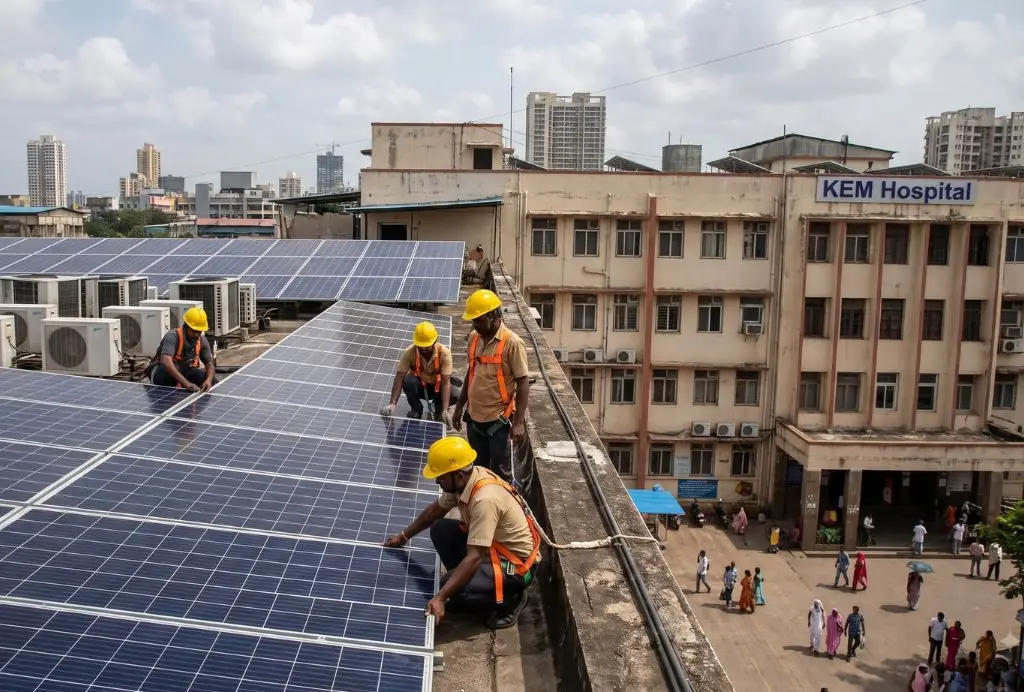

8kW Solar Panel Price in Chennai
8 kW from ₹4.02 lakh after the ₹78,000 subsidy. Installed from ₹4.8 lakh.
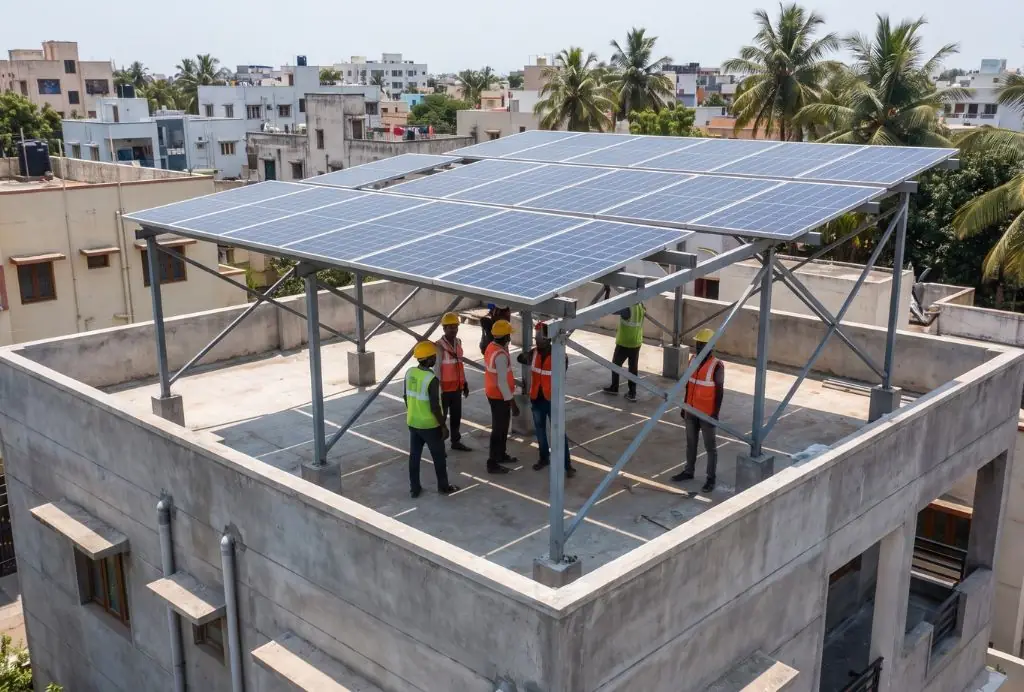
An 8 kW rooftop system covers a very large Chennai home, a substantial apartment common area, or a small commercial premises.
It also sits inside the 10 kW ceiling
Which matters more than most buyers realise. Below 10 kW you keep three things. Above it, all three change.
Installing in Chennai since 2020
Homes, apartments and businesses
Three-phase conversion handled
Two years free maintenance
Size finder
Which size is right for your home?
Recommended size
8 kW
Suits a bi-monthly bill of ₹18,600 to ₹22,000.
- Installed
- from ₹4.8 lakh
- Subsidy
- ₹78,000
- After subsidy
- from ₹4.02 lakh
Output
How much power does an 8kW solar system generate in Chennai?
An 8 kW rooftop solar system in Chennai generates about 38 units a day, roughly 1,150 units a month, 2,300 units in a TANGEDCO bi-monthly cycle, or around 13,800 units a year. Chennai's approximately 5.3 peak sun hours a day place generation per kW above most of northern India.
If your yearly use sits between what 8 kW and 10 kW produce, a 9 kW system is the in-between size, still inside the 10 kW ceiling for homes.
| Output | Figure |
|---|---|
| Daily generation | About 38 units |
| Monthly generation | About 1,150 units |
| Bi-monthly generation | About 2,300 units |
| Annual generation | About 13,800 units |
| Bill it offsets | About ₹21,900 per bi-monthly cycle |
A year of generation
13,800
units from an 8 kW roof in Chennai
Two kilowatts of headroom before the ceiling that governs the subsidy, the export rate and the approval route.
Who installs 8 kW?
Who should not install 8 kW
Any property consuming under about 10,000 units a year. Below that, a large share of generation is exported rather than consumed, and exported units return less than self-consumed ones. Size against consumption, not against roof capacity.
The subsidy
How much subsidy do you get on an 8kW solar system?
An individual household installing an 8 kW system in Chennai receives ₹78,000 under the PM Surya Ghar Muft Bijli Yojana, the same amount paid on a 3 kW system, since the subsidy is capped at ₹78,000 for all systems of 3 kW and above. Housing societies claiming for common facilities receive ₹18,000 per kW instead, which at 8 kW comes to ₹1,44,000. Commercial installations receive no subsidy but can claim accelerated depreciation.
| Buyer | Subsidy at 8 kW | Effective per kW |
|---|---|---|
| Individual household | ₹78,000 | ~₹9,750 |
| Housing society, common facilities | ₹1,44,000 | ₹18,000 |
| Commercial premises | None | Accelerated depreciation up to 40% year one |
The residential subsidy is available up to 10 kW
At 8 kW you are inside that band with room to spare. Push past 10 kW and Central Financial Assistance disappears entirely, which is one of three reasons the ceiling matters. See also the full subsidy process.
Our honest recommendation
At 8 kW, a non-subsidy plan is usually the better buy
The residential subsidy is capped, and the cap is reached at 3 kW. Every kilowatt you add above that is paid for entirely by you, so at 8 kW the question is no longer how to maximise the subsidy, it is whether chasing it is worth what it costs you in choice, price and time.
The ceiling is reached at 3 kW
PM Surya Ghar pays ₹30,000 for 1 kW, ₹60,000 for 2 kW and ₹78,000 for 3 kW and above. A 8 kW system receives exactly the same ₹78,000 as a 3 kW one. Past 3 kW the subsidy stops growing while the system keeps getting bigger, so its share of your cost falls with every additional kilowatt.
It narrows what we can install
A subsidised system must use ALMM-listed modules meeting domestic content rules and be registered through the national portal. That rules out several inverters and module lines we would otherwise recommend at this size, and the portal step adds time to the file.
A non-subsidy plan usually wins here
On a 8 kW system the ₹78,000 is a small share of the total. A non-subsidy build gives a wider choice of modules and inverters, a keener price per kW, no portal dependency and a faster commissioning. For most Chennai homes at this size, that is the better deal even before the subsidy arrives.
We quote both ways and show you the difference in writing, subsidised and non-subsidised, side by side, with the equipment named in each. You decide which you would rather have on your roof.
Get both quotesThe threshold nobody mentions
Why 10kW is the size that changes everything in Tamil Nadu
Ten kilowatts is the threshold at which three things change for a domestic rooftop solar system in Tamil Nadu. The PM Surya Ghar subsidy is available only up to 10 kW. Above 10 kW a home also needs CEIG approval and a separate generation meter, although net metering continues up to the sanctioned load. And systems up to 10 kW follow a simpler approval route at section office level. An 8 kW system sits inside all three limits.
| Up to 10 kW | Above 10 kW, domestic | |
|---|---|---|
| PM Surya Ghar subsidy | Available, capped at ₹78,000 | Not available |
| Metering | Net metering, one bidirectional meter | Net metering up to sanctioned load, plus CEIG and a generation meter |
| Approval route | Section office level, simpler | Escalated, technical feasibility study |
| Eligibility limit | Up to sanctioned load | Up to sanctioned load |
Which of the three matters to you?
Metering: what changes above 10 kW
Homes keep net metering up to their sanctioned load, so a unit you export is credited against a unit you later import whether the system is 8 kW or 12 kW. What changes above 10 kW is the metering and paperwork: CEIG approval and a separate generation meter, on top of losing the subsidy.
This is why crossing 10 kW is not a linear step. The eleventh kilowatt does not simply cost you the subsidy on that kilowatt, it changes how the whole system’s exports are treated.
8 kW or 10 kW?
If your consumption supports it and your roof allows it, 10 kW is the largest system that keeps all three advantages, so there is a reasonable argument for using the full band. The counter-argument is that the subsidy is fixed at ₹78,000 either way, so the ninth and tenth kilowatts are paid entirely at market rate and only pay back on units you actually consume.
The practical rule: pull twelve months of bills. If your annual consumption is comfortably above 13,800 units, should you go to 10 kW?, usually yes. If it sits near 12,000, take 8 kW and keep the difference. Do not go past 10 kW for a domestic property unless there is a specific reason that outweighs losing the subsidy and taking on CEIG approval and a generation meter.
Sanctioned load is a separate limit
Your system capacity cannot exceed your sanctioned load, regardless of the 10 kW figure. The two limits are separate and both apply.
We check both at the survey. More on how TANGEDCO net metering works.
Most installers quoting you 8 kW will not have mentioned the ceiling at all. Send us twelve months of bills and we will tell you exactly where you sit against it, and whether the right answer is 8 kW, 10 kW or something smaller.
Send your billsSpecification
What an 8kW installation includes
An 8 kW rooftop solar installation in Chennai needs roughly 640 to 750 square feet of shade-free roof area and typically uses fourteen to fifteen panels. It requires a three-phase connection, since TANGEDCO provides three-phase supply for connected loads exceeding 4,000 watts, and a sanctioned load enhancement in nearly all cases.
Array layout is a real design problem at this size
Fourteen or fifteen panels rarely fit on a single unobstructed roof plane. Expect the array to split across sections, orientations or levels, which makes inverter configuration a genuine decision. Multiple MPPT inputs allow each section to perform independently rather than the weakest string dragging the rest down, and where shading cannot be avoided, optimisers on affected strings recover output that would otherwise be lost.
Ask how many MPPT inputs your inverter has and how the strings are arranged. On an 8 kW system, a lazy layout costs real generation every day for 25 years, and it is invisible on the quotation.
Businesses and associations
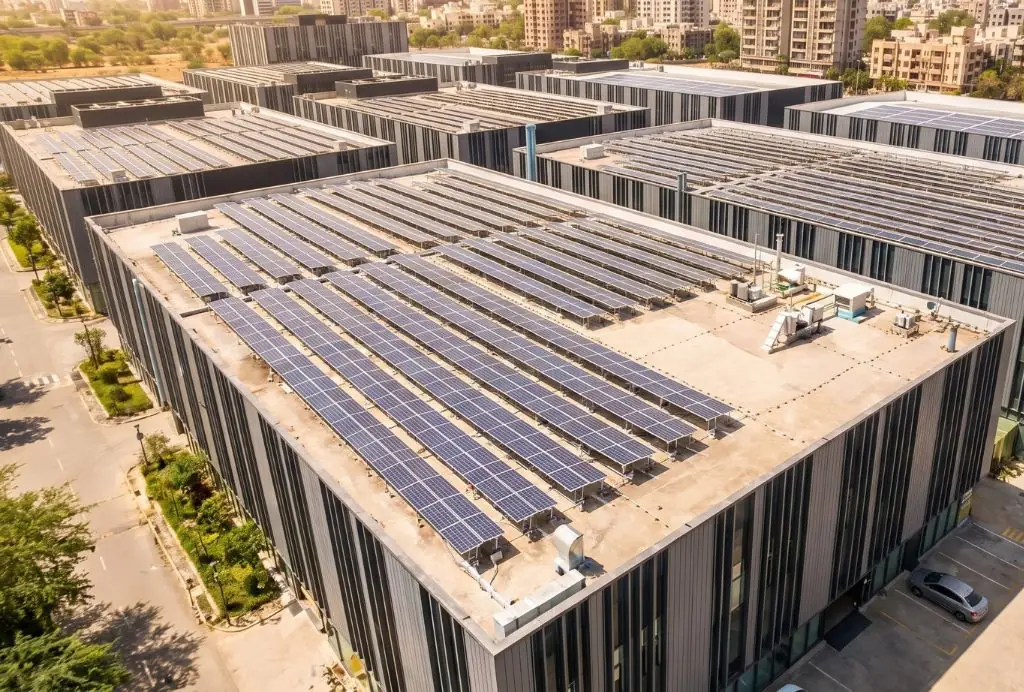
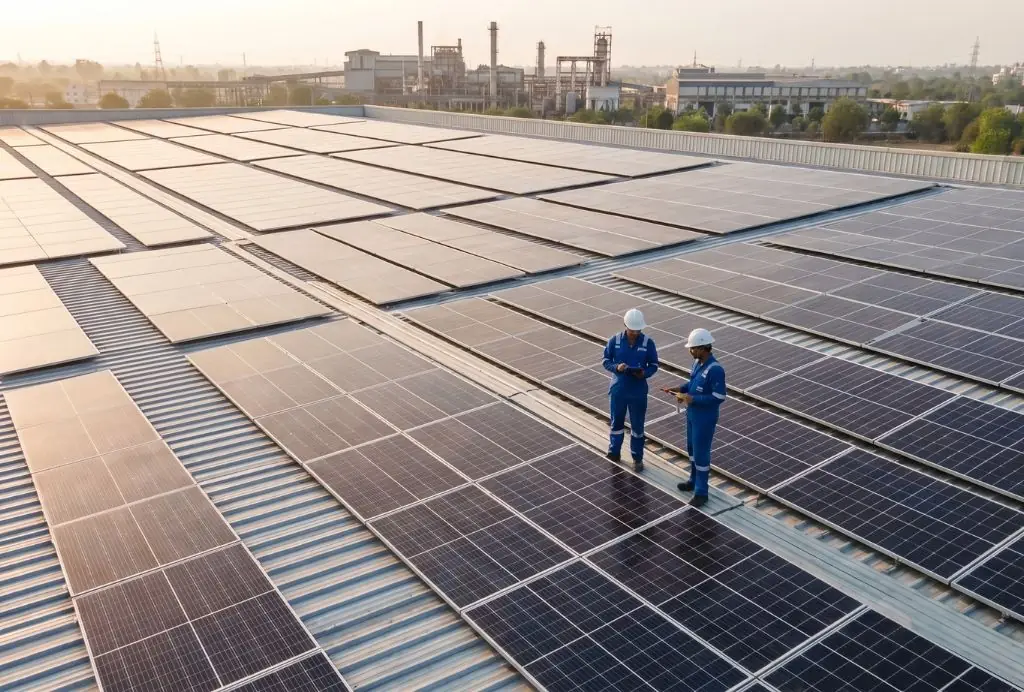
8kW solar for businesses and apartment associations
Commercial premises installing 8 kW solar in Chennai receive no PM Surya Ghar subsidy, which is residential only, but can claim accelerated depreciation of up to 40% in year one and GST input tax credit. Housing societies installing common-area systems claim ₹18,000 per kW, which at 8 kW is ₹1,44,000, subject to a limit of 3 kW per residential unit in the building.
For businesses
Payback is often faster than residential despite the absence of a subsidy, because commercial tariffs are higher and consumption is concentrated in daylight hours when the system is generating. Almost nothing is exported, so nearly every unit is self-consumed at full value.
That also means the net metering versus net feed-in distinction matters less to a business than to a household, since a business exports little either way. For larger arrays, see commercial solar in Chennai.
For apartment associations
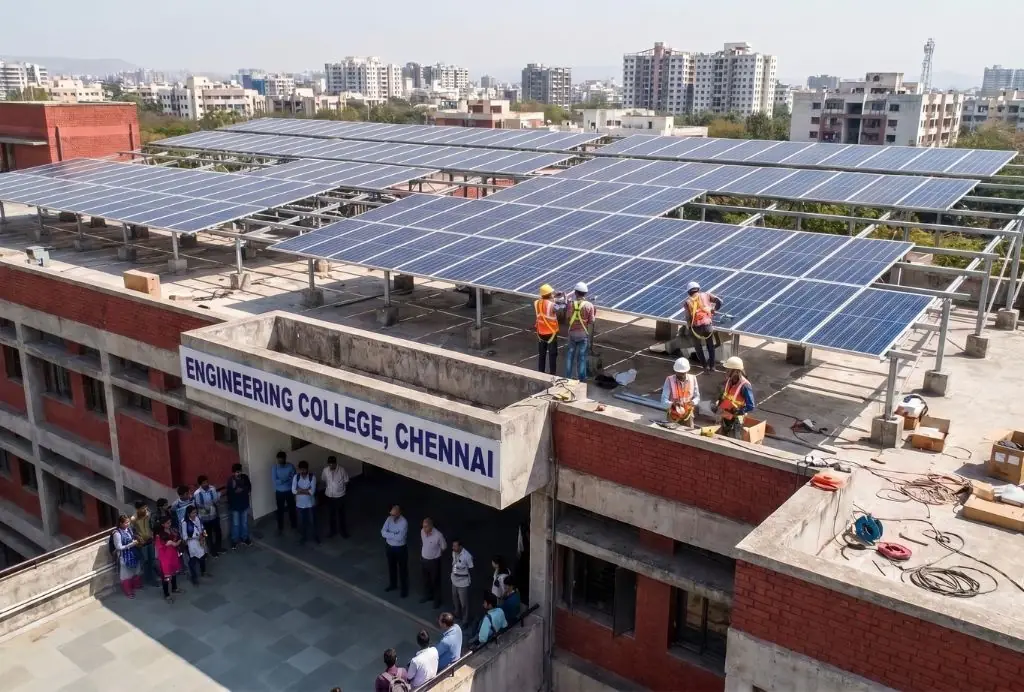
An 8 kW common-area system suits a mid-sized Chennai building, covering lifts, water pumps, borewell motors, corridor and stairwell lighting, the STP and EV charging points.
The association must apply collectively through the RWA or Apartment Owners Association, following a general body resolution, since the terrace is common property. See solar for apartments and housing societies.
Which route applies to you depends on the tariff category of the service connection, not the type of building. We check that at the survey and tell you before quoting.
What drives the number
What makes one 8kW installation cost more than another
The installed price of an 8 kW system in Chennai is driven by whether a three-phase conversion and sanctioned load enhancement are required, panel and inverter specification, how the array splits across roof planes and how many MPPT inputs that needs, structure type and height, roof access, and distance from the coast.
| What varies | Effect | Why |
|---|---|---|
| Three-phase conversion | Additional | Separate TANGEDCO application and connection work |
| Sanctioned load enhancement | Additional | Required in nearly all cases at 8 kW |
| Split array and MPPT configuration | Higher | More structure, more inputs, sometimes optimisers |
| Elevated structure on a shared terrace | Higher | Preserves access, improves airflow |
| DCR compliant panels | Higher | Mandatory for either subsidy route |
| Coastal location | Higher | Salt mist certified modules, corrosion resistant mounting |
| Height and roof access | Higher | Craneage, scaffolding, longer cable runs |
| Hybrid inverter with battery | Considerably higher | Backup during outages |
At 8 kW the array layout alone can move the price substantially, before the connection work is counted. A single published figure would be wrong for nearly every roof it was read on. We survey, then quote once, itemised. More on what drives solar prices in Chennai.
Book a free surveySavings
What an 8kW system saves in Chennai
An 8 kW system generating around 13,800 units a year covers the full consumption of a very large Chennai home, a mid-sized apartment building's common areas, or a small commercial premises. Payback typically runs four to six years for residential and society installations and three to four for commercial.
Why staying under 10 kW protects your returns
Net metering credits exports one for one against imports, so surplus generation retains close to full retail value, and homes keep it up to their sanctioned load. What crossing 10 kW costs is the ₹78,000 subsidy, plus CEIG approval and a separate generation meter. On a system of this size, staying at or under 10 kW keeps all of that simple.

The sizing qualifier that matters most at 8 kW
Payback assumes you consume most of what you generate. Self-consumed units are worth full retail value; exported units only offset later imports, and credit still unused on 31 March lapses.
This is why we size against twelve months of actual bills rather than against available roof area, and why we will recommend a smaller system when the numbers say so.
Timeline
How long does an 8kW installation take?
An 8 kW rooftop installation in Chennai typically takes eight to twelve weeks from survey to a live, net-metered system, since a three-phase conversion and sanctioned load enhancement are almost always involved. Staying under 10 kW keeps the approval at section office level, which is faster than the escalated route larger systems require.
STEP 01
Site assessment, connection, load and tariff check
Same week as your enquiry
STEP 02
Design, array layout and itemised quotation
3 to 5 days after survey
STEP 03
Association resolution, societies only
Society-dependent, start first
STEP 04
Three-phase conversion and load enhancement
Filed in parallel with net metering
STEP 05
Net metering and subsidy filing
Filed by us on approval
STEP 06
Installation on site
3 to 4 days
STEP 07
TANGEDCO inspection and meter
4 to 8 weeks, the main variable
STEP 08
Subsidy credited
about 15 days after DISCOM approval and your redemption request
The main determinant of your timeline remains whether the connection work was identified at the survey and filed alongside the solar application, or discovered later and filed after it.
Your 8kW quotation
Get your 8kW price
At 8 kW your price depends on your connection, your array layout and which subsidy route applies. Send us your details and your last EB bill and we will come back with an itemised quotation, plus a straight answer on whether 8 kW is the right size or whether your consumption justifies going closer to the 10 kW ceiling.
What you get back
- A confirmed system size based on twelve months of actual consumption
- A check on your connection, phase, sanctioned load and tariff category
- The subsidy route that applies, household, society or commercial
- An array layout with the inverter and MPPT configuration explained
- An itemised price naming every component and brand
- An honest recommendation, including if a smaller system serves you better
Common questions
8kW solar in Chennai, common questions
What is the price of an 8kW solar system in Chennai?
The installed price depends on whether a three-phase conversion and sanctioned load enhancement are needed, the panel and inverter specification, how the array splits across roof planes, structure type and height, roof access and distance from the coast. It is quoted after a site survey rather than from a price list. Send us your details and EB bill for an itemised quotation.
How many units does an 8kW solar system generate in Chennai?
About 38 units a day, 1,150 units a month, or roughly 13,800 units a year. Chennai receives around 5.3 peak sun hours daily, higher than most of northern India, so generation per kW here is above the national average.
Is there a limit on solar system size for net metering in Tamil Nadu?
Yes. Under the TNERC framework, domestic consumers are eligible for net metering, where exports are credited one for one against imports, up to their sanctioned load. An 8 kW system qualifies as long as your sanctioned load is at least 8 kW.
What happens if I install more than 10kW at home?
Three things change. The PM Surya Ghar subsidy is no longer available, since residential Central Financial Assistance applies only up to 10 kW. The system needs CEIG approval and a separate generation meter, although net metering continues up to the sanctioned load. And the approval route escalates beyond section office level, adding a technical feasibility assessment. For most domestic properties, staying at or under 10 kW is the better decision.
How much subsidy is available on an 8kW solar system?
₹78,000 for an individual household, the same as a 3 kW system, since the subsidy is capped at ₹78,000 for all systems of 3 kW and above. Housing societies claiming for common facilities receive ₹18,000 per kW, which at 8 kW is ₹1,44,000. Commercial installations receive no subsidy but can claim accelerated depreciation of up to 40% in year one.
Should I install 8kW or 10kW?
Ten kilowatts is the largest system that keeps the subsidy, net metering and the simpler approval route, so using the full band is defensible if your consumption supports it. But the subsidy is fixed at ₹78,000 either way, so the ninth and tenth kilowatts are paid at full market rate and only pay back on units you consume rather than export. If your annual consumption is comfortably above 13,800 units, 10 kW is justified. If it sits near 12,000, take 8 kW.
How many panels are in an 8kW solar system?
Fourteen to fifteen panels, depending on module wattage. With the 545 to 590 watt modules common in 2026, fourteen panels gives an array of around 8.1 kW.
How much roof area does an 8kW solar system need?
About 640 to 750 square feet of shade-free area. At this size the array rarely fits on one roof plane, so expect it to split across sections or orientations, which makes the inverter's MPPT configuration a genuine design decision rather than a formality.
Does an 8kW system need a three-phase connection?
Yes. TANGEDCO provides three-phase supply for connected loads exceeding 4,000 watts, so an 8 kW system requires three-phase, and a sanctioned load enhancement in nearly all cases. Both should be filed alongside the net metering application rather than after it.
What is the payback period on an 8kW system in Chennai?
Four to six years for residential and society installations, and often three to four for commercial. Payback is fastest where most generation is consumed on site rather than exported, since export credit still unused on 31 March lapses unpaid.