



4kW Solar Panel Price in Chennai
4 kW from ₹1.87 lakh after the ₹78,000 subsidy. Installed from ₹2.65 lakh.
A 4 kW system suits Chennai homes where 3 kW falls short but 5 kW is more than the roof or budget allows. Price, subsidy, units and payback.
One thing to know before you go further: the government subsidy is capped at ₹78,000 from 3 kW upward, so the fourth kilowatt is entirely unsubsidised. It can still be the right call, and this page explains when.
Installing in Chennai since 2020
₹78,000 subsidy filed by us
Two years free maintenance
DCR compliant panels
Size finder
Which size is right for your home?
Recommended size
4 kW
Suits a bi-monthly bill of ₹5,400 to ₹8,600.
- Installed
- from ₹2.65 lakh
- Subsidy
- ₹78,000
- After subsidy
- from ₹1.87 lakh
Output
How much power does a 4kW solar system generate in Chennai?
A 4 kW rooftop solar system in Chennai generates about 19 units a day, roughly 575 units a month, 1,150 units in a TANGEDCO bi-monthly cycle, or around 6,900 units a year. Chennai's approximately 5.3 peak sun hours a day put generation per kW above most of northern India, so a 4 kW array here produces what a larger system would need to deliver inland.
| Output | Figure |
|---|---|
| Daily generation | About 19 units |
| Monthly generation | About 575 units |
| Bi-monthly generation | About 1,150 units |
| Annual generation | About 6,900 units |
| Bill it offsets | About ₹8,600 per bi-monthly cycle |
Is 4 kW right for your home?
A 4 kW system typically suits a Chennai household with a bi-monthly EB bill between ₹5,400 and ₹8,600. In practice that means a larger three bedroom home, or a home running two or more air conditioners through the hot months, or a household with a significant daytime load such as someone working from home full time.
It is also the right answer in a specific and common situation: your consumption points to 5 kW, but your usable shade-free roof area does not stretch that far. In that case 4 kW is not a compromise so much as the largest system your roof can properly carry.
A year of generation
6,900
units from a 4 kW roof in Chennai
That is roughly 1,500 units more than a 3 kW system produces, the question this page answers is whether you will use them.
The subsidy
How much subsidy do you get on a 4kW solar system?
A 4 kW residential system in Chennai receives ₹78,000 under the PM Surya Ghar Muft Bijli Yojana, which is exactly the same amount a 3 kW system receives. The subsidy is capped at ₹78,000 from 3 kW upward, so the fourth kilowatt attracts no additional government support and is paid for entirely at market rate.
What this means for your decision
It does not mean 4 kW is a bad choice. It means the fourth kilowatt has to justify itself purely on the electricity it generates, without any subsidy helping it along. For a household that genuinely consumes what a 4 kW system produces, it does. For a household that installed 4 kW because it sounded better than 3 kW, it does not. The comparison below works through which one you are.
How the subsidy is paid: directly to your bank account after TANGEDCO inspects and commissions the system, typically within about 15 days of DISCOM approval, once you redeem it on the portal. You pay in full first and receive it as a reimbursement. We file the application and follow it through to disbursal. See the full subsidy process. The account must be name-matched, or the transfer fails after everything else has gone right.
The decision
Is 4kW worth it over 3kW?
A 4 kW system is worth it over 3 kW when your annual consumption genuinely exceeds what 3 kW generates, roughly 5,200 units a year, and your roof has the space. Because the ₹78,000 subsidy does not increase beyond 3 kW, the fourth kilowatt is paid at full price, so it only earns its place if you will actually use the extra 1,500 units it produces each year. Exporting surplus to TANGEDCO returns less than consuming it, since unused annual credit is settled at a rate below the retail tariff.
| 3 kW | 4 kW | 5 kW | |
|---|---|---|---|
| Annual generation | ~5,200 units | ~6,900 units | ~8,600 units |
| Daily generation | 14 units | 19 units | 24 units |
| Subsidy | ₹78,000 | ₹78,000 | ₹78,000 |
| Roof area needed | 250 – 300 sq ft | 330 – 400 sq ft | 400 – 450 sq ft |
| Panels (545 – 590W) | 5 – 7 | 7 – 8 | 9 – 10 |
| Suits a bi-monthly bill of | Up to ₹5,400 | ₹5,400 to ₹8,600 | ₹8,600 to ₹11,900 |
| Subsidy per kW installed | ₹26,000 | ₹19,500 | ₹15,600 |
Choose 4 kW if
Your consumption clearly exceeds what 3 kW covers, you have 330 to 400 square feet of usable roof, or your roof cannot accommodate 5 kW. It is also the sensible choice if your consumption is rising, for instance if you are adding an air conditioner, an EV charger or a home office.
4 kW is a genuine sweet spot for a specific household: consumption above 3 kW's output, roof area below 5 kW's requirement. If you fall outside that description, one of the neighbouring sizes will serve you better, and we will tell you so at the survey rather than selling you the larger system.
Send your bill, we will tell youSpecification
What a 4kW installation includes
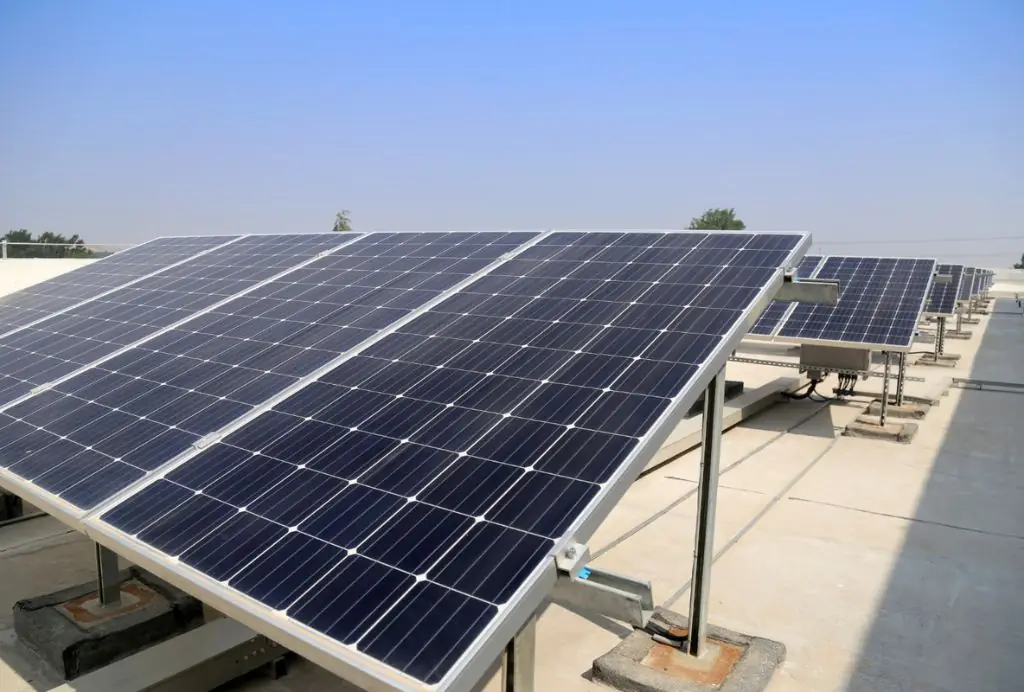
A 4 kW rooftop solar installation in Chennai needs roughly 330 to 400 square feet of shade-free roof area and typically uses seven to eight panels. With the 545 to 590 watt modules common in 2026, seven panels is the usual configuration, giving a slightly oversized array of around 4.1 kW.
On sanctioned load, which matters more at 4 kW than at 3 kW
Your system capacity cannot exceed your sanctioned load, and a 4 kW system pushes past what many Chennai domestic connections are sanctioned for. If enhancement is needed, it has to be filed and approved before commissioning. We check this at the survey. Discovering it at the inspection stage is what turns a six week project into a twelve week one.
Inverter
What size inverter does a 4kW system need?
A 4 kW solar array is usually paired with either a 4 kW or a 5 kW string inverter. The 5 kW option costs slightly more but leaves headroom to add panels later without replacing the inverter, which matters if your consumption is likely to rise. Solar arrays are also commonly sized slightly above the inverter rating, because panels rarely produce their full rated output in real conditions.
We specify the inverter to the roof and to what you are likely to need in five years, not to whatever produces the lowest quote today.
What to ask about, in either case
Headroom
If you may add an air conditioner, an EV charger or a home office load in the next few years, the larger inverter is usually worth the small premium now against replacing it later.
Hybrid or string
A hybrid inverter allows a battery to be added later for outage backup. A standard string inverter does not, without replacement.
Warranty term
The inverter is the component most likely to need attention across the system's life. Ask for the term in writing, and ask who handles the claim.
MPPT count
If your roof has shading or faces more than one direction, multiple MPPT inputs let sections of the array perform independently instead of dragging each other down.
What drives the number
What makes one 4kW installation cost more than another
The installed price of a 4 kW system in Chennai is driven by panel technology and DCR compliance, inverter type and capacity, mounting structure material, roof type and access height, distance from the coast, cable runs, whether a sanctioned load enhancement is required, and whether net metering and maintenance are inside the quote or outside it.
| What varies | Effect | Why |
|---|---|---|
| DCR compliant panels | Higher | Mandatory for the ₹78,000 subsidy |
| 5 kW inverter instead of 4 kW | Slightly higher | Headroom for future expansion |
| Hybrid inverter with battery | Considerably higher | Backup during outages |
| Galvanised vs painted structure | Higher | Painted mild steel pits within a couple of monsoons in coastal air |
| Coastal location | Higher | Salt mist certified modules, corrosion resistant mounting |
| Sloped tile or metal roof | Higher | More complex mounting than flat RCC |
| Height and roof access | Higher | Craneage, scaffolding, longer cable runs |
| Shading requiring split arrays | Higher | Extra structure, sometimes optimisers |
| Sanctioned load enhancement | Additional | A TANGEDCO cost, more often needed at 4 kW |
A single 4 kW price on a web page is too high for a simple flat terrace and too low for a third-floor coastal roof needing a load enhancement, and you would only find out which after the crew arrived. We survey, then quote once, itemised, and that is the price. More on what drives solar prices in Chennai.
Book a free surveySavings
What a 4kW system saves in Chennai
A 4 kW system generating around 6,900 units a year covers the full consumption of most Chennai households billing ₹5,400 to ₹8,600 per bi-monthly cycle. Payback typically runs four to six years, on panels warranted to perform for 25, and lands at the faster end for households consuming above 500 units per bi-monthly cycle.
The domestic tariff is telescopic and bi-monthly, and it changes sharply at 500 units. Since 10 May 2026, households consuming up to 500 units per bi-monthly cycle receive 200 free units, while those above 500 units receive only 100 and are repriced into higher slabs at the same time.
A 4 kW system generates 1,150 units per bi-monthly cycle, which for most households in this bill band is enough to move consumption decisively below the threshold and restore the larger free-unit allowance. For those homes the effective value of each generated unit sits well above the headline tariff.

One caution, stated because it is true
Because the fourth kilowatt carries no subsidy, a 4 kW system pays back more slowly than a 3 kW system for a household that does not use the extra output.
Solar economics reward matching generation to consumption, not maximising system size.
Send 12 months of billsTimeline
How long does a 4kW installation take?
A 4 kW rooftop installation in Chennai typically takes six to ten weeks from survey to a live, net-metered system, extending further if a sanctioned load enhancement is required. The physical installation is one to two days, and TANGEDCO approval with bi-directional meter installation accounts for most of the elapsed time.
STEP 01
Site assessment and energy audit
Same week as your enquiry
STEP 02
Design and itemised quotation
2 to 3 days after survey
STEP 03
Sanctioned load enhancement, if needed
Filed first, adds to the timeline
STEP 04
PM Surya Ghar and TANGEDCO filing
Filed by us on approval of the quote
STEP 05
Installation on site
1 to 2 days
STEP 06
TANGEDCO inspection and meter
4 to 8 weeks, the main variable
STEP 07
Subsidy credited
about 15 days after DISCOM approval and your redemption request
More on how TANGEDCO net metering works.
Your 4kW quotation
Get your 4kW price
Every roof prices differently, and at 4 kW two additional factors come into play: your sanctioned load, and whether the inverter should be sized with headroom. Send us your area and your last EB bill and we will come back with an itemised quotation, the subsidy applied, and a straight answer on whether 4 kW is genuinely the right size for you.
What you get back
- A confirmed system size based on twelve months of actual consumption
- An itemised price naming every component and brand
- The ₹78,000 subsidy applied, with the net figure stated plainly
- A sanctioned load check, and the enhancement filed if one is needed
- An honest recommendation, including if that means 3 kW or 5 kW instead
Common questions
4kW solar in Chennai, common questions
What is the price of a 4kW solar system in Chennai?
The installed price of a 4 kW system in Chennai depends on panel technology, inverter capacity, mounting structure, roof type, access height, distance from the coast and whether a sanctioned load enhancement is needed, so it is quoted after a site survey rather than from a price list. What is fixed is the subsidy: a 4 kW residential system qualifies for ₹78,000 under PM Surya Ghar, the same amount a 3 kW system receives. Send us your area and EB bill for an itemised quotation.
How much subsidy is available on a 4kW solar system?
₹78,000, identical to a 3 kW system. The PM Surya Ghar subsidy is capped at ₹78,000 for all systems of 3 kW and above, so the fourth kilowatt receives no additional government support and is paid at full market rate. It is credited to your bank account after TANGEDCO commissions the system, usually within about 15 days of DISCOM approval, once you redeem it on the portal.
Is a 4kW solar system better than 3kW?
Only if you will use the extra output. A 4 kW system generates roughly 6,900 units a year against 4,500 for a 3 kW system, but attracts exactly the same ₹78,000 subsidy, so the additional capacity is paid for at full price. It is the right choice for households consuming more than 3 kW produces, and the wrong choice for households that simply want a larger number.
How many units does a 4kW solar system generate in Chennai?
About 19 units a day, 575 units a month, or roughly 6,900 units a year. Chennai receives around 5.3 peak sun hours daily, which is higher than most of northern India, so generation per kW here is above the national average.
How many panels are in a 4kW solar system?
Seven to eight panels, depending on module wattage. With the 545 to 590 watt modules common in 2026, seven panels is the usual configuration, producing a slightly oversized array of around 4.1 kW.
How much roof area does a 4kW solar system need?
About 330 to 400 square feet of shade-free roof area. What counts is usable area through the middle of the day, so water tanks, staircase headrooms, parapet walls and neighbouring buildings all reduce the figure. Roof area is the most common reason a household choosing between 4 kW and 5 kW ends up at 4 kW.
What size inverter is needed for a 4kW solar system?
Either a 4 kW or a 5 kW string inverter. The 5 kW option costs slightly more but allows panels to be added later without replacing the inverter, which is worth considering if your consumption is likely to rise through an added air conditioner, EV charger or home office. A hybrid inverter is required if you may want battery backup later.
Will a 4kW system need a sanctioned load enhancement?
Often, yes. Your solar capacity cannot exceed the sanctioned load on your TANGEDCO connection, and 4 kW exceeds what many Chennai domestic connections carry. The enhancement must be filed and approved before commissioning, so it should be checked at the survey rather than discovered at inspection.
What is the payback period on a 4kW system in Chennai?
Typically four to six years, faster for households consuming above 500 units per bi-monthly cycle, since those households receive only 100 free units instead of 200 under Tamil Nadu's tariff and pay higher slab rates. Payback is slower than a 3 kW system for any household that does not consume the additional output, because the fourth kilowatt carries no subsidy.
Does a 4kW solar system work during power cuts?
A standard on-grid 4 kW system shuts down during a grid outage, which is a mandatory safety requirement protecting line workers. Backup during outages needs a hybrid system with a battery. Sizing the battery to critical loads rather than the whole house keeps that cost reasonable.