




Capacity page · 2026 pricing
2 MW Solar Power Plant Cost in India
Last reviewed August 2026 · capex, land, generation, PM-KUSUM · every assumption stated
A 2 MW solar power plant costs ₹7.6 to ₹8.4 crore to build turnkey in 2026, excluding land. That is ₹3.80 to ₹4.20 crore per MW, about six per cent below a standalone 1 MW plant. It needs 8 to 10 acres, generates about 33 lakh units a year in Tamil Nadu, connects at 33 kV rather than 11 kV, and sits exactly on the ceiling of PM-KUSUM Component A.
2 MW is a threshold, not just a size. It is the last capacity that qualifies for Component A, and the first that usually has to inject at 33 kV. Both change the project more than the extra megawatt does.
Baseline on this page
2,000 kWp of non-DCR modules, fixed tilt, level terrain, 1 km to a 33 kV substation with spare capacity, land excluded, 18.9–19.6% CUF, O&M at ₹11 lakh a year, degradation 0.5% a year.
Get a free feasibility read for your 2 MW site
Send the district and the extent. We reply in writing on PM-KUSUM eligibility, the 33 kV bay and whether your quote sits inside the ₹7.6 to ₹8.4 crore band.
Cost breakdown
₹7.8 crore, line by line
Baseline plant: 2,000 kWp of non-DCR modules on fixed tilt, level terrain, one kilometre to a 33 kV substation, land excluded, GST treated separately. The midpoint of the band is ₹7.8 crore, which is ₹39 a watt.
| Line item | Cost | Share | What moves it |
|---|---|---|---|
| Modules, 2,000 kWp | ₹3.30 cr | 42% | Cell origin. DCR adds ₹4 to ₹6 a watt over non-DCR. |
| Inverters | ₹66 lakh | 8% | Central versus string. Central is cheaper at 2 MW, string is easier to service. |
| Mounting structure | ₹94 lakh | 12% | Galvanisation thickness, tilt type, pile depth after the soil report. |
| DC and AC cabling, junction boxes | ₹62 lakh | 8% | Layout compactness. A long thin plot adds cable, not capacity. |
| Civil works and foundations | ₹58 lakh | 7% | Rocky ground or black cotton soil can double this line alone. |
| Step-up transformer and 33 kV evacuation | ₹86 lakh | 11% | Line length and whether the substation bay exists. 33 kV metering is mandatory at this size. |
| SCADA, monitoring, weather station | ₹18 lakh | 2% | Bought once. Almost identical at 1 MW and 2 MW. |
| Approvals, DPR, connectivity, inspectorate | ₹24 lakh | 3% | Fixed cost. This is where the per-MW saving comes from. |
| Contractor margin, insurance, contingency | ₹42 lakh | 5% | Scope clarity. Vague scope becomes a variation claim later. |
| Turnkey total | ₹7.80 cr | ₹39/W | Band ₹7.6 cr to ₹8.4 cr on competent quotations |
Land, GST, financing costs and interest during construction sit outside this table. A quotation more than ten per cent below the band is usually missing the evacuation package, the transformer, or both — check those two lines first.
Cost per MW
Doubling the capacity does not double the bill
Two 1 MW plants on two sites cost about ₹8.1 crore. One 2 MW plant on one site costs about ₹7.8 crore. The ₹30 lakh difference is entirely in the lines that do not scale, and knowing which ones they are tells you where a second phase is worth building on the same land.
Bought once, whatever the size
Approvals, the DPR, the connectivity application, inspectorate clearance, the site office, SCADA head end, the weather station and contractor mobilisation. About ₹42 lakh at 1 MW and ₹48 lakh at 2 MW — not ₹84 lakh.
Scales almost exactly
Modules, inverters, mounting structure, DC cable and piling. These are per-watt costs and no amount of scale changes them at MW level. About 70 per cent of the bill.
Scales, but in steps
The transformer, the switchyard and the evacuation line. They jump at voltage thresholds rather than sliding, which is why 2 MW at 33 kV costs more per MW to evacuate than 1 MW at 11 kV.
| Capacity | Turnkey capex | Per MW | Land | Evacuation |
|---|---|---|---|---|
| 1 MW | ₹3.8–4.3 cr | ₹4.05 cr | 4–5 acres | 11 kV |
| 2 MW THIS PAGE | ₹7.6–8.4 cr | ₹3.90 cr | 8–10 acres | 33 kV |
| 5 MW | ₹18.2–19.9 cr | ₹3.75 cr | 20–25 acres | 33 kV |
| 10 MW | ₹35–38 cr | ₹3.60 cr | 40–50 acres | 33–110 kV |
| 100 MW | ₹330–360 cr | ₹3.40 cr | 400–500 acres | 220 kV |
Per-MW figures are midpoints for fixed-tilt non-DCR plants on level land within a kilometre of the evacuation point. Evacuation voltage is the usual case and is set by the state distribution code, not by us.
PM-KUSUM Component A
2 MW is the ceiling, and four conditions decide it
Component A covers decentralised plants of 500 kW to 2 MW selling to the DISCOM at a regulator-set feed-in tariff. It is not a capital subsidy. What it gives you is a guaranteed offtake, concessional IREDA or NABARD debt, and a tariff that survives a change of government. What it demands is a specific owner category, a specific land classification and a substation close enough to reach.
The misconception worth correcting
PM Surya Ghar has nothing to do with a 2 MW plant. It is a residential rooftop scheme capped at ₹78,000 for a 3 kW system. No central capital subsidy exists for a 2 MW ground-mount plant built for a company's own consumption. What exists is accelerated depreciation, Component A if you are an eligible owner, and state policy incentives. The subsidy page sets out exactly what applies.
Land
Eight to ten acres, and it should be one parcel
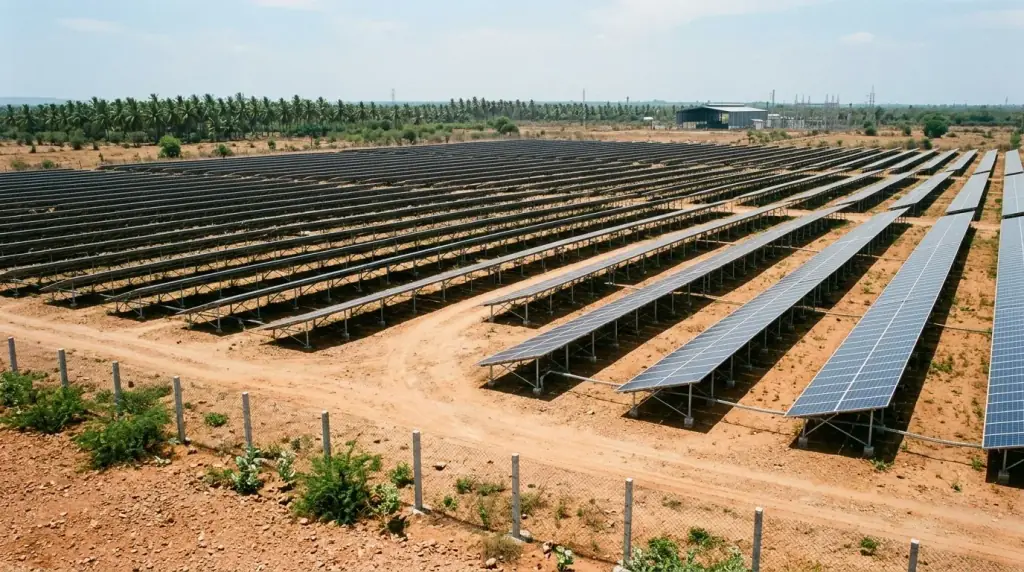
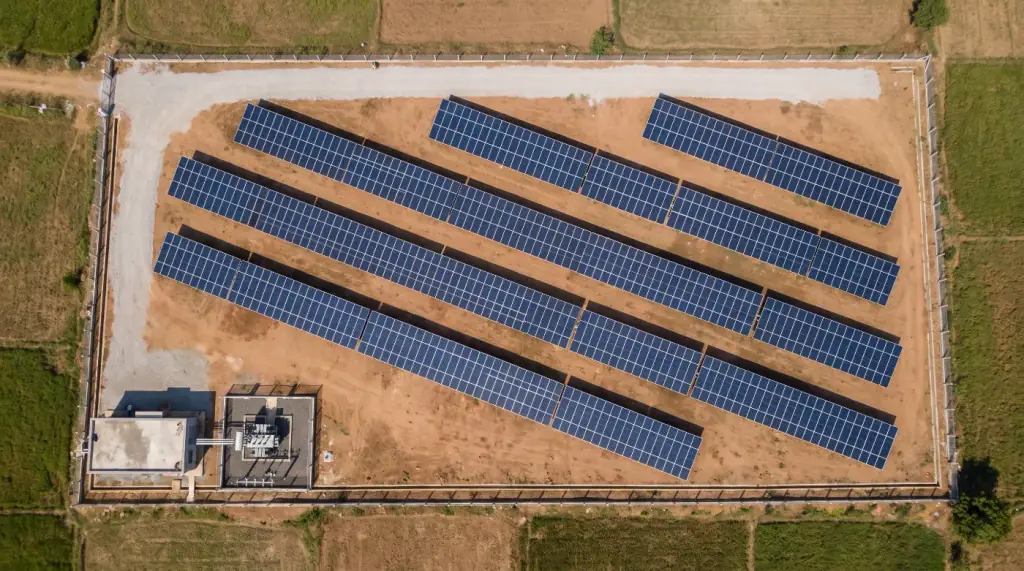
A 2 MW plant needs 8 to 10 acres on fixed tilt, 10 to 12 on seasonal tilt and 12 to 16 on single-axis trackers. About a third of the area sits under module. The rest is the row spacing that prevents December shading, plus internal roads, two inverter stations, the switchyard and setbacks.
At 2 MW the practical question shifts from extent to contiguity. Ten acres assembled from four survey numbers with a cart track through the middle costs more to build on than twelve acres in one piece: the cable runs get longer, the road layout gets forced, and every additional owner is another signature on the lease and another title to diligence.
Land sits outside every capex figure on this page because it is not comparable between districts. Dry agricultural land in Tirunelveli and land near an industrial corridor in Kanchipuram differ by an order of magnitude, and lease terms differ more than prices do.
Land required per MW, in detailRule of thumb
Four to five acres per MW on fixed tilt. Below four acres per MW something has been compromised: row spacing, service access, or the assumption about module efficiency.
Generation
33 lakh units a year, falling half a per cent annually
A 2 MW plant generates about 33 to 34 lakh units a year in Tamil Nadu at 18.9 to 19.6 per cent CUF, and 33 to 36 lakh across India. That is 9,100 to 9,400 units on an average day, and about 3,200 on a heavily overcast monsoon day. Any projection built on a flat daily number rather than a monthly profile will be wrong in both directions.
Year one
33.3 lakh units
At 18% CUF, the midpoint of the Tamil Nadu band.
Year ten
31.8 lakh units
After 0.5% a year of module degradation.
Year twenty-five
29.3 lakh units
What the tail of a 25-year PPA actually delivers.
Average day
8,650 units
Annual figure divided by 365. Peak days exceed 11,000.
CUF assumes a fixed-tilt plant with no shading, monthly cleaning in the dry season and inverter availability above 99 per cent. How the unit figure is derived, per MW.
Revenue and profit
One ₹7.8 crore plant, three different businesses
All three columns are the same 2 MW plant costing ₹7.8 crore and generating 33.3 lakh units in year one, with O&M at ₹11 lakh a year. The only variable is who consumes the unit and what it is worth to them.
DISCOM feed-in
₹3.20 a unit
Net a year after O&M
₹96 lakh
Simple payback, no debt
8.2 years
Component A and state feed-in tariffs. Bankable, predictable, and dependent on cheap long-tenure debt to work at all.
Third-party or open access PPA
₹5.40 a unit
Net a year after O&M
₹1.69 cr
Simple payback, no debt
4.6 years
Below the consumer tariff, above the auction rate. Whether it clears depends on the open access charge stack in your state.
Your own HT tariff
₹7.80 a unit
Net a year after O&M
₹2.49 cr
Simple payback, no debt
3.1 years
The highest-value unit available. The constraint is not money, it is how much of your consumption a daytime plant can reach.
Simple payback ignores debt service, degradation, inverter replacement around year twelve and tariff escalation. It is a comparison tool, not a financial model. Profit modelled properly, per MW · how the debt is raised.
Evacuation
The 33 kV step is the real difference between 1 MW and 2 MW
Most state distribution codes cap 11 kV injection somewhere between 1 and 1.5 MW. Cross it and the project moves to 33 kV, which changes the transformer, the metering, the protection scheme, the substation bay and the approval queue. It is the single most commonly under-budgeted part of a 2 MW plant.
At 11 kV, up to about 1–1.5 MW
- Injection into an existing 11 kV feeder, often from a nearby distribution transformer.
- Metering at 11 kV, simpler protection, shorter connectivity application.
- ₹30 lakh to ₹55 lakh for the evacuation package before line length.
At 33 kV, 2 MW and above
- A dedicated 33 kV bay at the substation, or a new bay if none is spare.
- 33 kV metering, CT and PT class accuracy, a full protection and relay scheme.
- ₹65 lakh to ₹1.1 crore before line length, plus ₹12 to ₹16 lakh a kilometre of line.
Ask this before you buy the land
Does the nearest 33 kV substation have a spare bay and spare transformation capacity, and how much of it is already committed to other applicants? A substation two kilometres away with no spare capacity is worse than one six kilometres away with a bay free. The DISCOM will tell you if you ask in writing, and the answer belongs in the DPR before the land is paid for.
Approvals and timeline
Six months to build, twelve to eighteen to commission
Construction of a 2 MW plant takes five to seven months. Everything before it is what sets the commissioning date, and a Component A project adds a DISCOM tender cycle on top.
Months 0–3
Site and paperwork
Title diligence, survey, soil investigation, land use position, DPR, and the connectivity application filed at 33 kV.
Months 2–8
Approvals in parallel
Connectivity approval, evacuation scheme sanction, electrical inspectorate, pollution board where applicable, and financial close. This is the long pole.
Months 7–13
Construction
Piling, structure, modules, DC and AC cabling, inverter stations, transformer, switchyard and the line to the substation.
Months 13–18
Charging and COD
Inspectorate charging permission, protection testing, metering, synchronisation and commercial operation. Reconcile the first month of generation against the DPR.
Where we fit, and where we do not
We are not selling you a 2 MW plant on this page
Blues Renewables works at MW scale as a subcontract EPC and balance-of-system contractor inside other developers' projects, and as a turnkey contractor at the rooftop and ground-mount sizes we have actually built. We do not own plants, bid tenders or hold power purchase agreements. What we will do, at no cost, is tell you whether the project you are considering is real.
What a feasibility read covers at 2 MW
- Whether the owner category and land classification actually clear Component A, or whether you are outside it.
- Whether the nearest 33 kV substation has a spare bay, and the route distance to it.
- Whether ten acres across several survey numbers can be laid out as one plant without wasting capacity.
- Whether the quotation you hold sits inside the ₹7.6 to ₹8.4 crore band, and which line is off if it does not.
What we will tell you to get elsewhere
- A bankable detailed project report, and a lender's engineer to certify it.
- Land aggregation, title diligence and land use conversion filings.
- A principal EPC contractor for a plant above the sizes we build.
- PM-KUSUM tender bidding and the DISCOM interface.
Send us the district and the extent
That is enough for a first read. We will come back in writing on classification, substation distance and spare bay position, a defensible generation figure, and whether the capex you have been quoted is sane. If the site does not work we will say so in the first call rather than the third.
If you are pursuing Component A, tell us the owner category as well. Half the projects that reach us are technically sound and structurally ineligible, and that is cheaper to find out now.
2 MW solar plants, answered
How much does a 2 MW solar power plant cost in India?
A 2 MW solar power plant costs ₹7.6 to ₹8.4 crore turnkey in 2026, excluding land. That works out to ₹3.80 to ₹4.20 crore per MW, roughly six per cent below the per-MW cost of a single 1 MW plant, because approvals, the switchyard, mobilisation, the site office and the monitoring system are bought once and shared across twice the capacity. DCR modules, tracking structures, rocky ground or a distant substation each push the number up, and together they can take the same 2 MW past ₹10 crore.
Why is 2 MW cheaper per MW than 1 MW?
Because a fixed set of costs does not double. Land survey, soil investigation, the detailed project report, connectivity application, electrical inspectorate approval, the site office, the boundary wall per MW, the SCADA and monitoring head end and contractor mobilisation are close to identical at 1 MW and 2 MW. Modules, inverters, structure and cable scale almost exactly with capacity and cannot be optimised by size. That is why the saving is around six per cent and not thirty.
Is 2 MW eligible for PM-KUSUM subsidy?
Yes, 2 MW is the upper limit of PM-KUSUM Component A, which covers decentralised ground-mounted plants of 500 kW to 2 MW set up by farmers, farmer groups, cooperatives, panchayats, farmer producer organisations and water user associations on barren, fallow or agricultural land, selling to the DISCOM at a regulator-set feed-in tariff. It is a procurement scheme with concessional finance and a guaranteed offtake, not a capital subsidy of the PM Surya Ghar kind. A private company building 2 MW for its own use is outside it.
How much land is required for a 2 MW solar power plant?
Eight to ten acres on fixed tilt. Only about a third of that carries module; the rest is inter-row spacing sized so no row shades the next around the December solstice, plus internal roads, inverter stations, the switchyard and boundary setbacks. Seasonal tilt needs 10 to 12 acres and single-axis trackers 12 to 16. PM-KUSUM Component A projects should read the land classification before the extent, because barren, fallow and agricultural land qualify and converted industrial land does not need to.
How many units does a 2 MW solar plant generate?
About 33 to 34 lakh units a year in Tamil Nadu at 18.9 to 19.6 per cent CUF, which is roughly 9,100 to 9,400 units on an average day, and 33 to 36 lakh across India. Output falls about 0.5 per cent a year as the modules degrade, so a 25-year model that uses the first-year figure throughout overstates lifetime generation by about six per cent. Rajasthan and Gujarat deliver seven to nine per cent more from the identical plant.
What is the profit from a 2 MW solar power plant?
Between ₹96 lakh and ₹2.49 crore a year after operations and maintenance, depending on what the unit is worth. At a DISCOM feed-in tariff of ₹3.20 the net is about ₹96 lakh a year against a ₹7.8 crore plant. Displacing your own HT tariff at ₹7.80 nets about ₹2.49 crore and pays back in under four years. The plant is identical in both cases, so the offtake decision matters more than any equipment decision.
Does a 2 MW plant connect at 11 kV or 33 kV?
Almost always 33 kV. Most state distribution codes cap 11 kV injection at around 1 to 1.5 MW, so 2 MW crosses into 33 kV, which means a 33/11 kV or 33 kV bay at the substation, a higher-rated step-up transformer, metering at 33 kV and a longer connectivity approval. Budget ₹65 lakh to ₹1.1 crore for the evacuation package at 2 MW before line length, and confirm the threshold in your own state code rather than assuming it.
How long does it take to build a 2 MW solar plant?
Five to seven months of construction and 12 to 18 months from a secured site to commercial operation. Connectivity approval at 33 kV, electrical inspectorate clearance, land use conversion where needed and financial close run in parallel and are what set the commissioning date. A PM-KUSUM Component A project adds the tendering and letter of award cycle of the DISCOM, which is usually the longest single item.