






Capacity page · 2026 pricing
5 MW Solar Power Plant Cost in India
Last reviewed August 2026 · capex, land, connectivity, offtake · every assumption stated
A 5 MW solar power plant costs ₹18.2 to ₹19.9 crore to build turnkey in 2026, excluding land. That is about ₹3.75 crore per MW, seven per cent below a standalone 1 MW plant. It needs 20 to 25 acres, generates about 83 lakh units a year in Tamil Nadu, and needs a dedicated 33 kV bay rather than an injection into someone else's feeder.
At 5 MW the plant stops being the hard part. Land aggregation, the evacuation scheme and the offtake contract decide whether the project happens. The panels are a procurement exercise.
Get a free feasibility read for your 5 MW site
Send the district, the extent and the substation. We reply in writing on land, bay availability and whether your quote sits inside the ₹18.2 to ₹19.9 crore band.
Cost breakdown
₹18.75 crore, line by line
Baseline plant: 5,000 kWp of non-DCR modules on fixed tilt, level terrain, one kilometre to a 33 kV substation with a spare bay, land excluded, GST treated separately. The midpoint of the band is ₹18.75 crore, which is ₹37.50 a watt.
| Line item | Cost | Share | What moves it |
|---|---|---|---|
| Modules, 5,000 kWp | ₹8.10 cr | 43% | Cell origin and delivery schedule. A 5 MW order is 90 to 110 containers arriving against a piling programme. |
| Inverters | ₹1.50 cr | 8% | Central inverters become the default at this size. String is still defensible on an irregular plot. |
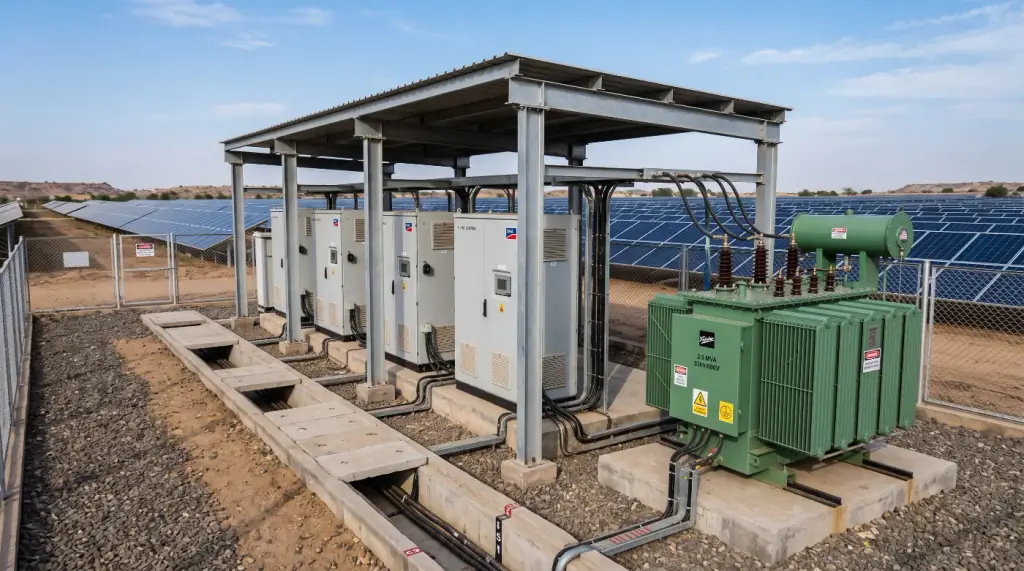
| Mounting structure | ₹2.25 cr | 12% | Galvanisation thickness and pile depth after the geotechnical report, not before it. |
| DC and AC cabling, junction boxes | ₹1.45 cr | 8% | Plot shape. A long thin site adds cable length and copper losses, not capacity. |
| Civil works, roads, drains, boundary | ₹1.35 cr | 7% | Rocky ground, black cotton soil or a flood-prone site can take this line past ₹2.5 crore. |
| Transformers, 33 kV switchyard, line | ₹2.20 cr | 12% | Bay availability and route length. The estimator below prices this properly. |
| SCADA, monitoring, weather station, CCTV | ₹30 lakh | 2% | Almost flat across 2 MW and 10 MW. It is bought once. |
| Approvals, DPR, connectivity, inspectorate | ₹45 lakh | 2% | Fixed cost. This is most of the per-MW saving against 1 MW. |
| Contractor margin, insurance, contingency | ₹1.15 cr | 6% | Scope clarity and how the risk of delay is allocated in the contract. |
| Turnkey total | ₹18.75 cr | ₹37.50/W | Band ₹18.2 cr to ₹19.9 cr on competent quotations |
Land, GST, financing costs and interest during construction sit outside this table. At 5 MW, interest during construction alone is typically ₹60 lakh to ₹1 crore and belongs in the project cost the lender sees, not in the EPC price.
What changes with scale
Five megawatts is a different project, not a bigger one
The per-MW cost falls seven per cent against 1 MW. That is the least interesting thing that changes. Four things genuinely change at 5 MW, and each one has sunk projects that had the money in place.
Land becomes an assembly problem
Twenty-five acres is rarely one owner. Every additional survey number is another title chain, another signature, another chance of a boundary dispute surfacing after the piling starts. Plants get delayed by land, not by panels.
The grid stops being a formality
You need a dedicated 33 kV bay and a sanctioned evacuation scheme. Whether the substation has spare transformation capacity, and how much is already committed to other applicants, decides the project before any equipment is ordered.
The offtake has to be contracted
Eighty-three lakh units a year is more than most single sites consume. Somebody has to be contractually obliged to take it: a DISCOM, an open access consumer, or a group captive structure with the equity tests met.
O&M becomes a real line
₹25 to ₹30 lakh a year, and it earns its keep. Module cleaning, vegetation, security, insurance, spares and a guaranteed response time. A five-year O&M contract with performance guarantees is standard at this size and should be priced with the EPC, not after it.
| 1 MW | 5 MW | Per MW at 5 MW | |
|---|---|---|---|
| Turnkey capex | ₹4.05 cr | ₹18.75 cr | ₹3.75 cr, 7% lower |
| Approvals and DPR | ₹18 lakh | ₹45 lakh | ₹9 lakh, 50% lower |
| SCADA and monitoring | ₹12 lakh | ₹30 lakh | ₹6 lakh, 50% lower |
| Evacuation package | ₹45 lakh | ₹2.20 cr | ₹44 lakh, roughly flat |
| Land | 4–5 acres | 20–25 acres | No saving at all |
| O&M a year | ₹5.5 lakh | ₹27.5 lakh | ₹5.5 lakh, flat |
| Construction time | 4–6 months | 7–9 months | Longer, not proportionally |
Connectivity estimator
The line to the substation is the most under-budgeted item at 5 MW
Most quotations carry a nominal evacuation line and a footnote saying it is subject to the DISCOM scheme. Four inputs decide the real number, and it ranges from ₹2.1 crore to well past ₹5 crore on the same 5 MW plant. Set them against your actual site.
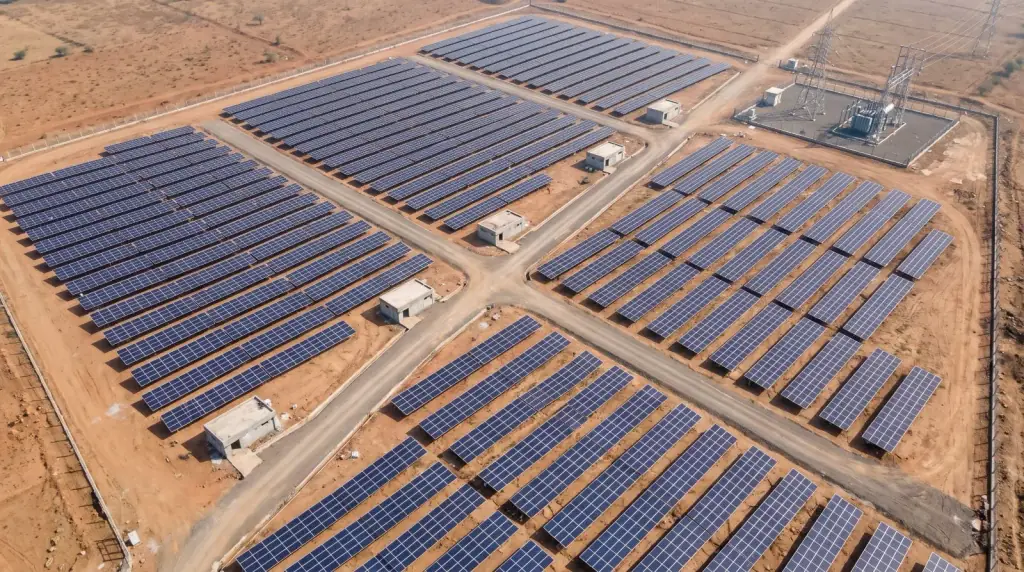
Inside the fence. Twenty-odd acres of array, inverter stations, and the plant switchyard at the corner where the line leaves. This is the part an EPC quotation prices properly.
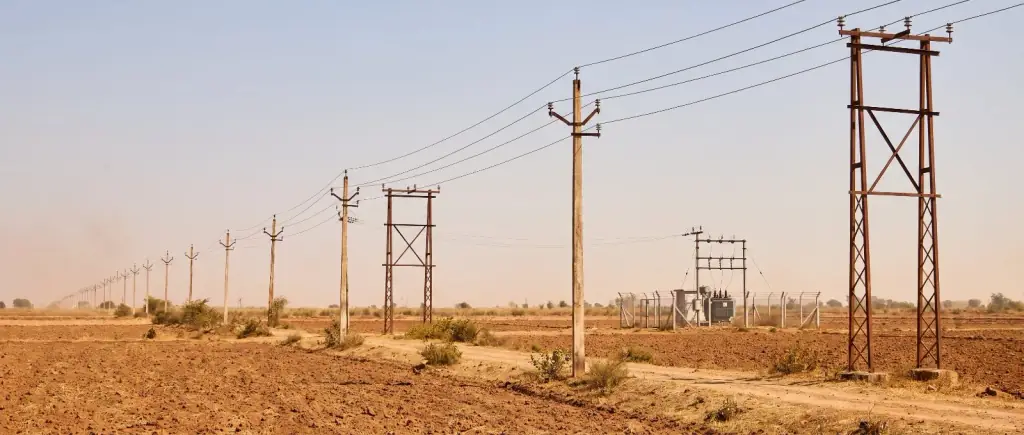
Outside it. The kilometre from that switchyard to the DISCOM substation. Every pole is a cost line, the ground under it is a consent, and this is the part reduced to one word.
Line rates assume overhead ACSR construction on standard poles or towers, way leave compensation at prevailing district rates, and no cable section. An underground section, a railway crossing or a forest diversion each add cost and months that no estimator can predict.
Land
Twenty to twenty-five acres, and how many owners
A 5 MW plant needs 20 to 25 acres on fixed tilt, 25 to 30 on seasonal tilt and 30 to 40 with single-axis trackers. About a third carries module. The rest is row spacing sized against December shading, internal roads wide enough for a crane, inverter stations, the switchyard and setbacks.
The number that decides the project is not the extent, it is the count of survey numbers and owners behind it. Six owners means six title chains, six sets of encumbrance certificates, six family settlements to verify, and one holdout who can stop the layout. Aggregators exist for exactly this reason and their fee is real project cost.
Lease or buy is a financing question, not a preference. Most 5 MW projects lease for 25 to 30 years at ₹25,000 to ₹60,000 an acre a year with a fixed escalation, because ₹2 to ₹5 crore of land purchase against an ₹18.75 crore plant moves the return more than any equipment decision. Lenders will want the lease registered and assignable.
Land, lease terms and the layout, in detail
Generation
83 lakh units a year, and what the tail looks like
A 5 MW plant generates about 83 to 86 lakh units a year in Tamil Nadu at 18.9 to 19.6 per cent CUF, and 83 to 91 lakh across India, roughly 22,800 units on an average day. Over 25 years that is about 19.2 crore units, and the difference between assuming a flat output and modelling degradation is nearly 1.6 crore units of revenue.
Year one
84 lakh units
At 18% CUF, the midpoint of the Tamil Nadu band.
Year ten
80.5 lakh units
After 0.5% a year of module degradation.
Year twenty-five
74.1 lakh units
About 88 per cent of year one, which is what the tail of a PPA earns.
Twenty-five year total
19.4 crore units
The denominator in any levelised cost calculation.
CUF assumes no shading, monthly cleaning in the dry season and inverter availability above 99 per cent. A performance ratio below 78 per cent in the first year is a commissioning problem, not weather. How the unit figure is derived.
Offtake and returns
Nobody consumes 83 lakh units by accident
At 1 MW you can usually absorb the generation in your own load. At 5 MW you cannot, unless you are a genuinely large industrial consumer. That makes the offtake contract the first thing to settle, and it changes the return by a factor of nearly three on an identical ₹18.75 crore plant.
DISCOM feed-in or tender
₹3.20 a unit
Net a year after O&M
₹2.39 cr
Simple payback, no debt
7.9 years
Bankable and predictable. Only works with 70 to 75 per cent debt at 9.5 to 11 per cent over 12 to 13 years, which is why the loan structure matters more than the capex here.
Open access or group captive
₹5.40 a unit
Net a year after O&M
₹4.22 cr
Simple payback, no debt
4.4 years
The classic home for 5 MW. Sell to one or several HT consumers below their grid tariff. The open access charge stack, not the generation tariff, decides whether it clears.
Your own HT load
₹7.80 a unit
Net a year after O&M
₹6.21 cr
Simple payback, no debt
3.0 years
Only if you genuinely consume 83 lakh units a year in daytime. Very few single sites do, and unconsumed generation is worth the export rate, not your tariff.
Group captive, in one paragraph
Consumers hold at least 26 per cent of the equity in the generating company and consume at least 51 per cent of the generation. That structure is exempt from cross-subsidy surcharge, which is the largest line in the open access stack. Both tests have to hold every year, so one consumer whose production drops can take the exemption down with it. Build the charge stack for Tamil Nadu before signing anything.
Contracting
One contract, or four packages
At 5 MW you have a genuine choice about how to buy the plant, and it is worth two to four per cent of capex either way. The right answer depends on whether you have someone in-house who can hold four contractors to a programme.
Single turnkey EPC
One contract, one performance guarantee, one party to hold to the CUF number. Costs two to four per cent more and is what lenders prefer, because the risk of interface failure sits with the contractor rather than with you.
Right when this is your first plant, or when the lender asks for a single point of responsibility.
Split packages
You buy modules directly, and contract structure and civil, electrical balance of plant, and the evacuation line separately. Cheaper, and you keep the module procurement margin. It also means every interface dispute lands on your desk.
Right when you have an in-house project manager and have built before.
Insist on a performance ratio guarantee
Not a peak-watt guarantee. A PR of 78 to 80 per cent measured over the first year, with liquidated damages, is what protects you from a plant that was built to price.
Tie payment to milestones, not to months
Advance, delivery at site, mechanical completion, charging, and a retention released after the performance test. Front-loaded payment terms are the most common way a 5 MW project loses control.
Buy the O&M with the EPC
Five years, with cleaning frequency, response times and a minimum availability written in. Renegotiating O&M after commissioning is a weak position.
Keep the as-built drawings
Single line diagram, cable schedules, earthing layout, protection settings and the string mapping. When the plant is ten years old and the contractor has moved on, this is the difference between a repair and a survey.
How to appoint and evaluate an EPC contractor · what a bankable DPR contains
Approvals and timeline
Eight months to build, fifteen to twenty to commission
Construction takes seven to nine months. Land aggregation and the evacuation scheme are what set the date, and both are outside the contractor's control.
Months 0–5
Land and diligence
Aggregation across survey numbers, title chains, encumbrance certificates, registered lease or sale, survey, geotechnical investigation and the DPR.
Months 3–10
Connectivity and finance
Connectivity application, evacuation scheme sanction, way leave, inspectorate, offtake contract signature and financial close. The critical path lives here.
Months 9–17
Construction
Piling, structure, 5 MW of modules across 90 to 110 containers, DC and AC cabling, inverter stations, transformers, switchyard and the line.
Months 17–20
Testing and COD
Protection testing, charging permission, synchronisation, the performance ratio test, and reconciliation of the first month against the DPR.
Where we fit, and where we do not
We are a subcontract EPC at 5 MW, not the principal contractor
Blues Renewables works at MW scale as a subcontract EPC and balance-of-system contractor inside other developers' projects, and as a turnkey contractor at the rooftop and ground-mount sizes we have actually built. We do not own plants, bid tenders or hold power purchase agreements. What we will do, at no cost, is tell you whether the project you are considering is real.
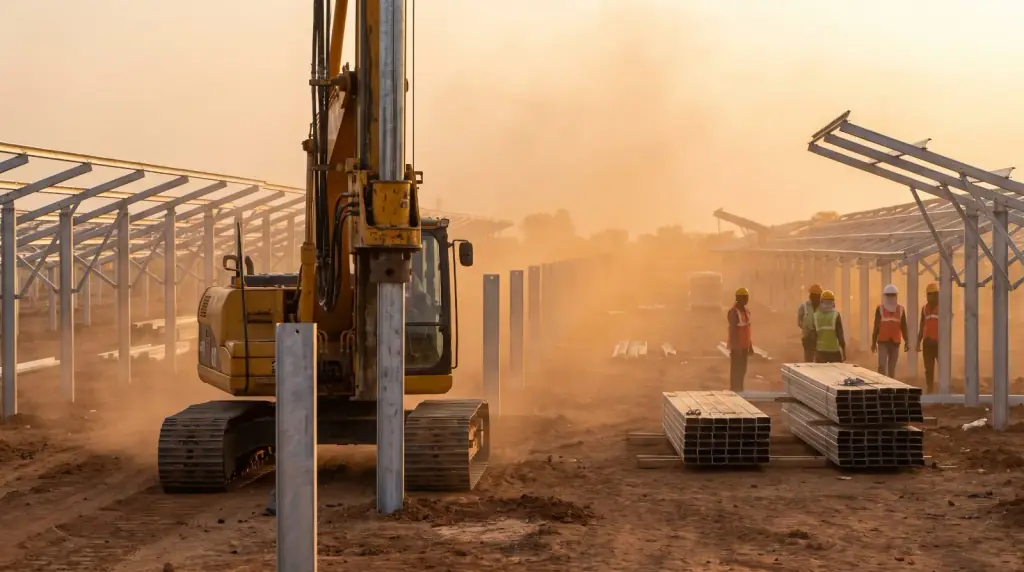
Balance of system
This is the scope we take at 5 MW
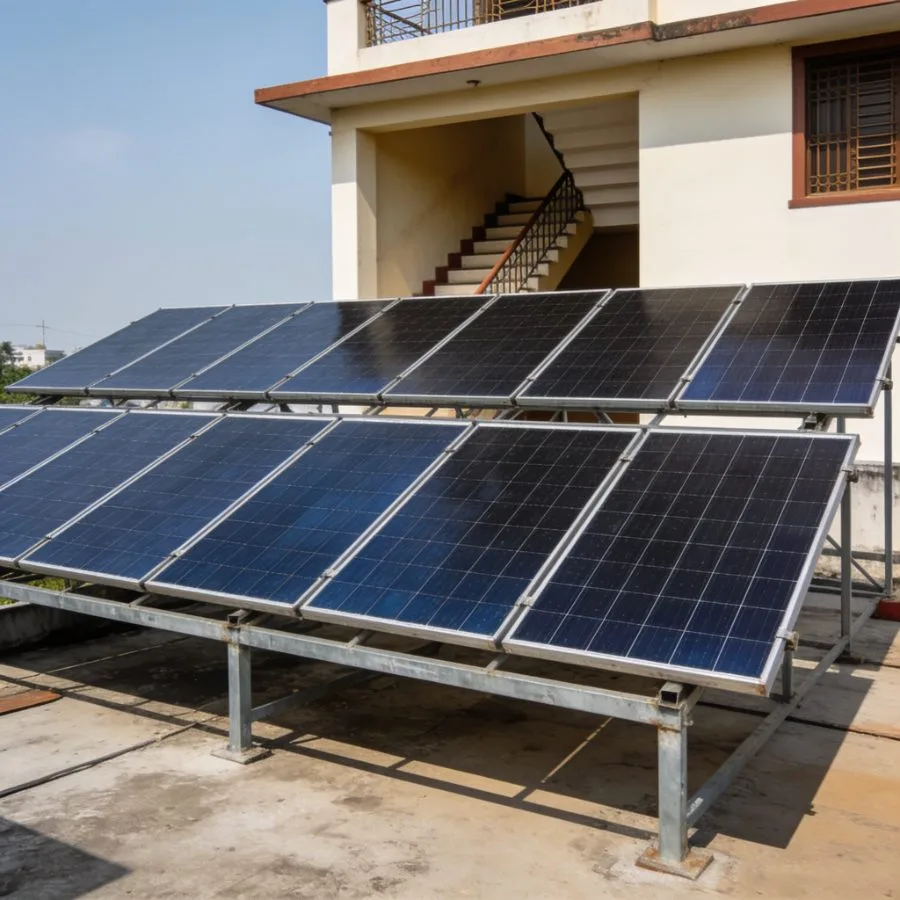
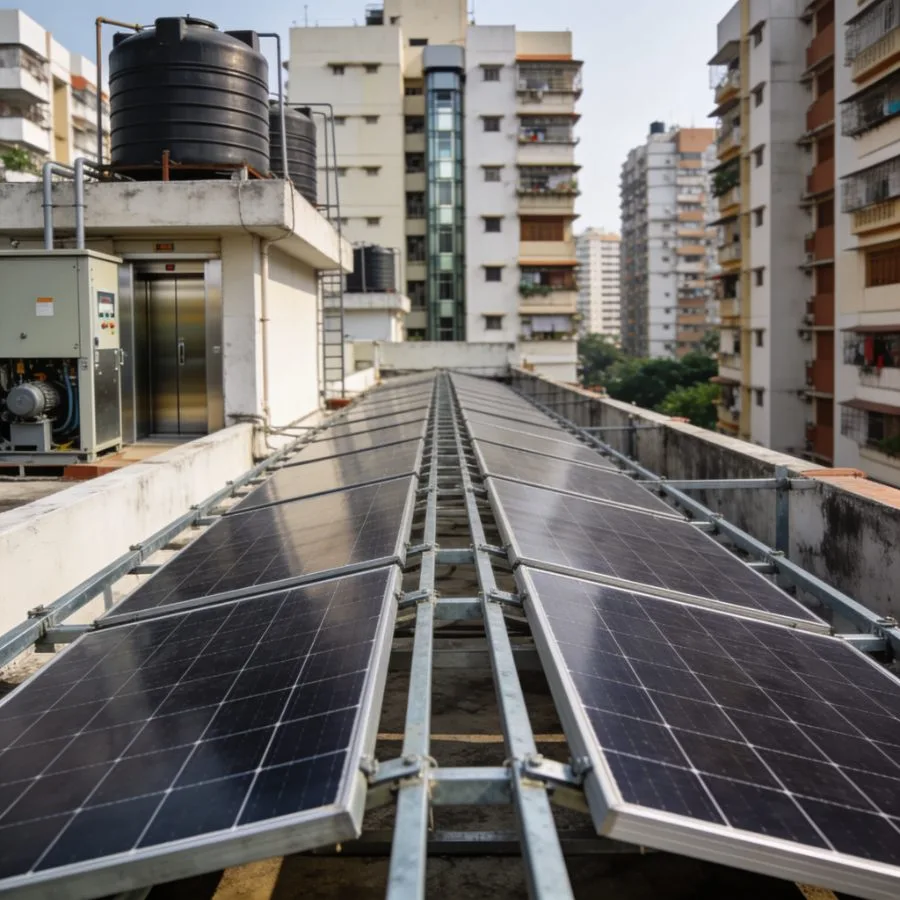
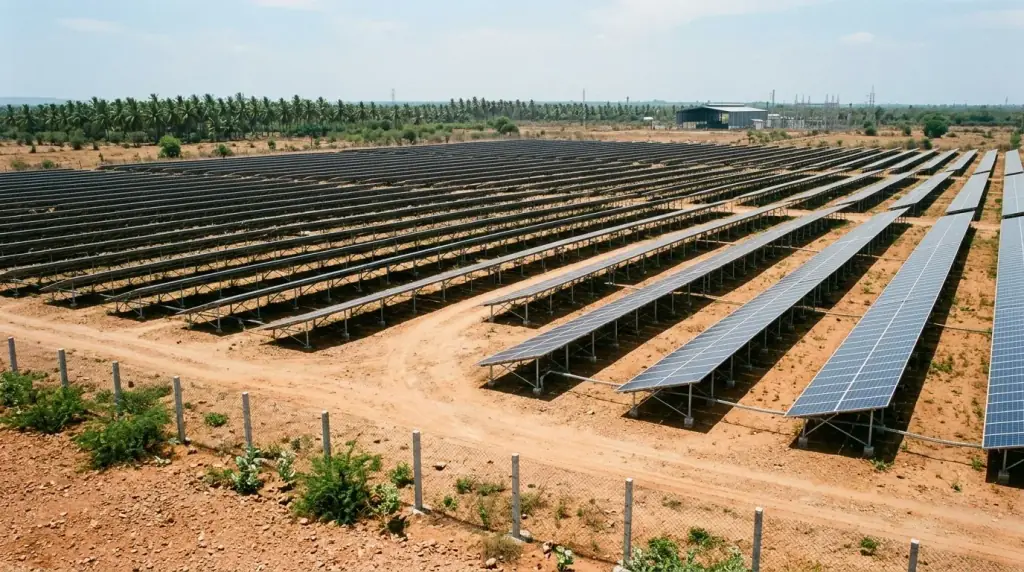
Piling, structure, DC and AC, earthing and testing, delivered to a principal contractor's drawings and programme. Illustrative site photograph, not a specific project.
What we can take on at 5 MW
- Balance-of-system packages inside a principal EPC scope: structure, DC, AC, earthing and testing.
- A feasibility read on the site, the substation position and the quotation you are holding.
- Comparing two or three EPC bids line by line and telling you which one has priced the evacuation properly.
- O&M scope definition, so the contract you sign is measurable.
What we will tell you to get elsewhere
- A bankable detailed project report, and a lender's engineer to certify it.
- Land aggregation, title diligence and conversion filings.
- Principal EPC responsibility for a 5 MW plant, with a single-point performance guarantee.
- Open access registration, tender bidding and the DISCOM interface.
Send us the district, the extent and the substation
That is enough for a first read. We will come back in writing on the land position, the route distance and bay availability, a defensible generation figure, and whether the capex you have been quoted sits inside the band on this page. If the site does not work we will say so in the first call rather than the third.
If you have EPC bids in hand, send them. Comparing two 5 MW quotations line by line takes us half a day, and the difference is almost always in the evacuation package and the performance guarantee.
5 MW solar plants, answered
How much does a 5 MW solar power plant cost in India?
A 5 MW solar power plant costs ₹18.2 to ₹19.9 crore turnkey in 2026, excluding land. That is ₹3.64 to ₹3.98 crore per MW, or ₹36 to ₹40 a watt, for fixed-tilt non-DCR modules on level terrain with a 33 kV injection point within a kilometre. The evacuation package and the ground conditions are the two lines that move it most; DCR modules add another ₹2 to ₹3 crore.
What is the cost per MW of a 5 MW plant compared with 1 MW?
About ₹3.75 crore per MW against ₹4.05 crore for a standalone 1 MW plant, a saving of roughly seven per cent. The saving comes from fixed costs spread over five times the capacity: one DPR, one connectivity application, one site establishment, one SCADA head end, one mobilisation. Modules, structure, cable and piling are per-watt costs and do not improve with scale at this size. Bulk module procurement at 5 MW buys a discount of one or two per cent, not ten.
How much land is required for a 5 MW solar power plant?
Twenty to twenty-five acres on fixed tilt, 25 to 30 on seasonal tilt and 30 to 40 with single-axis trackers. At this size the binding constraint is usually contiguity rather than extent: twenty-five acres assembled from nine survey numbers with three owners and a cart track through the middle will cost more to build on, and take longer to close, than thirty acres in a single parcel with clean title.
How many units does a 5 MW solar plant generate?
About 83 to 86 lakh units a year in Tamil Nadu at 18.9 to 19.6 per cent CUF, and 83 to 91 lakh across India, which is roughly 22,700 to 23,500 units on an average day. Rajasthan and Gujarat deliver seven to nine per cent more from an identical plant. Output falls about 0.5 per cent a year, so year twenty-five delivers about 88 per cent of year one and a 25-year revenue model must reflect that.
Is a 5 MW plant eligible for any subsidy?
No central capital subsidy applies. PM Surya Ghar is residential rooftop only, and PM-KUSUM Component A stops at 2 MW, so a 5 MW plant sits outside both. What does apply is accelerated depreciation at 40 per cent in the first year for a taxpaying company, state solar policy benefits such as banking and wheeling concessions, and viability gap funding on specific central tenders. Treat any quotation that includes a subsidy line at 5 MW as a warning about the contractor.
What does the grid connection cost for a 5 MW plant?
Between ₹2.1 crore and ₹4.5 crore for the evacuation package at 33 kV, depending on whether the substation has a spare bay, how far the line runs and what it crosses. Budget ₹12 to ₹16 lakh a kilometre for a 33 kV line on plain terrain, ₹60 lakh to ₹80 lakh for a new bay, and the transformers, metering and protection scheme on top. A 110 kV connection roughly triples the base package and is only worth it when the 33 kV network is genuinely full.
What is the profit from a 5 MW solar power plant?
About ₹2.39 crore a year net of O&M at a DISCOM feed-in tariff of ₹3.20 a unit, ₹4.22 crore under an open access PPA at ₹5.40, and ₹6.21 crore where it displaces your own HT tariff at ₹7.80. Payback runs from about 3 years to about 7.9 years on the same ₹18.75 crore plant. O&M at this size runs ₹25 to ₹30 lakh a year including module cleaning, security, insurance and spares.
How long does it take to build a 5 MW solar plant?
Seven to nine months of construction and 15 to 20 months from a secured site to commercial operation. Connectivity approval at 33 kV, the evacuation scheme, land aggregation and conversion, electrical inspectorate clearance and financial close run in parallel. At 5 MW the module delivery schedule also starts to matter: a 5 MW order is 90 to 110 containers of modules and structure arriving against a piling programme that has to be ready for them.