


7kW Solar Panel Price in Chennai
7 kW gets the full ₹78,000 subsidy. We price it after a free site survey of your roof.
A 7 kW rooftop system covers a very large Chennai home, a small commercial premises, or the full common-area load of an apartment building.
If you are a housing society
Societies claim ₹18,000 per kW for common facilities, considerably more than an individual household can.
₹1,26,000
at 7 kW, vs ₹78,000
Installing in Chennai since 2020
Homes, apartments and businesses
Three-phase conversion handled
Two years free maintenance
Size finder
Which size is right for your home?
Recommended size
7 kW
Suits a bi-monthly bill of ₹15,300 to ₹18,600. We price 7 kW after a free site survey.
- Installed
- After survey
- Subsidy
- ₹78,000
- After subsidy
- After survey
Output
How much power does a 7kW solar system generate in Chennai?
A 7 kW rooftop solar system in Chennai generates about 34 units a day, roughly 1,010 units a month, 2,020 units in a TANGEDCO bi-monthly cycle, or around 12,100 units a year. Chennai's approximately 5.3 peak sun hours a day place generation per kW above most of northern India.
| Output | Figure |
|---|---|
| Daily generation | About 34 units |
| Monthly generation | About 1,010 units |
| Bi-monthly generation | About 2,020 units |
| Annual generation | About 12,100 units |
| Bill it offsets | About ₹18,600 per bi-monthly cycle |
A year of generation
12,100
units from a 7 kW roof in Chennai
Enough to cover the full common-area load of most small to mid-sized Chennai apartment buildings.
Who installs 7 kW?
Who should not install 7 kW
Any property consuming under about 10,400 units a year. At that consumption a large share of generation is exported, and exported units settle below the retail tariff. A 5 kW system would return more per rupee spent.
The subsidy
How much subsidy do you get on a 7kW solar system?
An individual household installing a 7 kW system in Chennai receives ₹78,000 under the PM Surya Ghar Muft Bijli Yojana, the same amount paid on a 3 kW system, since the subsidy is capped at ₹78,000 for all systems of 3 kW and above. At 7 kW that works out to roughly ₹11,000 per kW installed, against ₹26,000 per kW at 3 kW. Housing societies claiming for common facilities are treated differently, and receive considerably more.
Who is buying?
A housing society, common facilities
₹1,26,000
₹18,000 per kW, up to 500 kW
A different route entirely, worth ₹48,000 more than the household cap at this exact size. It covers lifts, pumps, corridor lighting and EV charging, subject to a limit of 3 kW per residential unit in the building.
| Buyer | Subsidy at 7 kW | Per kW |
|---|---|---|
| Individual household | ₹78,000 | ~₹11,000 |
| Housing society, common facilities | ₹1,26,000 | ₹18,000 |
| Commercial premises | None | Accelerated depreciation instead |
The residential subsidy remains available up to 10 kW. Above that, no residential Central Financial Assistance applies. See the full subsidy process.
Our honest recommendation
At 7 kW, a non-subsidy plan is usually the better buy
The residential subsidy is capped, and the cap is reached at 3 kW. Every kilowatt you add above that is paid for entirely by you, so at 7 kW the question is no longer how to maximise the subsidy, it is whether chasing it is worth what it costs you in choice, price and time.
The ceiling is reached at 3 kW
PM Surya Ghar pays ₹30,000 for 1 kW, ₹60,000 for 2 kW and ₹78,000 for 3 kW and above. A 7 kW system receives exactly the same ₹78,000 as a 3 kW one. Past 3 kW the subsidy stops growing while the system keeps getting bigger, so its share of your cost falls with every additional kilowatt.
It narrows what we can install
A subsidised system must use ALMM-listed modules meeting domestic content rules and be registered through the national portal. That rules out several inverters and module lines we would otherwise recommend at this size, and the portal step adds time to the file.
A non-subsidy plan usually wins here
On a 7 kW system the ₹78,000 is a small share of the total. A non-subsidy build gives a wider choice of modules and inverters, a keener price per kW, no portal dependency and a faster commissioning. For most Chennai homes at this size, that is the better deal even before the subsidy arrives.
We quote both ways and show you the difference in writing, subsidised and non-subsidised, side by side, with the equipment named in each. You decide which you would rather have on your roof.
Get both quotesApartments and associations
7kW solar for apartment common areas
Group Housing Societies and Resident Welfare Associations in Chennai claim ₹18,000 per kW under PM Surya Ghar for common-area solar, lifts, pumps, corridor lighting and EV charging, up to 500 kW and subject to 3 kW per residential unit. At 7 kW that is ₹1,26,000, well above the ₹78,000 an individual household is capped at.
An individual flat owner generally cannot install on a shared terrace, because the roof is common property. The workable route is a collective application through the association, covering the loads the society itself pays for.
The association process, the 3 kW-per-flat arithmetic, the common-area load case and the general body resolution are all set out in full on the apartments page, along with why the economics beat home solar.
Solar for apartments and housing societiesSpecification
What a 7kW installation includes
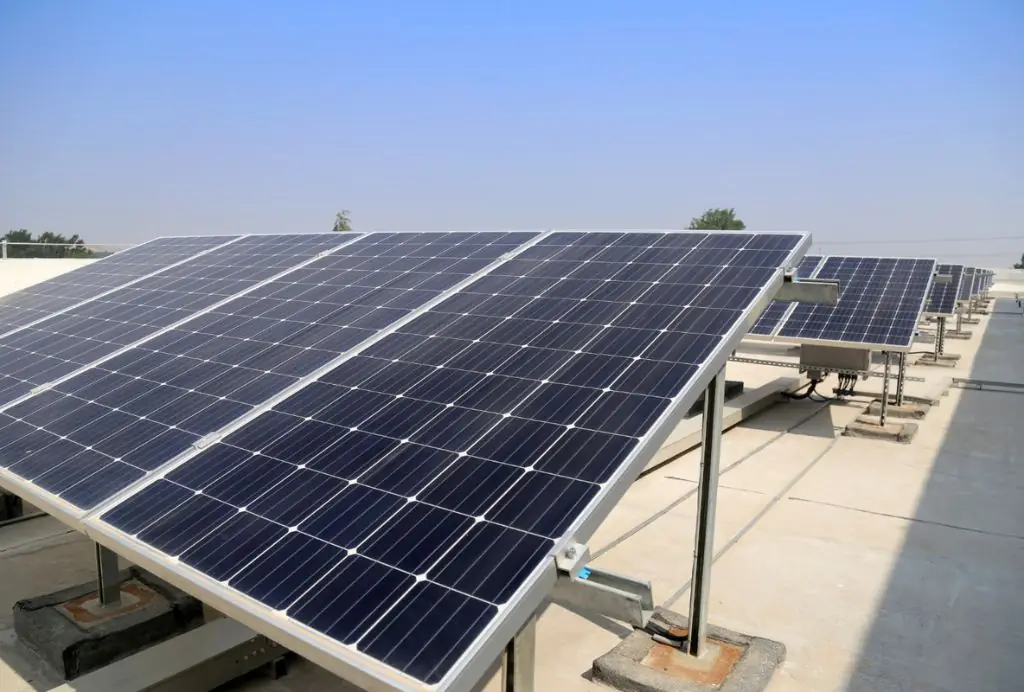
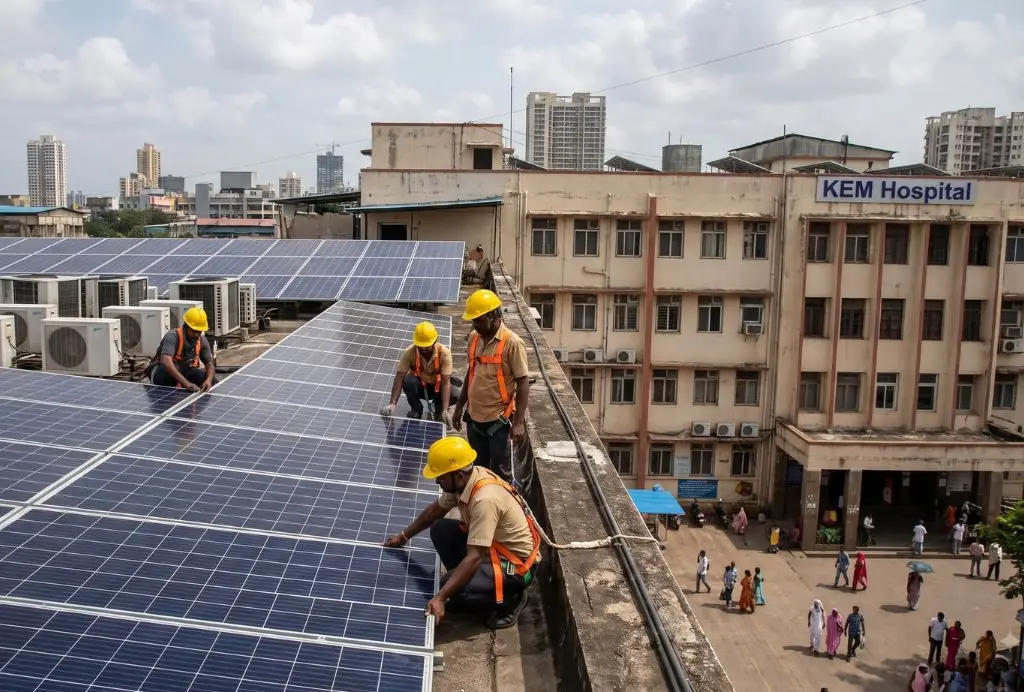
A 7 kW rooftop solar installation in Chennai needs roughly 560 to 650 square feet of shade-free roof area and typically uses twelve to thirteen panels. It requires a three-phase connection, since TANGEDCO provides three-phase supply for connected loads exceeding 4,000 watts, and a sanctioned load enhancement in nearly all cases.
Apartment terraces have their own constraints
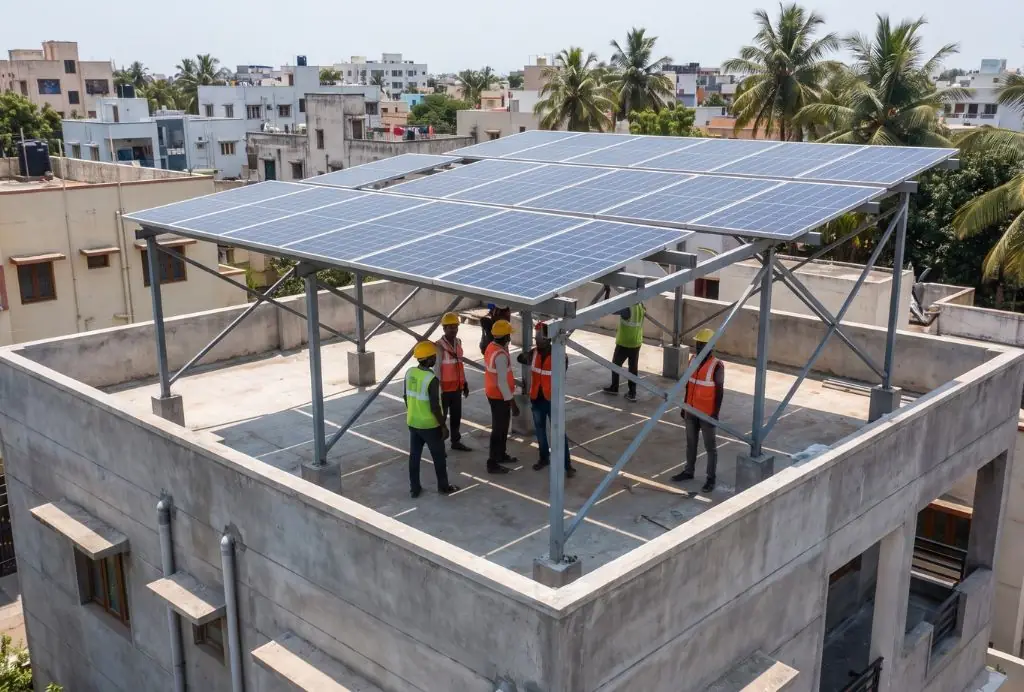
A 7 kW array on an apartment terrace competes for space with water tanks, lift machine rooms, staircase headrooms, dish antennas and, in many Chennai buildings, resident use of the terrace itself. Structures are usually elevated to preserve access underneath, which costs more than a ground-hugging residential mount but keeps the terrace usable and improves airflow beneath the panels, which matters in Chennai heat.
Waterproofing at the penetration points is also more critical on a shared terrace than on a private one, because a leak becomes a maintenance dispute involving every owner below it. Ask any installer how they seal penetrations and what warranty covers that specifically.
Commercial and mixed use
7kW solar for shops, clinics and small offices
Commercial premises installing 7 kW solar in Chennai do not receive the PM Surya Ghar subsidy, which is residential only, but can claim accelerated depreciation of up to 40% in year one and GST input tax credit. Payback is often faster than residential despite the absence of a subsidy, because commercial tariffs are higher and consumption is concentrated in daylight hours when the system is generating.
| Individual household | Housing society | Commercial | |
|---|---|---|---|
| Subsidy at 7 kW | ₹78,000 | ₹1,26,000 | None |
| Accelerated depreciation | No | No | Up to 40% year one |
| GST input credit | No | No | Yes, if GST registered |
| Tariff displaced | Domestic | Domestic, society connection | Commercial, higher |
| Typical payback | 4 to 6 years | 4 to 6 years | 3 to 4 years |
Which category you fall into depends on the tariff on the service connection, not on the type of building. We check that at the survey and tell you which route applies before quoting. For larger arrays, see commercial solar in Chennai.
What drives the number
What makes one 7kW installation cost more than another
The installed price of a 7 kW system in Chennai is driven by whether a three-phase conversion and sanctioned load enhancement are needed, the panel and inverter specification, whether the array splits across roof planes, structure height and type, roof access, distance from the coast, and whether the installation is on a private roof or a shared apartment terrace.
| What varies | Effect | Why |
|---|---|---|
| Three-phase conversion | Additional | Separate TANGEDCO application and connection work |
| Sanctioned load enhancement | Additional | Required in nearly all cases at 7 kW |
| Elevated structure on apartment terrace | Higher | Preserves terrace access, improves airflow |
| Split array across roof planes | Higher | More structure, more MPPT inputs, sometimes optimisers |
| DCR compliant panels | Higher | Mandatory for either subsidy route |
| Coastal location | Higher | Salt mist certified modules, corrosion resistant mounting |
| Height and roof access | Higher | Craneage, scaffolding, longer cable runs |
| Hybrid inverter with battery | Considerably higher | Backup during outages |
At 7 kW the spread between installations is at its widest. A flat private terrace already on three-phase supply and a shared apartment roof needing elevated structures, a phase conversion and careful waterproofing are different projects with different costs. A single published figure would mislead nearly everyone reading it. We survey, then quote once, itemised. More on what drives solar prices in Chennai.
Book a free surveySavings
What a 7kW system saves in Chennai
A 7 kW system generating around 12,100 units a year covers the full common-area consumption of most small to mid-sized Chennai apartment buildings, or a very large home billing above ₹15,300 per bi-monthly cycle. Payback typically runs four to six years for residential and society installations and three to four for commercial.
Why the daylight match matters here
Common-area load runs heavily during daylight hours, so most generation is consumed on site rather than exported. Self-consumed units are worth full retail value, while exported units only offset later imports, and credit still unused on 31 March lapses. A common-area system is therefore among the better-matched solar applications there is.
At 7 kW, sizing against actual consumption matters more than at any smaller size. We size against twelve months of bills, and if 5 kW is the honest answer for your building or your home, we will say so. If your consumption is above 10,000 units a year, look at 8 kW and the 10 kW ceiling.

For a housing society, the savings land somewhere unusual
Not in any individual's electricity bill, but in the society's common-area bill, which is funded from monthly maintenance charges.
A reduction there is shared across every flat, which is why common-area solar tends to pass a general body vote more easily than proposals benefiting individual owners.
Timeline
How long does a 7kW installation take?
A 7 kW rooftop installation in Chennai typically takes eight to twelve weeks from survey to a live, net-metered system, since a three-phase conversion and sanctioned load enhancement are almost always involved. For housing societies, add the time needed to pass the association resolution, which is often the longest single step and should be started first.
STEP 01
Site assessment, connection, load and tariff check
Same week as your enquiry
STEP 02
Technical documentation for the association
3 to 5 days, societies only
STEP 03
General body resolution
Society-dependent, start this first
STEP 04
Design and itemised quotation
3 to 4 days after survey
STEP 05
Three-phase conversion and load enhancement
Filed in parallel with net metering
STEP 06
Net metering and subsidy filing
Filed by us on approval
STEP 07
Installation on site
2 to 4 days
STEP 08
TANGEDCO inspection and meter
4 to 8 weeks, the main variable
STEP 09
Subsidy credited
about 15 days after DISCOM approval and your redemption request
For associations, the sequencing advice is simple
Get the survey and the technical documentation done first, so the committee has real numbers to put to the general body. Passing a resolution on an estimate, then discovering the design differs, means going back to the members a second time. More on how TANGEDCO net metering works.
Your 7kW quotation
Get your 7kW price
At 7 kW, your price depends on your connection, your roof and which subsidy route applies to you. Send us your details and your last EB bill and we will come back with an itemised quotation and a clear answer on all three. Associations get a load assessment and savings projection suitable for presenting to the general body.
What you get back
- A confirmed system size based on twelve months of actual consumption
- A check on your connection, phase, sanctioned load and tariff category
- The subsidy route that applies to you, household, society or commercial
- An itemised price naming every component and brand
- For associations, documentation the committee can put to the members
- An honest recommendation, including if a smaller system is the right answer
Common questions
7kW solar in Chennai, common questions
What is the price of a 7kW solar system in Chennai?
The installed price depends on whether a three-phase conversion and sanctioned load enhancement are needed, the panel and inverter specification, whether the array splits across roof planes, structure height, and whether the roof is a private terrace or a shared apartment one. It is quoted after a site survey rather than from a price list. Send us your details and EB bill for an itemised quotation.
How many units does a 7kW solar system generate in Chennai?
About 34 units a day, 1,010 units a month, or roughly 12,100 units a year. Chennai receives around 5.3 peak sun hours daily, higher than most of northern India, so generation per kW here is above the national average.
How much subsidy can a housing society claim for solar in Chennai?
Group Housing Societies and Resident Welfare Associations can claim ₹18,000 per kW for common-area facilities including lifts, pumps, corridor lighting and EV charging, up to 500 kW and subject to a limit of 3 kW per residential unit in the building. At 7 kW that is ₹1,26,000, considerably more than the ₹78,000 an individual household can claim.
Can an individual flat owner install solar on an apartment terrace?
Generally no. The terrace is common property belonging to all owners collectively, so individual applications against a society address are usually rejected at the feasibility stage. The workable route is a collective application through the RWA or Apartment Owners Association, typically for common-area loads.
What does a 7kW common-area system power in an apartment building?
Lifts, water pumps, borewell motors, corridor and stairwell lighting, compound lighting, the sewage treatment plant and EV charging points. These loads run largely during daylight hours, which matches solar generation well, so most output is consumed on site rather than exported.
How much subsidy does an individual household get on a 7kW system?
₹78,000, the same as a 3 kW system, since the PM Surya Ghar subsidy is capped at ₹78,000 for all systems of 3 kW and above. At 7 kW that is roughly ₹11,000 per kW installed against ₹26,000 per kW at 3 kW. The residential subsidy remains available up to 10 kW.
How many panels are in a 7kW solar system?
Twelve to thirteen panels, depending on module wattage. With the 545 to 590 watt modules common in 2026, twelve panels gives an array of around 7.1 kW.
How much roof area does a 7kW solar system need?
About 560 to 650 square feet of shade-free area. On apartment terraces the array competes with water tanks, lift machine rooms, staircase headrooms and resident use of the terrace, so elevated structures are commonly used to preserve access underneath.
Does a 7kW system need a three-phase connection?
Yes. TANGEDCO provides three-phase supply for connected loads exceeding 4,000 watts, so a 7 kW system requires three-phase, and a sanctioned load enhancement in nearly all cases. Both should be filed alongside the net metering application rather than after it.
What does a housing society need to do before installing solar?
Pass a formal resolution at a general body meeting authorising the installation and application, apply through the RWA or Apartment Owners Association rather than as individuals, confirm the society's service connection and sanctioned load, and use DCR compliant modules. The resolution is usually the longest step, so it should be started before anything else.