





Home / Commercial solar / 500 kW solar plant cost
Commercial solar · 500 kW500 kW Solar Plant Cost for Factories in Tamil Nadu
A 500 kW rooftop solar plant costs ₹1.85 to ₹2.1 crore installed in 2026, including 8.9% GST, which is ₹37 to ₹42 a watt. A manufacturer that claims the GST back pays ₹1.70 to ₹1.93 crore, and the plant makes about 8,00,000 units a year at Chennai yields.
At this size the questions are a factory owner's questions. Is the roof big and strong enough, or do you need land? What HT equipment does the price cover? Would a captive plant off site suit you better? What is the 40% depreciation worth? This page answers each with numbers, and works the payback on an HT I bill with the demand charge left in.
Get an itemised proposalCall +91 98841 07170500 kW at a glance
- Installed price₹1.85 to 2.1 crore
- Before GST₹1.70 to 1.93 crore
- Units a yearabout 8,00,000
- Roof needed40,000 to 50,000 sq ft
- Or landabout 2 to 2.5 acres
- Saving on HT Iabout ₹50 lakh a year
Chennai yield of 1,600 units per kW a year; saving for a factory on HT I using 95% of its solar, after the ₹1.04 network charge.
What a 500 kW plant costs, on a roof or on the ground
A GST-registered factory recovers the 8.9% GST as input credit, so the ex-GST column is its real cost. Every size from 10 kW up is on the commercial solar cost per kW table.
Ground mount at 500 kW is quoted per site: piling, fencing, levelling and longer cable runs replace the roof work, and land is extra. The 1 MW solar plant page shows the ground band at that size. A roof you own carries no land cost.
The ₹2 crore, line by line, including the HT side
Modules are roughly two-fifths of the ex-GST price at JMK Research's Q4 2025 prices. DCR modules at about ₹23 to ₹26 a watt would add ₹40 to ₹55 lakh, so factories, with no subsidy that asks for DCR, buy non-DCR.
The HT side varies most between quotes. Whether the plant ties into an LT bus behind your own transformer or needs its own switchgear depends on your substation, so ask every bidder to name what they supply. Roof type, inverter brand, structure height, cable runs and roof repairs move the rest.
Generation across Tamil Nadu districts: 7.75 to 8.5 lakh units
Chennai district yields about 1,600 units per kW a year, about 4.4 a day. Across Tamil Nadu the figure runs from about 1,550 to 1,700, depending on district and site, so a 500 kW plant makes 7.75 lakh to 8.5 lakh units a year. Every worked figure here uses 1,600.
The last column values each unit at ₹6.24 (95% at ₹7.50, 5% at ₹3.10, less ₹1.04). Output falls by about half a percent a year, so by year ten the Chennai figure is roughly 7.6 lakh units.
Roof area, sheet roof load checks, or about 2 to 2.5 acres of land
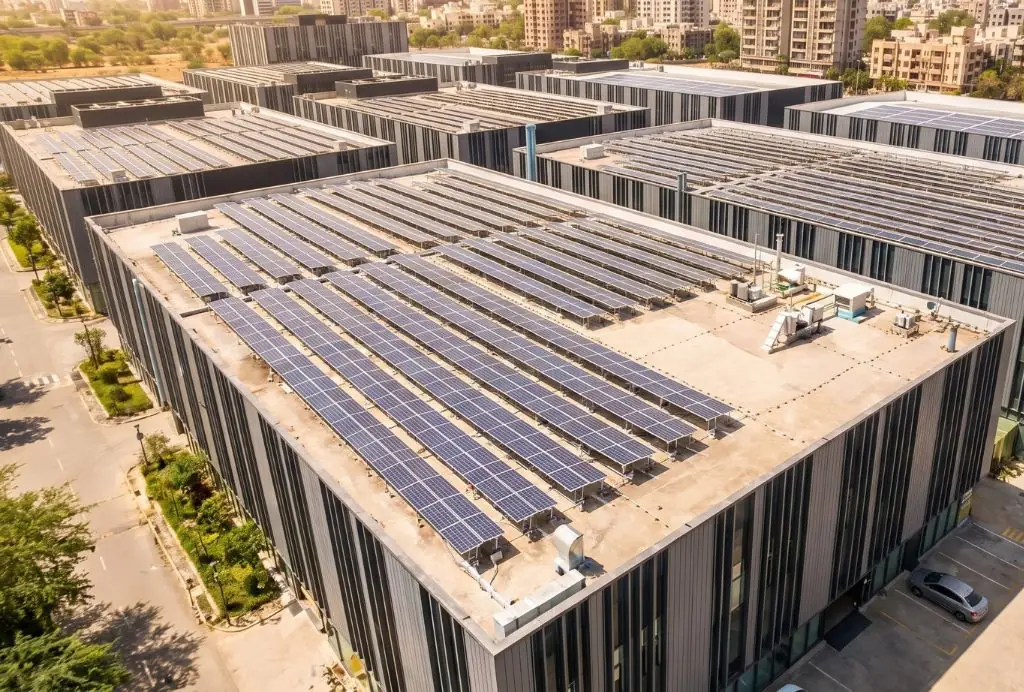
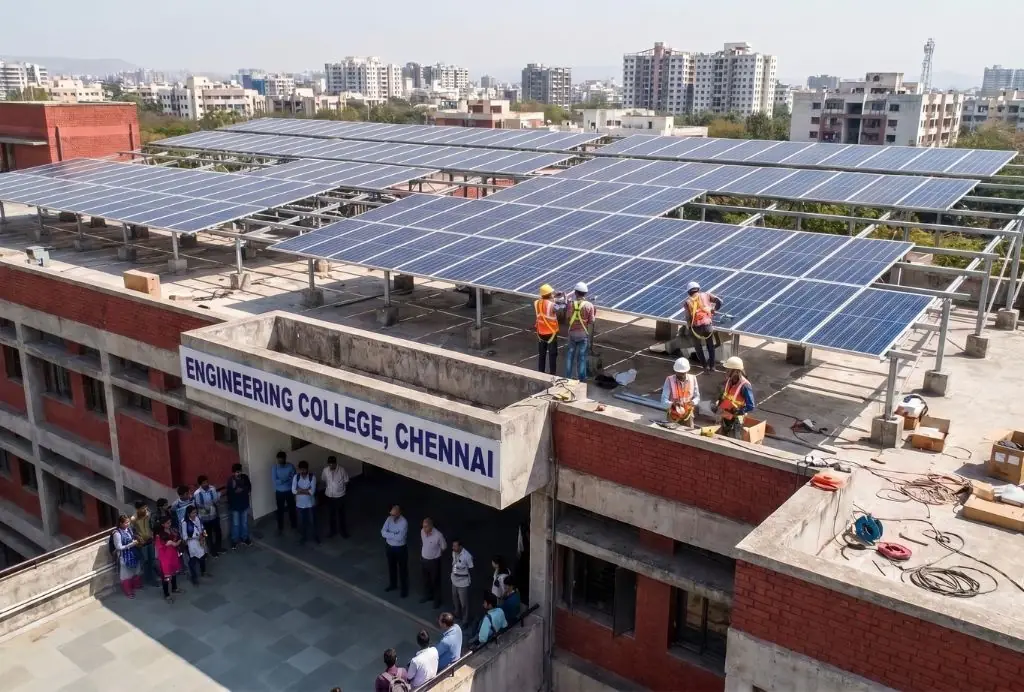
At 80 to 100 sq ft per kW, 500 kW needs 40,000 to 50,000 sq ft of shade-free roof. Few single sheds are that big, so factory plants often spread over several buildings, each inverter set with its own generation meter.
Metal sheet and RCC roofs
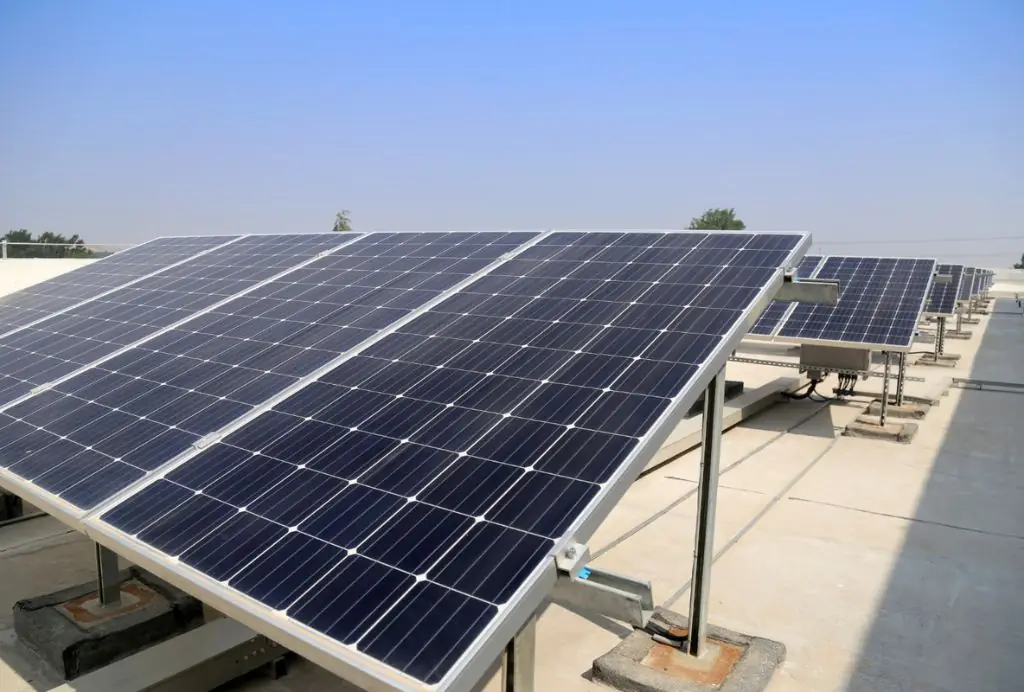
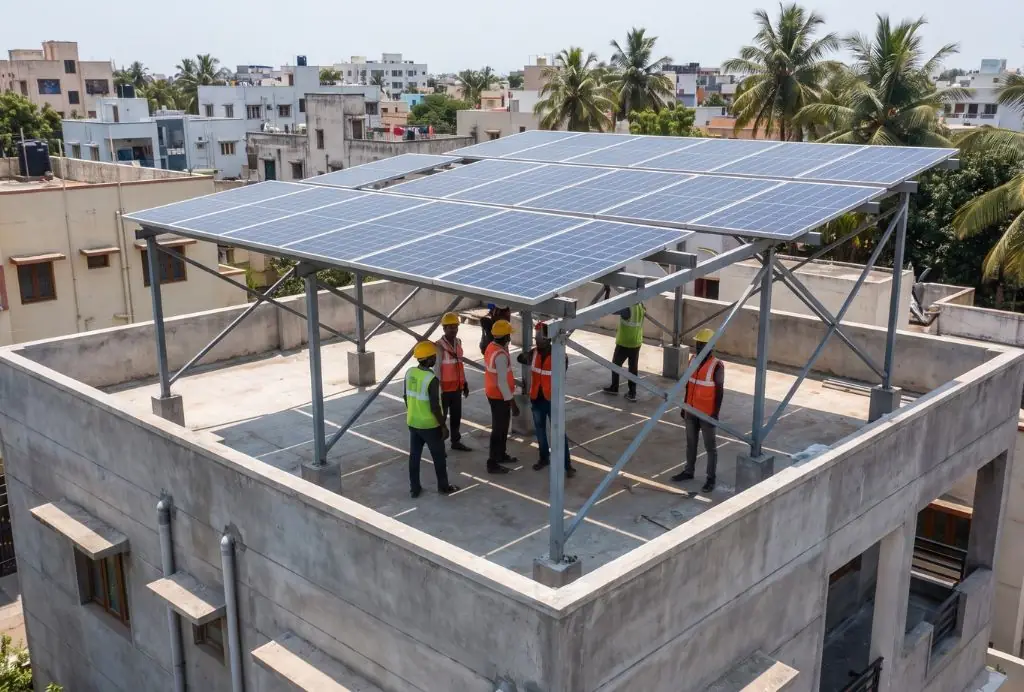
Metal sheet costs less per kW because rails fix straight to the purlins, but the roof must carry the load: we check purlin size and spacing, sheet age and fixings, and whether the roof will outlast the plant. Flat RCC roofs take an elevated galvanised frame, which raises the cost per kW. Both are designed for coastal cyclone winds.
Ground mount
With no usable roof, a ground-mounted 500 kW plant needs about 2 to 2.5 acres of shade-free land. Land away from the factory turns the project into a captive or open access plant, with the different rules below.
HT rules at 500 kW: ₹3.10 export, gross metering option, ₹10,000 fee
- Net feed-in by default. Units used on site offset your HT tariff. The surplus earns ₹3.10 a unit, the rate for 151 to 999 kW, as a money credit that carries forward; on 31 March you choose payment or carry-over. See the export unit price guide.
- Gross metering is optional for HT consumers at 151 to 999 kW: all generation sold at ₹3.10, no network charge. For a factory that uses most of its output it is worth about half as much: 8,00,000 × ₹3.10 = ₹24.8 lakh, against ₹49.9 lakh on net feed-in.
- Network charge of ₹1.04 a unit on total generation, currently levied and under legal challenge in the Madras High Court. See the network charges guide.
- Registration fee: the ₹10,000 band starts at 500 kW and runs to just under 1 MW. 300 and 400 kW plants pay ₹5,000.
- CEIG approval before commissioning, plus a generation meter. Our CEIG guide lists the documents.
- Capacity cap: contracted demand or 999 kW, whichever is lower. At 1 MW and above TNPDCL approves parallel operation with reverse power relays, not net feed-in. The capacity limit guide explains the test.
Rooftop, captive, group captive or open access at 500 kW
Rooftop is limited by your roof and contracted demand. Beyond that, or for a second site, the off-site routes come in, with rules of their own.
Off-site routes carry their own charges and can bank energy; rooftop net feed-in has no unit banking, only a money credit. Read what a captive solar plant is, who can use group captive power and what open access solar is before comparing offers.
Payback on an HT I factory bill, with the demand charge left in
Take a factory on HT I with 750 kVA contracted demand, using 2,50,000 units a month, with enough daytime load to use 95% of the plant output. Energy costs ₹7.50 a unit. Demand costs ₹608 per kVA a month on the higher of recorded demand or 90% of contracted demand, so at least 675 kVA.
The saving is ₹4,16,000 a month, about ₹49.9 lakh a year. The roof supplies about a quarter of the units, but the bill falls by 18%, because the demand charge does not move. On ₹1.70 to ₹1.93 crore before GST, simple payback is about 3.4 to 3.9 years, before depreciation.
The table bills energy at a flat ₹7.50. HT energy costs 25% more from 6 to 10 am and 6 to 10 pm, and 5% less from 10 pm to 5 am. Solar covers part of the morning peak, where each unit is worth ₹9.375, so every 10,000 such units a year add ₹18,750. Run your own bill through the commercial solar ROI calculator, or see our industrial solar page.
Tax at 500 kW: 40% depreciation, the extra 20% and Section 115BAA
A factory depreciates the ex-GST cost, because the GST, about ₹15 to ₹17 lakh on a 500 kW contract, comes back as input credit. On a plant costing ₹1.80 crore before GST:
So timing matters: a plant put to use after about the first week of October gets half rates that year. From the 2026-27 tax year the Income-tax Act 2025 keeps the same mechanics, with Section 33 for depreciation and Section 200 replacing 115BAA, still without the extra 20%.
It needs taxable profit, and your CA should model it. The working is in how to calculate accelerated depreciation for solar. Factories get no central subsidy; the solar power plant subsidy guide covers who does.
Build timeline and production shutdown windows
Most of the build happens on the roof while the factory runs. Approvals and one planned shutdown set the pace:
- Survey and structural check of each roof, then design and bill of materials.
- HT application with the ₹10,000 fee; feasibility within 15 working days (deemed feasible under the 2024 central rules if not done), approval within 5 more.
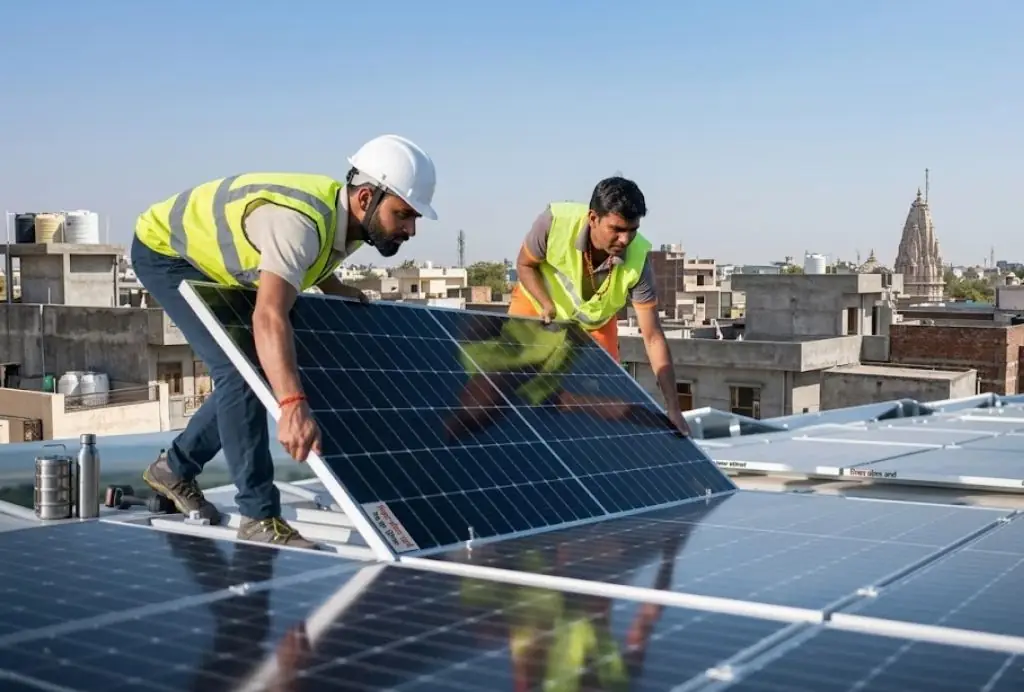
- Procurement and installation by our own crews, building by building.
- Shutdown window: the tie-in to your HT or main LT panel needs a short planned power cut, scheduled on your weekly off or a maintenance day and named in the proposal.
- CEIG inspection and approval, then meters, synchronisation and commissioning.
What a 500 kW quotation must include
- Capacity in kWp DC and kW AC; the AC figure is what TNPDCL approves.
- Module and inverter make, model and count, DCR or non-DCR, and warranty terms.
- Structure material, height and the roof load check behind it, plus cabling, earthing and monitoring.
- The HT side: what the bidder supplies and what the factory must provide.
- Meters, CEIG and TNPDCL work, and who pays the ₹10,000 fee.
- Price before and after GST, with the 70:30 split shown.
- Expected generation at 1,600 units per kW or your district's yield, and the yearly loss assumed.
- Maintenance cover for two years, the AMC price after, payment milestones and a dated schedule.
A ₹1.6 crore offer that leaves out the HT side, the CEIG work or the GST is not cheaper. It is incomplete. Our quote check guide shows how to compare per-watt figures fairly.
300 kW and 400 kW: smaller HT plants
A 400 kW plant is quoted inside its neighbours' range of ₹37 to ₹43 a watt including GST, about ₹1.48 to ₹1.72 crore.
Size to your daytime load, not your roof. A unit used on site nets ₹6.46 on HT I after the network charge; a unit exported nets ₹2.06. Below 300 kW, see the 200 kW page.
Other commercial sizes
500 kW solar plants, common questions
How much does a 500 kW solar plant cost in India in 2026?
On a Tamil Nadu factory roof, ₹1.85 to ₹2.1 crore installed, including 8.9% GST, which is ₹37 to ₹42 a watt. Before GST it is ₹1.70 to ₹1.93 crore. Ground mount is quoted per site, and land is extra.
How many units does a 500 kW solar plant generate per day?
About 2,190 units on an average day in Chennai, or 8,00,000 a year at 1,600 units per kW. Across Tamil Nadu districts the range is about 2,120 to 2,330 a day.
How much land is needed for a 500 kW solar plant?
About 2 to 2.5 acres of shade-free land for ground mount. On a roof, 40,000 to 50,000 sq ft, which can be split across several buildings.
Rooftop or ground mount for a 500 kW plant?
Rooftop, if the roof is big and sound: no land, and it runs behind your meter on net feed-in. Land away from the factory makes it a captive or open access plant.
Is ₹1.6 crore a complete 500 kW quotation?
Check what it leaves out. Our turnkey band is ₹1.70 to ₹1.93 crore before GST, with the HT side, metering, CEIG work and maintenance. A lower figure may drop one, or omit GST silently.
What is the payback period of a 500 kW solar plant?
About 3.4 to 3.9 years before depreciation for a factory on HT I using 95% of its solar. It saves about ₹49.9 lakh a year after the ₹1.04 network charge, with the demand charge unchanged.
Can a factory claim 60% depreciation on a solar plant?
A manufacturer can claim 40% plus 20% additional depreciation in year one. A company on the Section 115BAA regime keeps the 40% but loses the extra 20%. Non-manufacturers get 40%. Your CA should model it.
Is there a subsidy for a 500 kW factory solar plant?
No central subsidy for a factory. Housing societies get ₹18,000 per kW for common facilities up to 500 kW, but businesses do not. A factory gets 40% depreciation and GST input credit instead.
Can I install more than 500 kW on my factory roof?
Yes, up to your contracted demand or 999 kW, whichever is lower. At 1 MW and above TNPDCL does not allow net feed-in, so larger needs move to a captive or open access plant.
Get a 500 kW proposal for your factory
Send your last two HT bills, your contracted demand and the roof drawings if you have them. An engineer from our Guindy office surveys every roof, checks the structure, and returns an itemised proposal with the HT side, the shutdown windows and the payback worked on your own bill.
An engineer calls back within one working day. We use your bill only to size the system and never pass your details on.
Sources
Blues Renewables price bands for Chennai rooftop installations, October 2026: 300 kW, 500 kW and 1 MW ground-mount prices.
TNERC Suo-motu Tariff Order No. 6 of 2025, 30 June 2025, effective 1 July 2025: HT I ₹7.50/kWh, ₹608/kVA demand charge, billable demand at the higher of recorded or 90% of contracted demand, 25% peak surcharge 6 to 10 am and 6 to 10 pm, 5% night rebate, HT network charge ₹1.04/kWh.
TNERC Grid Interactive Solar PV Energy Generating System Regulations 2021 (notified 7 Oct 2021) and TNERC Order No. 8 of 2021 (22 Oct 2021), with the TANGEDCO Technical Branch salient features of Order 8/2021: net feed-in, gross metering at 151 to 999 kW, feed-in ₹3.10, capacity cap, generation and check meters, registration fees, feasibility timelines, parallel operation above 1 MW.
CBIC Notification No. 9/2025-Central Tax (Rate), 17 Sept 2025, in force 22 Sept 2025: 5% GST on solar devices; 70:30 valuation, giving 8.9% on turnkey EPC.
Income-tax Act 1961 Section 32 and Appendix I, Income-tax Rules 1962: 40% depreciation on solar power generating systems, half rate under 180 days, additional depreciation under Section 32(1)(iia), denied under Section 115BAA(2)(ii). Income-tax Act 2025, Sections 33 and 200.
MoP Electricity (Rights of Consumers) Amendment Rules 2024, 22 Feb 2024: feasibility study within 15 days, else deemed feasible.
G.O.Ms. No. 98, Energy Department, 14 Oct 2024: CEIG approval for generating units above 10 kVA.
Madras High Court, South India Spinners Association v. CMD TANGEDCO, single judge order 22 Dec 2024 and division bench stay 28 Apr 2025: network charges under challenge.
JMK Research, Q4 2025 module price report: non-DCR modules ₹14.32/Wp (mono PERC) and ₹14.88/Wp (TOPCon); DCR modules about ₹23 to ₹26/W.
MNRE, PM Surya Ghar: Muft Bijli Yojana: ₹18,000 per kW for housing society common facilities up to 500 kW.