












Solar Panel Installation in T Nagar
We tell you in one phone call whether your site is viable, before anyone visits
T Nagar is Chennai’s retail centre, and solar here is mostly a commercial conversation. Showrooms carry very high lighting and air conditioning loads, trade well into the evening, and occupy leased premises where the roof frequently belongs to somebody else. That last point decides more T Nagar enquiries than any technical factor.
Installing across Chennai since 2020
Two years free maintenance included
Subsidy and TANGEDCO paperwork filed by us
Free site survey, no obligation
The short answer
Looking for a solar panel installation company in T Nagar?
T Nagar is commercial ground, and a business roof is priced from a load study rather than a bill amount. The streets are too narrow for a crane on most jobs, so material handling is planned into the programme rather than discovered on day one. We have installed across Chennai since 2020, file the PM Surya Ghar subsidy of up to ₹78,000 for households and the TANGEDCO net metering application ourselves, and include two years of free maintenance. Before the survey, you can check the solar panel price in Chennai for 3 kW to 10 kW systems and see how our solar panel installation in Chennai works, the same process we follow in T Nagar.
What it costs here
A typical 5 kW system in T Nagar
Standard 5 kW example
What a typical 5 kW home system does here. Commercial and industrial connections are quoted differently and do not receive the subsidy.
Not sure what your roof can carry?
Send us a photo of your latest EB bill on WhatsApp and we will come back with your system size, the subsidy you qualify for and an estimated saving. No visit required to get that first answer.
The local picture
Roof rights come before roof size
Most commercial premises in T Nagar are leased, and many occupy the lower floors of buildings with other occupants above, which means the retailer often has no rights over the terrace at all. Before any assessment is worth doing in T Nagar, three things need establishing: whether you control the roof, whether the usable area is meaningful relative to your load, and whether your remaining lease term justifies a 25-year asset.
The three questions, in order
Do you have documented rights to use the roof?
A ground-floor showroom on Usman Road or off Ranganathan Street generally does not control the terrace of the building it sits in.
Is the usable area meaningful?
T Nagar frontages are narrow and buildings are packed. A showroom with substantial lighting and cooling load may have roof area supporting only a fraction of it.
How long is left on the lease?
A system designed for 25 years on a six-year lease needs the ownership and exit position documented before installation.
Where it does work in T Nagar
Owner-occupied commercial buildings, larger showrooms and complexes with their own terrace and parking, landlord participation where the building owner is the better investor, and the residential streets off the commercial core.
The honest position
We will tell you before we visit
We will say at the first conversation whether a T Nagar site is worth surveying. A wasted survey costs us both time, and this locality produces more unviable enquiries than any other in Chennai.
Areas we cover within T Nagar: Usman Road, Ranganathan Street, Pondy Bazaar, Panagal Park, Mambalam, the residential streets off Venkatanarayana Road.
All areas we cover in Chennai →Residential
Solar for T Nagar homes
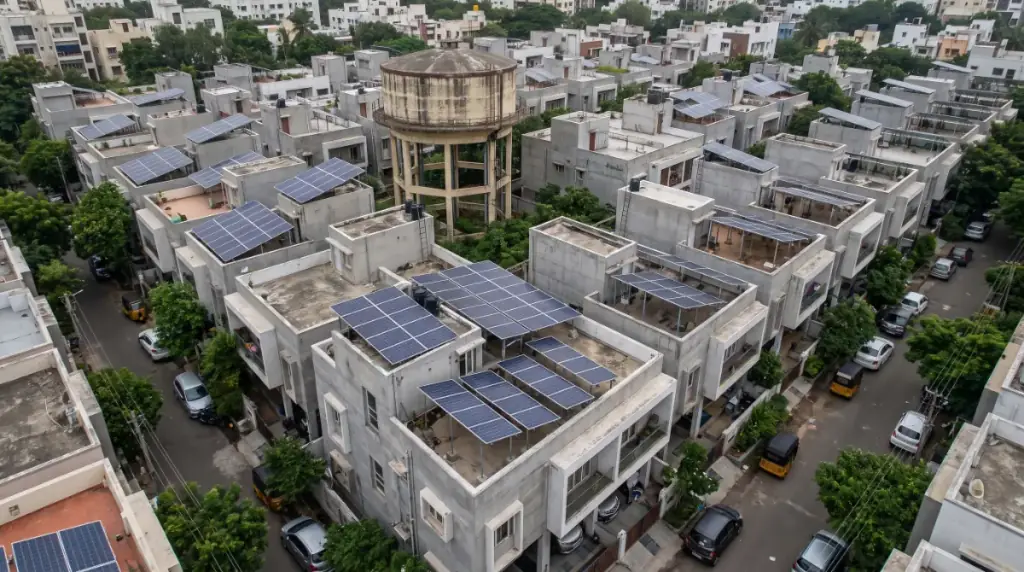
Away from the commercial core, T Nagar has established residential streets with independent houses and apartment blocks.
Independent houses
Typically install 3 kW to 4 kW, with usable roof area rather than consumption usually the limiting factor.
Apartment associations
Follow the common-area route, claiming ₹18,000 per kW.
Mixed-use buildings
Where a residence sits above commercial space, the connection and tariff category need checking carefully, since it determines which subsidy route applies.
Commercial
Solar for T Nagar businesses
Jewellery and textile showrooms
Very high display lighting and air conditioning loads, long trading hours. Daytime load is substantial and worth addressing, but the evening share is large, so solar covers part of the bill rather than most of it.
Offices and commercial buildings
Better daytime match than retail, and a straightforward case where the roof is available.
Solar carports
Where the roof is not available but parking is, a carport generates power and shades customer vehicles, which a showroom values independently.
Multi-outlet retailers
If you run several showrooms across Chennai, screen the portfolio first and install at the viable sites rather than uniformly.
Local guide
T Nagar solar: fire safety and floodwater come before the panels
T Nagar was carved out of the Mambalam estate between 1923 and 1925, partly on the bed of the Long Tank, which was drained in 1923. A century later its shops handle 70 to 80 per cent of the gold sold in Chennai, often in buildings that rose well past their approvals.
Solar on a building with a fire history
After the 2008 Saravana Stores fire, Tamil Nadu Fire and Rescue Services audited about 150 commercial buildings in T Nagar and found that not one met even basic fire safety norms. In 2017 the Chennai Silks fire took about 38 hours to control, and fire vehicles struggled to reach the building through narrow entrances. An array adds DC cabling that stays live in daylight, so on a showroom terrace the design should include: DC cable in metal conduit, isolators at the array and before the inverter, module-level shutdown on occupied buildings, the inverter kept out of staircases and escape routes, clear walkways to the terrace exit, and labels firefighters can read.
Built over a tank: plan for water at street level
Part of T Nagar stands where the Long Tank held water until 1923, and the area still floods. During the November 2023 rains commuters waded through water at the T Nagar bus depot, and during Cyclone Michaung that December the police and Army rescued stranded residents from neighbouring West Mambalam. For solar, ground level is the risk, especially where the meter room or LT panel sits on the ground floor or in a basement. Keep the inverter on the terrace or an upper floor, route the AC cable down a riser rather than a floor trench, and make sure the solar ACDB is mounted above the highest water level the building has seen.
What net feed-in means for a showroom
Showrooms are non-domestic connections on net feed-in. Solar used inside the shop saves the full commercial tariff; a unit sent to the grid earns ₹3.61 for systems up to 10 kW and ₹3.37 from 11 to 150 kW. So size the array to the cooling and lighting load the shop runs between about 9 am and 4 pm, and export almost nothing. At Chennai district's 1,600 units per kW a year, a 20 kW system makes about 32,000 units, and its value depends on keeping nearly all of them inside the building. The export credit also drops from ₹3.61 to ₹3.37 once a system goes above 10 kW, so a showroom whose daytime load sits near that line should go larger only if the extra output is used on site.
What we install
What we install in T Nagar
The process
How installation works
Free site survey
Shade-free roof area measured across the day, structure checked, connection name and sanctioned load confirmed.
Design and itemised quotation
Sized against twelve months of consumption, with every component named.
Approvals filed
PM Surya Ghar and TANGEDCO net metering, plus load enhancement or phase conversion in parallel where needed.
Installation
One to three days for a residential system, carried out by our own team rather than subcontracted.
Inspection and commissioning
TANGEDCO inspects, the net meter goes in, the system goes live.
Subsidy tracked to your account
And two years of maintenance included from commissioning.
We check the name on your electricity connection at the survey, because a mismatch stops more applications than any technical issue. See what to keep ready.
Free, no obligation
What will it cost on your roof in T Nagar?
Not sure you control your roof?
That is the first thing we check, and it is the most common reason a T Nagar enquiry stops. A two minute call saves you a wasted survey.
What happens after you send your details
- We call you within one working day, and an engineer rather than a salesperson comes to the site.
- The survey is free and takes under an hour. We measure shade free area across the day, check your connection name and sanctioned load, and photograph the roof.
- You get an itemised quotation naming every component and brand, the subsidy applied, and the net figure.
- No obligation at any point. If solar does not make sense for your property, we will say so.
Common questions
Solar in T Nagar, common questions
Can I install solar on a leased showroom in T Nagar?
Only with the property owner’s written agreement, and often the roof is not available at all where the building has multiple occupants. This is the most common reason a T Nagar enquiry does not proceed. Where parking or a forecourt is within your demise, a solar carport may be an alternative that does not depend on roof rights.
Will solar cover a T Nagar showroom’s electricity bill?
Part of it. Showroom trading extends well past sunset, and display lighting and air conditioning peak in the evening, while solar generates for roughly five effective hours around midday. Daytime cooling and lighting load is substantial and worth displacing, but expect a meaningful reduction rather than elimination.
Is there enough roof space on a T Nagar building for solar?
Frequently not, relative to the load. Frontages are narrow, buildings are packed, and usable shade-free area is often a fraction of the total. We will tell you honestly at the first conversation whether your site is worth surveying, rather than sending someone out to confirm what a phone call could establish.
How long does installation take in T Nagar?
Eight to fourteen weeks for a commercial property in T Nagar, compared with six to ten for a house. The approval path is longer for non-domestic connections, and installation is scheduled around trading hours.
Do you handle the subsidy paperwork?
For homes, yes. For the commercial connections common in T Nagar, there is no PM Surya Ghar subsidy, so what we file is the TANGEDCO net feed-in application, and we supply the invoice and commissioning documents needed for accelerated depreciation and GST input credit.
What is included after installation?
Two years of free maintenance from commissioning, covering panel cleaning, annual inspection of connections and structure, generation monitoring and warranty coordination with the manufacturer.
Does adding solar to a T Nagar showroom building raise the fire risk?
It adds DC wiring that stays live while the sun shines, so the installation must be done properly. Metal conduit, isolators at both ends of the DC run, module-level shutdown, clear terrace walkways and an inverter kept out of staircases address that. Ask any installer to show these on the drawing before you sign.
What does my showroom earn for solar power it sends to the grid?
On a non-domestic connection, exported units are credited at ₹3.61 each for systems up to 10 kW and ₹3.37 from 11 to 150 kW. That is well below what the shop pays for grid power, so the system should be sized to use its output inside the building.
Long tail coverage
Areas we cover within T Nagar
Not listed? We survey across the whole city and the metropolitan area. Call and we will tell you straight away whether we can reach your address this week.