












Solar Panel Installation in Maraimalai Nagar
Industrial and township housing both handled, with the right survey for each
Maraimalai Nagar was planned as an industrial township, which means the factories and the housing that serves them sit in the same place. That is unusual, and it means a solar conversation here can start from either end: a plant with a sheet roof, or a household two roads away.
Installing across Chennai since 2020
Two years free maintenance included
Subsidy and TANGEDCO paperwork filed by us
Free site survey and energy audit, no obligation
The short answer
Looking for a solar panel installation company in Maraimalai Nagar?
Maraimalai Nagar is largely low-rise and owner-occupied, so a rooftop system here is usually a straightforward job with no shared-roof paperwork. Industrial dust is a real yield factor. Soiling here builds faster than in residential areas, so cleaning frequency belongs in the plan from day one. Installing across Chennai since 2020, we file the PM Surya Ghar application worth up to ₹78,000 for households, handle TANGEDCO net metering end to end, and cover two years of maintenance after commissioning. Before the survey, you can check the solar panel price in Chennai for 3 kW to 10 kW systems and see how our solar panel installation in Chennai works, the same process we follow in Maraimalai Nagar.
What it costs here
A typical 5 kW system in Maraimalai Nagar
Standard 5 kW example
What a typical 5 kW home system does here. Your own figures come from the survey.
Not sure what your site can carry?
Send us your last electricity bill on WhatsApp and we will come back with an indicative system size and what it would offset. No visit needed for that first answer.
The local picture
One town, two completely different projects
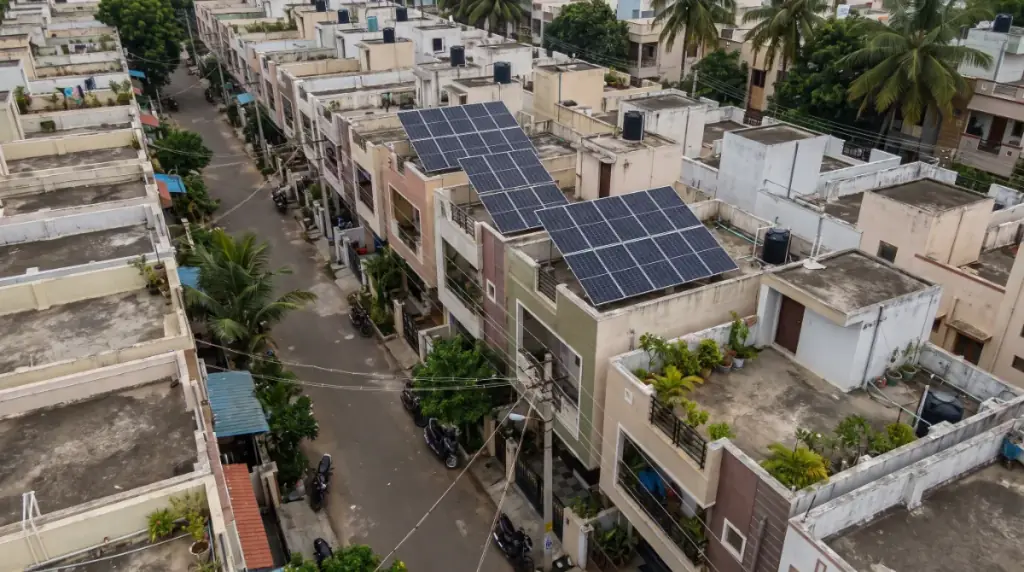
Maraimalai Nagar’s planned township structure puts manufacturing plants and residential housing within the same locality, and the two need entirely different approaches. Industrial sites here are sheet-roofed with HT connections and demand that usually exceeds what a roof can serve. The residential township is planned housing on regular plots with straightforward flat terraces and predictable structure.
For the industrial side
Anchor plants and ancillary units
Along the GST Road corridor, with the same split as elsewhere in the belt: large sites with balance sheet for CAPEX, smaller units often better served by OPEX where taxable profit is limited.
Non-domestic consumers are generally on net feed-in
Rather than one-for-one net metering, so size to daytime self-consumption rather than to available roof.
Solar reduces the energy charge, not the demand charge
Which on an HT connection remains substantial.
Installation around production
With shutdown windows booked well in advance.
For the residential township
Planned layout advantages
Regular plots, rectangular terraces, wide roads and easy installation access. Inter-building shading is less common than in organically grown localities.
Predictable structure
Since township housing was built to common specifications, though later extensions vary as everywhere.
Systems typically 3 kW to 5 kW
With three-phase required above 4,000 watts of connected load.
A third layer
The GST Road corridor
Showrooms, warehousing and logistics operations with their own load patterns, where roof area frequently exceeds what the load justifies and correct sizing matters more than filling the roof.
Areas we cover around Maraimalai Nagar: GST Road, Singaperumal Koil, Potheri approach, Chengalpattu border, Kattankulathur, the industrial estate roads.
All areas we cover in Chengalpattu →Residential
Solar for Maraimalai Nagar homes
Township housing
On regular plots, typically installing 3 kW to 5 kW, with straightforward layouts and good access.
Newer developments
Around the town, with similar characteristics.
Three-phase conversion
Where systems exceed 4 kW, filed alongside the net metering application.
Apartment blocks
Follow the association route for common-area systems.
Commercial and industrial
Solar for Maraimalai Nagar businesses
Auto and engineering manufacturing
The core industrial market, with large sheet roofs and HT connections.
Ancillary and supplier units
Smaller systems where funding structure matters more than hardware.
Warehousing and logistics
Along the GST Road. Large roof relative to load.
Showrooms and retail
On the corridor frontage. Evening-weighted, roof rights first on leased premises.
Local guide
Solar in Maraimalai Nagar: what a CMDA new town means for your roof
Maraimalai Nagar was planned by CMDA under its first Master Plan as a satellite town, and its CMDA layouts now hold about 3,500 housing units and 80 industries side by side. That mix, and the age of the original buildings, shapes how a system should be designed here.
CMDA layout houses are reaching 40 years
In September 2024 a Maraimalai Nagar municipality official told DT Next that the town's underground drainage was laid about 40 years ago, and much of the original CMDA housing dates from the same early years of the new town. Slabs of that age often carry patch repairs, added floors and newer water tanks. Before an array goes on, the survey should check slab cover, cracks near the parapet and old leak marks, and any waterproofing should be redone first, because lifting panels later to repair a roof costs far more. On a tired slab, the structure is best anchored near beams and columns rather than spread across the slab with heavy ballast blocks.
Factories in the CMDA Industrial Area need no pollution consent for solar
TNPCB handles consents for units in the CMDA Industrial Area through its Maraimalai Nagar office, and its records show units here in the red, orange and green categories, including metal finishing and light engineering. Rooftop solar adds nothing to that paperwork: CPCB classifies solar power generation through photovoltaic cells, of all capacities, in the white category, which does not need consent to operate. What a factory roof does need is a check of sheet condition and purlin spacing, and an array layout that stays clear of exhaust stacks and roof vents, where fumes and heat speed up soiling and corrosion of the frame.
Sizing with the Chengalpattu district figure
The state rooftop calculator uses 1,580 units per kW a year for Chengalpattu district, about 4.3 units a day. A 3 kW home system here makes about 4,740 units a year and a 5 kW system about 7,900. For a factory or shop on a non-domestic connection, exports are credited under net feed-in at ₹3.61 a unit up to 10 kW and ₹3.37 from 11 to 150 kW, well below what the unit pays for grid power. So the array should follow the daytime load rather than the roof area. A plant that shuts on Sundays exports that day's generation at the lower rate, which belongs in the payback sum.
New sheds around the Ford restart
Ford stopped vehicle production at its Maraimalai Nagar plant in 2021. In October 2025 it signed an MoU with the state to invest ₹3,250 crore in an engine plant there, fully export oriented, with production due in 2029 and about 600 direct jobs. Suppliers and service units planning sheds around that restart get the cheapest solar by designing it in from the start: roof sheet type, purlin spacing and walkways chosen for an array, a cable route from roof to panel room, and space in the electrical room for the inverter and protection gear.
What we install
What we install in Maraimalai Nagar
The process
How installation works
Free site survey
Shade-free roof area measured across the day, structure checked, connection name and sanctioned load confirmed.
Design and itemised quotation
Sized against twelve months of consumption, with every component named.
Approvals filed
PM Surya Ghar and TANGEDCO net metering, plus load enhancement or phase conversion in parallel where needed.
Installation
One to three days for a residential system, carried out by our own team rather than subcontracted.
Inspection and commissioning
TANGEDCO inspects, the net meter goes in, the system goes live.
Subsidy tracked to your account
And two years of maintenance included from commissioning.
We check the name on your electricity connection at the survey, because a mismatch stops more applications than any technical issue. See what to keep ready.
Free, no obligation
What will it cost on your roof in Maraimalai Nagar?
Not sure whether you need an audit or a survey?
Plants get a load profile analysis. Houses get a roof survey. We start with the right one rather than the same one.
What happens after you send your details
- We call you within one working day, and an engineer rather than a salesperson attends the site.
- The survey is free. We measure usable area and shading, check your connection and sanctioned load, and photograph the site.
- You get an itemised quotation naming every component and brand, with the subsidy or depreciation position set out.
- No obligation at any point. If solar does not make sense for your property, we will say so.
Common questions
Solar in Maraimalai Nagar, common questions
Is the solar approach different for a plant and a house here?
Entirely. An industrial site starts with an energy audit covering load profile, contract demand and shift pattern, because that determines the system size and the roof only constrains it. A house starts with a roof survey and a sanctioned load check. Maraimalai Nagar has both within the same township, so we begin with the right one.
Why size an industrial system to self-consumption rather than roof area?
Because non-domestic consumers in Tamil Nadu are generally on net feed-in rather than one-for-one net metering, so exported units are compensated well below the commercial tariff paid on imports. A unit consumed on site saves the full tariff; a unit exported earns a fraction of it.
What makes the township housing straightforward?
It was planned rather than grown. Plots are regular, terraces tend to be rectangular and unobstructed, roads are wide enough for easy material access, and the original construction followed common specifications. Later extensions vary, as they do everywhere, and those are assessed at the survey.
How long does installation take in Maraimalai Nagar?
Eight to fourteen weeks for the industrial and commercial connections typical of Maraimalai Nagar, against six to ten for a home. HT connections need more approval steps, and the work is usually phased around your shifts rather than done in one run.
Do you handle the subsidy and TANGEDCO paperwork?
Yes for residential connections. Note that the PM Surya Ghar subsidy does not apply to commercial or industrial connections, which is the position for most properties in Maraimalai Nagar. For those we file the TANGEDCO net feed-in application and provide the documentation your accountant needs for accelerated depreciation instead.
What is included after installation?
Two years of free maintenance from commissioning, covering panel cleaning, annual inspection of connections and structure, generation monitoring and warranty coordination with the manufacturer.
My house is in one of the original CMDA layouts. Is the slab strong enough for panels?
Usually yes, but age matters more than the layout. Much of the original township housing is close to 40 years old, so the survey checks slab condition, cracks and earlier repairs before anything is fixed. On an older slab the frame is anchored near beams and columns instead of loading the middle of the slab with ballast.
Does my factory need fresh TNPCB consent to add rooftop solar?
No. CPCB lists solar power generation through photovoltaic cells, of all capacities, in the white category, which does not need consent to operate. Your existing consent for the main process is unaffected. You still need the TNPDCL connection approval, and electrical inspectorate approval where the system size calls for it.
Long tail coverage
Areas we cover around Maraimalai Nagar
Not listed? We survey across Chennai and the surrounding districts. Call and we will tell you straight away whether we can reach your site this week.