












Solar Panel Installation in Selaiyur
Larger plots take 4 kW to 8 kW, with three phase work filed in parallel not afterwards
Selaiyur has the plot sizes that most of Chennai gave up decades ago. Genuine terrace area, room to raise an array, and consumption to match. It is also a college locality, which brings a second kind of project with a completely different sizing logic.
Installing across Chennai since 2020
Two years free maintenance included
Subsidy and TANGEDCO paperwork filed by us
Free site survey and energy audit, no obligation
The short answer
Looking for a solar panel installation company in Selaiyur?
Selaiyur is largely low-rise and owner-occupied, so a rooftop system here is usually a straightforward job with no shared-roof paperwork. It sits beside water bodies, so humidity and occasional standing water both influence where equipment goes and how earthing is done. We install across Chennai and have done since 2020, filing both the PM Surya Ghar subsidy of up to ₹78,000 for homes and the TANGEDCO net metering application, with two years of free maintenance included. Before the survey, you can check the solar panel price in Chennai for 3 kW to 10 kW systems and see how our solar panel installation in Chennai works, the same process we follow in Selaiyur.
What it costs here
A typical 5 kW system in Selaiyur
Standard 5 kW example
What a typical 5 kW home system does here. Your own figures come from the survey.
Not sure what your site can carry?
Send us your last electricity bill on WhatsApp and we will come back with an indicative system size and what it would offset. No visit needed for that first answer.
The local picture
Larger plots, larger systems, and the three-phase step
Selaiyur’s residential plots are significantly larger than those in inner Chennai, which means bigger usable terraces and systems that commonly run 5 kW and above. That threshold has a procedural consequence: TANGEDCO supplies three-phase above 4,000 watts of connected load, so most installations here involve either an existing three-phase connection or a phase conversion.
What that means for your timeline
Phase conversion is a separate application
And it must complete before the solar system can be commissioned.
Filed alongside the net metering application, the two run in parallel
Filed afterwards, a six-week project becomes twelve. We check your connection at the survey specifically to avoid this.
Sanctioned load enhancement
Frequently needed for the same reason, with the same fix.
Space makes elevated structures practical here
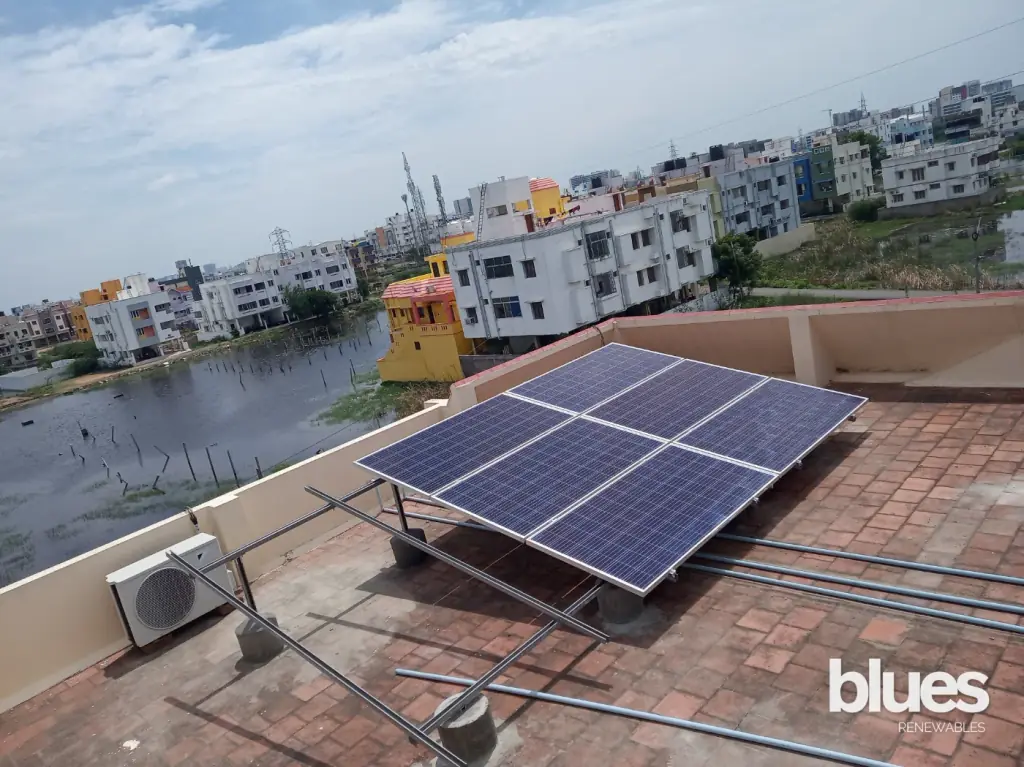
Larger terraces mean a raised array is a clean installation rather than a compromise, and households that use their terrace keep it. Raising the array to 9 feet leaves the space walkable and shaded, and improves generation through airflow beneath the panels.
The college factor
A campus generates most in the months it is closed
Selaiyur’s institutional presence brings campus projects, and those follow a different logic entirely. Because institutions are non-domestic consumers on net feed-in rather than net metering, vacation surplus sells back well below what the campus pays for imports. Campus systems should be sized to term-time daytime load, and installed during a vacation, which means starting the approvals months ahead.
Areas we cover around Selaiyur: Selaiyur Main Road, Camp Road, Rajakilpakkam, Sembakkam approach, Agaramthen, the college campus area.
All areas we cover in Chengalpattu →Residential
Solar for Selaiyur homes
Independent houses
The core market, typically 4 kW to 8 kW depending on air conditioning and pump load.
Gated communities
Following either the individual villa route where connections are separate, or the association route for common areas.
Elevated structures
Genuinely practical here and worth costing if you use your terrace.
Systems above 4 kW need three-phase
So the connection check happens at the survey rather than at inspection.
Commercial and industrial
Solar for Selaiyur businesses
Educational institutions
The distinguishing commercial segment. Term-time sizing, vacation installation windows, and the trust tax position where the institution is not a profit-making company.
Clinics and diagnostic centres
Daytime load matching generation, with equipment that makes power quality a legitimate question.
Retail and showrooms
Along the main roads. Evening-weighted, and roof rights first on leased premises.
Small offices and service businesses
Good daytime match and commercial tariffs.
Local guide
What shapes a rooftop solar system in Selaiyur
Selaiyur Tank, listed as Selaiyur Lake in Tambaram Corporation records, is one of a chain of interconnected tanks that CMDA planning records trace through Sembakkam, Rajakilpakkam and Chitlapakkam towards the Pallikaranai marsh. Where its surplus water runs decides where solar equipment should sit on many streets here.
Where Selaiyur Tank's surplus goes
Every monsoon, neighbouring Chitlapakkam used to flood because it sits between the flood plains of Selaiyur Tank and the Chitlapakkam lake surplus, and missing links in the surplus channels between the two lakes made it worse. A cut and cover drain about 1,440 metres long, built in 2019 by the local panchayat and the Water Resources Department, brought inundation levels down considerably. If your house is on the low side of Selaiyur, between the tank and Chitlapakkam or along a surplus channel, treat standing water as likely in a heavy monsoon. Mount the inverter and AC distribution board on a wall at least 1.5 metres above the ground floor, or in the terrace stair room, and bring cables down the outside wall in conduit rather than through a ground-level trench.
Sizing a larger Selaiyur home
The state rooftop calculator uses 1,580 units per kW a year for Chengalpattu district, about 4.3 units a day. A 5 kW system makes about 7,900 units a year, roughly 1,320 in each two-month billing cycle, and a 6 kW system about 9,480. A 5 kW system costs about ₹3,20,000 before subsidy and about ₹2,20,000 after the central ₹78,000 and the ₹22,000 Tamil Nadu top-up. Homes keep net metering up to their sanctioned load. Stay at or below 10 kW: above that a home loses the PM Surya Ghar subsidy and needs CEIG approval and a separate generation meter, which rarely pays for a single house. What stays on the bill is mostly the network charge on generation, about ₹0.32 a unit, because homes pay no fixed charge.
Monsoon months and how to judge output
The southern suburbs that drain into the Pallikaranai marsh get about 1,300 mm of rain a year, most of it in the northeast monsoon. Expect October to December to be the weakest generation months and the dry months from February onwards to be the strongest. Judge the system on its twelve-month total, not on a cloudy November bill. Wash the panels once the monsoon ends rather than during it, because rain does only a partial job of cleaning them. The inverter's monitoring app shows daily units; a sudden drop on a clear day points to a fault or shading, not weather.
What we install
What we install in Selaiyur
The process
How installation works
Free site survey
Shade-free roof area measured across the day, structure checked, connection name and sanctioned load confirmed.
Design and itemised quotation
Sized against twelve months of consumption, with every component named.
Approvals filed
PM Surya Ghar and TANGEDCO net metering, plus load enhancement or phase conversion in parallel where needed.
Installation
One to three days for a residential system, carried out by our own team rather than subcontracted.
Inspection and commissioning
TANGEDCO inspects, the net meter goes in, the system goes live.
Subsidy tracked to your account
And two years of maintenance included from commissioning.
We check the name on your electricity connection at the survey, because a mismatch stops more applications than any technical issue. See what to keep ready.
Free, no obligation
What will it cost on your roof in Selaiyur?
Put off by the three phase conversion?
Filed alongside your net metering application the two run together. Filed separately it adds six weeks. We file them together as standard.
What happens after you send your details
- We call you within one working day, and an engineer rather than a salesperson attends the site.
- The survey is free. We measure usable area and shading, check your connection and sanctioned load, and photograph the site.
- You get an itemised quotation naming every component and brand, with the subsidy or depreciation position set out.
- No obligation at any point. If solar does not make sense for your property, we will say so.
Common questions
Solar in Selaiyur, common questions
Will a Selaiyur installation need three-phase supply?
Probably, if the system is 5 kW or larger, which is common here given the plot sizes. TANGEDCO supplies three-phase above 4,000 watts of connected load, and the conversion is a separate application that must complete before commissioning. Filed alongside the net metering application the two run in parallel; filed afterwards it roughly doubles the timeline.
Are elevated structures worth it on a Selaiyur terrace?
Often yes, because plots here are large enough that the terrace is genuinely used. Raising the array to 9 feet keeps the space walkable and shaded, lets the array span above water tanks and headrooms, and improves generation because the panels run cooler. It costs more than a low mount and we state the difference before you decide.
How should a college campus size its solar system?
Against term-time daytime load, not annual average. A campus generates most during the long vacation when it is closed, and institutions are non-domestic consumers on net feed-in rather than net metering, so that surplus sells back below what the campus pays for imports. Averaging across the year systematically oversizes the system.
How long does installation take in Selaiyur?
Six to ten weeks. In Selaiyur the only site-specific delay we see is earthing, which needs more care near the water bodies here; TANGEDCO approval remains the long pole.
Do you handle the subsidy and TANGEDCO paperwork?
Yes, both. We file the PM Surya Ghar application and the TANGEDCO net metering application and follow them through the section office covering Selaiyur. We confirm the connection name and sanctioned load at the survey, since those are what stop applications, and we track the subsidy to your bank account after commissioning.
What is included after installation?
Two years of free maintenance from commissioning, covering panel cleaning, annual inspection of connections and structure, generation monitoring and warranty coordination with the manufacturer.
My street in Selaiyur takes water when the tank overflows. Where should the inverter go?
Above the water. On streets between Selaiyur Tank and Chitlapakkam or along a surplus channel, mount the inverter and distribution board at least 1.5 metres above the ground floor, or in the terrace stair room. The panels on the roof are not affected by flooding; the equipment at ground level is.
Selaiyur is under Tambaram Corporation, not Chennai. Does that change the solar application?
No. Rooftop solar for a home is applied for through the national PM Surya Ghar portal and the electricity distributor, not the municipal corporation. The subsidy of up to ₹78,000 plus the ₹22,000 state top-up and the net metering terms are the same as in Chennai.
Long tail coverage
Areas we cover around Selaiyur
Not listed? We survey across Chennai and the surrounding districts. Call and we will tell you straight away whether we can reach your site this week.