


Solar Panel Installation in Keelkattalai
We check your sanctioned load first, because here it usually caps the system before the roof does
In Keelkattalai the limit on your solar system is more often your electricity connection than your roof. Many houses here were connected decades ago at a sanctioned load that made sense then, and have added air conditioning since without ever revisiting it.
Installing across Chennai since 2020
Two years free maintenance included
Subsidy and TANGEDCO paperwork filed by us
Free site survey and energy audit, no obligation
The short answer
Looking for a solar panel installation company in Keelkattalai?
Keelkattalai is largely low-rise and owner-occupied, so a rooftop system here is usually a straightforward job with no shared-roof paperwork. It sits beside water bodies, so humidity and occasional standing water both influence where equipment goes and how earthing is done. We have installed across Chennai since 2020, file the PM Surya Ghar subsidy of up to ₹78,000 for households and the TANGEDCO net metering application ourselves, and include two years of free maintenance. Before the survey, you can check the solar panel price in Chennai for 3 kW to 10 kW systems and see how our solar panel installation in Chennai works, the same process we follow in Keelkattalai.
What it costs here
A typical 5 kW system in Keelkattalai
Standard 5 kW example
What a typical 5 kW home system does here. Your own figures come from the survey.
Not sure what your site can carry?
Send us your last electricity bill on WhatsApp and we will come back with an indicative system size and what it would offset. No visit needed for that first answer.
The local picture
When the connection caps the system, not the roof
Your solar system capacity cannot exceed the sanctioned load on your electricity connection. In Keelkattalai a large share of properties hold connections set decades ago, at sanctioned loads reflecting the household of that time, and consumption has grown considerably since with air conditioning, pumps and modern appliances. The practical consequence is that the connection frequently caps the system well before the roof does.
What that means in practice
Check your sanctioned load before anything else
It is printed on your electricity bill, and it is the number that determines your ceiling.
A load enhancement is a separate TANGEDCO application
And it must complete before the solar system can be commissioned.
Filed alongside the net metering application, the two run in parallel
Filed afterwards, a six-week project becomes twelve. We check this at the survey specifically to avoid it.
Above 4,000 watts of connected load, supply moves to three-phase
So an enhancement past that threshold brings a phase conversion with it.
The single most common avoidable delay we see here
Entirely fixable if identified at the start
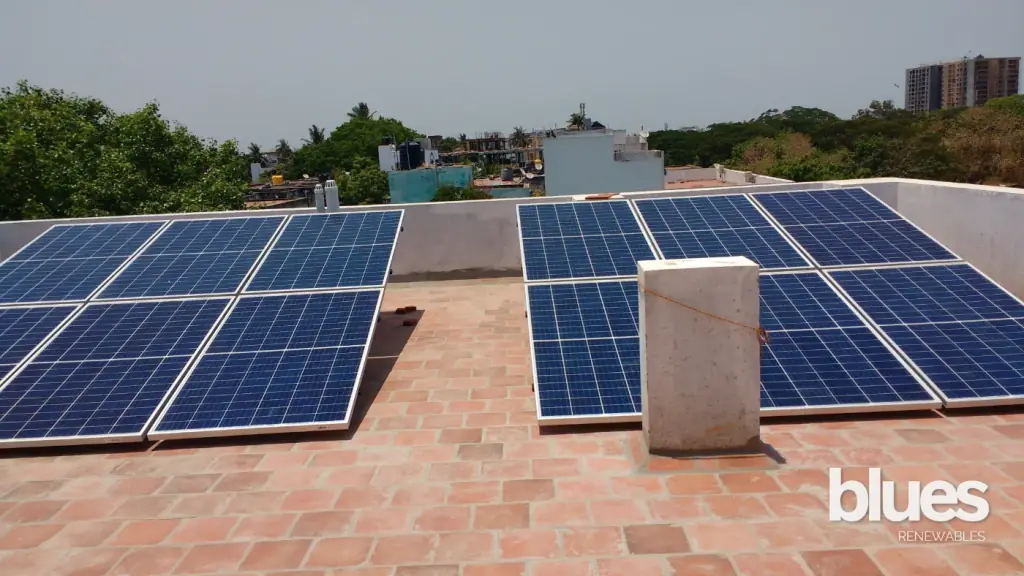
Rather than discovered at feasibility stage. Beyond the connection, Keelkattalai is a mixed picture: the older streets have dense plots with close neighbours and usable roof area below terrace measurement, while newer apartment development on the fringes has sound structure, clear terraces and generally adequate sanctioned load from the outset. Systems here typically run 3 kW to 5 kW where the connection supports it.
Areas we cover around Keelkattalai: Keelkattalai, Madipakkam border, Puzhuthivakkam approach, Nanmangalam, Kovilambakkam, the lake side streets.
All areas we cover in Chennai →Residential
Solar for Keelkattalai homes
Independent houses
Typically install 3 kW to 5 kW, subject to sanctioned load rather than roof area.
Older connections
Frequently need enhancement, filed alongside the net metering application.
Apartment blocks
Follow the association route for common-area systems.
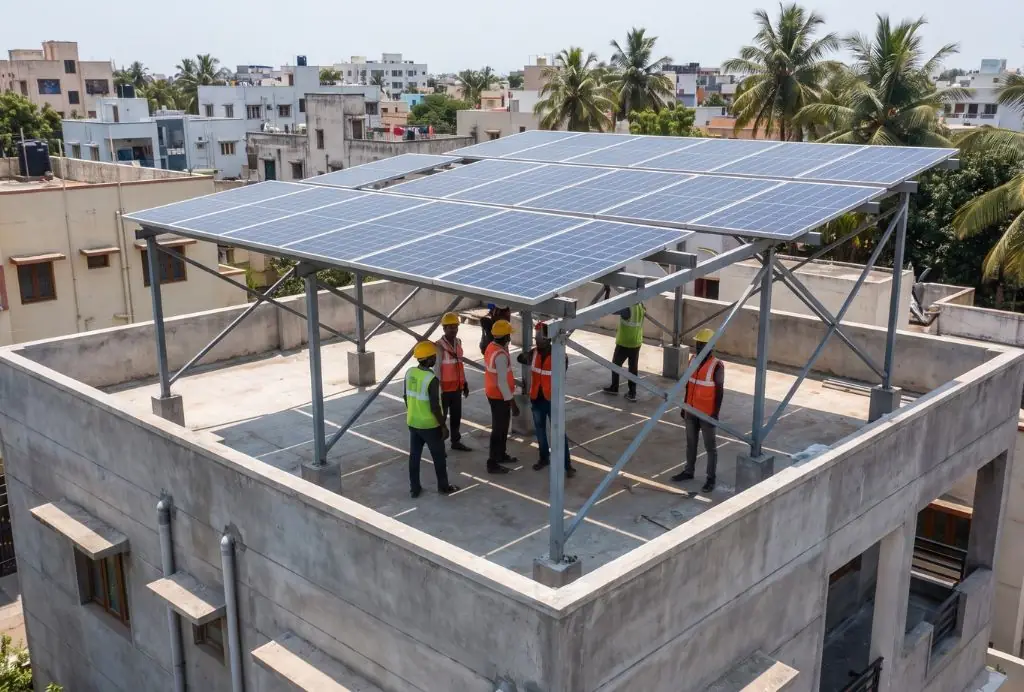
Elevated structures
Suit properties where the terrace is in active use.
Commercial and industrial
Solar for Keelkattalai businesses
Shops and small retail
On the main roads. Evening-weighted, usually leased, so roof rights first.
Clinics and small practices
Good daytime match and commercial tariffs.
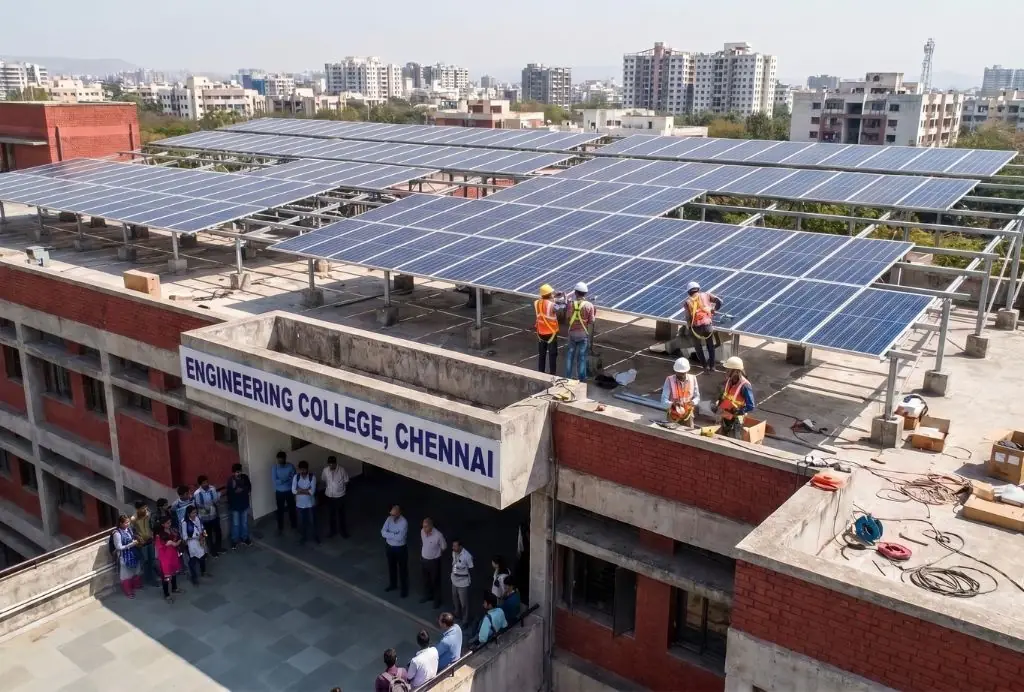
Schools and coaching centres
Strong term-time daytime load.
Small offices and service businesses
Often in converted residential buildings.
Local guide
Keelkattalai and rooftop solar: the lake, the radial road and the airport
Keelkattalai sits on the Pallavaram to Thoraipakkam Radial Road beside Keezhkattalai Lake, about 6 km from Chennai International Airport. The lake, the road that floods beside it, and the airport each add something to a solar design here.
Keezhkattalai Lake and the drains that overflow
Keezhkattalai Lake lies upstream of Narayanapuram Lake in the Pallikaranai watershed, and the Radial Road cuts through both. Citizen Matters reported in May 2025 that the road was submerged in the 2015, 2021 and 2023 floods. The lake's excess water canal was converted into three stormwater drains after 2017, and a fourth drain worth ₹45 crore was under construction. Until that work proves itself, treat the low streets near the lake as flood prone. In practice that means the inverter and distribution boxes go on the terrace or an upper floor, and DC cables run down from the roof rather than along the ground.
Six kilometres from the runways
The Airports Authority of India sets a permitted top elevation for every grid square around the airport, in metres above mean sea level, through its colour coded zoning map. Buildings below that elevation can be approved locally. Above it, or in a red grid, an AAI no objection certificate is needed. A standard low-mounted array adds very little height, but an elevated structure on a three or four storey building is worth checking against the map first. We check your building height before quoting a raised structure, so the design never has to be cut down after installation.
Sizing on the Chengalpattu yield
Keelkattalai is in Chengalpattu district, where the state rooftop calculator gives about 1,580 units per kW a year. A 3 kW system makes about 4,740 units a year and a 4 kW system about 6,320. Four kW is also the ceiling on single-phase supply, so a 5 kW system here, making about 7,900 units, means three-phase. A 3 kW system costs about ₹2,10,000 before subsidy and about ₹1,10,000 after both subsidies. A 5 kW system costs about ₹3,20,000, or about ₹2,20,000 after both.
Hospitals and schools on the two main roads
Keelkattalai has three hospitals and several matriculation and higher secondary schools along its arterial roads. Both run heavy daytime loads, which suits solar, but they are on non-domestic connections and so on net feed-in rather than net metering. Exported units earn ₹3.61 a unit up to 10 kW and ₹3.37 from 11 to 150 kW, far below the tariff they pay. A hospital that runs round the clock can use almost everything it generates. A school on a long holiday cannot, so size its system to term-time daytime load.
What we install
What we install in Keelkattalai
The process
How installation works
Free site survey
Shade-free roof area measured across the day, structure checked, connection name and sanctioned load confirmed.
Design and itemised quotation
Sized against twelve months of consumption, with every component named.
Approvals filed
PM Surya Ghar and TANGEDCO net metering, plus load enhancement or phase conversion in parallel where needed.
Installation
One to three days for a residential system, carried out by our own team rather than subcontracted.
Inspection and commissioning
TANGEDCO inspects, the net meter goes in, the system goes live.
Subsidy tracked to your account
And two years of maintenance included from commissioning.
We check the name on your electricity connection at the survey, because a mismatch stops more applications than any technical issue. See what to keep ready.
Free, no obligation
What will it cost on your roof in Keelkattalai?
Assuming your roof size decides your system size?
Here it usually does not. An old connection sanctioned decades ago is the more common ceiling, and it is fixable.
What happens after you send your details
- We call you within one working day, and an engineer rather than a salesperson attends the site.
- The survey is free. We measure usable area and shading, check your connection and sanctioned load, and photograph the site.
- You get an itemised quotation naming every component and brand, with the subsidy or depreciation position set out.
- No obligation at any point. If solar does not make sense for your property, we will say so.
Common questions
Solar in Keelkattalai, common questions
Why does sanctioned load matter more than roof area in Keelkattalai?
Because your solar system capacity cannot exceed the sanctioned load on your connection, and a large share of properties here hold connections set decades ago at loads reflecting a much smaller household. Consumption has grown with air conditioning and pumps, so the connection frequently caps the system well before the roof does.
How do I check my sanctioned load?
It is printed on your electricity bill. That figure is your ceiling, and it is worth checking before anything else. If it is lower than the system you want, an enhancement is a separate TANGEDCO application which must complete before commissioning.
Does a load enhancement delay the installation?
Only if it is filed after the net metering application. Filed alongside, the two run in parallel and add almost nothing. Filed afterwards, a six-week project becomes twelve. We check your connection at the survey specifically to avoid that, and above 4,000 watts of connected load the enhancement also brings a three-phase conversion with it.
How long does installation take in Keelkattalai?
Six to ten weeks. In Keelkattalai the only site-specific delay we see is earthing, which needs more care near the water bodies here; TANGEDCO approval remains the long pole.
Do you handle the subsidy and TANGEDCO paperwork?
Yes, both. We file the PM Surya Ghar application and the TANGEDCO net metering application and follow them through the section office covering Keelkattalai. We confirm the connection name and sanctioned load at the survey, since those are what stop applications, and we track the subsidy to your bank account after commissioning.
What is included after installation?
Two years of free maintenance from commissioning, covering panel cleaning, annual inspection of connections and structure, generation monitoring and warranty coordination with the manufacturer.
Is Keelkattalai treated as Chennai or Chengalpattu for solar?
Keelkattalai is in Chengalpattu district and Tambaram City Municipal Corporation. The subsidy, the net metering rules and the price are the same either way. Only the yield figure differs slightly: we size here on about 1,580 units per kW a year.
The Radial Road floods most years. Should I choose a hybrid system?
Only if you need power during outages. An on-grid system shuts down whenever the grid is switched off, including the precautionary cuts made in flooded areas. A hybrid system with a battery, kept on an upper floor, can run a few lights, fans and the fridge through those cuts, but it costs more, so size the battery to essentials only.
Long tail coverage
Areas we cover around Keelkattalai
Not listed? We survey across Chennai and the surrounding districts. Call and we will tell you straight away whether we can reach your site this week.