












Solar Panel Installation in Mudichur
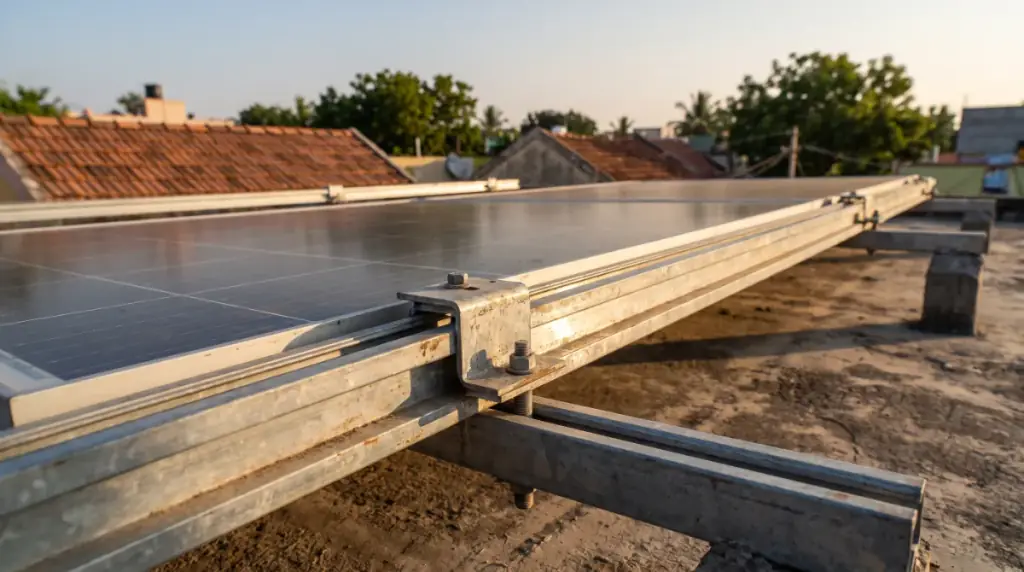
Equipment mounted for this flood plain, and foundations designed to the actual ground
Mudichur sits on the Adyar flood plain, and properties here have a documented history with water. The panels are never affected. What needs deciding is where the electrical equipment sits, and what the ground can carry if you want a raised structure.
Installing across Chennai since 2020
Two years free maintenance included
Subsidy and TANGEDCO paperwork filed by us
Free site survey and energy audit, no obligation
The short answer
Looking for a solar panel installation company in Mudichur?
Mudichur is mostly independent houses with their own terraces, which is the simplest case for rooftop solar: one owner, one roof, one connection. Because it sits low, we mount inverters, ACDB and earthing points above the levels the area has seen rather than at convenient waist height. Installing across Chennai since 2020, we file the PM Surya Ghar application worth up to ₹78,000 for households, handle TANGEDCO net metering end to end, and cover two years of maintenance after commissioning. Before the survey, you can check the solar panel price in Chennai for 3 kW to 10 kW systems and see how our solar panel installation in Chennai works, the same process we follow in Mudichur.
What it costs here
A typical 5 kW system in Mudichur
Standard 5 kW example
What a typical 5 kW home system does here. Your own figures come from the survey.
Not sure what your site can carry?
Send us your last electricity bill on WhatsApp and we will come back with an indicative system size and what it would offset. No visit needed for that first answer.
The local picture
Flood plain ground, and what it changes
Mudichur’s position on the Adyar flood plain means two things for a solar installation, and neither concerns the panels themselves. Electrical equipment placement needs to account for the area’s flood history, and ground conditions affect the foundation design for any elevated or ground-mounted structure.
On equipment placement
Inverter and distribution boxes mounted high
Above levels the area has previously seen, rather than at convenient height on a ground-floor wall.
Protection equipment and earthing points sited accordingly
Since water reaching an ACDB is a safety matter rather than a warranty one.
Cable routing planned away from low points
Where water collects.
It costs nothing extra when decided before installation
Relocating equipment afterwards costs a great deal.
On ground conditions, which matters here more than in most flood-affected areas
Flood plain soil behaves differently from firm ground
Particularly for foundations carrying a raised structure with meaningful wind load.
Elevated structures and ground-mount arrays
Need foundations designed to the actual ground rather than to a standard detail.
On larger plots, where ground-mount is a genuine option
A proper assessment of what is underneath is part of the design rather than an optional extra.
Two questions for any installer
Where does the inverter go, and what is the foundation designed to?
An installer who has not considered either has not surveyed the location properly. Otherwise Mudichur is favourable: plots are larger than inner Chennai, terraces are generally clear and unobstructed, and access is straightforward. Systems commonly run 4 kW to 6 kW, with three-phase required above 4,000 watts of connected load.
Areas we cover around Mudichur: Mudichur, Perungalathur approach, Varadharajapuram, Tambaram border, Adyar river side, the layout sectors.
All areas we cover in Chengalpattu →Residential
Solar for Mudichur homes
Independent houses
On larger plots, typically installing 4 kW to 6 kW.
Equipment mounting height
A design decision here, not a detail.
Ground-mount
Available on properties with land, subject to foundation design for the ground conditions.
Three-phase conversion
Common, and filed alongside the net metering application.
Commercial and industrial
Solar for Mudichur businesses
Small industry and workshops
On the approaches. Sheet roofs and commercial tariffs.
Retail and showrooms
On the main roads. Evening-weighted, roof rights first on leased premises.
Schools and institutions
Strong term-time daytime match.
Warehousing
Where present, with large roof relative to load, so sizing to self-consumption matters.
Local guide
Rooftop solar in Mudichur: designing for the days the grid is off
Mudichur was under 3 to 4 feet of water during Cyclone Michaung in December 2023, and residents were rescued by boat, as they had been in 2015. A solar system here should be planned for the days the supply is switched off, not only for the sunny ones.
Three floods in eight years, and what they mean for the wiring
Water has entered Mudichur homes three times since 2015. In November 2021 levels reached 6 feet in parts after Chembarambakkam released more than 2,000 cusecs into the Adyar. In December 2023 residents of Mudichur, Mannivakkam, Bharathi Nagar and Krishna Nagar were trapped by neck-deep water on the roads. In floods, supply to inundated streets is switched off. Three decisions follow. Run the AC cable from the terrace inverter down an outside wall in conduit, never through the ground floor. Fit a lockable DC isolator at terrace level so the array can be made safe before water rises. Keep the earthing test point above ground so it can be checked after the water drains.
Should a Mudichur home add a battery?
A plain on-grid system stops when the grid stops, by design, so it gives no power on the days you most want it. Neighbouring Varadharajapuram went at least two days without power in 2023. A hybrid inverter with a battery can keep lights, fans, the fridge and the overhead tank pump running through an outage. If you choose one, size the battery to those critical loads rather than the whole house, and put the battery and hybrid inverter on the first floor or in the terrace stair room, never on the ground floor. The subsidy is worked out on the panel capacity, so the battery is an extra cost you carry yourself.
The airbase next door: height rules for elevated frames
Going by the published coordinates of each, Mudichur lies about 5 km west of Air Force Station Tambaram, inside the area of the IAF zoning map that CMDA publishes. The map sets a permitted top elevation above sea level for each grid: 69 m in sky blue and pink grids, 144 m in yellow, 174 m in green. In a red grid any structure needs an IAF NOC, whatever its height. The map counts water tanks, lift rooms and lightning arresters in a building's top elevation, and an elevated solar frame sits in the same place. The airbase itself is at 27 m, so an ordinary house usually stays well short of 69 m. Red grids are the ones to check.
What a system makes at the Chengalpattu yield
The state rooftop calculator uses 1,580 units per kW a year for Chengalpattu district, about 4.3 a day. A 3 kW system here makes about 4,740 units a year and a 5 kW system about 7,900. A 3 kW system costs about ₹2,10,000 before subsidy and about ₹1,10,000 after the central and Tamil Nadu subsidies. Above 4 kW you need three-phase supply. What remains on a solar home's bill is the network charge on generation, about ₹0.32 a unit. Homes pay no fixed charge.
What we install
What we install in Mudichur
The process
How installation works
Free site survey
Shade-free roof area measured across the day, structure checked, connection name and sanctioned load confirmed.
Design and itemised quotation
Sized against twelve months of consumption, with every component named.
Approvals filed
PM Surya Ghar and TANGEDCO net metering, plus load enhancement or phase conversion in parallel where needed.
Installation
One to three days for a residential system, carried out by our own team rather than subcontracted.
Inspection and commissioning
TANGEDCO inspects, the net meter goes in, the system goes live.
Subsidy tracked to your account
And two years of maintenance included from commissioning.
We check the name on your electricity connection at the survey, because a mismatch stops more applications than any technical issue. See what to keep ready.
Free, no obligation
What will it cost on your roof in Mudichur?
Concerned about the flood plain?
The panels are on the roof and unaffected. What matters is where the inverter goes and what the foundations are designed to, and both are decided before installation.
What happens after you send your details
- We call you within one working day, and an engineer rather than a salesperson attends the site.
- The survey is free. We measure usable area and shading, check your connection and sanctioned load, and photograph the site.
- You get an itemised quotation naming every component and brand, with the subsidy or depreciation position set out.
- No obligation at any point. If solar does not make sense for your property, we will say so.
Common questions
Solar in Mudichur, common questions
Does Mudichur’s flood history affect a solar installation?
Not the panels, which sit on the roof, but it affects where the inverter, distribution boxes and protection equipment are mounted. That equipment should sit above levels the area has previously seen, with cable routing planned away from low points. It costs nothing extra when decided before installation.
Can I have a ground-mounted array on flood plain ground?
Often, but the foundations need designing to the actual ground rather than to a standard detail. Flood plain soil behaves differently from firm ground, particularly for foundations carrying a raised structure with meaningful wind load, so an assessment of what is underneath is part of the design.
What size system suits a Mudichur home?
Commonly 4 kW to 6 kW, since plots here are larger than inner Chennai and terraces are generally clear and unobstructed. Above 4,000 watts of connected load TANGEDCO supplies three-phase, so a conversion is frequently part of the project and is filed alongside the net metering application.
How long does installation take in Mudichur?
Six to ten weeks from survey to a live system in Mudichur. We avoid scheduling roof work through the heaviest monsoon weeks, so if you are starting in October or November expect the site dates to move rather than the approval.
Do you handle the subsidy and TANGEDCO paperwork?
Yes, we handle both and track the subsidy to your bank account. In Mudichur we also photograph the inverter and protection positions at commissioning, because siting equipment above previous flood levels is worth documenting for both the warranty and any future insurance question.
What is included after installation?
Two years of free maintenance from commissioning, covering panel cleaning, annual inspection of connections and structure, generation monitoring and warranty coordination with the manufacturer.
Will my solar system keep running when the power is cut during a Mudichur flood?
Not an ordinary on-grid system. It shuts down whenever grid supply is off, which protects line workers, so it produces nothing while TNPDCL keeps a flooded area switched off. If outages of a day or two worry you, a hybrid inverter with a battery mounted upstairs will carry essential loads until supply returns.
Does being near the Tambaram airbase stop me installing solar?
No. Panels on a terrace add little height. The question only arises with an elevated frame, because height rules around Air Force Station Tambaram count everything on top of the building. If your plot falls in a red grid on the IAF zoning map, any new structure needs an NOC, so we check the grid before proposing a raised frame.
Long tail coverage
Areas we cover around Mudichur
Not listed? We survey across Chennai and the surrounding districts. Call and we will tell you straight away whether we can reach your site this week.