












Solar Panel Installation in Pammal
We model both your domestic and commercial connection before recommending either
Pammal mixes independent housing with small industrial and workshop units, often on the same street and sometimes in the same building. That raises a question with real money attached: which tariff category your connection sits in, because it decides whether you can claim the subsidy at all.
Installing across Chennai since 2020
Two years free maintenance included
Subsidy and TANGEDCO paperwork filed by us
Free site survey and energy audit, no obligation
The short answer
Looking for a solar panel installation company in Pammal?
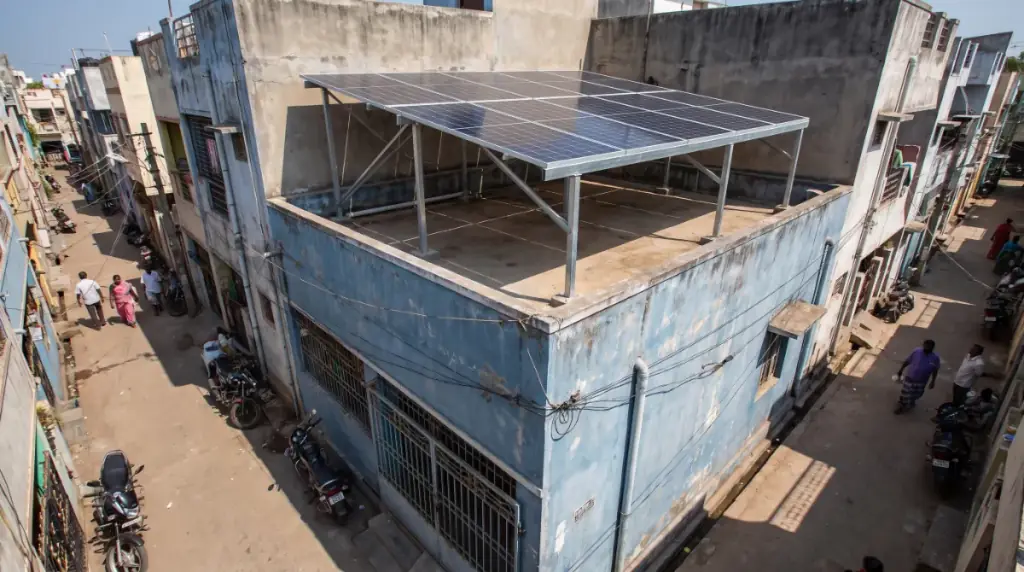
Pammal is largely low-rise and owner-occupied, so a rooftop system here is usually a straightforward job with no shared-roof paperwork. Industrial dust is a real yield factor. Soiling here builds faster than in residential areas, so cleaning frequency belongs in the plan from day one. We have installed across Chennai since 2020, file the PM Surya Ghar subsidy of up to ₹78,000 for households and the TANGEDCO net metering application ourselves, and include two years of free maintenance. Before the survey, you can check the solar panel price in Chennai for 3 kW to 10 kW systems and see how our solar panel installation in Chennai works, the same process we follow in Pammal.
What it costs here
A typical 5 kW system in Pammal
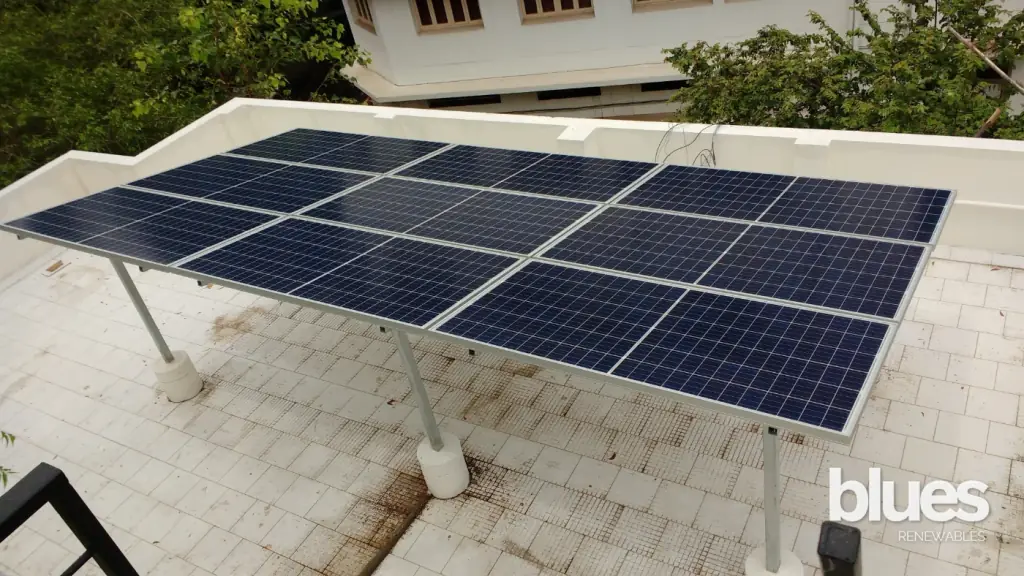
Standard 5 kW example
What a typical 5 kW home system does here. Your own figures come from the survey.
Not sure what your site can carry?
Send us your last electricity bill on WhatsApp and we will come back with an indicative system size and what it would offset. No visit needed for that first answer.
The local picture
A workshop at home changes the answer
Pammal’s mix of residential housing and small industrial units means many properties sit somewhere between the two, with a workshop, small production unit or trade premises operating from or alongside a home. The tariff category on the electricity connection determines which support applies, and the difference is substantial.
The practical questions
Which category is your connection actually in?
It is stated on your bill, and it may not match what you assume.
Where does the load sit?
If the workshop consumes most of the electricity, a system on the domestic connection will not offset it.
Do you have one connection or two?
Some properties here run separate meters for the residence and the unit, which makes it a genuine choice rather than a given.
Can you use the tax benefit?
Accelerated depreciation is worth nothing without taxable profit to offset, which matters for small units running thin margins.
We set out both positions at the survey
This decision is worth more than the difference between two hardware quotes
Rather than defaulting to whichever connection is convenient. Small industrial units here typically have modest sheet or RCC roofs, and the design is straightforward once the connection question is settled. Commercial tariffs mean each displaced unit saves more than a domestic one, which partly offsets the absence of a subsidy.
Areas we cover around Pammal: Pammal, Anakaputhur border, Pallavaram approach, Nagalkeni, Kundrathur Road, the small industry streets.
All areas we cover in Chengalpattu →Residential
Solar for Pammal homes
Independent houses on domestic connections
Typically install 3 kW to 4 kW and claim the subsidy normally.
Mixed properties
Need the connection and tariff question answered before design.
Apartment blocks
Follow the association route for common-area systems.
Older properties
May have sloped sections needing pitch mounting.
Commercial and industrial
Solar for Pammal businesses
Small industrial and workshop units
Modest roofs, commercial tariffs, and the depreciation question dependent on taxable profit.
Trade and service premises
Daytime load matching generation reasonably well.
Retail on the main roads
Evening-weighted and usually leased.
Schools and institutions
Strong term-time daytime match.
Local guide
Rooftop solar in Pammal: the airport, the tanneries and the 2023 floods
Pammal sits about 2 km from Chennai International Airport, at roughly 47 m above sea level, and has been part of Tambaram City Municipal Corporation since 2021. Being this close to the runway decides how high a solar structure can safely go.
Check the airport height limit before raising the array
Airports Authority of India publishes colour coded zoning maps that split the land around an airport into grids of about 3 sq km. Each grid has a permissible top elevation, measured above mean sea level. Your local body can approve anything below that figure. Above it, or anywhere in a red grid, an AAI no objection certificate is needed through its NOCAS portal. To get the headroom above ground, subtract your site elevation, roughly 47 m in Pammal, from the grid figure. An elevated solar structure adds to the building's top height, just as a water tank does. So on a building already close to its limit, we keep the array low on the slab instead of raising it, and we check the figure on NOCAS before design.
Tannery and workshop units: size for daytime use, not export
Leather and tannery units are part of Pammal's economy, and the Pallavaram tanners' common effluent treatment plant at Nagalkeni, commissioned in 1995 with a design capacity of 3,000 cubic metres a day, serves about 144 member tanneries. These units sit on non-domestic connections, which are on net feed-in. Exported units are credited at ₹3.61 a unit up to 10 kW and ₹3.37 from 11 to 150 kW, well below what a commercial connection pays to import. So the system should match the load that actually runs in daylight shifts, read from twelve months of bills, rather than fill the roof. Every unit used on site is worth far more than a unit sent to the grid.
After Michaung: keep the inverter above the water line
When lakes in the Tambaram area overflowed on 4 December 2023, Pammal was among the low-lying localities that flooded, and local resident groups ran their own rescue and relief work. Panels on the roof are not at risk from that. The inverter, the AC distribution board and the cable joints are. In Pammal we mount them on an upper floor wall or in the terrace stair room, never in ground floor parking. Cables drop from the terrace instead of running along the ground. If water entered your ground floor in 2023, treat that mark as the minimum height for any solar equipment, and add a margin above it.
A Pammal sizing example
The state rooftop calculator puts Chengalpattu district at 1,580 units per kW a year, about 4.3 units a day. A 3 kW system here makes about 4,740 units a year, and a 5 kW system about 7,900. A 3 kW home system costs about ₹2,10,000 before subsidy and about ₹1,10,000 after the ₹78,000 central subsidy and the ₹22,000 Tamil Nadu top-up. Single-phase supply is limited to 4 kW, so a 5 kW system needs a three-phase connection. What remains on the bill is mainly the network charge on generation, about ₹0.32 a unit for homes up to 10 kW.
What we install
What we install in Pammal
The process
How installation works
Free site survey
Shade-free roof area measured across the day, structure checked, connection name and sanctioned load confirmed.
Design and itemised quotation
Sized against twelve months of consumption, with every component named.
Approvals filed
PM Surya Ghar and TANGEDCO net metering, plus load enhancement or phase conversion in parallel where needed.
Installation
One to three days for a residential system, carried out by our own team rather than subcontracted.
Inspection and commissioning
TANGEDCO inspects, the net meter goes in, the system goes live.
Subsidy tracked to your account
And two years of maintenance included from commissioning.
We check the name on your electricity connection at the survey, because a mismatch stops more applications than any technical issue. See what to keep ready.
Free, no obligation
What will it cost on your roof in Pammal?
Workshop attached to the house?
Then which connection the system serves decides whether you get a subsidy or a tax benefit. We model both rather than defaulting to the convenient one.
What happens after you send your details
- We call you within one working day, and an engineer rather than a salesperson attends the site.
- The survey is free. We measure usable area and shading, check your connection and sanctioned load, and photograph the site.
- You get an itemised quotation naming every component and brand, with the subsidy or depreciation position set out.
- No obligation at any point. If solar does not make sense for your property, we will say so.
Common questions
Solar in Pammal, common questions
Does a workshop at home affect my solar subsidy?
It can, entirely. PM Surya Ghar is a residential scheme, so a system on a commercial or industrial connection gets no subsidy. What a business gets instead is accelerated depreciation of up to 40% in the first year plus GST input credit, and a higher tariff means each displaced unit saves more. Which is better depends on your load split and tax position.
How do I know which tariff category my connection is in?
It is stated on your electricity bill, and it may not match what you assume. On a mixed property the more useful question is where the load actually sits, because a system on the domestic connection will not offset workshop consumption metered separately.
Is accelerated depreciation always worth having?
Only with taxable profit to offset. For a small unit running thin margins or carrying forward losses it is worth little, which is why we set out both the domestic and commercial positions at the survey rather than assuming the business route is better.
How long does installation take in Pammal?
Six to ten weeks for a home in Pammal, and eight to fourteen weeks for an industrial or commercial connection. HT connections need more approval steps, and the work is usually phased around your shifts rather than done in one run.
Do you handle the subsidy and TANGEDCO paperwork?
Yes for residential connections. Note that the PM Surya Ghar subsidy does not apply to commercial or industrial connections, such as the tannery and workshop units in Pammal. For those we file the TANGEDCO net metering application and provide the documentation your accountant needs for accelerated depreciation instead.
What is included after installation?
Two years of free maintenance from commissioning, covering panel cleaning, annual inspection of connections and structure, generation monitoring and warranty coordination with the manufacturer.
My house in Pammal is close to the runway. Do I need AAI permission for rooftop solar?
AAI controls the total top height of buildings and structures around the airport, not solar as such. If your building plus the array stays below the permissible top elevation for your grid, no AAI certificate is needed. If the plot is in a red grid, or the top would go above the limit, an application through AAI's NOCAS portal is required. We check the figure before design and keep the array low where headroom is tight.
Pammal flooded in December 2023. Can water damage a rooftop solar system?
The panels sit on the roof, so floodwater does not reach them. The parts at risk are the inverter, the distribution board and any cable joints placed at ground level. We mount those on an upper floor or the terrace and route cables from above, so a repeat of 2023 does not take the system out.
Long tail coverage
Areas we cover around Pammal
Not listed? We survey across Chennai and the surrounding districts. Call and we will tell you straight away whether we can reach your site this week.