












Solar Panel Installation in Urapakkam
Straight answer on whether a let property can claim before you spend anything
A large share of Urapakkam’s housing was built as investment property and is let out. That creates a genuine problem for solar that nobody in the industry likes to talk about: the owner pays for the system and the tenant gets the lower electricity bill.
Installing across Chennai since 2020
Two years free maintenance included
Subsidy and TANGEDCO paperwork filed by us
Free site survey and energy audit, no obligation
The short answer
Looking for a solar panel installation company in Urapakkam?
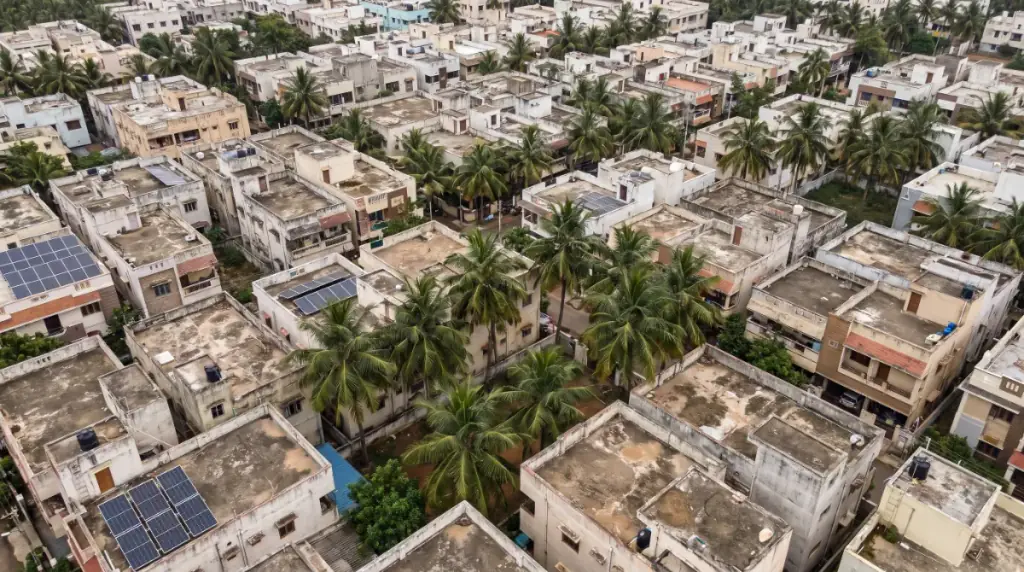
Urapakkam is largely low-rise, so a rooftop system here is usually a straightforward job with no shared-roof paperwork. It has flooded before, so where the inverter and protection gear are mounted is a real design decision here, not a detail. We site them well above previous water levels. We install across Chennai and have done since 2020, filing both the PM Surya Ghar subsidy of up to ₹78,000 for homes and the TANGEDCO net metering application, with two years of free maintenance included. Before the survey, you can check the solar panel price in Chennai for 3 kW to 10 kW systems and see how our solar panel installation in Chennai works, the same process we follow in Urapakkam.
What it costs here
A typical 5 kW system in Urapakkam
Standard 5 kW example
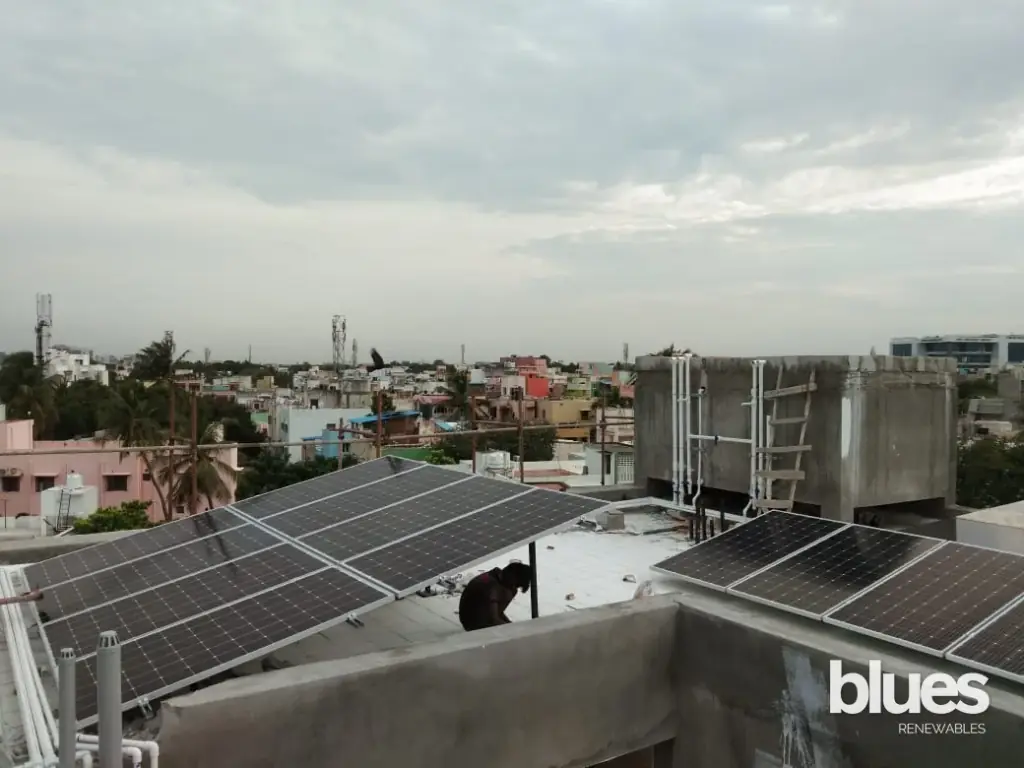
What a typical 5 kW home system does, on a terrace that can take one. Your own figures come from the survey.
Not sure what your site can carry?
Send us your last electricity bill on WhatsApp and we will come back with an indicative system size and what it would offset. No visit needed for that first answer.
The local picture
When the owner pays and the tenant saves
Where a property is let and the electricity connection is in the tenant’s name, the owner who would fund a solar installation is not the party whose bill it reduces. This split incentive is the main obstacle to solar on tenanted residential property, and it is worth addressing openly rather than pretending it does not exist.
Why it is not straightforward
The subsidy follows the connection
Both the PM Surya Ghar application and the net metering application are tied to the service connection and require the applicant’s name to match. If the connection is in the tenant’s name, the owner cannot claim.
The tenant is unlikely to fund it
A 25-year asset on a property they may leave in two years is a poor investment for an occupant.
The owner sees no direct return
Unless the arrangement is structured for it.
The structures that do work
Owner holds the connection and recovers through rent
Where the owner is the connection holder and bills the tenant, or reflects the lower running cost in the rent, the economics align. This is the cleanest arrangement.
Reflect it in the rent
A property with solar has a genuinely lower running cost, and that can be reflected in what it commands, particularly where a tenant sees the bill.
Owner-occupied portion
Where the owner lives in part of the property and lets another, a system on the owner’s connection is straightforward.
Common services in a let building
Where multiple units are let and common lighting or pumping runs on the owner’s connection, that is a clean target for a smaller system.
Our position, plainly
We will tell you the position rather than designing something that cannot be claimed
If you own a let property and the connection is in the tenant’s name, restructuring the connection may be possible, and it may not be worth it. Either way you should know before you commit. For owner-occupied houses, Urapakkam is straightforward: layout plots, clear terraces, easy access and systems typically 3 kW to 5 kW.
Areas we cover around Urapakkam: Urapakkam, Guduvanchery approach, Vandalur border, Nandivaram, GST Road frontage, the layout developments.
All areas we cover in Chengalpattu →Residential
Solar for Urapakkam homes
Owner-occupied houses
Follow the standard route, typically 3 kW to 5 kW.
Let properties
Need the connection and incentive question answered before design.
New layout plots
Benefit from planning provisions in during construction.
Three-phase conversion
Where systems exceed 4 kW, filed alongside the net metering application.
Commercial and industrial
Solar for Urapakkam businesses
Retail and small commercial
On the main roads. Evening-weighted and usually leased.
Small industry
On the corridor approaches. Sheet roofs and commercial tariffs.
Schools and institutions
Strong term-time daytime match.
Warehousing
Where roof area often exceeds what the load justifies.
Local guide
Urapakkam rooftop solar: drains, groundwater and borewell pumps
Urapakkam is a village panchayat on GST Road in Chengalpattu district, with a 2011 population of 29,122 and the Kilambakkam bus terminus within about 2 km. Much of its layout housing went up before roads, drains and sewer lines caught up, and that affects where solar equipment should sit.
Water that seeps in: keep the electrics off the ground floor
Residents told Deccan Chronicle in 2017 that water and insects had seeped into houses through two monsoons, and that most localities lacked proper roads, storm water drains and sewer lines. In 2023 DT Next reported that rainwater from the Kilambakkam terminus side could not cross GST Road into Urapakkam Lake because there were not enough culverts, and the collector ordered culverts at four points. Until the drainage on your street has been proven, mount the inverter, the AC and DC boxes and any battery well above floor level, ideally on a first floor or terrace wall under a rain hood, and bring cables down from the roof rather than along the ground.
A high water table changes the earthing
The same 2017 report quoted residents saying the groundwater sat just two feet below their household sewage pits. Shallow groundwater makes it easy to reach moist soil for an earth pit, which helps keep earth resistance low. It also means the pits must sit well away from septic tanks and soak pits, and the electrodes need to resist corrosion in wet ground. A sound design here uses separate earth pits for the panel structure and for the inverter, keeps them clear of sewage pits, and tests earth resistance at handover and again before each monsoon. Earth pit covers should also sit above the level water reaches on your street, so the pit can still be inspected after heavy rain.
Borewell pumps and a midday load
The 2017 report also said panchayat water connections were a long standing demand, so many homes depend on their own borewell pumps. A pump that fills the overhead tank between 10 am and 3 pm runs on solar units directly instead of drawing from the grid. At the Chengalpattu figure of 1,580 units per kW a year, a 3 kW system makes about 4,740 units a year, roughly 13 units a day, enough for a pump and daytime fans with surplus for net metering. Homes that add a second air conditioner or an EV and need more than 4 kW must move to three-phase supply first. A pump timer set for midday is the cheapest way to raise the share of solar you use yourself.
What we install
What we install in Urapakkam
The process
How installation works
Free site survey
Shade-free roof area measured across the day, structure checked, connection name and sanctioned load confirmed.
Design and itemised quotation
Sized against twelve months of consumption, with every component named.
Approvals filed
PM Surya Ghar and TANGEDCO net metering, plus load enhancement or phase conversion in parallel where needed.
Installation
One to three days for a residential system, carried out by our own team rather than subcontracted.
Inspection and commissioning
TANGEDCO inspects, the net meter goes in, the system goes live.
Subsidy tracked to your account
And two years of maintenance included from commissioning.
We check the name on your electricity connection at the survey, because a mismatch stops more applications than any technical issue. See what to keep ready.
Free, no obligation
What will it cost on your roof in Urapakkam?
Own a let property?
Then the subsidy follows the connection, not the owner. We will tell you the position before you spend anything rather than designing something that cannot be claimed.
What happens after you send your details
- We call you within one working day, and an engineer rather than a salesperson attends the site.
- The survey is free. We measure usable area and shading, check your connection and sanctioned load, and photograph the site.
- You get an itemised quotation naming every component and brand, with the subsidy or depreciation position set out.
- No obligation at any point. If solar does not make sense for your property, we will say so.
Common questions
Solar in Urapakkam, common questions
Can I install solar on a house I rent out in Urapakkam?
Only if the electricity connection is in your name. Both the PM Surya Ghar application and the net metering application are tied to the service connection and require the applicant’s name to match, so where the connection is in the tenant’s name the owner cannot claim. Restructuring the connection may be possible, and we will tell you whether it is worth it.
Why would an owner install solar if the tenant gets the saving?
Only where the arrangement is structured for it. The cleanest version is the owner holding the connection and recovering through the rent or by billing the tenant. A property with solar also has a genuinely lower running cost, which can be reflected in what it commands. Where the owner occupies part of the property, a system on their own connection is straightforward.
What about common services in a let building?
That is often the cleanest target. Where multiple units are let and common lighting or pumping runs on the owner’s connection, a smaller system on that connection offsets a cost the owner actually bears, without the split incentive problem.
How long does installation take in Urapakkam?
Six to ten weeks from survey to a live system in Urapakkam. We avoid scheduling roof work through the heaviest monsoon weeks, so if you are starting in October or November expect the site dates to move rather than the approval.
Do you handle the subsidy and TANGEDCO paperwork?
Yes, we handle both and track the subsidy to your bank account. In Urapakkam we also photograph the inverter and protection positions at commissioning, because siting equipment above previous flood levels is worth documenting for both the warranty and any future insurance question.
What is included after installation?
Two years of free maintenance from commissioning, covering panel cleaning, annual inspection of connections and structure, generation monitoring and warranty coordination with the manufacturer.
Rainwater stands on my Urapakkam street every monsoon. Where should the inverter go?
On a wall well above floor level, preferably on the first floor or in the terrace stair room, with a hood against rain. The DC cables then run a short distance from the roof and nothing important sits where water collects. The net meter goes beside your existing meter, so if that board is low, discuss raising it with the TNPDCL section office when the net meter is fitted.
Can my solar system run the borewell pump during a power cut?
Not with a standard on-grid system. A grid-tied inverter shuts down when the grid fails, as a safety rule for linemen working on the lines. If running the pump during outages matters, a hybrid inverter with a battery sized for the pump is the option to price.
Long tail coverage
Areas we cover around Urapakkam
Not listed? We survey across Chennai and the surrounding districts. Call and we will tell you straight away whether we can reach your site this week.