












Solar Panel Installation in Alandur
Neighbouring arrays and future ones both checked before your layout is fixed
As rooftop solar spreads through dense residential areas like Alandur, something new is starting to happen: a neighbour’s elevated array can shade yours. It is an emerging issue rather than a widespread one, and it is worth thinking about before you install rather than afterwards.
Installing across Chennai since 2020
Two years free maintenance included
Subsidy and TANGEDCO paperwork filed by us
Free site survey and energy audit, no obligation
The short answer
Looking for a solar panel installation company in Alandur?
Alandur has houses and flats side by side, which means the useful answer depends on whether you own your roof outright or share it with an association. It has seen heavy redevelopment around the metro, so roof age varies widely from one building to the next. We install across Chennai and have done since 2020, filing both the PM Surya Ghar subsidy of up to ₹78,000 for homes and the TANGEDCO net metering application, with two years of free maintenance included. Before the survey, you can check the solar panel price in Chennai for 3 kW to 10 kW systems and see how our solar panel installation in Chennai works, the same process we follow in Alandur.
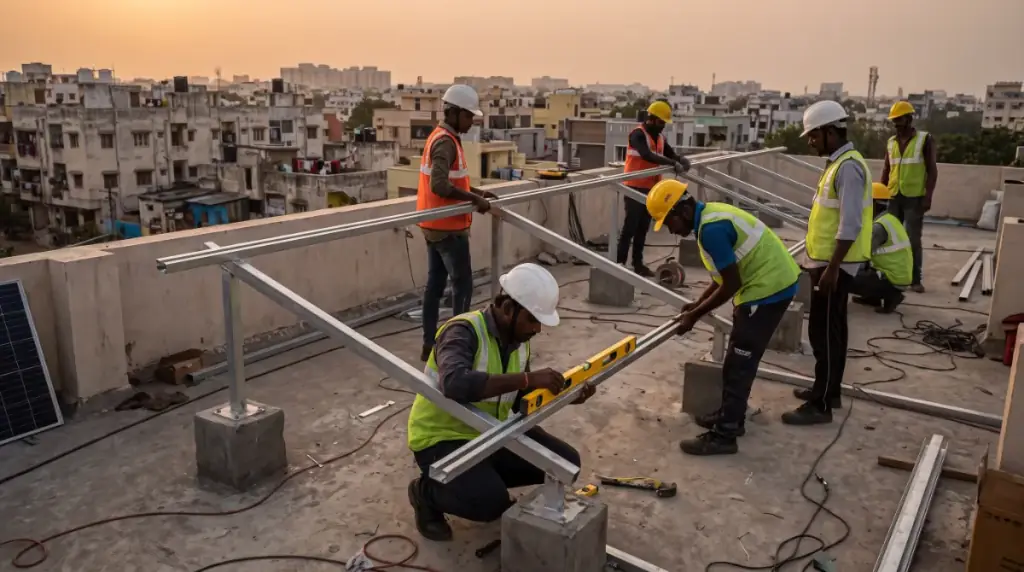
What it costs here
A typical 5 kW system in Alandur
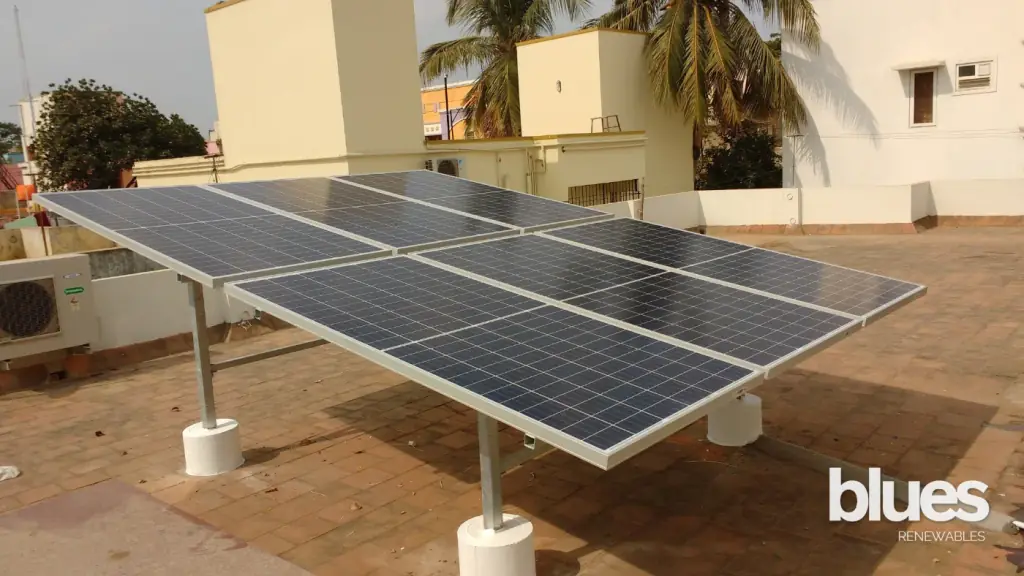
Standard 5 kW example
What a typical 5 kW home system does here. Your own figures come from the survey.
Your figures, not these ones
The numbers above are a standard 5 kW example. What your roof in Alandur can carry, and what it costs after subsidy, comes from a free survey: an engineer on the terrace, not a salesperson on the phone.
Not sure what your site can carry?
Send us your last electricity bill on WhatsApp and we will come back with an indicative system size and what it would offset. No visit needed for that first answer.
The local picture
When your neighbour’s array shades yours
In densely built areas where solar adoption is growing, a raised array on a neighbouring building can cast a shadow onto an adjacent lower roof, particularly in the early morning and late afternoon when the sun is low. This is a new consideration in Chennai and there is no established regulation covering it, so the practical protection lies in how your own system is designed and where it is positioned.
What we assess at survey
What is already installed nearby
And at what height. An existing elevated array on a taller adjacent building is a known quantity we can design around.
What is likely to be installed
Where a neighbouring building is taller and has a clear terrace, an array there at some future point is a reasonable possibility, and array placement can allow for it.
Your own position relative to boundaries
Keeping the array away from the boundary edge that faces a taller neighbour reduces exposure to future shading.
Whether raising your own array helps
Height can lift you above a neighbouring parapet, though not above a taller building’s raised array.
Courtesy, and practicality
Your array should not create the problem for someone else
On tight plots we check whether a proposed elevated structure would overshadow an adjacent lower roof, and adjust where it would. A neighbour dispute over shading is unpleasant and difficult to resolve after the fact. Where two adjacent owners are both considering solar, coordinating array heights and positions produces a better result for both than each designing in isolation. It costs nothing and prevents the problem entirely.
Areas we cover around Alandur: Alandur, Nanganallur border, Guindy approach, St Thomas Mount, Adambakkam side, the metro corridor.
All areas we cover in Chennai →Residential
Solar for Alandur homes
Independent houses
Typically install 3 kW to 5 kW once shading is properly assessed.
Adjacent buildings
Checked for existing and likely future arrays at survey.
Apartment blocks
Follow the association route for common-area systems.
Coordinating with neighbours
Where both are considering solar, produces a better result for each.
Commercial and industrial
Solar for Alandur businesses
Retail and small commercial
On the main roads. Evening-weighted and usually leased.
Small offices and service businesses
Good daytime match and commercial tariffs.
Clinics and practices
Daytime load matching generation.
Schools and coaching centres
Strong term-time daytime match.
Local guide
Solar on Alandur roofs: airport headroom, airport dust and Adambakkam drains
Alandur is Zone 12 of the Greater Chennai Corporation, a former municipality that joined the city in 2011, and it sits right beside Chennai International Airport. That puts its roofs in the area AAI maps for building heights, which matters before anyone raises a solar structure.
Airport headroom comes before array height
Raising an array on a tall structure is the usual fix for shade from a neighbour. In Alandur, check one figure first. AAI's colour coded zoning map gives every grid around the airport a permissible top elevation above mean sea level. Subtract your site elevation, about 39 m here, and you have the height above ground a building and everything on it may reach without an AAI certificate. Red grids always need one, through AAI's NOCAS portal. A three or four storey block with a water tank may already be near its figure. We read the grid value on NOCAS before choosing between a raised structure and a low mount on the slab.
Airport-side dust and how often to clean
DT Next's March 2026 report on the Alandur constituency notes rising air and noise pollution near the airport areas, alongside heavy traffic on narrow interior roads. Fine deposits on glass cut output gradually, so nobody notices until generation is well down. For roofs on the airport side of Alandur, we plan a terrace water point near the array and a cleaning check every two to four weeks in the dry months, then adjust the interval once the first months of monitoring show how fast output drops between washes. Rain does part of the job during the northeast monsoon, so the schedule can relax from October to December.
Adambakkam and the low streets: equipment off the ground floor
The same report says Adambakkam Lake has shrunk sharply, encroachments have disrupted natural drainage, and waterlogging continues in Adambakkam during the monsoon, with residents saying stormwater drains remain inadequate. Lakshmi Nagar improved after new drains went in. For homes in the lower streets toward Adambakkam, we put the inverter and the AC distribution board on the first floor or in the terrace stair room, run cables down from the terrace, and keep the earth pit out of the lowest corner of the plot. None of this adds cost when it is decided at design stage.
What a system makes in Alandur
The state rooftop calculator gives Chennai district 1,600 units per kW a year, about 4.4 units a day. A 3 kW system makes about 4,800 units a year and a 5 kW system about 8,000. A 3 kW home system costs about ₹2,10,000 before subsidy and about ₹1,10,000 after both subsidies. For the apartment blocks in Alandur, a common area system for lifts, pumps and corridor lighting gets ₹18,000 per kW, so a 10 kW common system attracts ₹1,80,000 and makes about 16,000 units a year.
What we install
What we install in Alandur
The process
How installation works
Free site survey
Shade-free roof area measured across the day, structure checked, connection name and sanctioned load confirmed.
Design and itemised quotation
Sized against twelve months of consumption, with every component named.
Approvals filed
PM Surya Ghar and TANGEDCO net metering, plus load enhancement or phase conversion in parallel where needed.
Installation
One to three days for a residential system, carried out by our own team rather than subcontracted.
Inspection and commissioning
TANGEDCO inspects, the net meter goes in, the system goes live.
Subsidy tracked to your account
And two years of maintenance included from commissioning.
We check the name on your electricity connection at the survey, because a mismatch stops more applications than any technical issue. See what to keep ready.
Free, no obligation
What will it cost on your roof in Alandur?
Neighbour already installed?
Their raised array may shade yours morning and evening. We check what is there and what is likely, then position accordingly.
What happens after you send your details
- We call you within one working day, and an engineer rather than a salesperson attends the site.
- The survey is free. We measure usable area and shading, check your connection and sanctioned load, and photograph the site.
- You get an itemised quotation naming every component and brand, with the subsidy or depreciation position set out.
- No obligation at any point. If solar does not make sense for your property, we will say so.
Common questions
Solar in Alandur, common questions
Can my neighbour’s solar array shade mine?
It can, particularly a raised array on a taller adjacent building in the early morning or late afternoon when the sun is low. It is an emerging issue in dense areas rather than a widespread one, and there is no established regulation covering it, so the protection lies in how your own array is positioned and designed.
How do you allow for future neighbouring installations?
By assessing what is already installed nearby and what is realistically likely. Where a neighbouring building is taller with a clear terrace, we position your array away from that boundary edge where possible, so a future array there has less effect on you.
Will my array shade my neighbour’s roof?
We check that on tight plots, particularly where an elevated structure is proposed, and adjust the design where it would. A shading dispute is unpleasant and hard to resolve afterwards. Where adjacent owners are both considering solar, coordinating heights and positions produces a better outcome for both.
How long does installation take in Alandur?
Six to ten weeks from survey to live. In Alandur an older roof sometimes needs strengthening work agreed first, which is the main local variable.
Do you handle the subsidy and TANGEDCO paperwork?
Yes, both. We handle the PM Surya Ghar claim and the TANGEDCO net metering application for Alandur. Because building ages vary widely here, we also confirm at survey that the existing installation will pass inspection.
What is included after installation?
Two years of free maintenance from commissioning, covering panel cleaning, annual inspection of connections and structure, generation monitoring and warranty coordination with the manufacturer.
Does being next to the airport limit how high my solar structure can be in Alandur?
It can. AAI sets a permissible top elevation for each grid around the airport, and the building plus anything on its roof has to stay under it unless AAI grants a certificate. A low mount on the slab rarely changes the picture, but a tall raised structure on an already tall building might. We check your grid figure before design.
Our Alandur apartment wants solar for the lifts and pumps. What subsidy applies?
Common area systems for apartments get ₹18,000 per kW. The association needs a general body resolution, and the system is sized to the common area load: lifts, pumps, corridor and compound lighting. As a guide, 10 kW makes about 16,000 units a year in Chennai district.
Long tail coverage
Areas we cover around Alandur
Not listed? We survey across Chennai and the surrounding districts. Call and we will tell you straight away whether we can reach your site this week.