












Solar Panel Installation in Choolaimedu
Tank and stair block shadows mapped before sizing, not after
On a large terrace an overhead water tank is a minor obstruction. On the small terraces common in Choolaimedu it can occupy a substantial share of the usable area and shade a good deal more. It is worth planning around properly rather than treating it as a detail.
Installing across Chennai since 2020
Two years free maintenance included
Subsidy and TANGEDCO paperwork filed by us
Free site survey and energy audit, no obligation
The short answer
Looking for a solar panel installation company in Choolaimedu?
Roofs in Choolaimedu are small and close together, so the honest system size here is usually decided by shading from the building next door rather than by your bill. Getting modules onto the roof usually means a staircase and a crew, which we allow for when we quote rather than after. We have installed across Chennai since 2020, file the PM Surya Ghar subsidy of up to ₹78,000 for households and the TANGEDCO net metering application ourselves, and include two years of free maintenance. Before the survey, you can check the solar panel price in Chennai for 3 kW to 10 kW systems and see how our solar panel installation in Chennai works, the same process we follow in Choolaimedu.
What it costs here
A typical 5 kW system in Choolaimedu
Standard 5 kW example
What a typical 5 kW home system does, on a terrace that can take one. Your own figures come from the survey.
Your figures, not these ones
The numbers above are a standard 5 kW example. What your roof in Choolaimedu can carry, and what it costs after subsidy, comes from a free survey: an engineer on the terrace, not a salesperson on the phone.
Not sure what your site can carry?
Send us your last electricity bill on WhatsApp and we will come back with an indicative system size and what it would offset. No visit needed for that first answer.
The local picture
Working around the water tank
Almost every Chennai building has an overhead water tank on the terrace, and on the compact roofs typical of Choolaimedu it takes up a meaningful proportion of the area available for solar. It also casts a moving shadow through the day that affects considerably more roof than the tank itself covers, and that shadow travels across the array as the sun moves.
The options, and what each costs
Design around it
The simplest approach. The array is laid out to avoid both the tank and its shadow path, which on a small terrace can mean losing a substantial share of the theoretical capacity.
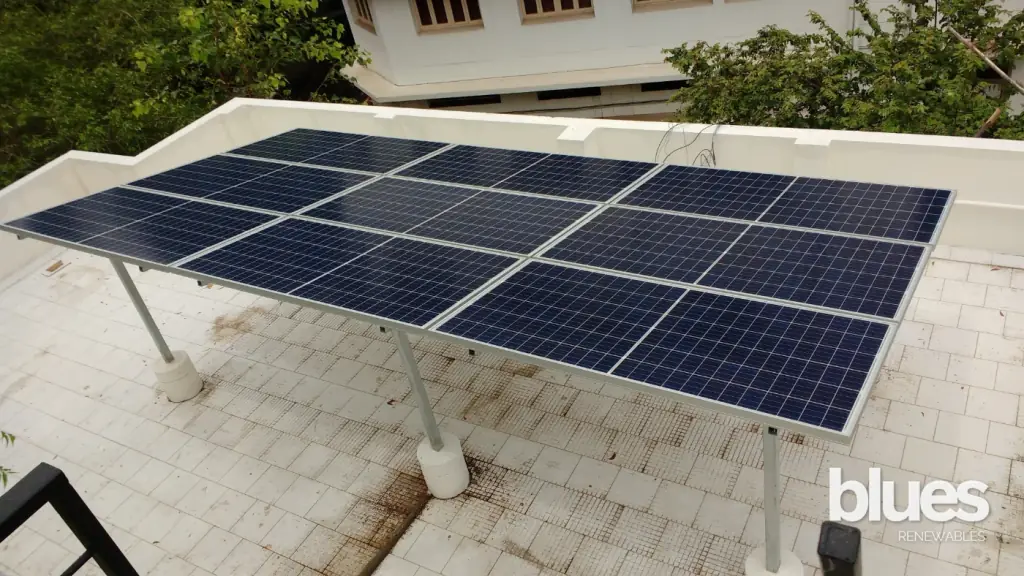
Span over it with an elevated structure
Raising the array above tank height recovers the area underneath and eliminates the shading. It costs more in steel, foundations and anchoring, but on a tank-dominated terrace it frequently recovers enough capacity to pay for itself.
Relocate the tank
Occasionally worth considering where the tank is due for replacement anyway, though it involves plumbing work and is rarely justified for solar alone.
Split the array with multiple MPPT inputs
So the section that gets shaded as the shadow passes does not drag down the sections that do not.
Worth working out rather than defaulting
Which option is right depends on the numbers
We map the tank’s shadow path at the survey and set out what each option yields and costs before you decide. Stair blocks and headroom rooms create the same problem and are handled the same way. Between a tank and a stair block, a compact terrace can lose a great deal of its theoretical area, which is why the measured figure is routinely well below the terrace dimension.
The rest of Choolaimedu
Dense residential with tight plots
Close neighbours and narrow streets affecting material access. Systems typically run 3 kW to 4 kW once usable area is properly established.
Areas we cover around Choolaimedu: Choolaimedu, Aminjikarai border, Kodambakkam approach, Nelson Manickam Road, Vadapalani side, the high road streets.
All areas we cover in Chennai →Residential
Solar for Choolaimedu homes
Independent houses
Typically install 3 kW to 4 kW once tanks, stair blocks and shading are accounted for.
Elevated structures
Worth costing where a tank dominates the terrace.
Apartment blocks
Follow the association route for common-area systems.
Access on narrow streets
Planned at survey rather than discovered on installation day.
Commercial and industrial
Solar for Choolaimedu businesses
Retail and small shops
On the main roads. Evening-weighted and usually leased.
Small offices and service businesses
In converted residential space.
Clinics and practices
Good daytime load and commercial tariffs.
Coaching centres and small schools
Strong term-time daytime match.
Local guide
Choolaimedu rooftop solar: what your street and building change
Choolaimedu has grown from part of the old Puliyur village into a commercial hub, so many buildings mix shops and homes. In October 2024 parts of it also stood in knee-deep water for two days.
Knee-deep water in 2024: keep the electronics upstairs
During the heavy rain of 15 and 16 October 2024, South First reported that heavily populated areas including Choolaimedu were submerged in knee-deep water, and Chennai Corporation pumped the streets out with motors. On a compact Choolaimedu building the temptation is to put the inverter on the ground floor wall beside the meter, where there is space. We would rather fix it on the terrace headroom wall, under a sunshade, or on an upper floor landing, and run the AC cable down to the meter. The distribution boxes go with it. That keeps the expensive parts dry when the street floods, and it costs nothing extra at the design stage. If space forces the inverter lower, keep it well above the water level your street saw in 2024.
Shop below, home above: one roof, two connections
Where a Choolaimedu building has a shop on the ground floor and a home above, each usually has its own electricity connection. A solar system connects to one service connection and offsets only that connection's units, so the choice matters. A domestic connection gets net metering, the PM Surya Ghar subsidy of up to ₹78,000 and the ₹22,000 Tamil Nadu top-up. A commercial connection gets no subsidy and is on net feed-in, with exports credited at ₹3.61 a unit up to 10 kW. If the shop's daytime load is steady, solar on that connection saves at the higher commercial tariff. If not, the home's connection usually wins. We read both bills at the survey and show the saving on each connection before you choose.
Does a small terrace fit the 3 kW minimum?
We install from 3 kW, which needs roughly 240 to 300 sq ft of shade-free terrace once the tank, stair block and their shadows are left out. At Chennai's yield of about 1,600 units per kW a year, 3 kW makes about 4,800 units a year, or about 13 a day. A 4 kW system makes about 6,400 and is the most a single-phase connection allows. A 3 kW system costs about ₹2,10,000 before subsidy and about ₹1,10,000 after both subsidies, for an eligible home. If your measured area falls short of 3 kW even with an elevated structure over the tank, we will tell you. What remains on the bill is mainly the network charge on generation, roughly ₹1,500 a year on 4,800 units.
What we install
What we install in Choolaimedu
The process
How installation works
Free site survey
Shade-free roof area measured across the day, structure checked, connection name and sanctioned load confirmed.
Design and itemised quotation
Sized against twelve months of consumption, with every component named.
Approvals filed
PM Surya Ghar and TANGEDCO net metering, plus load enhancement or phase conversion in parallel where needed.
Installation
One to three days for a residential system, carried out by our own team rather than subcontracted.
Inspection and commissioning
TANGEDCO inspects, the net meter goes in, the system goes live.
Subsidy tracked to your account
And two years of maintenance included from commissioning.
We check the name on your electricity connection at the survey, because a mismatch stops more applications than any technical issue. See what to keep ready.
Free, no obligation
What will it cost on your roof in Choolaimedu?
Quoted from your terrace dimension?
On a small roof the tank and stair block take more than you think, and their shadows take more again. We measure what is usable.
What happens after you send your details
- We call you within one working day, and an engineer rather than a salesperson attends the site.
- The survey is free. We measure usable area and shading, check your connection and sanctioned load, and photograph the site.
- You get an itemised quotation naming every component and brand, with the subsidy or depreciation position set out.
- No obligation at any point. If solar does not make sense for your property, we will say so.
Common questions
Solar in Choolaimedu, common questions
Will my water tank stop me installing solar?
No, but it shapes the design and can cost you capacity. On a compact terrace a tank occupies meaningful area and casts a moving shadow across considerably more. The options are designing around it, spanning over it with an elevated structure, or splitting the array with multiple MPPT inputs so the shaded section does not drag the rest down.
Is it worth raising the array above the tank?
Often yes on a tank-dominated terrace, because it recovers the area underneath and eliminates the shading entirely. It costs more in steel, foundations and anchoring. We map the tank’s shadow path at the survey and set out what each option yields and costs so the decision is made on figures.
Should I relocate my water tank for solar?
Rarely worth it for solar alone, since it involves plumbing work and disruption. It becomes worth considering where the tank is due for replacement anyway, in which case moving it to a corner while it is being replaced can free up prime roof area at little extra cost.
How long does installation take in Choolaimedu?
Six to ten weeks from survey to a live system. In Choolaimedu the installation itself can take an extra day because material has to come up by staircase, but the timeline is still governed by TANGEDCO approval and the meter, not by the roof work.
Do you handle the subsidy and TANGEDCO paperwork?
Yes. We file the PM Surya Ghar claim and the TANGEDCO net metering application for you and follow both through the section office. In Choolaimedu the detail that delays applications most often is the sanctioned load being too low for the system you want, which we check before designing so the load enhancement runs in parallel rather than afterwards.
What is included after installation?
Two years of free maintenance from commissioning, covering panel cleaning, annual inspection of connections and structure, generation monitoring and warranty coordination with the manufacturer.
Two families own different floors of the same Choolaimedu building. Can both put solar on the one terrace?
Yes, if the owners agree how the terrace is shared. Each system ties to its own electricity connection, and each household claims its own subsidy. Since each system must be at least 3 kW, you need roughly 500 to 600 sq ft of shade-free terrace between you, which a split design or an elevated structure sometimes makes possible.
Part of my building is rented out as a shop. Can I still claim the home subsidy?
Yes, for a system on the domestic connection that serves your home. The subsidy follows the connection, not the building, so a system on the shop's commercial connection would not qualify. We check which connection is which on your bills at the survey.
Long tail coverage
Areas we cover around Choolaimedu
Not listed? We survey across Chennai and the surrounding districts. Call and we will tell you straight away whether we can reach your site this week.