












Solar Panel Installation in Mugalivakkam
Vacant plots nearby noted at survey, so future shading is visible before you commit
Mugalivakkam is still being built out, and a clear roof today is not a guarantee of a clear roof in five years. Where a vacant plot next door could become a five-storey building, that possibility belongs in the design rather than in hindsight.
Installing across Chennai since 2020
Two years free maintenance included
Subsidy and TANGEDCO paperwork filed by us
Free site survey and energy audit, no obligation
The short answer
Looking for a solar panel installation company in Mugalivakkam?
In Mugalivakkam we work on both independent terraces and apartment common areas, and the two need different paperwork even on the same street. Because it is a newer area, roofs here are generally in good condition and the paperwork moves faster than the average. We have installed across Chennai since 2020, file the PM Surya Ghar subsidy of up to ₹78,000 for households and the TANGEDCO net metering application ourselves, and include two years of free maintenance. Before the survey, you can check the solar panel price in Chennai for 3 kW to 10 kW systems and see how our solar panel installation in Chennai works, the same process we follow in Mugalivakkam.
What it costs here
A typical 5 kW system in Mugalivakkam
Standard 5 kW example
What a typical 5 kW home system does here. Your own figures come from the survey.
Not sure what your site can carry?
Send us your last electricity bill on WhatsApp and we will come back with an indicative system size and what it would offset. No visit needed for that first answer.
The local picture
Designing for the building that is not there yet
In rapidly developing localities, a solar array installed on a clear roof can find itself shaded within a few years by a taller building constructed on an adjacent plot. A solar system is a twenty-five year asset, and in an area still under active development the future skyline is a legitimate design consideration rather than speculation.
What we look at during the survey
Vacant and under-construction plots nearby
Particularly to the south, east and west of your building, since those directions govern shading through the generating hours.
How tall neighbouring development is likely to be
Existing buildings in the immediate area give a reasonable indication of what a new one will be.
Where to position the array
Keeping it away from boundaries that face developable plots reduces future exposure, at some cost in available area.
Whether raising the array helps
Height provides some protection against a moderately taller neighbour, though not against a substantially taller one.
What is realistically at risk
Not every vacant plot gets built on, and over-designing for a hypothetical costs you generation today. This is a judgement rather than a rule, and we set out the trade-off rather than deciding it for you.
The honest limitation
Nobody can guarantee what will be built next door
There is no established mechanism in Chennai protecting a solar installation’s access to light. What we can do is make the risk visible before you install and position the array to reduce it where that is possible without sacrificing too much present capacity.
If shading does arrive later
The options are limited but not zero
Reconfiguring the array within the roof, adding MPPT inputs so shaded strings are isolated, or in some cases raising the structure. All are cheaper to allow for at the outset than to retrofit. Mugalivakkam otherwise is favourable: newer construction means sound slabs, clear terraces and generally adequate sanctioned load, with systems typically running 3 kW to 5 kW.
Areas we cover around Mugalivakkam: Mugalivakkam, Ramapuram border, Porur approach, Manapakkam side, Kovur, the newer layout sectors.
All areas we cover in Chennai →Residential
Solar for Mugalivakkam homes
Independent houses
Typically install 3 kW to 5 kW, with future development considered in the array position.
Apartment blocks
Follow the association route for common-area systems.
Newer construction
Means fewer structural surprises across most of the locality.
Vacant adjacent plots
Noted at survey so the risk is visible before you commit.
Commercial and industrial
Solar for Mugalivakkam businesses
Retail and food service
Serving the growing residential base. Evening-weighted and usually leased.
Small offices
On the Porur and Ramapuram approaches. Good daytime match.
Clinics and practices
Daytime load and commercial tariffs.
Schools and institutions
In the surrounding development.
Local guide
Mugalivakkam solar: the canal, the airport and newer homes
During Cyclone Michaung in December 2023 the Manapakkam canal overflowed through Thiruvalluvar Nagar and Arumugam Nagar, and one Mugalivakkam resident told the Times of India she had 3 ft of water inside her house. Where you place the inverter here matters as much as where you place the panels.
Why the Manapakkam canal overflows
The Manapakkam canal was built to carry irrigation water from Chembarambakkam and now carries floodwater from Porur lake to the Adyar. The Times of India reported that Porur lake's surplus canal feeds it at a design capacity of 500 cusecs, and that in December 2023 about 600 cusecs was released, so the canal overtopped into Thiruvalluvar Nagar and Arumugam Nagar, which also flooded in 2015 and 2021. The Water Resources Department said it was extending branch canals in Kolapakkam and Gerugambakkam at ₹88 crore. The New Indian Express noted that Sabari Nagar drained within hours, so exposure differs street by street.
Electronics above your street's water mark
On the canal-side streets, plan as if water will reach the ground floor again. We note the 2023 water mark at survey, then put the inverter, the solar distribution box and the AC isolator on a first-floor wall or on the terrace in shade, at least a metre above it. The panels never see floodwater. The net meter stays where TNPDCL fits it. If you have a hybrid system, the battery goes upstairs too, because a lithium battery that has been submerged must be replaced. In Sabari Nagar and other streets that drained quickly in 2023, a normal placement is usually fine.
Next to the airport: check height before raising the array
Mugalivakkam borders Meenambakkam, where Chennai airport sits. The Airports Authority of India's Colour Coded Zoning Map gives each grid a permissible top elevation above mean sea level, and its 2015 guidelines say no height NOC is needed for buildings up to that level. Homes in red grids, or buildings already near their limit, need care. A flush rooftop array adds very little, but an elevated structure adds two to three metres. Before proposing a raised frame on a taller building here, we check its approved height and the zoning map on AAI's NOCAS portal.
Sizing on a newer slab
Most houses here are recent, with sound slabs and clear terraces. On the state rooftop calculator's 1,600 units per kW a year for Chennai district, a 3 kW system makes about 4,800 units a year and a 5 kW system about 8,000, roughly 1,330 per bi-monthly cycle. Anything above 4 kW needs three-phase supply. A 5 kW system costs about ₹3,20,000 before subsidy and about ₹2,20,000 after the central and Tamil Nadu subsidies. Homes up to 10 kW keep net metering, and what remains on the bill is mainly the network charge of about ₹0.32 a unit on generation.
What we install
What we install in Mugalivakkam
The process
How installation works
Free site survey
Shade-free roof area measured across the day, structure checked, connection name and sanctioned load confirmed.
Design and itemised quotation
Sized against twelve months of consumption, with every component named.
Approvals filed
PM Surya Ghar and TANGEDCO net metering, plus load enhancement or phase conversion in parallel where needed.
Installation
One to three days for a residential system, carried out by our own team rather than subcontracted.
Inspection and commissioning
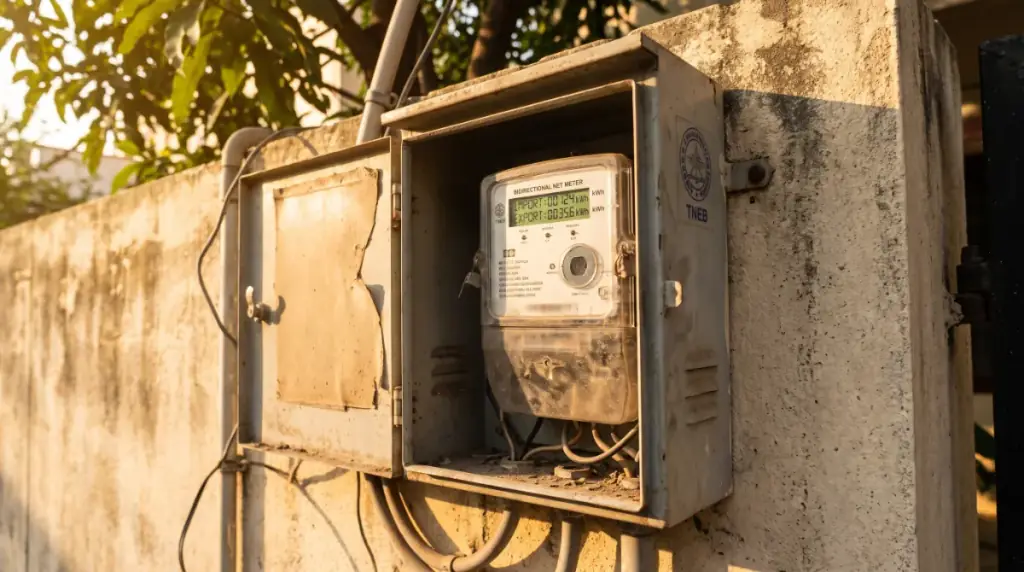
TANGEDCO inspects, the net meter goes in, the system goes live.
Subsidy tracked to your account
And two years of maintenance included from commissioning.
We check the name on your electricity connection at the survey, because a mismatch stops more applications than any technical issue. See what to keep ready.
Free, no obligation
What will it cost on your roof in Mugalivakkam?
Clear roof today?
In an area still building out that is not a guarantee. We note what could go up nearby and position the array with that in mind.
What happens after you send your details
- We call you within one working day, and an engineer rather than a salesperson attends the site.
- The survey is free. We measure usable area and shading, check your connection and sanctioned load, and photograph the site.
- You get an itemised quotation naming every component and brand, with the subsidy or depreciation position set out.
- No obligation at any point. If solar does not make sense for your property, we will say so.
Common questions
Solar in Mugalivakkam, common questions
Could a new building next door shade my solar panels?
It could, and in a developing area like Mugalivakkam that is a legitimate consideration for a twenty-five year asset. We note vacant and under-construction plots at the survey, particularly to the south, east and west, and position the array to reduce exposure where that is possible without sacrificing too much present capacity.
Is there any protection if a neighbour blocks my sunlight?
There is no established mechanism in Chennai protecting a solar installation’s access to light, so the practical protection is in the design rather than in any right. That is why we make the risk visible before you install rather than treating a clear roof today as a guarantee.
What can be done if shading appears later?
The options are limited but not zero. The array can sometimes be reconfigured within the roof, MPPT inputs can be added so shaded strings are isolated from the rest, and in some cases the structure can be raised. All of these are cheaper to allow for at the outset than to retrofit afterwards.
How long does installation take in Mugalivakkam?
Six to eight weeks from survey to a live, net-metered system is typical in Mugalivakkam, and newer areas often land at the shorter end because connection records are current. The installation itself is one to three days for a home; the rest is TANGEDCO approval and the meter.
Do you handle the subsidy and TANGEDCO paperwork?
Yes, both are ours to file. Applications from newer areas like Mugalivakkam usually move faster because the connection details and sanctioned load are recent and correct. We still verify the name on the connection and the load at the survey, then track the subsidy to your bank account after commissioning.
What is included after installation?
Two years of free maintenance from commissioning, covering panel cleaning, annual inspection of connections and structure, generation monitoring and warranty coordination with the manufacturer.
Our street flooded in Michaung. Is rooftop solar still sensible?
Yes. Floodwater does not reach the panels, and the parts that can be damaged, the inverter, the distribution box and any battery, can all be mounted upstairs or on the terrace. We note the 2023 water level at survey and design above it.
Do I need an airport NOC to put panels on my Mugalivakkam house?
Usually not. AAI's 2015 zoning guidelines say no height NOC is needed for buildings up to the permitted top elevation for their grid. A flush array adds little height, but an elevated structure on a tall building or in a red grid should be checked against the zoning map first, which we do before quoting.
Long tail coverage
Areas we cover around Mugalivakkam
Not listed? We survey across Chennai and the surrounding districts. Call and we will tell you straight away whether we can reach your site this week.