












Solar Panel Installation in Pallikaranai
Inverter and protection gear mounted for this area’s water history, at no extra cost
Pallikaranai is built around a marsh, and that shapes more of a solar installation than most installers acknowledge. The panels are never the issue. Where the inverter and protection equipment go, and what the ground underneath a structure is doing, are the questions worth asking here.
Installing across Chennai since 2020
Two years free maintenance included
Subsidy and TANGEDCO paperwork filed by us
Free site survey and energy audit, no obligation
The short answer
Looking for a solar panel installation company in Pallikaranai?
In Pallikaranai we work on both independent terraces and apartment common areas, and the two need different paperwork even on the same street. Ground conditions around here are soft and damp, which affects earthing pit design as much as it affects the structure. Installing across Chennai since 2020, we file the PM Surya Ghar application worth up to ₹78,000 for households, handle TANGEDCO net metering end to end, and cover two years of maintenance after commissioning. Before the survey, you can check the solar panel price in Chennai for 3 kW to 10 kW systems and see how our solar panel installation in Chennai works, the same process we follow in Pallikaranai.
What it costs here
A typical 5 kW system in Pallikaranai
Standard 5 kW example
What a typical 5 kW home system does here. Your own figures come from the survey.
Not sure what your site can carry?
Send us your last electricity bill on WhatsApp and we will come back with an indicative system size and what it would offset. No visit needed for that first answer.
The local picture
Building on and around the marsh
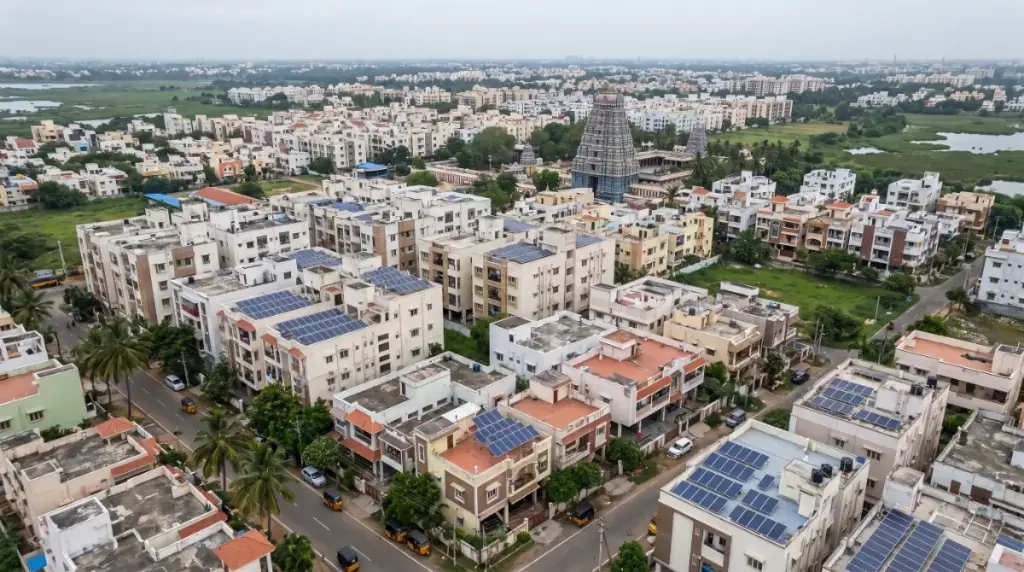
Pallikaranai sits on and around a marshland, and much of the developed area is low-lying with a documented history of water logging and flooding. For rooftop solar the panels themselves are unaffected, since they sit on the roof. The equipment that can be affected is the inverter, the DC and AC distribution boxes and the protection gear, and where those are mounted is a design decision rather than a detail.
What we do differently here
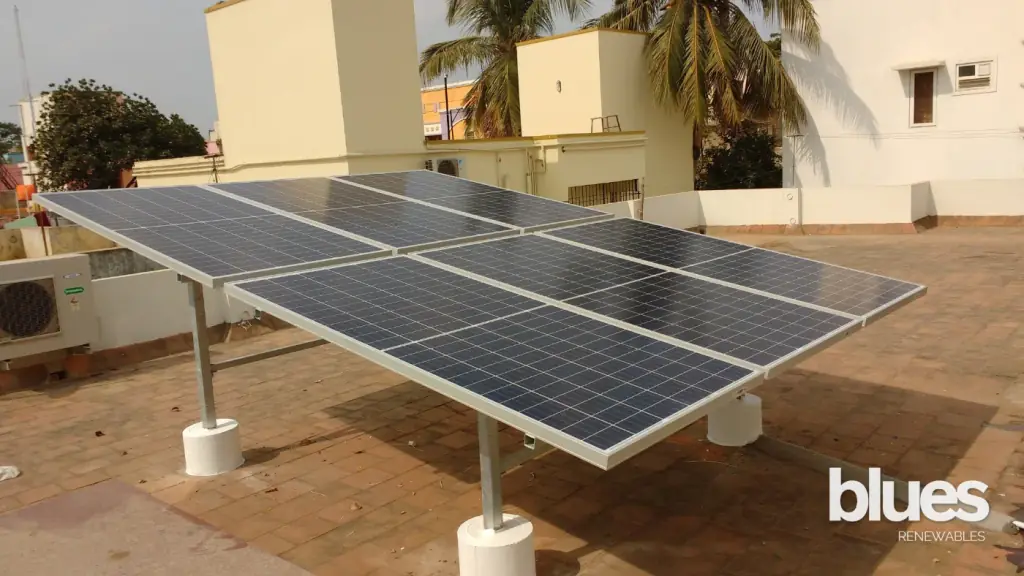
Inverter and DCDB mounted high
Well above levels the area has previously seen, rather than at convenient height on a ground-floor wall.
Protection equipment and earthing points sited accordingly
Water reaching an ACDB is a safety matter, not a warranty one.
Cable routing planned away from low points
Where water pools.
Ground-floor installation locations reconsidered
Where the only practical position is low, we say so and discuss the alternatives rather than installing and hoping.
Ask this of any installer
Where do you intend to mount the inverter?
One who has not thought about it has not surveyed the area properly. Ground conditions matter for structures too: reclaimed and made-up ground behaves differently from natural soil, so where a ground-mounted structure or a heavy elevated array is proposed, the foundation needs designing to what is actually underneath rather than to a standard detail.
The third factor
Humidity near the marsh
Proximity to the marsh means persistently higher humidity than a few kilometres inland, which makes enclosure sealing and ventilation for the inverter more important than it would otherwise be.
Areas we cover around Pallikaranai: Pallikaranai main road, Kamakoti Nagar, Velachery approach, Medavakkam border, Thoraipakkam Radial Road, the marsh periphery.
All areas we cover in Chennai →Residential
Solar for Pallikaranai homes
Apartment blocks
A large share of Pallikaranai, and common-area systems through the association are the practical route for flat owners.
Independent houses
Typically installing 3 kW to 5 kW, with inverter placement a live design question rather than an afterthought.
Newer construction
Across much of the area, meaning sound slabs and generally adequate sanctioned load.
Ground-floor equipment placement
Should be settled at the survey, not on installation day.
Commercial and industrial
Solar for Pallikaranai businesses
Clinics and diagnostic centres
Daytime load matching generation well.
Retail and showrooms
Along the main roads. Evening-weighted trading, and roof rights first on leased premises.
Schools and institutions
Strong term-time daytime match, with vacation periods affecting sizing.
Small offices and warehousing
On the fringes, where roof area often exceeds what the load justifies, making correct sizing more important than filling the roof.
Local guide
Pallikaranai and the marsh: what a solar owner should plan for
The Pallikaranai Marsh Reserve Forest became a Ramsar wetland on 8 April 2022, covering 1,247.54 hectares and draining a catchment of about 250 sq km. Since September 2025 a 1 km buffer around it has also changed what owners can build, and both facts bear on a rooftop system.
The 1 km marsh buffer and rooftop structures
After a National Green Tribunal order in September 2025, CMDA stopped issuing planning permissions inside a 1 km influence zone around the marsh, and Pallikaranai is in it. Residents reported in early 2026 that even routine repairs needed permission. A rooftop array fixed to an existing approved roof adds no floor area. A covered terrace structure with a solid roof or side cladding can look like an addition, so here we keep the frame open and check with the Corporation before anything that encloses space. Associations should also keep the building's approval papers ready, since the buffer has made approval status a live question. Keeping the array on the existing slab keeps it within the building's footprint.
Multi-day outages: what on-grid solar does and does not do
The marsh drains about 250 sq km of the city, and after Cyclone Michaung in December 2023 Pallikaranai was among the suburbs left submerged, with power cut for long spells. An on-grid inverter is required to shut down when the grid fails, so a standard system gives no power during a cut, even in sunshine. If keeping a fridge, lights, a borewell pump or a lift running matters to you, the choice is a hybrid inverter with a battery sized to those loads only. That costs more than on-grid, and the battery and inverter must be mounted well above any flood level. A battery sized for a few essential loads costs far less than one sized for the whole house.
Apartment common areas and the lift question
Apartment blocks make up a large share of Pallikaranai. A common-area system through the association gets ₹18,000 per kW for lifts, pumps and corridor lighting. At the Chennai yield of 1,600 units per kW a year, a 10 kW common-area system makes about 16,000 units a year. If the association wants lifts and the sump pump to run during a long outage, that part of the load needs a hybrid design, which should be decided at the general body before the quotation, not added later. The ₹18,000 per kW is for the association's common connection and is separate from any flat owner's own subsidy. Common loads such as the sump pump and the STP blower run through the day, which suits solar well.
What we install
What we install in Pallikaranai
The process
How installation works
Free site survey
Shade-free roof area measured across the day, structure checked, connection name and sanctioned load confirmed.
Design and itemised quotation
Sized against twelve months of consumption, with every component named.
Approvals filed
PM Surya Ghar and TANGEDCO net metering, plus load enhancement or phase conversion in parallel where needed.
Installation
One to three days for a residential system, carried out by our own team rather than subcontracted.
Inspection and commissioning
TANGEDCO inspects, the net meter goes in, the system goes live.
Subsidy tracked to your account
And two years of maintenance included from commissioning.
We check the name on your electricity connection at the survey, because a mismatch stops more applications than any technical issue. See what to keep ready.
Free, no obligation
What will it cost on your roof in Pallikaranai?
Concerned about water logging?
The panels are on the roof and unaffected. What matters is where the inverter goes, and we mount it for this area’s history rather than at convenient height.
What happens after you send your details
- We call you within one working day, and an engineer rather than a salesperson attends the site.
- The survey is free. We measure usable area and shading, check your connection and sanctioned load, and photograph the site.
- You get an itemised quotation naming every component and brand, with the subsidy or depreciation position set out.
- No obligation at any point. If solar does not make sense for your property, we will say so.
Common questions
Solar in Pallikaranai, common questions
Does the Pallikaranai marsh affect a solar installation?
Not the panels, which sit safely on the roof, but it affects where the inverter and protection equipment should be mounted. Given the area’s water logging and flood history, that equipment should sit at a height that accounts for it, with cable routing planned away from low points. It costs nothing extra when decided before installation.
Is the ground here suitable for a ground-mounted or elevated structure?
It depends on the specific site. Reclaimed and made-up ground behaves differently from natural soil, so foundations for a ground-mount or a heavy elevated array need designing to what is actually underneath rather than to a standard detail. We assess this at the survey where such a structure is proposed.
Does humidity near the marsh affect solar equipment?
It makes enclosure sealing and ventilation more important than in drier parts of the city. Persistent humidity affects electronics over time, so the inverter and protection equipment should be properly rated and sited with that in mind. The panels themselves are unaffected.
How long does installation take in Pallikaranai?
Six to ten weeks in Pallikaranai, with the installation itself one to three days. Earthing takes longer here than on firmer ground, and approval takes longer than both.
Do you handle the subsidy and TANGEDCO paperwork?
Yes. Both the PM Surya Ghar claim and the TANGEDCO net metering application are ours to file and follow up. In the Pallikaranai area we also check the sanctioned load early, because load enhancement filed late is the commonest cause of a delayed connection.
What is included after installation?
Two years of free maintenance from commissioning, covering panel cleaning, annual inspection of connections and structure, generation monitoring and warranty coordination with the manufacturer.
Will my on-grid solar system keep my Pallikaranai home running when power is cut during a flood?
No. On-grid inverters shut down automatically when the grid is off, for the safety of line workers. For backup you need a hybrid system with a battery, sized to the few loads you want to keep, and mounted above flood level.
Does living inside the 1 km marsh buffer stop me installing rooftop solar?
The buffer restricts new planning permissions, and residents say repairs now need permission too. A rooftop array on an existing approved roof adds no floor area. We keep the frame open and recommend checking with the Corporation before building any covered structure on the terrace.
Long tail coverage
Areas we cover around Pallikaranai
Not listed? We survey across Chennai and the surrounding districts. Call and we will tell you straight away whether we can reach your site this week.