












Solar Panel Installation in Royapettah
Structure assessed before the array is designed, because old fabric anchors differently
A good deal of Royapettah predates modern reinforced concrete construction, and the older building fabric here does not take a fixing the way a recent slab does. That is a structural question worth answering properly rather than drilling and hoping.
Installing across Chennai since 2020
Two years free maintenance included
Subsidy and TANGEDCO paperwork filed by us
Free site survey and energy audit, no obligation
The short answer
Looking for a solar panel installation company in Royapettah?
Royapettah is densely built, so the survey matters more than the brochure: roof area is tight and neighbouring buildings put shade where you do not expect it. In the area the existing electrical installation is frequently the first thing to fix. Older boards and earthing rarely meet what a solar connection needs. Blues Renewables has worked across Chennai since 2020. We handle the PM Surya Ghar claim of up to ₹78,000 where the property is residential, file the TANGEDCO net metering paperwork, and include two years of maintenance. Before the survey, you can check the solar panel price in Chennai for 3 kW to 10 kW systems and see how our solar panel installation in Chennai works, the same process we follow in Royapettah.
What it costs here
A typical 5 kW system in Royapettah
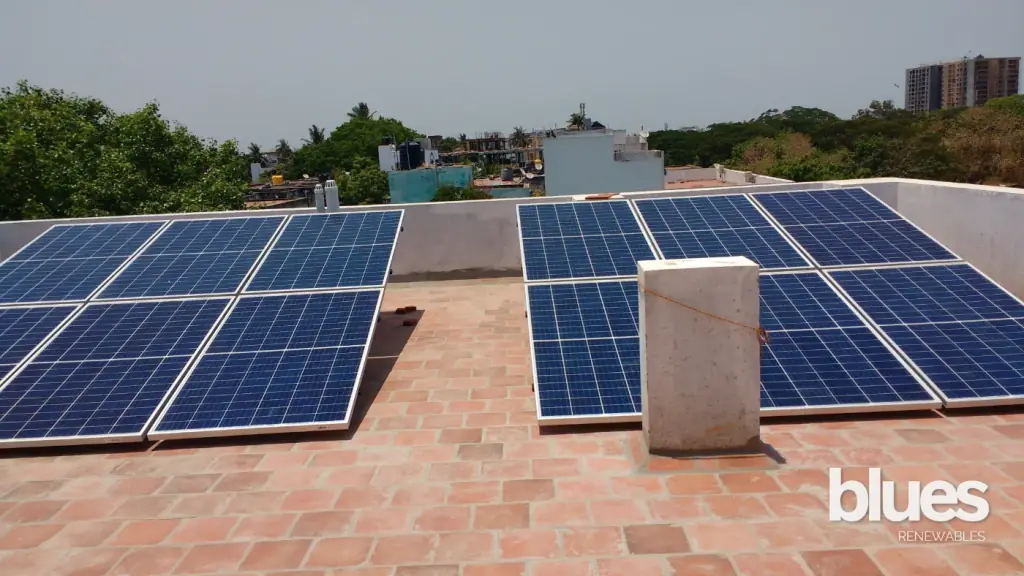
Standard 5 kW example
What a typical 5 kW home system does, on a terrace that can take one. Your own figures come from the survey.
Not sure what your site can carry?
Send us your last electricity bill on WhatsApp and we will come back with an indicative system size and what it would offset. No visit needed for that first answer.
The local picture
Anchoring into older building fabric
Royapettah contains a substantial stock of older buildings constructed before modern reinforced concrete practice, including load-bearing masonry walls, lime-based mortars and older slab systems. A solar mounting structure has to be anchored securely enough to resist wind uplift for twenty-five years, and the fixing methods appropriate to a recent RCC slab are not always appropriate to older fabric.
What that means at survey
The structure gets assessed before the array is designed
Not after. What the roof is made of determines how the array is fixed and how it is laid out.
Fixing method follows the fabric
Anchoring into sound modern concrete is straightforward. Older slabs, masonry parapets and lime-mortared construction need a considered approach and sometimes a spread load rather than point fixings.
Wind uplift is the governing force, not panel weight
Chennai sits in a 50 m/s basic wind speed zone under IS 875 Part 3, and an inadequately anchored array is a safety problem rather than a performance one.
Waterproofing at penetrations matters more on older roofs
Where the existing membrane may already be near the end of its life. If the terrace leaks, deal with it before installing rather than after.
Where the structure cannot safely take an array, we say so
That is a rare outcome but not an impossible one, and it is far better established at survey than after installation.
A second segment here
The hospital cluster
Older healthcare buildings carry plant added incrementally over decades, so usable roof area is a fraction of gross, and a grid-tied system shuts down during an outage by design, meaning it sits alongside existing DG and UPS rather than replacing either. Dense streets also mean access needs planning for material handling, and usable shade-free area on residential properties is routinely below terrace measurement.
Areas we cover around Royapettah: Royapettah, Mylapore border, Triplicane approach, Peters Road, Royapettah High Road, the hospital streets.
All areas we cover in Chennai →Residential
Solar for Royapettah homes
Older independent houses
Typically 3 kW to 4 kW, with the structural assessment coming before the sizing.
Waterproofing condition
Should be settled before installation on older terraces.
Apartment blocks
Follow the association route for common-area systems.
Divided older properties
Need roof ownership established first.
Commercial and industrial
Solar for Royapettah businesses
Hospitals and nursing homes
Congested older roofs, solar alongside DG and UPS, power quality a design question.
Retail and commercial in older buildings
Roof rights and structural condition both need establishing.
Offices in converted properties
Where the terrace may carry loads it was not designed for.
Clinics and practices
Good daytime match where the roof is sound and available.
Local guide
Royapettah solar: heritage rules, sea air and compact terraces
Royapettah's road network took shape in the late 18th and 19th centuries, and Amir Mahal on Pycrofts Road, built in 1798, is graded Grade I on CMDA's draft heritage list. Before anyone designs an array here, it is worth knowing whether your building is on that list.
Is your building on the heritage list?
CMDA's heritage rules came into force with the Second Master Plan in 2008, and the Heritage Conservation Committee oversees listed buildings by grade. In Grade I buildings, such as Amir Mahal, almost no intervention inside or out is allowed. In Grade II buildings, external changes are allowed after scrutiny by the committee. In Grade III buildings, changes are generally permissible. Panels and a mounting frame on the roof of a Grade II building are an external change, so they need committee approval before work starts. If your building is listed, a low-profile array set back from the street faces and kept below the parapet line is the least intrusive design to put before the committee. Check CMDA's draft list before you ask for a quote.
Sea air on the Marina side
Royapettah's south-eastern edge runs to Marina Beach, so the streets on that side take salt-laden sea air that the western streets toward Anna Salai feel less. On those eastern terraces, specify modules certified to IEC 61701 for salt mist, hot-dip galvanised or aluminium structure, and stainless steel fasteners. Fasteners and earthing clamps corrode first and are cheap to upgrade at installation. Keep the inverter in a covered, ventilated spot rather than on an exposed parapet wall. Plan freshwater rinsing of the panels between monsoons, because a salt film builds up and lowers output. On sound older slabs, combine this with the fixing method the structure allows.
Fitting 3 kW onto a compact terrace
Our systems start at 3 kW, which needs roughly 150 sq ft of shade-free roof. At Chennai district's 1,600 units per kW a year, 3 kW makes about 4,800 units a year. On a tight Royapettah terrace, water tanks, stair heads and neighbouring walls often eat into that area. An elevated frame that clears the tank and parapet shadows can recover enough space. If even that cannot fit 3 kW of unshaded panels, we will say solar does not suit the roof rather than fit something smaller. A 3 kW system costs about ₹2,10,000 before subsidy and about ₹1,10,000 after the ₹78,000 central subsidy and the ₹22,000 Tamil Nadu top-up. What remains on the bill is mainly the network charge, about ₹0.32 a unit.
What we install
What we install in Royapettah
The process
How installation works
Free site survey
Shade-free roof area measured across the day, structure checked, connection name and sanctioned load confirmed.
Design and itemised quotation
Sized against twelve months of consumption, with every component named.
Approvals filed
PM Surya Ghar and TANGEDCO net metering, plus load enhancement or phase conversion in parallel where needed.
Installation
One to three days for a residential system, carried out by our own team rather than subcontracted.
Inspection and commissioning
TANGEDCO inspects, the net meter goes in, the system goes live.
Subsidy tracked to your account
And two years of maintenance included from commissioning.
We check the name on your electricity connection at the survey, because a mismatch stops more applications than any technical issue. See what to keep ready.
Free, no obligation
What will it cost on your roof in Royapettah?
Old building?
Then fixing method follows the fabric, not a standard detail. Wind uplift is the governing force, and an under anchored array is a safety issue.
What happens after you send your details
- We call you within one working day, and an engineer rather than a salesperson attends the site.
- The survey is free. We measure usable area and shading, check your connection and sanctioned load, and photograph the site.
- You get an itemised quotation naming every component and brand, with the subsidy or depreciation position set out.
- No obligation at any point. If solar does not make sense for your property, we will say so.
Common questions
Solar in Royapettah, common questions
Can solar be fixed to an older Royapettah building?
Usually, but the fixing method has to follow the fabric. Load-bearing masonry, lime mortars and older slab systems do not take a fixing the way a recent RCC slab does, and sometimes a spread load is appropriate rather than point fixings. We assess the structure before designing the array, not after.
Why is wind uplift the governing force rather than panel weight?
Because Chennai sits in a 50 m/s basic wind speed zone under IS 875 Part 3, and an array presents a large surface to the wind. An inadequately anchored array is a safety problem rather than a performance one, which is why the anchoring detail matters more on older fabric than the weight of the panels does.
Should waterproofing be redone before installing?
If the membrane is near the end of its life or the terrace already leaks, yes. Penetrations matter more on an older roof, and removing an installed array to repair waterproofing costs considerably more than doing the work first. We assess it at the survey.
How long does installation take in Royapettah?
Six to ten weeks from survey to a live system. In Royapettah the installation itself can take an extra day because material has to come up by staircase, but the timeline is still governed by TANGEDCO approval and the meter, not by the roof work.
Do you handle the subsidy and TANGEDCO paperwork?
Yes. We file the PM Surya Ghar claim and the TANGEDCO net metering application for you and follow both through the section office. In Royapettah the detail that delays applications most often is the sanctioned load being too low for the system you want, which we check before designing so the load enhancement runs in parallel rather than afterwards.
What is included after installation?
Two years of free maintenance from commissioning, covering panel cleaning, annual inspection of connections and structure, generation monitoring and warranty coordination with the manufacturer.
My building in Royapettah is on the heritage list. Can I still install solar?
Usually yes for Grade II and Grade III buildings, but a Grade II building needs Heritage Conservation Committee approval for external changes, and a roof array is one. Grade I buildings allow almost no intervention. A low array kept out of sight from the street is the least intrusive design to propose.
We live on the Marina side of Royapettah. Do we need corrosion-resistant hardware?
Yes. Close to the beach, salt air corrodes ordinary steel fasteners and frames well before the panels wear out. Ask for IEC 61701 salt mist certified modules, galvanised or aluminium structure and stainless fasteners.
Long tail coverage
Areas we cover around Royapettah
Not listed? We survey across Chennai and the surrounding districts. Call and we will tell you straight away whether we can reach your site this week.