












Solar Panel Installation in Shenoy Nagar
Shading assessed across the day, because that matters far more than which way you face
One of the questions we are asked most often in established residential areas like Shenoy Nagar is whether a roof faces the right way. It is a reasonable question, and the answer is that in Chennai it matters considerably less than people expect. Shading matters far more.
Installing across Chennai since 2020
Two years free maintenance included
Subsidy and TANGEDCO paperwork filed by us
Free site survey and energy audit, no obligation
The short answer
Looking for a solar panel installation company in Shenoy Nagar?
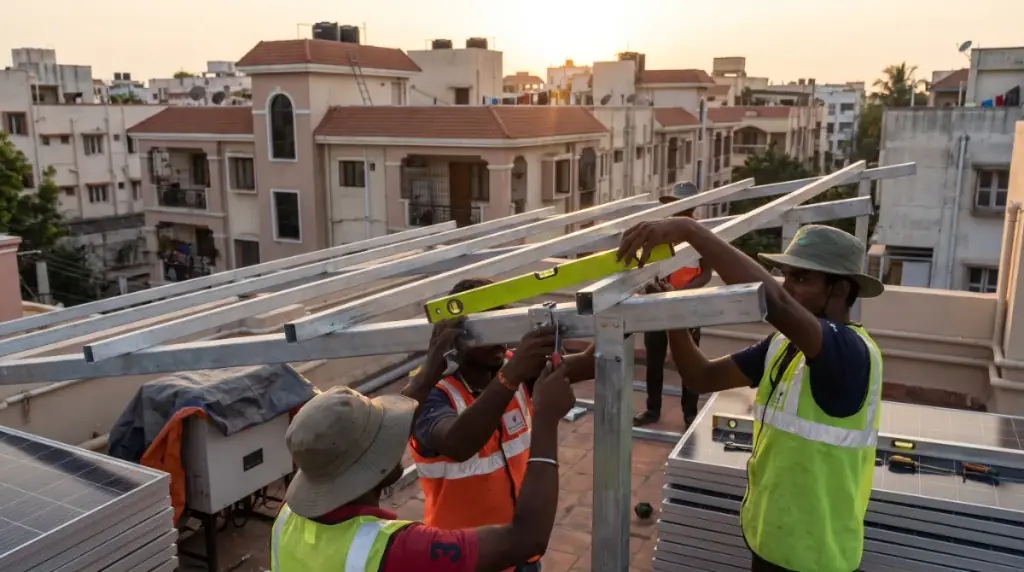
Most of what we install in Shenoy Nagar goes on independent houses, where the terrace belongs to the same person as the electricity connection and nothing needs a committee. It has an even layout, which means fewer shading surprises than in the older parts of the city. We have installed across Chennai since 2020, file the PM Surya Ghar subsidy of up to ₹78,000 for households and the TANGEDCO net metering application ourselves, and include two years of free maintenance. Before the survey, you can check the solar panel price in Chennai for 3 kW to 10 kW systems and see how our solar panel installation in Chennai works, the same process we follow in Shenoy Nagar.
What it costs here
A typical 5 kW system in Shenoy Nagar
Standard 5 kW example
What a typical 5 kW home system does here. Your own figures come from the survey.
Not sure what your site can carry?
Send us your last electricity bill on WhatsApp and we will come back with an indicative system size and what it would offset. No visit needed for that first answer.
The local picture
Does your roof face the right way?
Chennai sits close to the equator, and at this latitude solar panels are installed at a shallow tilt rather than the steep angles used in northern India or in temperate countries. A shallow-tilted panel is far less sensitive to which compass direction it faces than a steeply tilted one, so roof orientation is a much weaker constraint here than most buyers assume. Shading is the factor that genuinely limits output.
What actually determines your generation, in order of importance
Shading
A section of array shaded for part of the day loses far more than any orientation penalty. Trees, neighbouring buildings, parapets, water tanks and stair blocks all matter more than compass direction.
Soiling
Dirty panels lose output steadily and quietly, and in Chennai’s dry months that builds quickly.
Usable area
How much shade-free roof you actually have.
Orientation and tilt
Real, but modest at this latitude, and generally optimised within whatever the roof allows.
What this means practically
A flat terrace lets us set tilt and orientation regardless of the building
Which is what most Shenoy Nagar houses have. Orientation only becomes a genuine constraint on a sloped or tiled roof, where the array follows the roof plane. So do not rule out solar because your house faces the wrong way. Ask instead what shades your roof and when, which is the question we answer at the survey by assessing across the day rather than at a single moment.
Otherwise favourable
Established residential with regular plots
Mostly flat RCC terraces, reasonable access and buildings set back enough that inter-building shading is less severe than in the denser localities nearby. Systems typically run 3 kW to 5 kW, with three-phase required above 4,000 watts of connected load.
Areas we cover around Shenoy Nagar: Shenoy Nagar, Aminjikarai border, Anna Nagar approach, Nelson Manickam Road, Kilpauk side, the metro station area.
All areas we cover in Chennai →Residential
Solar for Shenoy Nagar homes
Independent houses
Typically install 3 kW to 5 kW, with orientation rarely the limiting factor on a flat terrace.
Apartment blocks
Follow the association route for common-area systems.
Shading assessment across the day
Is what determines the real answer, not compass direction.
Sloped or tiled roof sections
Are where orientation genuinely constrains the design.
Commercial and industrial
Solar for Shenoy Nagar businesses
Retail and small commercial
On the main roads. Evening-weighted and usually leased.
Clinics and practices
Good daytime match and commercial tariffs.
Schools and coaching centres
Strong term-time daytime load.
Small offices
In converted residential buildings, where the tariff category determines the subsidy route.
Local guide
Shenoy Nagar and rooftop solar: a 1950s colony being rebuilt
Shenoy Nagar was created in the 1950s and named after J P L Shenoy, Commissioner of the Corporation of Madras; an early resident recalled only 30 single-storey houses in the mid-1950s. Its old Housing Board tenements and government quarters are now being rebuilt, and an underground metro station sits at Thiru Vi Ka Park.
Rebuilt tenements: ask for solar in the new blocks
A long-time resident writing in Madras Musings in 2022 described the decrepit Housing Board tenements and government quarters in Shenoy Nagar being rebuilt from scratch. When a block is rebuilt, the cheapest time to provide for solar is before the new terrace is cast. Associations and future residents should ask the agency or builder for three things: a terrace with tanks, lift rooms and plant grouped on one side, a cable riser from the terrace to the meter room, and a common-area supply that can take an export meter. A new apartment block then qualifies for the common-area subsidy of ₹18,000 per kW for lifts, pumps and corridor lighting, without retrofitting conduits into finished walls.
Backflow on low streets: keep equipment off the ground floor
In November 2024 the Times of India reported stagnant sewage on Muthiappan Street, Arunachalam Street and Choolaimedu High Road, as garbage at stormwater drain outlets pushed sewage-mixed rainwater back onto the streets. A resident said heavy rain floods homes and costs at least ₹3,000 each time to clean out. Contaminated water is harder on electrical equipment than clean rainwater. On these streets the inverter and AC distribution box belong on an upper-floor wall or the terrace, cable runs from the roof should stay inside conduit on the outside of the building, and no isolator or junction box should be mounted where floodwater can reach it. After any flood, the system should be inspected before it is switched back on.
A Corporation colony's plots: a sizing example
Shenoy Nagar began as a colony the Corporation allotted to its engineers. Most houses sit on plots of a similar size, which makes sizing predictable. At the Chennai figure of 1,600 units per kW, a 4 kW system, the largest allowed on single-phase supply, makes about 6,400 units a year. A 5 kW system makes about 8,000 units but needs three-phase supply. A 3 kW system costs about ₹2,10,000 before subsidy and about ₹1,10,000 after both subsidies, and makes about 4,800 units a year. Because houses sit close together on similar plots, the change to watch is a neighbour adding a floor: a house rebuilt next door can shade part of a terrace that was clear for decades, so tell us about any construction planned beside you.
What we install
What we install in Shenoy Nagar
The process
How installation works
Free site survey
Shade-free roof area measured across the day, structure checked, connection name and sanctioned load confirmed.
Design and itemised quotation
Sized against twelve months of consumption, with every component named.
Approvals filed
PM Surya Ghar and TANGEDCO net metering, plus load enhancement or phase conversion in parallel where needed.
Installation
One to three days for a residential system, carried out by our own team rather than subcontracted.
Inspection and commissioning
TANGEDCO inspects, the net meter goes in, the system goes live.
Subsidy tracked to your account
And two years of maintenance included from commissioning.
We check the name on your electricity connection at the survey, because a mismatch stops more applications than any technical issue. See what to keep ready.
Free, no obligation
What will it cost on your roof in Shenoy Nagar?
Been told your roof faces the wrong way?
At this latitude that matters much less than you have been led to believe. Ask what shades the roof instead.
What happens after you send your details
- We call you within one working day, and an engineer rather than a salesperson attends the site.
- The survey is free. We measure usable area and shading, check your connection and sanctioned load, and photograph the site.
- You get an itemised quotation naming every component and brand, with the subsidy or depreciation position set out.
- No obligation at any point. If solar does not make sense for your property, we will say so.
Common questions
Solar in Shenoy Nagar, common questions
Does my roof need to face a particular direction for solar?
Far less than most people assume, at least in Chennai. This close to the equator panels are set at a shallow tilt, and shallow-tilted panels are much less sensitive to compass direction than steeply tilted ones. On a flat terrace we set tilt and orientation on the mounting structure regardless of how the building faces.
What actually limits my solar output?
Shading first, by a considerable margin, then soiling, then usable roof area, and only then orientation and tilt. A section of array shaded for part of the day loses far more than any orientation penalty, which is why we assess shading across the full day rather than at one moment.
When does roof orientation genuinely matter?
On sloped or tiled roofs, where the array has to follow the roof plane rather than sitting on an adjustable structure. There the direction the slope faces does constrain output. On a flat RCC terrace, which most houses here have, it is not a meaningful limitation.
How long does installation take in Shenoy Nagar?
Six to ten weeks. Shenoy Nagar is straightforward to work in, so the date depends on the section office rather than on the site.
Do you handle the subsidy and TANGEDCO paperwork?
Yes. We file the PM Surya Ghar claim and the TANGEDCO net metering application for Shenoy Nagar properties and follow both through the section office. We verify the connection name and sanctioned load at survey, then track the subsidy to your account.
What is included after installation?
Two years of free maintenance from commissioning, covering panel cleaning, annual inspection of connections and structure, generation monitoring and warranty coordination with the manufacturer.
Our Housing Board block in Shenoy Nagar is being rebuilt. When should we ask about solar?
Before the new terrace is designed. It costs little to group tanks and lift rooms on one side and leave a cable riser, and a great deal to add them after the building is finished. Once the association is formed, the common-area system can claim ₹18,000 per kW.
Rainwater mixed with sewage enters our ground floor. Does that affect a solar system?
Only if equipment is placed low. The panels are on the roof; we mount the inverter, distribution box and isolators high on the building so contaminated water cannot reach them, and route cables in conduit.
Long tail coverage
Areas we cover around Shenoy Nagar
Not listed? We survey across Chennai and the surrounding districts. Call and we will tell you straight away whether we can reach your site this week.