












Solar Panel Installation in Ullagaram and Puzhuthivakkam
Honest sizing for small plots, and a straight answer on whether it is worth it
Plots in Ullagaram and Puzhuthivakkam are small, and the honest answer here is frequently a 3 kW system rather than the 5 kW a household’s bill might suggest. That is worth saying plainly, along with why a smaller system is still worth installing.
Installing across Chennai since 2020
Two years free maintenance included
Subsidy and TANGEDCO paperwork filed by us
Free site survey and energy audit, no obligation
The short answer
Looking for a solar panel installation company in Ullagaram and Puzhuthivakkam?
Most of what we install in Ullagaram and Puzhuthivakkam goes on independent houses, where the terrace belongs to the same person as the electricity connection and nothing needs a committee. In the area the survey decides the size, because the building next door often decides the shading. Blues Renewables has worked across Chennai since 2020. We handle the PM Surya Ghar claim of up to ₹78,000 where the property is residential, file the TANGEDCO net metering paperwork, and include two years of maintenance. Before the survey, you can check the solar panel price in Chennai for 3 kW to 10 kW systems and see how our solar panel installation in Chennai works, the same process we follow in Ullagaram and Puzhuthivakkam.
What it costs here
A typical 5 kW system in Ullagaram and Puzhuthivakkam
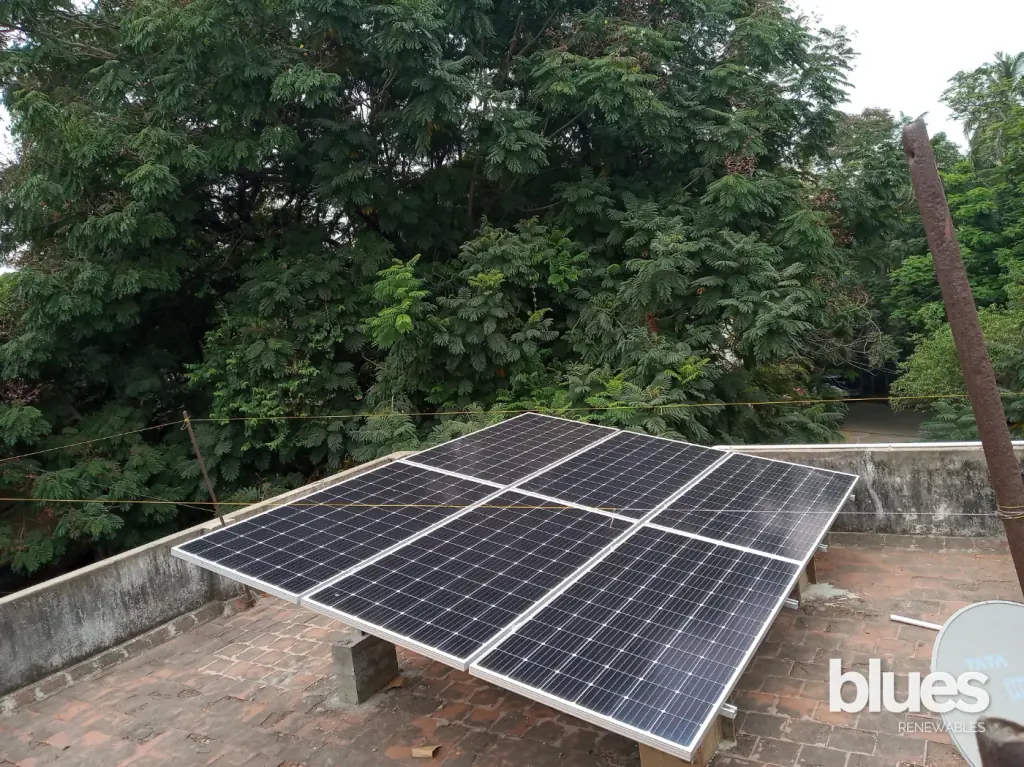
Standard 5 kW example
What a typical 5 kW home system does, on a terrace that can take one. Your own figures come from the survey.
Not sure what your site can carry?
Send us your last electricity bill on WhatsApp and we will come back with an indicative system size and what it would offset. No visit needed for that first answer.
The local picture
When a small system is still worth having
Ullagaram and Puzhuthivakkam are dense independent housing on small plots, and usable shade-free roof area routinely limits systems to about 3 kW regardless of what the household consumes. Rather than overselling a size the roof cannot carry, the useful question is whether a partial offset is worth the investment, and for most households here it is.
Why a 3 kW system still makes sense
The subsidy is proportionally strongest at small sizes
A 3 kW system claims ₹78,000 from the centre and up to ₹22,000 from Tamil Nadu, which covers a larger share of the cost than it does at 5 kW or 10 kW, where the amount is capped.
It displaces your most expensive units first
Tamil Nadu’s tariff is telescopic, so if your consumption sits above the 500 unit bi-monthly threshold, solar reduces the units billed at the highest slab rates before it touches the cheaper ones.
A partial offset compounds over 25 years
Panels carry performance warranties of around 25 years, so even a modest annual saving accumulates substantially over the asset’s life.
Fixed costs favour doing it once
Net metering, documentation and mobilisation cost roughly the same on a 3 kW system as on a 5 kW one, so installing 3 kW now and adding more later costs meaningfully more than installing what fits in one go.
Where a small system does not make sense
If you sit inside the free-unit allowance
There is relatively little billed consumption for solar to displace, and payback stretches considerably. We will tell you if that is your situation rather than selling you a system to be polite.
The physical constraints
The usual dense-plot ones, all workable
Neighbouring walls and stair blocks shading sections of roof through parts of the day, staircase headroom taking terrace area, and narrow lanes affecting material access. All of it needs measuring rather than estimating.
Areas we cover around Ullagaram: Ullagaram, Puzhuthivakkam, Madipakkam border, Nanganallur approach, Adambakkam, the temple street sectors.
All areas we cover in Chennai →Residential
Solar for Ullagaram homes
Independent houses
Dominate, most installing 3 kW once usable area is measured properly.
Households within the free-unit allowance
Should hear honestly that payback will be long.
Apartment blocks
Fewer here, following the association route.
Older properties
May have sloped sections needing pitch mounting rather than flat terrace mounting.
Commercial and industrial
Solar for Ullagaram businesses
Shops and small retail
On the main roads. Evening-weighted and usually leased.
Clinics and small practices
Good daytime match and commercial tariffs.
Coaching centres and small schools
Strong term-time daytime load.
Small offices
In converted residential buildings, where the connection tariff category determines the subsidy route.
Local guide
Ullagaram and Puzhuthivakkam: solar beside the airport and the lakes
Ullagaram-Puzhuthivakkam was its own municipality until October 2011, when it joined the Greater Chennai Corporation as part of Zone 14 (Perungudi). Going by published coordinates, Puzhuthivakkam sits only about 4 km east of Chennai airport.
Airport height zoning and elevated frames
AAI publishes a colour coded zoning map for every civil airport, covering up to 20 km from the airport's reference point. Each grid has a permissible top elevation above mean sea level. A building that stays below it needs no AAI height NOC, and the local body approves it. In a red grid, any structure needs an NOC through AAI's NOCAS portal, whatever its height. Puzhuthivakkam is about 4 km from the airport. Panels laid low on a terrace add little height, but an elevated frame raises the top of the building. If your building is already close to its approved height, or sits in a red grid, check the grid on NOCAS before choosing a raised frame.
Houses below the road
In November 2021 the Times of India reported that interior streets of Puzhuthivakkam flooded while the main roads stayed passable. Houses below road level took water into their ground floors on Otteri Salai, Nethaji Street and New India Colony Road, and water stood about 3 feet deep near the Zone 14 office. The Hindu reported improvements from new stormwater drains in 2025, but a house that sits below the road still collects water first. In such a house, put the inverter, ACDB and generation meter connection on the first floor or terrace, bring the cable down the outside wall, and keep the earthing test point clear of standing water.
Twice-a-week water and the pump on your roof
In 2022 Citizen Matters reported that parts of Srinivasa Nagar got piped water for just two hours on Tuesdays and Fridays, with tankers filling the gap. Homes that live on that supply depend on sumps, motors and large overhead tanks. The tank is a shade source: set out the array to the south of it, or raise the frame above it, so its shadow misses the panels through the day. Plan the pipe runs and the tank stand at the survey too, because they often take the best-lit strip of a small terrace and leave less room for panels than a tape measure suggests.
Why 3 kW is the right floor here
Our systems start at 3 kW, which needs roughly 150 sq ft of shade-free roof. At Chennai district's 1,600 units per kW a year it makes about 4,800 units. It qualifies for the full ₹78,000 central subsidy plus the ₹22,000 Tamil Nadu top-up, bringing about ₹2,10,000 down to about ₹1,10,000. A smaller system would lose part of that subsidy while the approval, meter and mobilisation costs stay much the same, so 3 kW is where a small plot gets the best return per rupee. If the shade-free area cannot take 3 kW even with a raised frame over the tank, we will say so rather than fit less.
What we install
What we install in Ullagaram
The process
How installation works
Free site survey
Shade-free roof area measured across the day, structure checked, connection name and sanctioned load confirmed.
Design and itemised quotation
Sized against twelve months of consumption, with every component named.
Approvals filed
PM Surya Ghar and TANGEDCO net metering, plus load enhancement or phase conversion in parallel where needed.
Installation
One to three days for a residential system, carried out by our own team rather than subcontracted.
Inspection and commissioning
TANGEDCO inspects, the net meter goes in, the system goes live.
Subsidy tracked to your account
And two years of maintenance included from commissioning.
We check the name on your electricity connection at the survey, because a mismatch stops more applications than any technical issue. See what to keep ready.
Free, no obligation
Book a free survey in Ullagaram
Been told you need 5 kW?
On these plots the roof often will not take it. A 3 kW system is still worth having where it fits, and we would rather fit what works than sell what does not.
What happens after you send your details
- We call you within one working day, and an engineer rather than a salesperson attends the site.
- The survey is free. We measure usable area and shading, check your connection and sanctioned load, and photograph the site.
- You get an itemised quotation naming every component and brand, with the subsidy or depreciation position set out.
- No obligation at any point. If solar does not make sense for your property, we will say so.
Common questions
Solar in Ullagaram, common questions
Is a 3 kW solar system worth installing on a small plot?
Usually yes on these plots. The subsidy is proportionally strongest at 3 kW: ₹78,000 central plus up to ₹22,000 from Tamil Nadu covers nearly half of a 3 kW system, a larger share than at 5 kW or 10 kW where the amount is capped. Solar also displaces your most expensive units first under the telescopic tariff, and a partial offset compounds across a 25-year asset life.
Should I install 3 kW now and add more later?
Rarely. Net metering, documentation and mobilisation cost roughly the same on a small system as on a larger one, so splitting the work into two projects costs meaningfully more than installing what fits in one go. Expanding later also means a fresh TANGEDCO net metering application.
When is solar not worth it here?
If your consumption sits comfortably within Tamil Nadu’s free-unit allowance, there is relatively little billed consumption for solar to displace and payback stretches considerably. We will tell you if that is your situation rather than selling you a system to be polite.
How long does installation take in Ullagaram?
Six to ten weeks from survey to a live system. In Ullagaram and Puzhuthivakkam the installation itself can take an extra day because material has to come up by staircase, but the timeline is still governed by TANGEDCO approval and the meter, not by the roof work.
Do you handle the subsidy and TANGEDCO paperwork?
Yes. We file the PM Surya Ghar claim and the TANGEDCO net metering application for you and follow both through the section office. In Ullagaram and Puzhuthivakkam the detail that delays applications most often is the sanctioned load being too low for the system you want, which we check before designing so the load enhancement runs in parallel rather than afterwards.
What is included after installation?
Two years of free maintenance from commissioning, covering panel cleaning, annual inspection of connections and structure, generation monitoring and warranty coordination with the manufacturer.
Do I need an airport NOC to put solar on my house in Puzhuthivakkam?
Not for panels on an ordinary terrace if your building is below the permissible height for its grid. You would need one if the plot sits in a red grid on AAI's zoning map, or if an elevated frame would take the building above its grid's limit. We check the grid on NOCAS before proposing a raised structure.
Our house is below road level and took water in 2021. Where should the solar equipment go?
Upstairs. Mount the inverter and distribution box on the first floor or terrace, run the cable down the outside wall in conduit, and keep connections off the ground floor. The panels are never at risk; the electrical equipment is.
Long tail coverage
Areas we cover around Ullagaram
Not listed? We survey across Chennai and the surrounding districts. Call and we will tell you straight away whether we can reach your site this week.