












Solar Panel Installation in Uthandi
Hybrid and ground mount genuinely evaluated here, not dismissed by default
Uthandi is where the ECR properties get larger and the grid gets a little less certain. Farmhouses and villas on generous plots, some with their own land alongside, and a genuine question about whether a battery is worth having rather than an automatic no.
Installing across Chennai since 2020
Two years free maintenance included
Subsidy and TANGEDCO paperwork filed by us
Free site survey and energy audit, no obligation
The short answer
Looking for a solar panel installation company in Uthandi?
Uthandi is villa and large-plot territory, where terraces are generous and the system size is set by consumption rather than by available roof. Salt air is the deciding specification. Untreated structure corrodes fast this close to the coast, so we quote salt-mist certified panels and protected mounting from the start. Installing across Chennai since 2020, we file the PM Surya Ghar application worth up to ₹78,000 for households, handle TANGEDCO net metering end to end, and cover two years of maintenance after commissioning. Before the survey, you can check the solar panel price in Chennai for 3 kW to 10 kW systems and see how our solar panel installation in Chennai works, the same process we follow in Uthandi.

What it costs here
A typical 5 kW system in Uthandi
Standard 5 kW example
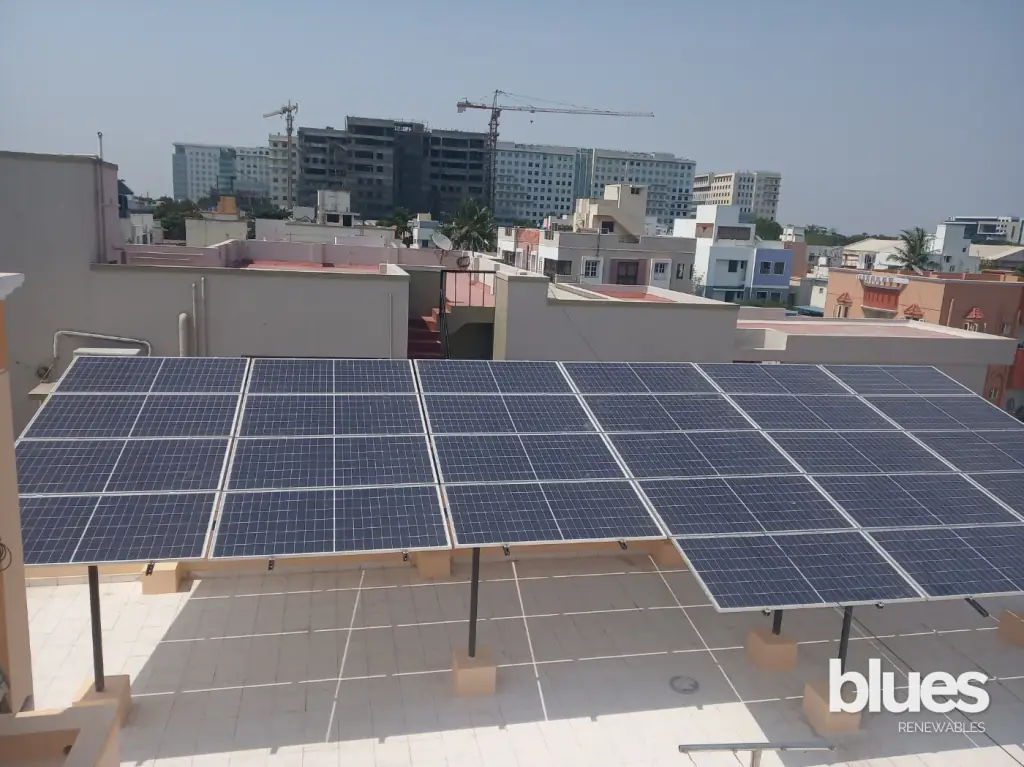
What a typical 5 kW home system does, on a terrace that can take one. Your own figures come from the survey.
Not sure what your site can carry?
Send us your last electricity bill on WhatsApp and we will come back with an indicative system size and what it would offset. No visit needed for that first answer.
The local picture
Larger plots, and when a battery actually earns its place
Uthandi’s larger plots and its position toward the southern end of the ECR change two things about the standard residential answer. First, several properties here hold open land alongside the building, which makes ground-mounted generation a real option rather than a theoretical one. Second, supply reliability at this end of the corridor makes hybrid systems worth genuinely evaluating rather than dismissing.
On hybrid systems, honestly
A standard on-grid system shuts down during a power cut
Which surprises most buyers. Only battery-backed systems keep running.
Hybrid remains subsidy eligible
Because it is grid-connected. Off-grid is not.
Size the battery to critical loads
Not to the whole property. Lights, fans, router, refrigerator and a pump ride through an outage comfortably. Running air conditioning through a cut requires a far larger and much more expensive battery.
The battery will need replacing
During the system’s life, which on-grid systems avoid entirely. Budget for it rather than being surprised.
Choose a hybrid-capable inverter at installation
Even if you skip the battery, because retrofitting to a standard string inverter means replacing the inverter.
Where there is land
Ground-mount is a real option here
An array can be tilted and oriented optimally rather than following the roof angle, with far easier cleaning and maintenance access. It costs more due to foundations and civil work, and it occupies the land it sits on. Coastal specification applies throughout, with IEC 61701 certified modules and galvanised or aluminium structures.
Worth flagging
Intermittent occupancy changes the right size
Weekend and holiday properties generate through the week with nobody consuming, and surplus credit still unused on 31 March lapses. For those properties a smaller, better-matched system usually returns more than a larger one.
Areas we cover around Uthandi: ECR, Uthandi, Akkarai border, Kanathur approach, Muttukadu, the farmhouse stretch.
All areas we cover in Chennai →Residential
Solar for Uthandi homes
Villas and farmhouses
Typically install 5 kW to 10 kW where occupancy justifies it.
Properties with land
Should have ground-mount costed alongside rooftop.
Hybrid systems
Worth genuinely evaluating here, sized to critical loads.
Weekend properties
Should be sized against actual consumption rather than roof area.
Commercial and industrial
Solar for Uthandi businesses
Resorts and event venues
Variable occupancy with evening peaks, so twelve months of bills matter more than an annual total.
Restaurants and beach cafés
Daytime refrigeration and cooling suit solar.
Guest houses
Continuous but variable load.
Small offices and clinics
Along the corridor.
Local guide
Uthandi's beach layouts and solar: what to plan for
Uthandi is where the ECR becomes a toll road, and its VGP Layout runs down to the beach beside the Nainarkuppam fishing hamlet, so many homes here take salt air from very close range.
Salt at short range
VGP Layout's roads lead straight to the beach, and the Nainarkuppam fishing community works the shore within 500 m of the proposed flood outfall. At that distance salt arrives on every sea breeze, not just in storms. Beyond the salt-mist modules and protected structure this page already describes, three choices matter here. Put the inverter indoors or in a ventilated room facing away from the sea, not on an open terrace wall. Use stainless fasteners throughout. And rinse panels and structure with fresh water every two to four weeks in the dry months, because salt crust left on the glass builds up quickly.
Ground mounts and the proposed flood channel
The Water Resources Department plans a cut-and-cover channel of about 1.05 km from the Buckingham Canal near Okkiyam Maduvu to the sea, running through VGP Layout's second main road, to relieve flooding around Pallikaranai marsh. Residents have opposed it, and the Times of India reported in February 2026 that it had no coastal zone clearance and preliminary work had stopped. If you are weighing a ground-mounted array on open land near this alignment, check the route against your plot first. Footings and buried cable runs should stay clear of any land that could be needed for the channel or its access.
Sewer works and corridor works
The Hindu reported in December 2025 that Metrowater's ₹82 crore sewerage project would lay 31.6 km of pipelines and provide 1,300 house service connections in Uthandi, with roads relaid only after the work ends. To the north, the elevated corridor from Thiruvanmiyur ends at Uthandi, with construction expected to run about three years from February 2026. Neither affects the panels directly. Both affect the job: dug-up roads slow deliveries, and corridor dust means ECR-facing roofs need more frequent cleaning until the works finish. We plan the installation date around the road works on your street.
Sizing a villa or farmhouse
The state rooftop calculator uses 1,600 units per kW a year for Chennai district. An 8 kW system on an Uthandi villa makes about 12,800 units a year, roughly 2,130 per bi-monthly cycle, and a 10 kW system about 16,000. Anything above 4 kW needs three-phase supply. Above 10 kW a home loses the PM Surya Ghar subsidy and needs CEIG approval and a separate generation meter, so a large property is usually better served by a well-matched 10 kW system than a bigger one.
What we install
What we install in Uthandi
The process
How installation works
Free site survey
Shade-free roof area measured across the day, structure checked, connection name and sanctioned load confirmed.
Design and itemised quotation
Sized against twelve months of consumption, with every component named.
Approvals filed
PM Surya Ghar and TANGEDCO net metering, plus load enhancement or phase conversion in parallel where needed.
Installation
One to three days for a residential system, carried out by our own team rather than subcontracted.
Inspection and commissioning
TANGEDCO inspects, the net meter goes in, the system goes live.
Subsidy tracked to your account
And two years of maintenance included from commissioning.
We check the name on your electricity connection at the survey, because a mismatch stops more applications than any technical issue. See what to keep ready.
Free, no obligation
What will it cost on your roof in Uthandi?
Want backup during cuts?
Then say so, because standard on grid solar shuts down in an outage. Hybrid keeps the subsidy and keeps chosen circuits live.
What happens after you send your details
- We call you within one working day, and an engineer rather than a salesperson attends the site.
- The survey is free. We measure usable area and shading, check your connection and sanctioned load, and photograph the site.
- You get an itemised quotation naming every component and brand, with the subsidy or depreciation position set out.
- No obligation at any point. If solar does not make sense for your property, we will say so.
Common questions
Solar in Uthandi, common questions
Is a hybrid system worth it in Uthandi?
It is worth evaluating properly rather than dismissing. A standard on-grid system shuts down during a power cut, so only a battery-backed system keeps circuits live. Hybrid remains subsidy eligible because it is grid-connected. Size the battery to critical loads rather than the whole property, and budget for a replacement during the system’s life.
Should I consider ground-mounted solar here?
If you have open land alongside the building, yes. A ground-mount array can be tilted and oriented optimally rather than following the roof angle, and cleaning and maintenance access are far easier. It costs more because of foundations and civil work, and it occupies the land it sits on.
I only use my Uthandi property at weekends. What size suits?
Smaller than the roof would take. Generation through the week with nobody consuming it is exported, and surplus is credited under net metering, but any credit still unused on 31 March lapses unpaid. A system matched to actual consumption usually returns more than a larger one sized to the terrace.
How long does installation take in Uthandi?
Six to ten weeks in Uthandi. Lead time on salt-mist certified modules and galvanised structure can add a few days at the procurement stage, which we tell you at quotation rather than after you have signed.
Do you handle the subsidy and TANGEDCO paperwork?
Yes. We file the PM Surya Ghar application and the TANGEDCO net metering paperwork, and follow both through the section office. One point specific to coastal properties like those in Uthandi: the hardware has to be ALMM-listed for the subsidy, and the salt-mist rated modules we specify here are, so the specification never puts the claim at risk.
What is included after installation?
Two years of free maintenance from commissioning, covering panel cleaning, annual inspection of connections and structure, generation monitoring and warranty coordination with the manufacturer.
Will the planned flood channel through VGP Layout affect a ground-mounted array?
It could if your land is on or beside the route. The channel is planned to run from near the Indian Maritime University on the ECR through VGP Layout's second main road to the sea, and was stalled without coastal zone clearance in early 2026. We check the alignment against your plot before designing any footings.
We are close to the beach. Should the inverter be indoors?
Yes, where possible. An inverter in a ventilated indoor space or a sheltered room facing away from the sea lasts longer than one on an open terrace wall, where salt settles in its vents. Short, well-protected cable runs to the terrace matter more here than saving a few metres of cable.
Long tail coverage
Areas we cover around Uthandi
Not listed? We survey across Chennai and the surrounding districts. Call and we will tell you straight away whether we can reach your site this week.