












Solar Panel Installation in Virugambakkam
Small systems done properly, because a cheap kit forfeits more than it saves
If you have been comparing rooftop solar against the inexpensive kits sold online, the difference is not just quality. A kit installation generally cannot be net metered and cannot claim the subsidy, and that changes the comparison entirely.
Installing across Chennai since 2020
Two years free maintenance included
Subsidy and TANGEDCO paperwork filed by us
Free site survey and energy audit, no obligation
The short answer
Looking for a solar panel installation company in Virugambakkam?
Virugambakkam is tightly packed, and on most terraces here the limit is usable shade-free area, not budget. It is laid out on a regular grid with consistent plot sizes, which makes shading predictable and system sizing unusually clean. Installing across Chennai since 2020, we file the PM Surya Ghar application worth up to ₹78,000 for households, handle TANGEDCO net metering end to end, and cover two years of maintenance after commissioning. Before the survey, you can check the solar panel price in Chennai for 3 kW to 10 kW systems and see how our solar panel installation in Chennai works, the same process we follow in Virugambakkam.
What it costs here
A typical 5 kW system in Virugambakkam
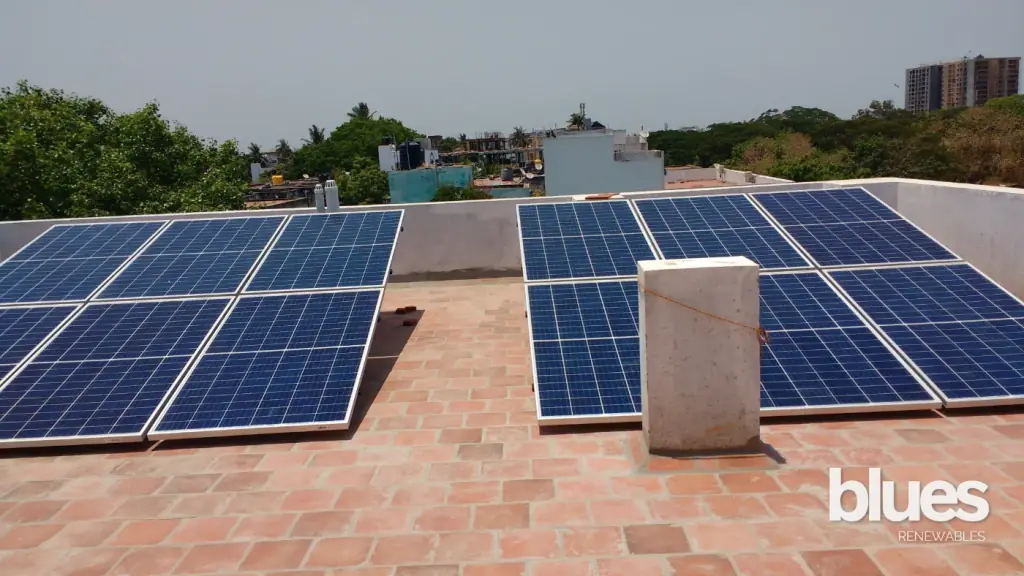
Standard 5 kW example
What a typical 5 kW home system does, on a terrace that can take one. Your own figures come from the survey.
Not sure what your site can carry?
Send us your last electricity bill on WhatsApp and we will come back with an indicative system size and what it would offset. No visit needed for that first answer.
The local picture
Why the cheap kit is not the same thing
Inexpensive solar kits sold online and by small traders look like a fraction of the cost of a proper installation, and for a price-conscious buyer the comparison is a reasonable one to make. What the price difference usually hides is that such an installation typically cannot be connected under net metering and cannot claim the PM Surya Ghar subsidy, which are the two things that make rooftop solar economic.
What a subsidised, net-metered installation requires
DCR-compliant panels
Built from cells listed on ALMM List-II. Most inexpensive kits use non-compliant modules, which disqualifies the entire subsidy claim.
Installation by a vendor registered with the DISCOM
Which a self-installed or unregistered-trader kit is not.
A TANGEDCO net metering application, inspection and approved metering
Which a kit installation generally has not been through.
Proper earthing, protection and compliant electrical work
Inspected before commissioning.
What that means for the arithmetic
A large part of the apparent saving is illusory
A 3 kW subsidised installation attracts ₹78,000 from the PM Surya Ghar scheme and exports surplus for credit under net metering. A kit at a lower headline price gets neither, and what remains is a system that cannot legally export to the grid. There is also a safety dimension: a rooftop array is a DC electrical installation with a structure exposed to Chennai’s wind loading, and earthing, surge protection, cable specification and structural anchoring are not optional details.
We are not against small systems
A properly installed 3 kW system is a good decision
The subsidy covers a larger proportion of the cost at those sizes than at larger ones. What we would not recommend is a cheap system that forfeits the subsidy to save less than the subsidy is worth. Virugambakkam is dense residential with tight plots and usable roof area routinely below terrace measurement, so systems typically run 3 kW to 4 kW.
Areas we cover around Virugambakkam: Virugambakkam, Saligramam border, Valasaravakkam approach, Arcot Road, Alwarthirunagar, the KK Nagar side.
All areas we cover in Chennai →Residential
Solar for Virugambakkam homes
Independent houses
Typically install 3 kW to 4 kW once usable area is measured.
The subsidy covers a larger share
Of the cost at small sizes, which favours doing it properly.
Apartment blocks
Follow the association route for common-area systems.
Access on narrower streets
Planned at survey.
Commercial and industrial
Solar for Virugambakkam businesses
Retail and small shops
On the main roads. Evening-weighted and usually leased.
Small offices and service businesses
Good daytime match and commercial tariffs.
Clinics and practices
Daytime load matching generation.
Coaching centres and small schools
Term-time daytime load.
Local guide
Virugambakkam solar: the canal, the old lake and Arcot Road
When Cyclone Fengal brought just 10 cm of rain in late 2024, the Virugambakkam canal breached and water stood for more than 24 hours. Homes near its banks need a solar design that expects water at street level.
Streets along the canal and the old lake bed
The canal starts in Nerkundram and runs through Chinmaya Nagar, Koyambedu, Saligramam and Arumbakkam to the Cooum. Officials told The Hindu that near Sainagar bridge it carried only about 600 cusecs against a design capacity of about 1,350, and a long-time resident said Chinmaya Nagar and Sai Nagar were severely inundated in the two years to 2025. Virugambakkam also once had a large lake, used by Metrowater until 1976, that was later built over; the road around it is still called Erikarai Street. Homes in these low pockets should keep the inverter and solar distribution box on the terrace or an upper wall.
What the canal project changes, and what it does not
The Corporation took the canal over from the Water Resources Department and began a ₹30 crore restoration in September 2025, covering sludge removal, bored piling and fencing. The Times of India reported plans to replace 11 of its 24 bridges, whose narrow vents cut the flow from about 1,700 to 800 cusecs, and an IIT Madras survey to desilt 35 hotspots. That should reduce how often water reaches homes, but 68 stormwater drains still feed one canal. We would still design every canal-side system as if a flood will come: equipment upstairs, sealed glands, and a monitoring app that shows when the system has tripped.
A worked example on the Chennai yield
On the Chennai yield of about 1,600 units per kW a year, roughly 4.4 a day, a 3 kW system makes about 4,800 units a year, around 800 in each bi-monthly cycle. For an eligible home it costs about ₹2,10,000 before subsidy and about ₹1,10,000 after the central and Tamil Nadu subsidies. Domestic connections pay no fixed charge, so the remaining bill is mostly the network charge on generation, about ₹0.32 a unit for homes up to 10 kW. A 5 kW system makes about 8,000 units a year and needs three-phase supply, because single-phase is limited to 4 kW.
Taller neighbours along the metro line
Chennai Metro's Phase II corridor from Light House to Poonamallee runs along Arcot Road, with stations at Alwarthirunagar on Arcot Road and Virugambakkam on Kaliamman Koil Street. Plots near metro stations attract redevelopment, and Chennai's planning rules allow extra floor space close to metro corridors. A new block of five or more floors next door can shade a terrace every afternoon for the rest of the panels' life. At the survey we look at what the neighbouring plots could become, not only what stands there now, and place the array on the side least likely to be overshadowed.
What we install
What we install in Virugambakkam
The process
How installation works
Free site survey
Shade-free roof area measured across the day, structure checked, connection name and sanctioned load confirmed.
Design and itemised quotation
Sized against twelve months of consumption, with every component named.
Approvals filed
PM Surya Ghar and TANGEDCO net metering, plus load enhancement or phase conversion in parallel where needed.
Installation
One to three days for a residential system, carried out by our own team rather than subcontracted.
Inspection and commissioning
TANGEDCO inspects, the net meter goes in, the system goes live.
Subsidy tracked to your account
And two years of maintenance included from commissioning.
We check the name on your electricity connection at the survey, because a mismatch stops more applications than any technical issue. See what to keep ready.
Free, no obligation
What will it cost on your roof in Virugambakkam?
Comparing against an online kit?
It cannot be net metered and cannot claim ₹78,000, so most of the apparent saving is not real. We will show you the arithmetic.
What happens after you send your details
- We call you within one working day, and an engineer rather than a salesperson attends the site.
- The survey is free. We measure usable area and shading, check your connection and sanctioned load, and photograph the site.
- You get an itemised quotation naming every component and brand, with the subsidy or depreciation position set out.
- No obligation at any point. If solar does not make sense for your property, we will say so.
Common questions
Solar in Virugambakkam, common questions
Why is a cheap solar kit not comparable to a proper installation?
Because it generally cannot be net metered and cannot claim the subsidy. Subsidised installations require DCR-compliant panels built from ALMM List-II cells, installation by a DISCOM-registered vendor, and an approved TANGEDCO net metering application with inspection. A kit meeting none of those forfeits ₹78,000 at 3 kW and the ability to export.
Are non-DCR panels cheaper?
Per watt, yes, which is exactly why they appear in cheap quotes. But they disqualify the subsidy claim entirely, and at residential scale the subsidy is worth considerably more than the hardware saving. It is the single most common reason a claim is rejected, and it surfaces months after installation.
Is a small properly installed system worth it?
Often yes. A 3 kW system claims ₹78,000 from the centre and up to ₹22,000 from Tamil Nadu, which covers a larger proportion of the cost than at larger sizes where the amount is capped. On tight plots that is frequently what the roof supports anyway, and it displaces your most expensive units first under Tamil Nadu’s telescopic tariff.
How long does installation take in Virugambakkam?
Six to ten weeks from survey to a live system. In Virugambakkam the installation itself can take an extra day because material has to come up by staircase, but the timeline is still governed by TANGEDCO approval and the meter, not by the roof work.
Do you handle the subsidy and TANGEDCO paperwork?
Yes. We file the PM Surya Ghar claim and the TANGEDCO net metering application for you and follow both through the section office. In Virugambakkam the detail that delays applications most often is the sanctioned load being too low for the system you want, which we check before designing so the load enhancement runs in parallel rather than afterwards.
What is included after installation?
Two years of free maintenance from commissioning, covering panel cleaning, annual inspection of connections and structure, generation monitoring and warranty coordination with the manufacturer.
We live near the canal in Chinmaya Nagar. Where should our solar inverter go?
On the terrace in a ventilated enclosure or on an upper wall, well above street level. Only the cable needs to come down to the ground-floor meter, and we seal the entries so floodwater cannot track along it.
Will the Virugambakkam canal restoration mean we can put equipment on the ground floor again?
We would not count on it. The project should cut the frequency of flooding, but many drains still feed one canal, and a flooded inverter is a replacement, not a repair.
Long tail coverage
Areas we cover around Virugambakkam
Not listed? We survey across Chennai and the surrounding districts. Call and we will tell you straight away whether we can reach your site this week.