












Solar Panel Installation in Vyasarpadi
Our own team on your roof, so the person who surveyed it is accountable for it
Solar installation is roof work, electrical work and structural work carried out at height above your home. Who physically does it matters more than most buyers ever ask about, and the answer is worth establishing before anyone climbs your staircase.
Installing across Chennai since 2020
Two years free maintenance included
Subsidy and TANGEDCO paperwork filed by us
Free site survey and energy audit, no obligation
The short answer
Looking for a solar panel installation company in Vyasarpadi?
Vyasarpadi is densely built, so the survey matters more than the brochure: roof area is tight and neighbouring buildings put shade where you do not expect it. Air here carries more dust than most of the city, which means soiling losses and a cleaning schedule worth quoting honestly. We have installed across Chennai since 2020, file the PM Surya Ghar subsidy of up to ₹78,000 for households and the TANGEDCO net metering application ourselves, and include two years of free maintenance. Before the survey, you can check the solar panel price in Chennai for 3 kW to 10 kW systems and see how our solar panel installation in Chennai works, the same process we follow in Vyasarpadi.
What it costs here
A typical 5 kW system in Vyasarpadi
Standard 5 kW example
What a typical 5 kW home system does, on a terrace that can take one. Your own figures come from the survey.
Not sure what your site can carry?
Send us your last electricity bill on WhatsApp and we will come back with an indicative system size and what it would offset. No visit needed for that first answer.
The local picture
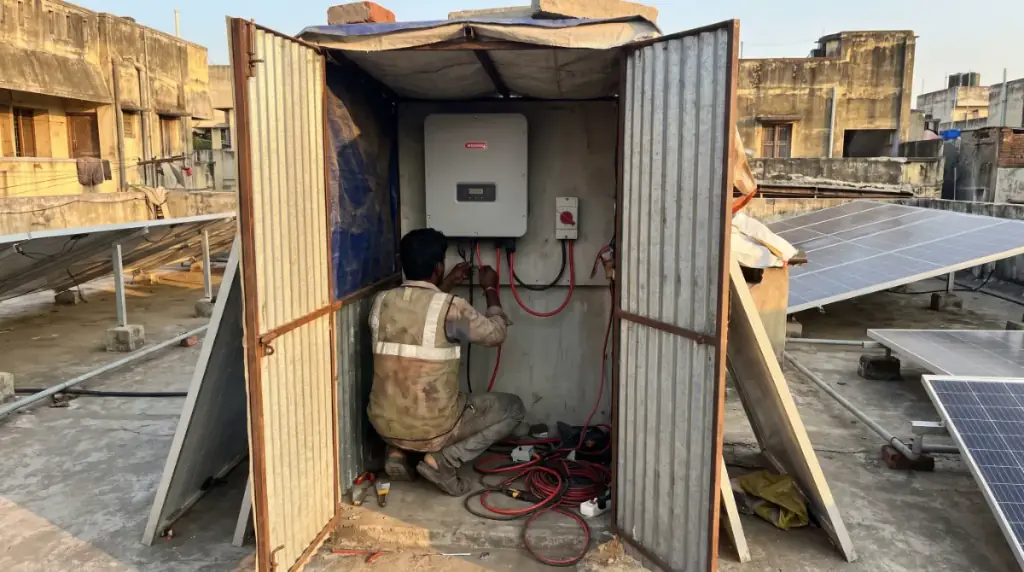
Who will actually be on your roof
A large share of rooftop solar in India is sold by one company and installed by another, with the sales entity subcontracting the physical work to whichever crew is available. That arrangement is not inherently wrong, but it changes accountability, and a buyer is entitled to know which company’s people will be on the roof and who is responsible if something goes wrong.
What to ask before signing
Do your own employees carry out the installation?
Or is it subcontracted? Either answer can be acceptable. An evasive answer is not.
Who is responsible for workmanship?
If the crew is a subcontractor and something fails in year three, who fixes it, and are they still in business.
What safety arrangements are in place for work at height?
Roof work above an occupied home carries real risk, to the workers and to the household.
Will the same team carry out maintenance?
Continuity matters, because a crew that installed a system knows where everything runs.
Who supervises, and will they visit?
A named person who has seen the roof is worth more than a call centre.
Our position
We install with our own team rather than subcontracting
Which means the person who surveyed your roof is accountable for what happens on it. We say that because it is the single question most likely to distinguish two quotes that otherwise look identical, and because a buyer should be able to ask it of anyone.
During installation
Expect one to three days, with noise and cabling work
Movement on the terrace and cabling inside the building. Water and power may need brief interruption. We agree access and timing beforehand rather than arriving and improvising. Vyasarpadi is dense residential with tight plots, close neighbours and usable shade-free area routinely below terrace measurement, so systems typically run 3 kW.
Areas we cover around Vyasarpadi: Vyasarpadi, Perambur border, Tondiarpet approach, Sembiam, Vyasarpadi Jeeva, the dense residential streets.
All areas we cover in Chennai →Residential
Solar for Vyasarpadi homes
Independent houses
Typically install 3 kW once usable area is measured.
Installation runs one to three days
With access and timing agreed beforehand.
Apartment blocks
Follow the association route for common-area systems.
Older properties
May have staged construction affecting where the array is anchored.
Commercial and industrial
Solar for Vyasarpadi businesses
Small workshops and units
Commercial tariffs, no subsidy, modest loads.
Retail and shops
Evening-weighted and usually leased.
Clinics and practices
Good daytime match.
Schools and institutions
Term-time daytime load.
Local guide
Solar for Vyasarpadi homes: three canals, tall tenements and inverter height
Vyasarpadi is boxed in by three waterways: the Buckingham Canal to the east, the Captain Cotton Canal to the north and the Otteri Nullah to the south. When they back up, as in December 2023 and October 2024, ground floors across the area flood.
Three canals decide the inverter height
A 2025 study by Vyasai Thozhargal and the Chennai Climate Action Group found the area's canal system impaired by encroachment and tidal influence. During Cyclone Michaung in December 2023, volunteers reported floodwater in every street of JJR Nagar, neck-deep water at the Mullai Nagar bus stop and ground floors flooded across Ezhil Nagar and Sathyamurthy Nagar. In October 2024 a blocked Captain Cotton Canal left 1.5 feet of water on Sathyamurthy Nagar Main Road and about 1,500 houses stranded, and supply was kept on by raising low-lying boxes. Here the inverter and distribution boxes must go on an upper floor or the terrace, never the ground floor.
Tenement blocks and common area solar
The TNUHDB tenements in Sathiamurthy Nagar include a 13-floor block of 480 units with six lifts, and in September 2024 residents told The New Indian Express that only one or two were working. Lifts and water pumps in blocks like this run on common connections through the day, which is the load solar serves best. Apartment common areas qualify for ₹18,000 per kW in subsidy. In a board-owned block, the decision rests with TNUHDB and the residents' association together, and the inverter belongs on the terrace, well clear of the ground floor panel rooms that flood.
Air off the Otteri Nullah
The Otteri Nullah forms Vyasarpadi's southern edge before it meets the Buckingham Canal at Basin Bridge. Residents along the channel told The Hindu in 2023 that effluent and sewage in it corrode metal at home and damage electronic gadgets. For houses close to the nullah or the canals, keep the inverter indoors in a ventilated spot rather than on an outside wall facing the water, use sealed cable glands and stainless steel fasteners, and have terminals and connectors checked at each maintenance visit, so corrosion is caught before it causes a fault.
Sizing a house on a tight plot
Blues installs from 3 kW, which needs roughly 150 sq ft of shade-free roof, and in Vyasarpadi's dense streets that is the figure the survey has to find. At Chennai district's 1,600 units per kW a year, a 3 kW system makes about 4,800 units a year, about 13 a day. For an eligible home it costs about ₹2,10,000 before subsidy and about ₹1,10,000 after the central and Tamil Nadu subsidies. An elevated structure can lift the array above a neighbour's shade or a water tank where the slab allows it, and keeps the panels well above any water on the terrace in a downpour.
What we install
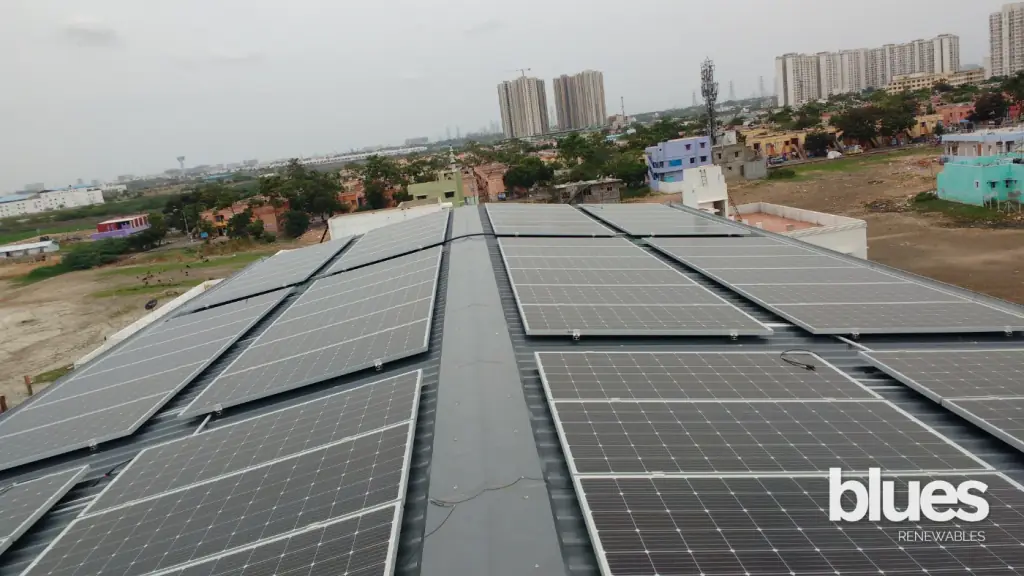
What we install in Vyasarpadi
The process
How installation works
Free site survey
Shade-free roof area measured across the day, structure checked, connection name and sanctioned load confirmed.
Design and itemised quotation
Sized against twelve months of consumption, with every component named.
Approvals filed
PM Surya Ghar and TANGEDCO net metering, plus load enhancement or phase conversion in parallel where needed.
Installation
One to three days for a residential system, carried out by our own team rather than subcontracted.
Inspection and commissioning
TANGEDCO inspects, the net meter goes in, the system goes live.
Subsidy tracked to your account
And two years of maintenance included from commissioning.
We check the name on your electricity connection at the survey, because a mismatch stops more applications than any technical issue. See what to keep ready.
Free, no obligation
What will it cost on your roof in Vyasarpadi?
Do you know who will actually install it?
Much of this industry subcontracts. Ask the question of anyone quoting you, and see whether the answer is straight.
What happens after you send your details
- We call you within one working day, and an engineer rather than a salesperson attends the site.
- The survey is free. We measure usable area and shading, check your connection and sanctioned load, and photograph the site.
- You get an itemised quotation naming every component and brand, with the subsidy or depreciation position set out.
- No obligation at any point. If solar does not make sense for your property, we will say so.
Common questions
Solar in Vyasarpadi, common questions
Who will actually install my solar system?
Ours is installed by our own team rather than subcontracted, which means the person who surveyed your roof is accountable for what happens on it. It is worth asking any installer the same question. Either answer can be acceptable, but an evasive one tells you something.
Why does subcontracting matter?
Because it changes who is accountable. If a crew is a subcontractor and workmanship fails in year three, the question is who fixes it and whether they are still trading. It also affects continuity, since a team that installed a system knows where everything runs when maintenance is needed.
What happens at home during installation?
One to three days for a residential system, with noise and movement on the terrace and cabling work inside the building. Water and power may need brief interruption. We agree access and timing with you beforehand rather than arriving and improvising.
How long does installation take in Vyasarpadi?
Six to ten weeks from survey to a live system. In Vyasarpadi the installation itself can take an extra day because material has to come up by staircase, but the timeline is still governed by TANGEDCO approval and the meter, not by the roof work.
Do you handle the subsidy and TANGEDCO paperwork?
Yes. We file the PM Surya Ghar claim and the TANGEDCO net metering application for you and follow both through the section office. In Vyasarpadi the detail that delays applications most often is the sanctioned load being too low for the system you want, which we check before designing so the load enhancement runs in parallel rather than afterwards.
What is included after installation?
Two years of free maintenance from commissioning, covering panel cleaning, annual inspection of connections and structure, generation monitoring and warranty coordination with the manufacturer.
Our house flooded in 2023. Is solar still a sensible investment?
Yes, if the equipment is placed for it. The panels sit on the roof and keep working once the water drains; the risk is to anything mounted low. Keep the inverter and boxes upstairs or on the terrace, seal cable entries, and have the meter board checked before switching back on after any flood.
Can our tenement block get solar for the lifts and pumps?
It can qualify as a common area system, which gets ₹18,000 per kW in subsidy, and lifts and pumps run in daylight hours when solar generates. Because the block belongs to TNUHDB, the board and the residents' association need to agree before any survey or application.
Long tail coverage
Areas we cover around Vyasarpadi
Not listed? We survey across Chennai and the surrounding districts. Call and we will tell you straight away whether we can reach your site this week.