


Solar Panel Installation in Iyyappanthangal
Inverter position agreed at survey, because heat there costs you output and years
The inverter is the component most likely to need replacing during a solar system’s life, and where it is mounted has a lot to do with how soon that happens. It is a decision usually made in thirty seconds on site, and it deserves rather more thought than that.
Installing across Chennai since 2020
Two years free maintenance included
Subsidy and TANGEDCO paperwork filed by us
Free site survey and energy audit, no obligation
The short answer
Looking for a solar panel installation company in Iyyappanthangal?
In Iyyappanthangal we work on both independent terraces and apartment common areas, and the two need different paperwork even on the same street. Because it is a newer area, roofs here are generally in good condition and the paperwork moves faster than the average. We have installed across Chennai since 2020, file the PM Surya Ghar subsidy of up to ₹78,000 for households and the TANGEDCO net metering application ourselves, and include two years of free maintenance. Before the survey, you can check the solar panel price in Chennai for 3 kW to 10 kW systems and see how our solar panel installation in Chennai works, the same process we follow in Iyyappanthangal.
What it costs here
A typical 5 kW system in Iyyappanthangal
Standard 5 kW example
What a typical 5 kW home system does here. Your own figures come from the survey.
Not sure what your site can carry?
Send us your last electricity bill on WhatsApp and we will come back with an indicative system size and what it would offset. No visit needed for that first answer.
The local picture
Where the inverter goes, and why it matters
A solar inverter generates heat while working, and like most power electronics it performs worse and ages faster when hot. Mounting it in a poorly ventilated spot, in direct sun, or in an enclosed cupboard shortens its life and reduces output on exactly the hot, bright days when the array is generating most. Where it goes is a design decision, not a convenience one.
What a good inverter position looks like
Shaded and ventilated
Out of direct sun, with air able to move around the unit and the clearances the manufacturer specifies actually respected.
Not in a sealed cupboard or enclosed shaft
Where heat accumulates with nowhere to go.
Accessible
You will need to read it, and someone will need to service it. An inverter behind a locked panel at height gets ignored.
Reasonably close to the array
Since long DC runs cost some generation to voltage drop, but not so close that it sits on an exposed terrace baking in the sun.
At an appropriate height
Where the location has any history of water.
The heat point in Chennai terms
An unventilated west-facing wall runs considerably hotter than a shaded spot a few metres away
Ambient temperatures here are high for most of the year, and inverters protect themselves by reducing output when they overheat. The practical effect is lost generation on your best days followed by a shorter service life. Ask where the inverter will go before you sign: an installer who intends to put it wherever there happens to be wall space has not designed the installation.
Otherwise straightforward
Mostly newer development
Sound structures, clear terraces and generally adequate connections. Apartment associations follow the common-area route at ₹18,000 per kW, and independent houses typically install 3 kW to 5 kW.
Areas we cover around Iyyappanthangal: Iyyappanthangal, Poonamallee approach, Kattupakkam, Mugalivakkam border, Porur side, the Bangalore Highway stretch.
All areas we cover in Tiruvallur →Residential
Solar for Iyyappanthangal homes
Apartment associations
Claim ₹18,000 per kW on common areas.
Independent houses
Typically install 3 kW to 5 kW on newer, generally sound slabs.
Inverter position
Agreed at survey rather than decided on installation day.
Three-phase conversion
Where systems exceed 4 kW, filed alongside the net metering application.
Commercial and industrial
Solar for Iyyappanthangal businesses
Retail and food service
Serving the residential base. Evening-weighted and usually leased.
Small offices and clinics
Good daytime match and commercial tariffs.
Schools and institutions
In the surrounding area.
Light commercial
On the Poonamallee and Porur approaches.
Local guide
Iyyappanthangal rooftops: metro dust, drains and a panchayat
Iyyappanthangal is still governed by a village panchayat rather than the Chennai Corporation, and it sits at the Mount-Poonamallee Road junction where Chennai Metro Phase II work has run for about five years.
Metro construction dust on Mount-Poonamallee Road
DT Next reported in October 2025 that the Mount-Poonamallee Road and Oil Mill Road junction had seen dust, pollution and broken surfaces through about five years of metro work, and in December 2025 that the Kathipara to Poonamallee stretch was among the worst-damaged roads after a week of rain. Dust from a broken arterial road settles on every nearby roof. For houses within a street or two of Mount-Poonamallee Road, we plan a panel wash every two to three weeks in the dry months until the road is relaid, and a check of the inverter's air vents at each service visit.
EVP Park Avenue and the unconnected drain
In December 2024 residents told DT Next that rainwater mixed with sewage flowed back into EVP Park Avenue because drains had not been desilted. In April 2026 DT Next reported that a drain built there from May 2025 was still unconnected at both ends, held up between the Iyyappanthangal Village Panchayat and Tiruverkadu municipality, so wastewater overflowed onto the road. On streets like this, keep the inverter, the solar distribution box and any battery off the ground floor. A first-floor wall or a shaded terrace spot keeps them clear of standing water.
Sizing on the district figure
The state rooftop calculator uses 1,600 units per kW a year for this part of the metro area, about 4.4 units a day. A 4 kW system, the largest on single-phase supply, makes about 6,400 units a year. A 5 kW system makes about 8,000 units a year, roughly 1,330 per bi-monthly cycle, and needs three-phase. It costs about ₹3,20,000 before subsidy and about ₹2,20,000 after the central and Tamil Nadu subsidies. Homes up to 10 kW keep net metering, and what remains on the bill is mainly the network charge of about ₹0.32 a unit on generation.
Shops and clinics on the main roads
Shops, clinics and small offices along Mount-Poonamallee Road and Oil Mill Road are non-domestic connections, so they are on net feed-in rather than net metering. Power used on site saves the full commercial tariff, while exported units are credited at ₹3.61 a unit up to 10 kW and ₹3.37 from 11 to 150 kW. Size the array to daytime use: a clinic or office open through the day suits solar well, a shop that trades mainly after dark much less. On leased premises, get the landlord's written consent for the roof first, and budget for the more frequent cleaning that road dust here calls for.
What we install
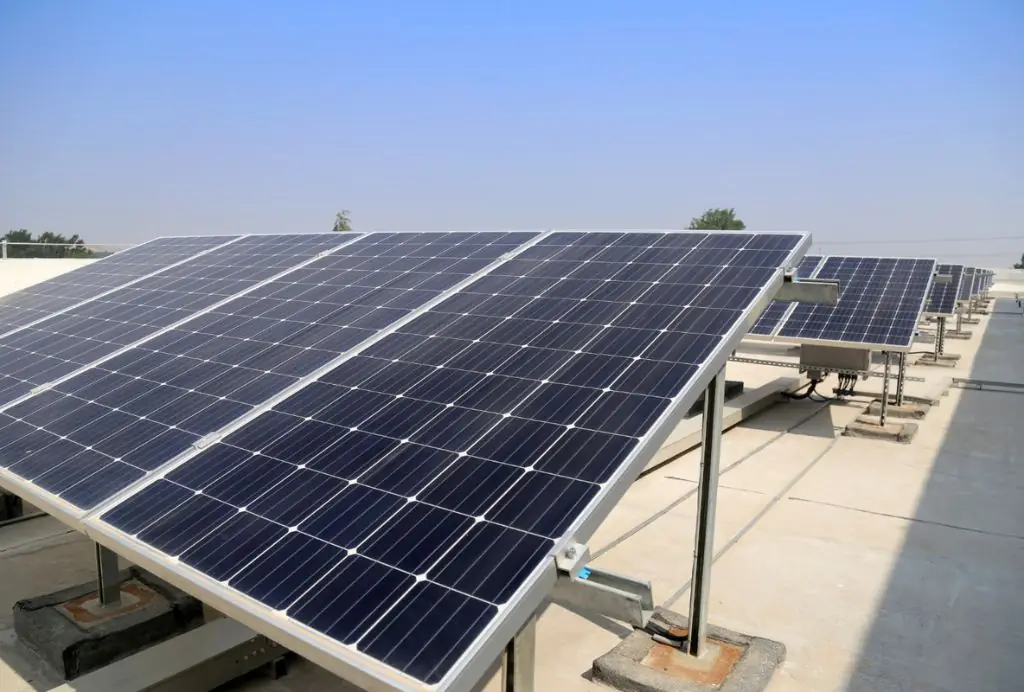
What we install in Iyyappanthangal
The process
How installation works
Free site survey
Shade-free roof area measured across the day, structure checked, connection name and sanctioned load confirmed.
Design and itemised quotation
Sized against twelve months of consumption, with every component named.
Approvals filed
PM Surya Ghar and TANGEDCO net metering, plus load enhancement or phase conversion in parallel where needed.
Installation
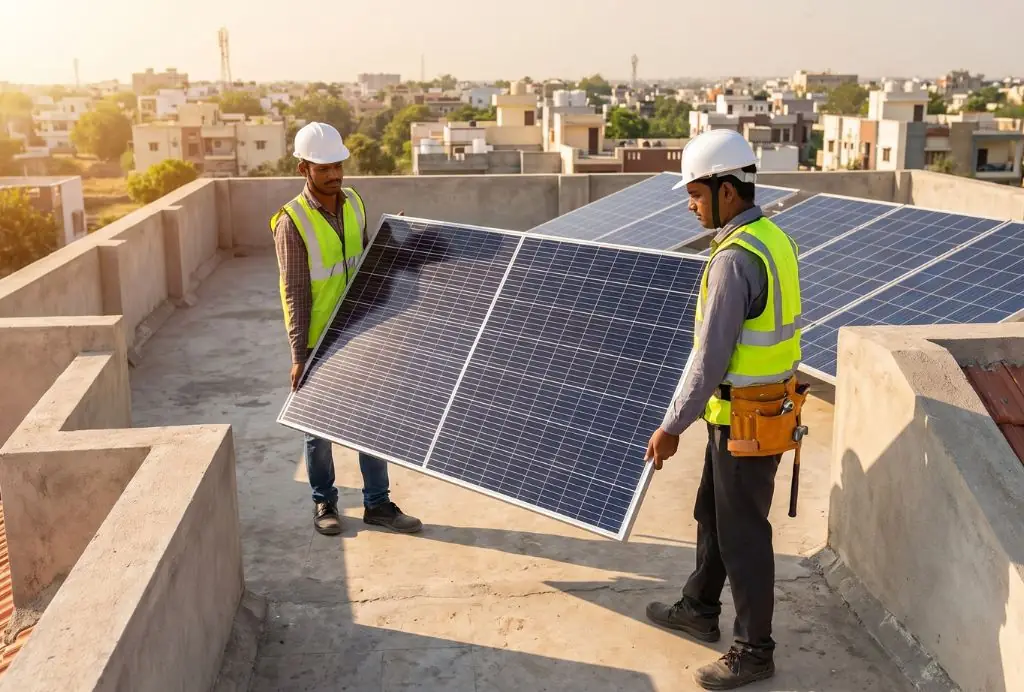
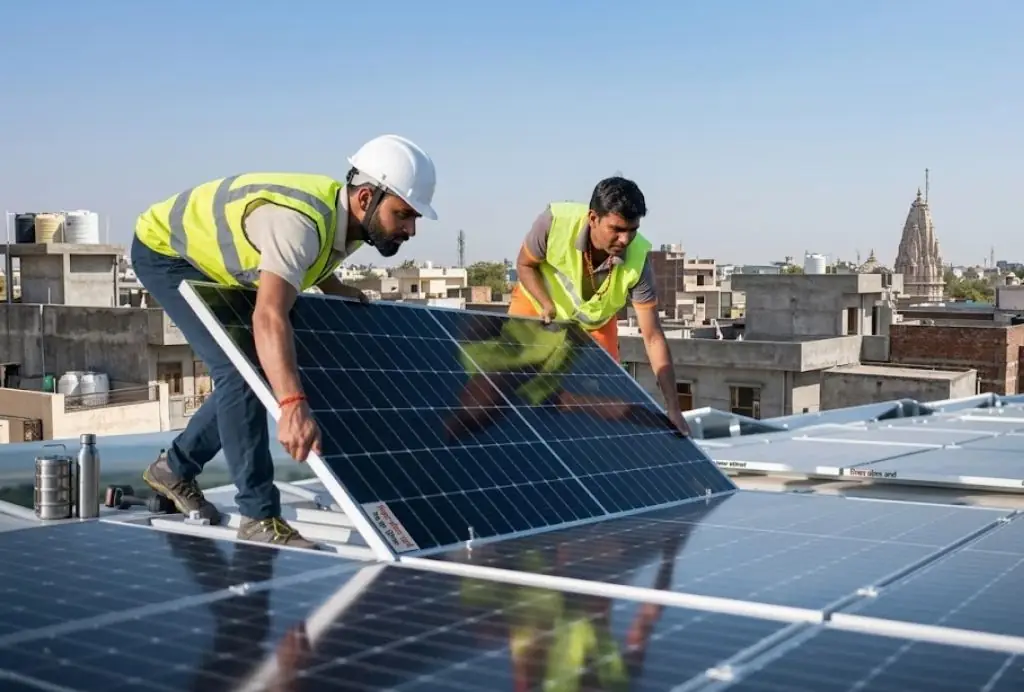
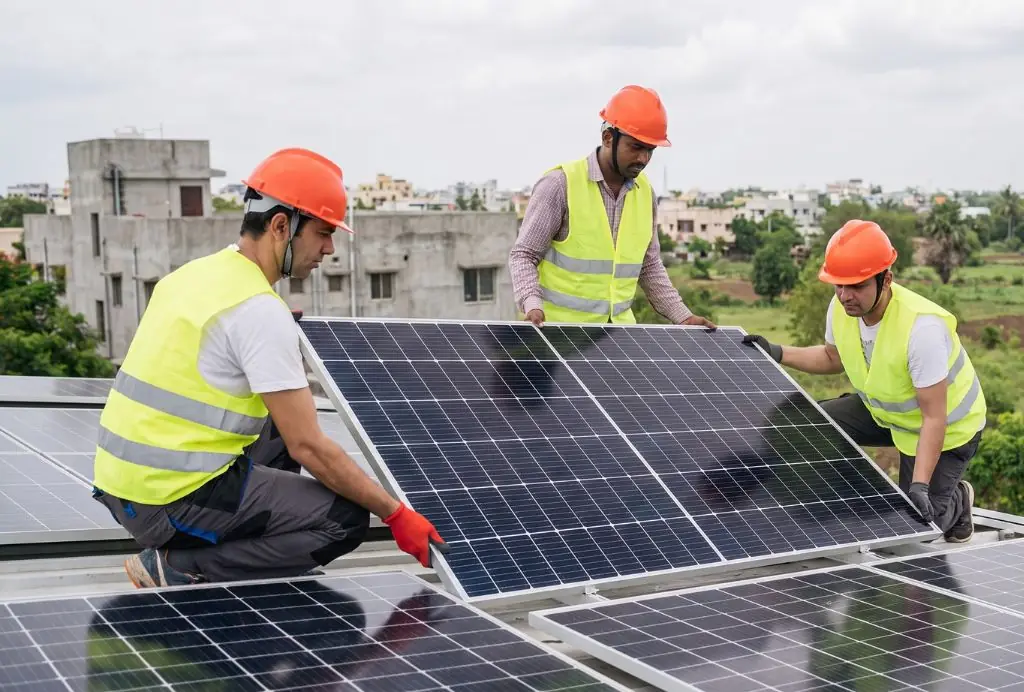
One to three days for a residential system, carried out by our own team rather than subcontracted.
Inspection and commissioning
TANGEDCO inspects, the net meter goes in, the system goes live.
Subsidy tracked to your account
And two years of maintenance included from commissioning.
We check the name on your electricity connection at the survey, because a mismatch stops more applications than any technical issue. See what to keep ready.
Free, no obligation
What will it cost on your roof in Iyyappanthangal?
Inverter going wherever there is wall space?
That decision affects output on your best days and the unit’s service life. It deserves more than thirty seconds.
What happens after you send your details
- We call you within one working day, and an engineer rather than a salesperson attends the site.
- The survey is free. We measure usable area and shading, check your connection and sanctioned load, and photograph the site.
- You get an itemised quotation naming every component and brand, with the subsidy or depreciation position set out.
- No obligation at any point. If solar does not make sense for your property, we will say so.
Common questions
Solar in Iyyappanthangal, common questions
Does it matter where the inverter is mounted?
Considerably. Inverters generate heat, and they perform worse and age faster when hot. A unit in direct sun or in a sealed cupboard runs hot, reduces its own output to protect itself on the brightest days, and has a shorter service life. Shaded, ventilated and accessible is what to aim for.
Should the inverter be close to the panels?
Reasonably close, because long DC cable runs lose a little generation to voltage drop, but not at the cost of putting it somewhere hot and exposed. A shaded, ventilated position a few metres further away is usually the better trade than a baking position on the terrace.
Why does inverter position affect my generation?
Because inverters reduce their output when they overheat, as a self-protection measure. That happens on hot, bright days, which are exactly the days the array is producing most. A poorly placed inverter therefore costs you generation precisely when there is most to lose.
How long does installation take in Iyyappanthangal?
Six to eight weeks from survey to a live, net-metered system is typical in Iyyappanthangal, and newer areas often land at the shorter end because connection records are current. The installation itself is one to three days for a home; the rest is TANGEDCO approval and the meter.
Do you handle the subsidy and TANGEDCO paperwork?
Yes, both are ours to file. Applications from newer areas like Iyyappanthangal usually move faster because the connection details and sanctioned load are recent and correct. We still verify the name on the connection and the load at the survey, then track the subsidy to your bank account after commissioning.
What is included after installation?
Two years of free maintenance from commissioning, covering panel cleaning, annual inspection of connections and structure, generation monitoring and warranty coordination with the manufacturer.
How often should panels near Mount-Poonamallee Road be cleaned?
Every two to three weeks in the dry months while the road remains broken after the metro work, and less often once it is relaid. A dusty array can lose a noticeable share of its output, and a rinse with clean water and a soft brush is enough.
Does being under a village panchayat change the solar subsidy?
No. The PM Surya Ghar subsidy of up to ₹78,000 and the Tamil Nadu top-up of ₹22,000 depend on a domestic electricity connection, not on whether the area is a panchayat or a corporation. Net metering is handled by TNPDCL in the same way.
Long tail coverage
Areas we cover around Iyyappanthangal
Not listed? We survey across Chennai and the surrounding districts. Call and we will tell you straight away whether we can reach your site this week.