












Solar Panel Installation in Padappai
Security designed in on remote sites rather than considered after an incident
On a remote industrial plot or an unattended site, a solar array is valuable equipment sitting in the open. It is not a reason to avoid installing, but it is a reason to think about security at design stage rather than after an incident.
Installing across Chennai since 2020
Two years free maintenance included
Subsidy and TANGEDCO paperwork filed by us
Free site survey and energy audit, no obligation
The short answer
Looking for a solar panel installation company in Padappai?
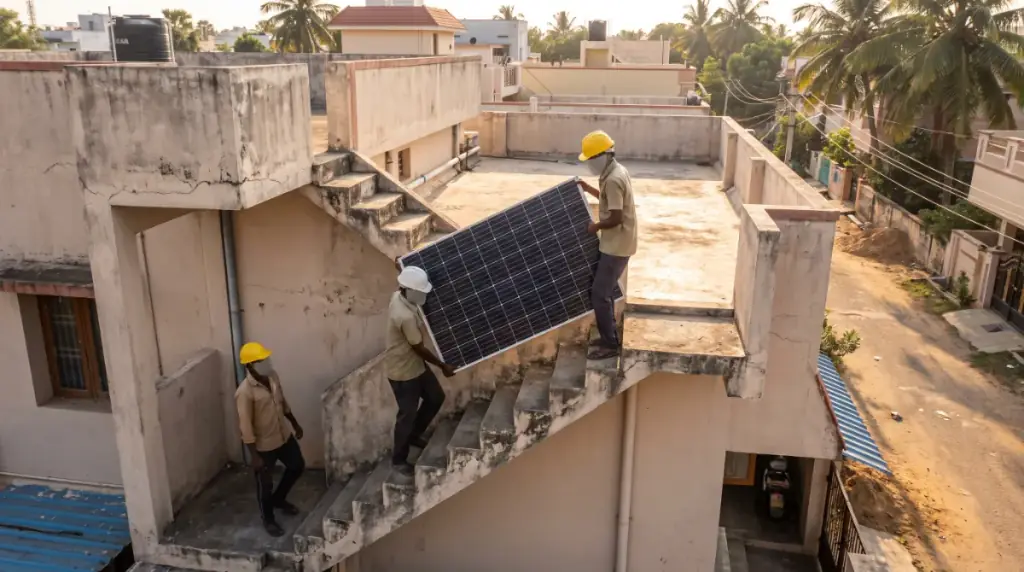
Padappai is largely low-rise and owner-occupied, so a rooftop system here is usually a straightforward job with no shared-roof paperwork. It is on the city edge, where plots are larger and ground-mount is sometimes a better answer than a rooftop system. We install across Chennai and have done since 2020, filing both the PM Surya Ghar subsidy of up to ₹78,000 for homes and the TANGEDCO net metering application, with two years of free maintenance included. Before the survey, you can check the solar panel price in Chennai for 3 kW to 10 kW systems and see how our solar panel installation in Chennai works, the same process we follow in Padappai.
What it costs here
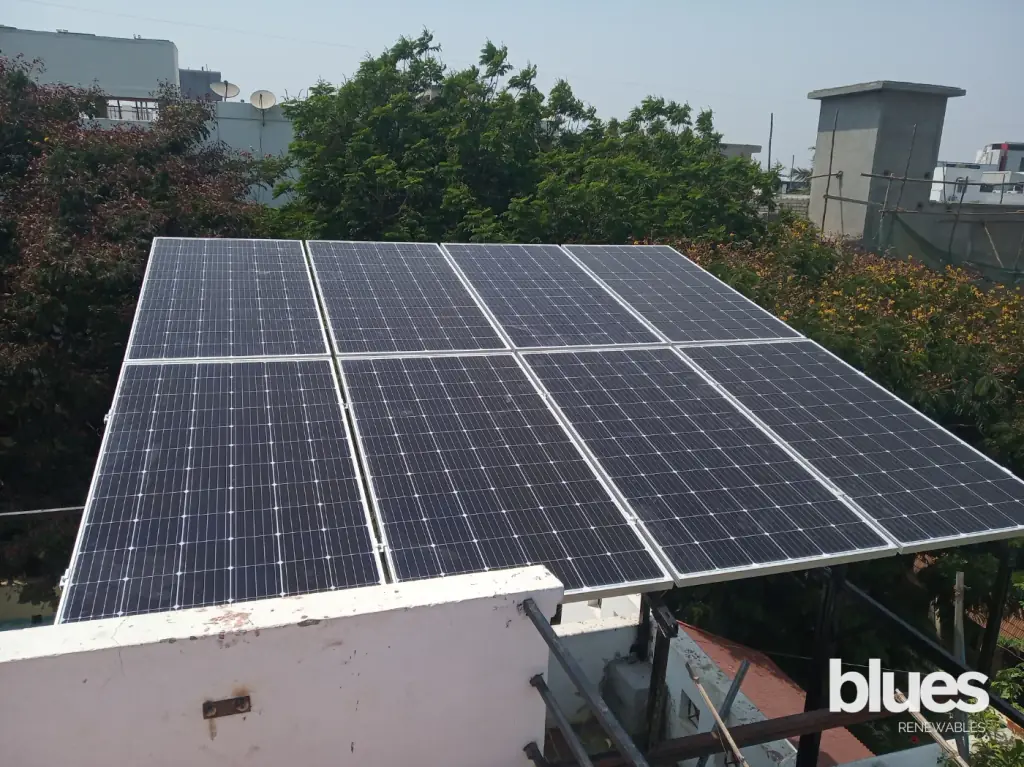
A typical 5 kW system in Padappai
Standard 5 kW example
What a typical 5 kW home system does here. Your own figures come from the survey.
Not sure what your site can carry?
Send us your last electricity bill on WhatsApp and we will come back with an indicative system size and what it would offset. No visit needed for that first answer.
The local picture
Security on remote and unattended sites
Solar panels, inverters and cabling have resale value, and on remote industrial plots, vacant land installations and unattended sites they are exposed in a way a residential rooftop is not. Ground-mounted arrays in particular sit at accessible height in open ground, and security should be part of the design conversation rather than something considered afterwards.
What is worth building in
Physical perimeter
Fencing around a ground-mount array, appropriate to the site and to what is around it.
Tamper-resistant fixings
Panel clamps and bolts that cannot be removed with common tools, which is a modest cost at installation.
Sensible equipment siting
Inverters and protection equipment inside a secured building rather than in an exposed cabinet where the site allows it.
Cable routing
Buried or protected runs rather than accessible surface cable, which is both a security and a safety measure.
Monitoring that would show a problem
A sudden drop in generation from part of an array is visible immediately in monitoring data, where an unattended site might otherwise go unchecked for weeks.
Rooftop arrays are considerably less exposed
Which is one practical argument for using an available roof
Where both options exist and the roof is otherwise suitable. Insurance is worth raising with your provider, since whether solar equipment is covered under an existing policy varies and it is better established before an incident than after.
The industrial picture here
Standard for the belt
Sheet roofs where condition determines the sequence, HT connections on larger units, net feed-in rather than net metering for non-domestic consumers, and demand charges that solar does not displace. Residential Padappai is layouts and independent houses on larger plots, typically 3 kW to 5 kW, with outer-circle approval timelines.
Areas we cover around Padappai: Padappai, Mannivakkam approach, Kundrathur border, Somangalam, Oragadam corridor, the industrial estate roads.
All areas we cover in Kanchipuram →Residential
Solar for Padappai homes
Independent houses on layout plots
Typically install 3 kW to 5 kW.
Rooftop arrays
Considerably less exposed than ground-mounted ones.
Outer-circle approval timelines
Apply, so applications are filed in parallel.
Service distance
Should be agreed at the outset.
Commercial and industrial
Solar for Padappai businesses
Industrial and manufacturing units
Sheet roofs, HT connections, standard belt considerations.
Ground-mounted installations
On plots with land, where security is part of the design.
Warehousing
Large roofs with modest loads, so size to consumption rather than area.
Small workshops
Commercial tariffs, depreciation subject to taxable profit.
Local guide
Rooftop solar around Padappai: the Oragadam corridor and home sizing
Padappai sits on the Vandalur to Walajabad road, about 12 km from Tambaram, and that road meets the Sriperumbudur to Singaperumalkoil road at the Oragadam junction beside the SIPCOT industrial park.
Supplier units on the Oragadam road
The Padappai road links Chennai and Kanchipuram and runs into the Oragadam junction, close to plants such as Nissan, Apollo Tyres, Alstom T&D and Infac India. If your unit supplies one of these plants and works a day shift, your load lines up well with generation. As a non-domestic connection you are on net feed-in: units you use yourself save your full tariff, while exported units earn only ₹3.61 a unit up to 10 kW and ₹3.37 from 11 to 150 kW. That makes the daytime load profile, not the shed size, the sizing input. Bring twelve months of bills and the shift pattern to the survey, and size the array so most of it is used on site.
When the roof is too small for the load
A large plant can draw far more in daylight than its roof can generate. Rooftop solar still helps, but the bigger lever for a heavy industrial load is captive or open-access solar: a ground-mounted plant elsewhere in Tamil Nadu that supplies the factory through the grid. That route has its own approvals and charges, and suits loads well beyond what a rooftop can cover. A sensible sequence is rooftop first, because it is quick and needs no land, then an open-access study if daytime demand remains far above what the roof delivers. For a unit that also runs at night, solar covers only the daylight hours; night shifts stay on grid power either way.
Sizing a Padappai home
The state rooftop calculator gives Kanchipuram district 1,600 units per kW a year, about 4.4 units a day. A 3 kW system makes about 4,800 units a year, roughly 800 per two-month billing cycle, and a 5 kW system about 8,000. A 3 kW system costs about ₹2,10,000 before subsidy and about ₹1,10,000 after the central ₹78,000 and the ₹22,000 Tamil Nadu top-up. A 5 kW system costs about ₹3,20,000, or about ₹2,20,000 after both, and needs three-phase supply because single-phase stops at 4 kW. What stays on the bill is mostly the network charge on generation, about ₹0.32 a unit, since homes pay no fixed charge. A 3 kW system needs about 250 to 300 square feet of shade-free roof.
What we install
What we install in Padappai
The process
How installation works
Free site survey
Shade-free roof area measured across the day, structure checked, connection name and sanctioned load confirmed.
Design and itemised quotation
Sized against twelve months of consumption, with every component named.
Approvals filed
PM Surya Ghar and TANGEDCO net metering, plus load enhancement or phase conversion in parallel where needed.
Installation
One to three days for a residential system, carried out by our own team rather than subcontracted.
Inspection and commissioning
TANGEDCO inspects, the net meter goes in, the system goes live.
Subsidy tracked to your account
And two years of maintenance included from commissioning.
We check the name on your electricity connection at the survey, because a mismatch stops more applications than any technical issue. See what to keep ready.
Free, no obligation
What will it cost on your roof in Padappai?
Ground mount on an unattended plot?
Then fencing, tamper resistant fixings and protected cable runs belong in the design, not in a conversation afterwards.
What happens after you send your details
- We call you within one working day, and an engineer rather than a salesperson attends the site.
- The survey is free. We measure usable area and shading, check your connection and sanctioned load, and photograph the site.
- You get an itemised quotation naming every component and brand, with the subsidy or depreciation position set out.
- No obligation at any point. If solar does not make sense for your property, we will say so.
Common questions
Solar in Padappai, common questions
Is solar equipment at risk of theft on a remote site?
It has resale value and on unattended plots it is exposed, particularly ground-mounted arrays at accessible height in open ground. It is not a reason to avoid installing, but it is a reason to build in fencing, tamper-resistant fixings, secured equipment siting and protected cable routing at design stage.
How would I know if something happened on an unattended site?
Through monitoring. A sudden drop in generation from part of an array shows immediately in the data, whereas an unattended site might otherwise go unchecked for weeks. We configure monitoring and set a generation benchmark at handover for exactly this reason.
Is a rooftop array safer than a ground mount?
Considerably, since it is neither at accessible height nor in open ground. Where both options exist and the roof is otherwise suitable, that is one practical argument for using it. Where ground mount is the right answer for other reasons, security is designed in rather than added later.
How long does installation take in Padappai?
Six to ten weeks, though section offices covering Padappai can run longer than the city ones at busy times. The installation is one to three days for a home; approval and the bi-directional meter account for the rest.
Do you handle the subsidy and TANGEDCO paperwork?
Yes. We file both the PM Surya Ghar application and the TANGEDCO net metering application, and follow them through the section office covering Padappai. Timelines at the outer offices vary more than in the city, so we tell you what we are seeing there rather than quoting a standard figure.
What is included after installation?
Two years of free maintenance from commissioning, covering panel cleaning, annual inspection of connections and structure, generation monitoring and warranty coordination with the manufacturer.
Our unit near Padappai supplies an Oragadam plant and runs one shift. How should we size solar?
To your daytime consumption. Units you use yourself save your full tariff, but exports on net feed-in earn only ₹3.61 a unit up to 10 kW and ₹3.37 from 11 to 150 kW. Twelve months of bills and your shift timings give a size that keeps most of the output on site.
Can a house in Padappai get the same solar subsidy as a house in Chennai?
Yes. Eligible homes with a domestic connection in their own name get up to ₹78,000 from PM Surya Ghar plus the ₹22,000 Tamil Nadu top-up, wherever they are in the state. The application goes through the national portal and the electricity distributor.
Long tail coverage
Areas we cover around Padappai
Not listed? We survey across Chennai and the surrounding districts. Call and we will tell you straight away whether we can reach your site this week.