












Solar Panel Installation in Minjur
Monitoring configured so a weak feeder tripping your inverter is visible, not invisible
On outer feeders the grid voltage is less stable than in the city, and a solar inverter is required to disconnect when voltage strays outside its permitted band. Where that happens often, a system can spend a meaningful part of the day offline through no fault of its own.
Installing across Chennai since 2020
Two years free maintenance included
Subsidy and TANGEDCO paperwork filed by us
Free site survey and energy audit, no obligation
The short answer
Looking for a solar panel installation company in Minjur?
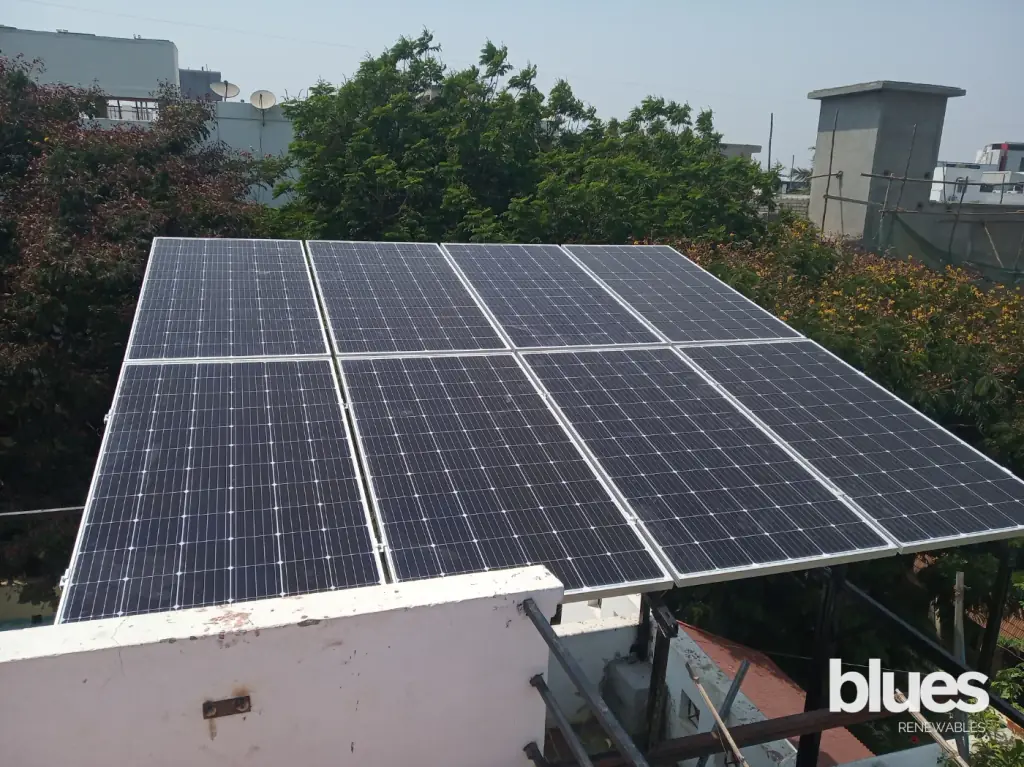
Most of what we install in Minjur goes on independent houses, where the terrace belongs to the same person as the electricity connection and nothing needs a committee. Coastal exposure changes the hardware list here: salt-mist rated modules, galvanised structure, and outdoor enclosures rated for the humidity. Blues Renewables has worked across Chennai since 2020. We handle the PM Surya Ghar claim of up to ₹78,000 where the property is residential, file the TANGEDCO net metering paperwork, and include two years of maintenance. Before the survey, you can check the solar panel price in Chennai for 3 kW to 10 kW systems and see how our solar panel installation in Chennai works, the same process we follow in Minjur.
What it costs here
A typical 5 kW system in Minjur
Standard 5 kW example
What a typical 5 kW home system does here. Your own figures come from the survey.
Not sure what your site can carry?
Send us your last electricity bill on WhatsApp and we will come back with an indicative system size and what it would offset. No visit needed for that first answer.
The local picture
When the grid itself trips your system
Grid-tied solar inverters monitor the voltage and frequency of the supply and are required to disconnect automatically when either moves outside a defined range. This is a safety requirement and it works as intended. On outer and rural feeders where voltage fluctuates more than in the city, an inverter can trip offline repeatedly through the day, and each disconnection means lost generation until it reconnects.
Why it happens more on outer feeders
Longer distribution lines
From the substation mean greater voltage variation along their length.
Heavy industrial loads switching on and off
Cause visible voltage movement on the same feeder.
High solar penetration on a feeder
Can itself push voltage up at the far end during peak generation, which is one reason the network capacity assessment exists.
Agricultural and pumping loads
In the surrounding area contribute to swings at particular times of day.
What can be done
Establish whether it is actually happening
Monitoring data will show repeated disconnections, and this is a specific pattern rather than general underperformance. Without monitoring, nobody knows.
Inverter selection matters
Units differ in how tolerant they are within permitted limits and how quickly they reconnect after a trip.
Report persistent voltage problems to TANGEDCO
Since supply voltage outside the permitted range is a network issue rather than a solar one, and you are entitled to raise it.
Do not accept it as normal
Repeated tripping is diagnosable, and an installer who dismisses it has not looked.
We set a benchmark at handover
Monitoring configured to show it
Precisely so this kind of pattern is visible rather than invisible. Minjur’s industrial base brings sheet roofs, HT connections and the northern belt’s corrosion considerations given proximity to the coast. Non-domestic consumers are generally on net feed-in, so size to daytime self-consumption, and demand charges are not displaced by solar.
Areas we cover around Minjur: Minjur, Ponneri approach, Gummidipoondi border, Athipattu, Ennore corridor, the industrial estate roads.
All areas we cover in Tiruvallur →Residential
Solar for Minjur homes
Independent houses
Typically install 3 kW to 4 kW on reasonable plots.
Monitoring
Matters here, since voltage-related tripping is invisible without it.
Outer-circle approval timelines
Apply, so applications are filed in parallel.
Service distance
Should be agreed at the outset given the location.
Commercial and industrial
Solar for Minjur businesses
Industrial and manufacturing units
Sheet roofs, HT connections, coastal corrosion considerations.
Warehousing and logistics
Large roofs with modest loads, so size to consumption.
Small workshops and units
Commercial tariffs, depreciation subject to taxable profit.
Support services
On the estate roads.
Local guide
Keeping solar output up in Minjur: ash, water and the right size
Minjur is a town panchayat about 25 km north of Chennai, near the coal-fired North Chennai Thermal Power Station at Athipattu and the 100 MLD seawater desalination plant commissioned in July 2010. The industrial air of this belt is the main local factor in how often panels need cleaning.
Fly ash and coal dust from the Ennore and Athipattu belt
The North Chennai Thermal Power Station at Athipattu burns coal brought in through Ennore Port, and its ash disposal has been documented as polluting the Buckingham Canal, nearby marshes and Ennore Creek. Fine ash and coal dust settle on module glass and cut output steadily. For Minjur roofs, plan cleaning every two weeks in the dry months instead of monthly, and after any windy spell from the direction of the plant. Set a tilt of at least 10 degrees so the monsoon helps, and leave a walkway so cleaning never means stepping on modules. The plant added an 800 MW unit in March 2024, so this source of ash is not going away. Ash is abrasive, so use a soft brush and plenty of water, never a dry cloth.
Which water to clean panels with
Groundwater across the Chennai region often carries 600 to 1,500 ppm of dissolved solids, above the 500 ppm limit for drinking water. Washing panels with hard borewell water leaves a white film that blocks light and builds up over months. Use low-TDS water for the final rinse, such as treated supply water or the output of a domestic RO unit, never the RO reject. A soft brush and a squeegee do the rest. If only borewell water is available, rinse lightly and wipe dry rather than letting it evaporate on the glass. Clean in the early morning, when the glass is cool, so water does not dry into spots. Let the rinse water drain away from the inverter and wiring.
Sizing a Minjur home system
Independent houses on Minjur plots suit 3 kW to 5 kW. Single-phase supply is limited to 4 kW, so a 5 kW system needs a three-phase connection. At the Thiruvallur yield of 1,600 units per kW a year, 3 kW makes about 4,800 units and 5 kW about 8,000. For a home, the remaining network charge is about ₹0.32 a unit. A 5 kW system costs about ₹3,20,000 before subsidy and about ₹2,20,000 after both subsidies. If a borewell pump runs during the day, sizing toward 5 kW lets that load use solar directly, which is worth more than exporting the units. A 3 kW system costs about ₹2,10,000 before subsidy and about ₹1,10,000 after both.
What we install
What we install in Minjur
The process
How installation works
Free site survey
Shade-free roof area measured across the day, structure checked, connection name and sanctioned load confirmed.
Design and itemised quotation
Sized against twelve months of consumption, with every component named.
Approvals filed
PM Surya Ghar and TANGEDCO net metering, plus load enhancement or phase conversion in parallel where needed.
Installation
One to three days for a residential system, carried out by our own team rather than subcontracted.
Inspection and commissioning
TANGEDCO inspects, the net meter goes in, the system goes live.
Subsidy tracked to your account
And two years of maintenance included from commissioning.
We check the name on your electricity connection at the survey, because a mismatch stops more applications than any technical issue. See what to keep ready.
Free, no obligation
What will it cost on your roof in Minjur?
System underperforming for no clear reason?
On outer feeders repeated voltage tripping is a real cause, and without monitoring nobody would ever know.
What happens after you send your details
- We call you within one working day, and an engineer rather than a salesperson attends the site.
- The survey is free. We measure usable area and shading, check your connection and sanctioned load, and photograph the site.
- You get an itemised quotation naming every component and brand, with the subsidy or depreciation position set out.
- No obligation at any point. If solar does not make sense for your property, we will say so.
Common questions
Solar in Minjur, common questions
Can grid voltage problems affect my solar system?
Yes. Grid-tied inverters must disconnect when supply voltage or frequency strays outside a defined range, and on outer feeders where voltage fluctuates more, an inverter can trip offline repeatedly through the day. Each disconnection means lost generation until it reconnects.
How would I know if that is happening?
Through monitoring, which shows repeated disconnections as a distinct pattern rather than general underperformance. Without monitoring configured and a generation benchmark to compare against, it is effectively invisible, which is why we set both at handover.
What can be done about it?
Establish that it is genuinely happening rather than assuming, since inverter selection affects tolerance within permitted limits and reconnection behaviour. Persistent supply voltage outside the permitted range is a network issue rather than a solar one, and it can be raised with TANGEDCO. It should not be accepted as normal.
How long does installation take in Minjur?
Six to ten weeks in Minjur. Lead time on salt-mist certified modules and galvanised structure can add a few days at the procurement stage, which we tell you at quotation rather than after you have signed.
Do you handle the subsidy and TANGEDCO paperwork?
Yes. We file the PM Surya Ghar application and the TANGEDCO net metering paperwork, and follow both through the section office. One point specific to coastal properties like those in Minjur: the hardware has to be ALMM-listed for the subsidy, and the salt-mist rated modules we specify here are, so the specification never puts the claim at risk.
What is included after installation?
Two years of free maintenance from commissioning, covering panel cleaning, annual inspection of connections and structure, generation monitoring and warranty coordination with the manufacturer.
How often should solar panels be cleaned in Minjur?
Every two weeks in the dry months is a sensible start, because ash and dust from the power and port belt settle faster than in the city. In the monsoon, rain does part of the work. A drop in generation against the handover benchmark tells you when a clean is due.
Can I use my borewell water to clean the panels?
It is better not to for the final rinse. Hard borewell water leaves mineral deposits on the glass that reduce output. Use treated or RO-filtered water, or wipe the glass dry after rinsing.
Long tail coverage
Areas we cover around Minjur
Not listed? We survey across Chennai and the surrounding districts. Call and we will tell you straight away whether we can reach your site this week.