












Solar Panel Installation in Kodambakkam
Measured sizing for dense plots, and load pattern analysis for studios that work nights
Kodambakkam is among the densest parts of Chennai, and it also holds the city’s film production base. Tight plots and narrow lanes on one hand, studios and post-production facilities with genuinely unusual load patterns on the other. Both need surveying rather than estimating.
Installing across Chennai since 2020
Two years free maintenance included
Subsidy and TANGEDCO paperwork filed by us
Free site survey and energy audit, no obligation
The short answer
Looking for a solar panel installation company in Kodambakkam?
Kodambakkam is tightly packed, and on most terraces here the limit is usable shade-free area, not budget. Access is the practical problem. Narrow streets mean panels come up by staircase rather than crane, and that shapes both the schedule and the structure design. Installing across Chennai since 2020, we file the PM Surya Ghar application worth up to ₹78,000 for households, handle TANGEDCO net metering end to end, and cover two years of maintenance after commissioning. Before the survey, you can check the solar panel price in Chennai for 3 kW to 10 kW systems and see how our solar panel installation in Chennai works, the same process we follow in Kodambakkam.
What it costs here
A typical 5 kW system in Kodambakkam
Standard 5 kW example
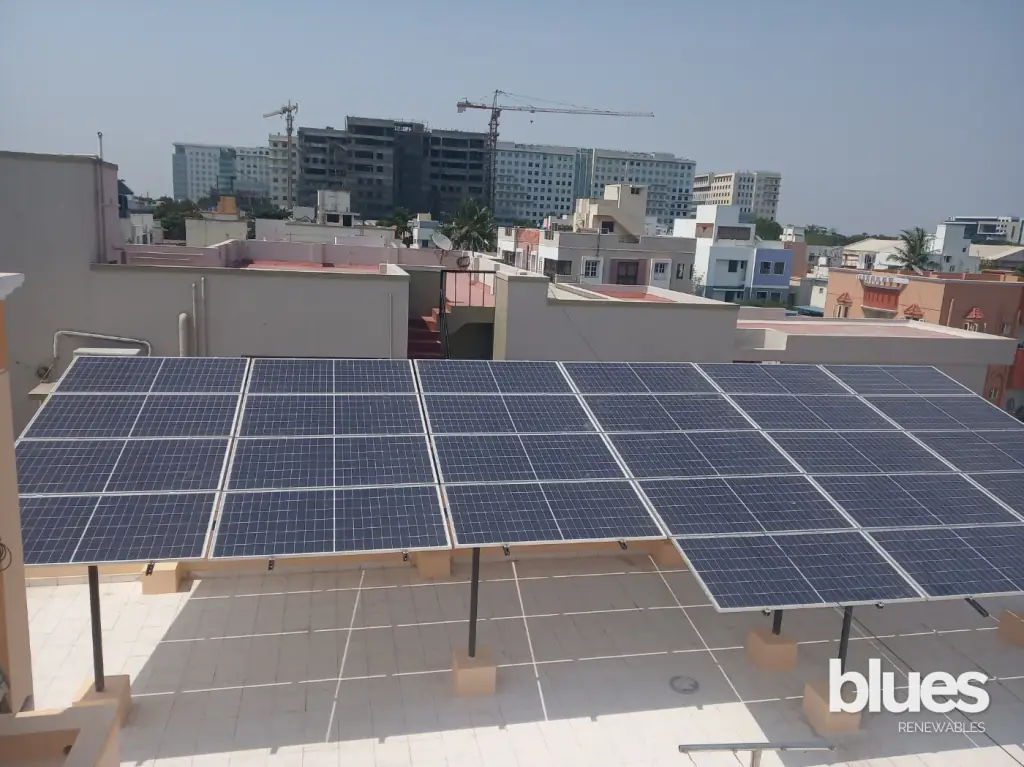
What a typical 5 kW home system does, on a terrace that can take one. Your own figures come from the survey.
Not sure what your site can carry?
Send us your last electricity bill on WhatsApp and we will come back with an indicative system size and what it would offset. No visit needed for that first answer.
The local picture
Dense plots, narrow lanes, and the studio load
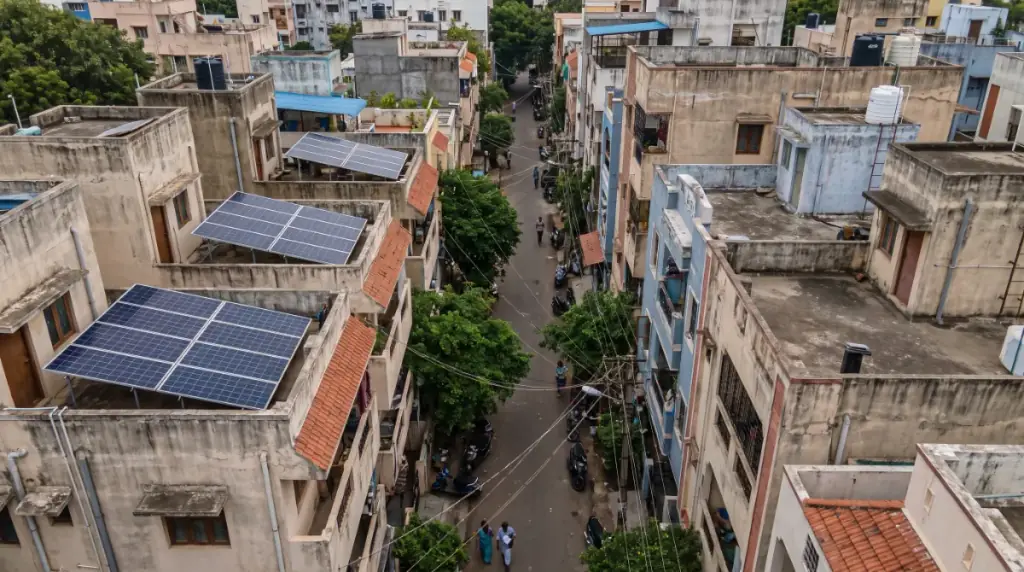
Kodambakkam’s residential density is among the highest in the city, with small plots, buildings sharing walls and lanes narrow enough to affect how materials reach a site. Usable shade-free roof area is routinely far below terrace measurement, and access planning is a real part of the project rather than an afterthought.
For residential properties
Shade-free area measured across the day
With buildings this close, a neighbouring wall shades a section of roof for part of every day, and that will not show in a single-visit assessment.
Realistic sizing
In tighter Kodambakkam properties the honest answer is often a 3 kW system rather than what the household’s bill would justify. A partial offset is still worth having.
Access planning
Narrow lanes mean material handling needs working out in advance. We establish this at the survey because discovering it on installation day extends the job.
Split arrays with multiple MPPT inputs
So a section shaded for part of the day does not pull down the whole system.
The distinguishing commercial segment
Studio and production loads look nothing like an office
Production facilities, post-production houses, dubbing studios and equipment rental businesses have intense but intermittent lighting loads, air conditioning that runs hard during shoots and lightly otherwise, and activity that frequently extends into the night. An annual average bill tells you very little. We look at the pattern across twelve months, because a facility working nights and weekends has a very different self-consumption profile from one working office hours, and the two justify different system sizes on identical roofs.
Areas we cover around Kodambakkam: Kodambakkam High Road, Power House, Meenakshi Colony, Ashok Nagar border, Saligramam approach, the studio streets.
All areas we cover in Chennai →Residential
Solar for Kodambakkam homes
Independent houses
On small plots, most installing 3 kW to 4 kW once usable area is measured properly.
Older properties
May have sloped or tiled sections needing different mounting from a flat terrace.
Apartment blocks
Follow the association route for common-area systems.
Access constraints
On the narrower lanes, affecting scheduling more often than they affect feasibility.
Commercial and industrial
Solar for Kodambakkam businesses
Studios and production facilities
The distinguishing segment, with intermittent and often night-weighted loads that need a twelve-month pattern rather than an annual average.
Post-production and equipment businesses
More regular daytime loads, and generally a straightforward case where the roof is available.
Retail and small shops
Evening-weighted, usually leased, so roof rights first.
Clinics and small offices
Good daytime match and commercial tariffs.
Local guide
Kodambakkam solar: low streets, long outages and tight terraces
In December 2023, Rangarajapuram in Kodambakkam stayed waterlogged for more than a week, and residents said they had no power for more than a week. That experience should shape where your solar equipment sits.
Rangarajapuram and the low pockets
The New Indian Express reported in December 2023 that Rangarajapuram, Subramania Nagar, Aziz Nagar and Parangusapuram Street had knee-deep stagnant water for days, and that Corporation officials blamed three culverts closed on railway land for holding the water back. Pumps sent it through the Trustpuram canal to the Cooum, and the Corporation brings high-power motors to these streets most monsoons, a sign the problem is structural. Two years later, in December 2025, Rangarajapuram Main Road and Corporation Colony Main Road were again among the few stretches still flooded. If your house is in one of these streets, the solar inverter and its distribution box belong on the terrace or an upper wall, with cable entries from below, even though the EB meter itself stays where TNPDCL fixed it.
A week without grid power
An on-grid system switches off whenever the grid fails, so the week-long outage residents described in 2023 would have stopped every on-grid array in the street, however sunny the days. If that is the risk you care about, the choice is a hybrid inverter with a battery sized to essential loads such as lights, fans, the fridge and a water pump. It costs more than an on-grid system, and the battery and its placement on an upper floor are quoted separately. For many homes the sensible answer is still on-grid for the bill and a small backup for essentials, and we price both so you can compare. A battery belongs on an upper floor in a ventilated spot, never in a ground-floor store room.
Fitting 3 kW onto a small terrace
We install from 3 kW, and on the Chennai yield of about 1,600 units per kW a year, roughly 4.4 a day, a 3 kW system makes about 4,800 units a year, around 800 in each bi-monthly cycle. It costs about ₹2,10,000 before subsidy and about ₹1,10,000 after the central and Tamil Nadu subsidies for an eligible home. Where a terrace cannot take 3 kW at floor level because of a water tank, a stair head or a shading wall, an elevated structure can carry the array above those obstructions. Higher-wattage modules also reduce the number of panels needed, which helps on narrow plots. Domestic connections pay no fixed charge, so what remains on the bill is mostly the network charge on generation, about ₹0.32 a unit.
What we install
What we install in Kodambakkam
The process
How installation works
Free site survey
Shade-free roof area measured across the day, structure checked, connection name and sanctioned load confirmed.
Design and itemised quotation
Sized against twelve months of consumption, with every component named.
Approvals filed
PM Surya Ghar and TANGEDCO net metering, plus load enhancement or phase conversion in parallel where needed.
Installation
One to three days for a residential system, carried out by our own team rather than subcontracted.
Inspection and commissioning
TANGEDCO inspects, the net meter goes in, the system goes live.
Subsidy tracked to your account
And two years of maintenance included from commissioning.
We check the name on your electricity connection at the survey, because a mismatch stops more applications than any technical issue. See what to keep ready.
Free, no obligation
What will it cost on your roof in Kodambakkam?
Think a bigger system means bigger savings?
Not if you work nights. We look at twelve months of pattern rather than the total, because when you use power decides what solar is worth.
What happens after you send your details
- We call you within one working day, and an engineer rather than a salesperson attends the site.
- The survey is free. We measure usable area and shading, check your connection and sanctioned load, and photograph the site.
- You get an itemised quotation naming every component and brand, with the subsidy or depreciation position set out.
- No obligation at any point. If solar does not make sense for your property, we will say so.
Common questions
Solar in Kodambakkam, common questions
How much solar can a Kodambakkam house fit?
Usually less than the terrace suggests. Plots are small and buildings share walls, so neighbouring structures shade sections of the roof through parts of the day. Most properties here support 3 kW to 4 kW once shade-free area is measured across the day rather than estimated from the total terrace size.
Do narrow lanes affect installation in Kodambakkam?
They affect planning rather than feasibility. Material handling and access have to be worked out in advance on the narrower lanes, which we establish at the survey rather than discovering on installation day. It occasionally affects the schedule and rarely affects whether the job can be done.
How is solar sized for a studio or production facility?
Against the pattern across twelve months rather than the annual average. Studio loads are intermittent and often extend into the night, so a facility working nights and weekends has a very different self-consumption profile from one working office hours. The same roof justifies different system sizes depending on when the power is actually used.
How long does installation take in Kodambakkam?
Six to ten weeks from survey to a live system. In Kodambakkam the installation itself can take an extra day because material has to come up by staircase, but the timeline is still governed by TANGEDCO approval and the meter, not by the roof work.
Do you handle the subsidy and TANGEDCO paperwork?
Yes. We file the PM Surya Ghar claim and the TANGEDCO net metering application for you and follow both through the section office. In Kodambakkam the detail that delays applications most often is the sanctioned load being too low for the system you want, which we check before designing so the load enhancement runs in parallel rather than afterwards.
What is included after installation?
Two years of free maintenance from commissioning, covering panel cleaning, annual inspection of connections and structure, generation monitoring and warranty coordination with the manufacturer.
Our street in Rangarajapuram floods almost every monsoon. Where should the solar equipment go?
On the terrace or an upper wall, well above any water level your street has seen. Panels are on the roof anyway, so only the cable needs to come down to the meter, and we plan that route at the survey.
Would rooftop solar have kept our lights on during the December 2023 outage in Kodambakkam?
An on-grid system would not, because it shuts down when the grid is off. A hybrid system with a battery kept upstairs can run essential loads through an outage, and we quote it alongside the on-grid option.
Long tail coverage
Areas we cover around Kodambakkam
Not listed? We survey across Chennai and the surrounding districts. Call and we will tell you straight away whether we can reach your site this week.