




Solar for Retail Showrooms in Chennai
Retail is the one commercial segment where solar needs a careful look before a quote. Your lighting and air conditioning run hardest into the evening, your roof is usually small relative to your load, and it often belongs to a landlord.
How we handle it
Where the numbers work they work well. Where they do not, we would rather tell you at the survey than after the quotation.
Feasibility before proposal
Solar carports and canopies
Multi-outlet portfolio assessments
Installing in Chennai since 2020
Speak to us
+91 98841 07170The option most retailers are never offered
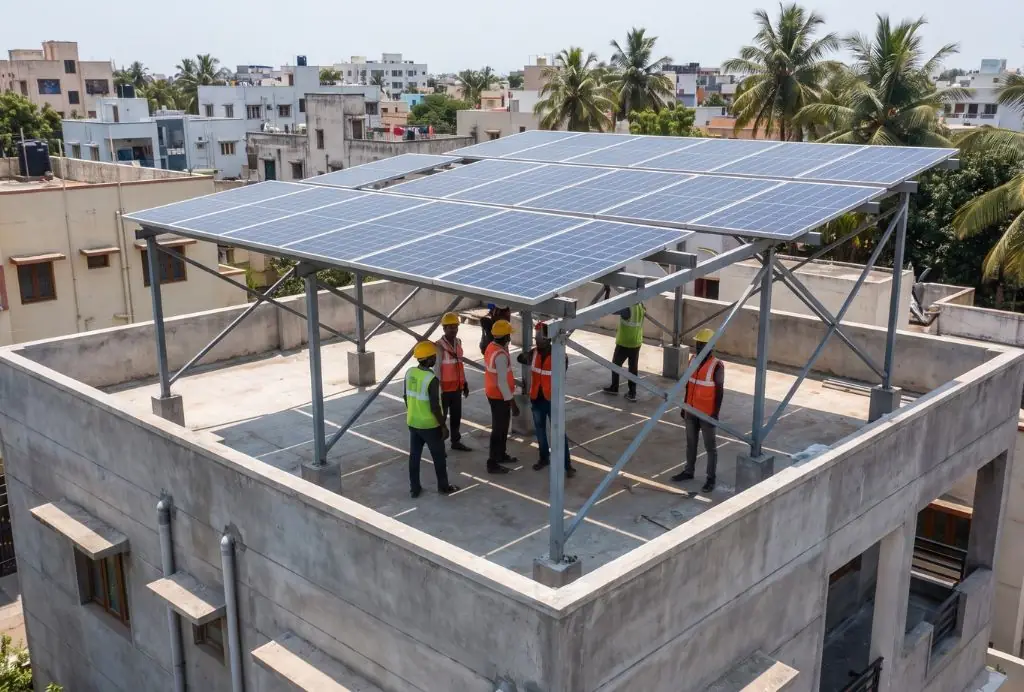
A solar carport generates where roof area is limited, and shades customer vehicles — a benefit a showroom values independently of the electricity.
The load profile
Why retail trading hours change the solar arithmetic
A retail showroom's electricity load is weighted towards the evening, because display lighting, air conditioning and customer footfall all peak in the hours after 5pm and continue until closing, often past 9pm. Rooftop solar generates for roughly five effective hours around midday, so it addresses the daytime portion of consumption only. For retail this is a smaller share of the total than it is for an office, a school or a single-shift factory.
A trading day against a solar day
Typical showroom, clear day.
Array generates
9am – 4pm
Showroom trades
11am – 9pm
The overlap is real and worth capturing. The gap after 4pm is where the money is, and where solar alone cannot reach.
The daytime load is still real, and worth capturing
Chennai showroom air conditioning runs hard from late morning, and display lighting in jewellery, apparel and furniture showrooms is substantial throughout trading hours, not only after dark. Retail is not a poor solar site. It is a site where the honest coverage figure is lower than a generic commercial proposal will suggest.
On export treatment
Retail premises are non-domestic consumers, generally on net feed-in rather than one-for-one net metering, so surplus generated in the quieter middle of the day earns a feed-in tariff well below what you pay for evening imports. Oversizing here produces surplus at exactly the time your own consumption is lowest.
The option worth asking about
If your peak is in the evening, a hybrid is the honest answer
The reason retail looks weak on a standard solar proposal is that the proposal only counts what you can consume while the sun is up. A hybrid system changes what is being counted. Midday generation charges a battery instead of being exported at the feed-in rate, and the battery discharges into your evening peak — the hours that make up most of your bill.
We will not pretend the payback is the same. A battery adds capital cost and will likely need replacing once inside the system's twenty-five year life, so the simple payback lands longer than a solar-only installation. What it buys is a much larger share of your consumption covered, and a per-unit cost you set today rather than one the tariff revision sets for you.
For a jewellery, apparel or furniture showroom trading late in a high-tariff category, that trade is often worth making. For a small outlet with a modest bill, it usually is not. The audit tells us which one you are, and we will say so either way.
Midday surplus is stored, not exported
The units you would have sold at the feed-in rate are kept and used at the retail rate you would otherwise pay after 5pm.
The evening peak is served from your own units
Which is the whole point for retail: your most expensive hours are the ones solar alone cannot reach.
Outage cover comes free with it
A showroom that cannot trade in a power cut is losing margin, not just electricity. The battery is already there.
We quote solar-only and hybrid side by side, with the battery cost, expected replacement point and coverage difference stated separately — never bundled into one number.
The number that actually decides it
Compare cost per unit over the asset's life, not payback in years
Levelised cost of energy is the total lifetime cost of the system — capital, financing, maintenance, inverter and battery replacement — divided by every unit it will generate over twenty-five years. It converts a solar quotation into a rupees-per-unit figure you can hold directly against your TANGEDCO tariff.
This is the comparison that matters for retail, because the two sides behave differently over time. Your solar cost per unit is fixed the day the system is commissioned and only falls in real terms. Your grid cost per unit is reset at every tariff revision, and commercial slabs have moved in one direction. A hybrid raises the solar figure — that is the honest cost of covering the evening — but it raises a number you control instead of one you receive by notice.
Ask any installer for the levelised cost of energy on their proposal, solar-only and hybrid. It is a harder number to dress up than a payback figure, and it is the one your accountant will want.
Grid cost per unit
Reset at every revision
Your solar cost per unit
Fixed at commissioning
Shape only, not scale. Your own figures come out of the audit, from your bills and your tariff category.
The question that decides most enquiries
Do you have a roof you can actually use?
Most retail showrooms in Chennai occupy leased premises, frequently on the lower floors of buildings with other occupants above, which means the retailer may have no rights over the roof at all. Before any solar assessment is worth doing, three things need establishing.
Work through them in order
Do you have roof rights?
A ground-floor showroom in a five-storey building generally does not control the terrace. If the building has multiple occupants, the roof is typically the landlord’s or shared, and installing requires the owner’s written agreement.
This is where most retail solar enquiries stop, and it is worth checking before anything else. If the answer is no but the parking is yours, a carport may still work.
Where the lease term is short, the options are worth discussing openly
Landlord participation. In some cases the building owner is the better investor, with the retailer benefiting through the tariff or the lease terms.
A relocatable design. Ballasted or demountable structures can be moved, though relocation costs are real and approvals restart at the new premises.
An OPEX arrangement. A developer-owned system aligned to the lease term can suit a tenant better than ownership. See CAPEX vs OPEX vs RESCO.
Negotiating it into the lease. Renewal terms, asset ownership at exit and reinstatement obligations documented before installation, not after.
We check all three at the first conversation, because a feasibility answer costs you nothing and a wasted survey costs us both time.
Check whether your site qualifiesCarports
When a carport beats a rooftop
A solar carport is an elevated structure over a parking area or forecourt carrying the array, rather than mounting it on the building roof. For retail it solves two problems at once: it creates generation capacity where roof area is limited, and it shades customer vehicles, which is a benefit a showroom values independently of the electricity. We build elevated structures up to 9 feet, with carport and canopy spans built to what the site requires.
Where a carport makes sense
Automobile showrooms
Display forecourts and customer parking, where shaded vehicles are a direct customer-experience benefit.
Furniture and large-format retail
Dedicated parking areas that already sit unused and unshaded through trading hours.
Standalone showrooms
Land around the building but limited usable roof once plant and access are accounted for.
Where the roof is not yours
The building roof belongs to a landlord, but the parking sits within the retailer's demise.
Anywhere shade has value
Customers or staff who park in the open in a Chennai summer notice it immediately.
Rooftop or carport, side by side
Be clear about the cost
A carport is a substantial steel structure with foundations, and it costs meaningfully more per kW than a roof mount. The case for it rests on the parking benefit and the visibility as much as on the electricity, which for a customer-facing showroom is often a legitimate way to justify it.
On wind loading
An elevated open structure in Chennai's 50 m/s wind zone, with a cyclone factor applied near the coast, carries significant uplift forces. Carports need proper structural design and foundations, and this is not a place to accept the cheapest quote.
Expectations
What solar will and will not do for a showroom
For a Chennai retail showroom, rooftop solar will typically offset a portion of daytime air conditioning and lighting load rather than the full electricity bill, because trading hours extend well past generation hours and roof area is usually limited relative to consumption. Where a solar carport is viable, coverage improves considerably. The honest figure comes from a load profile and a roof or parking assessment rather than from a percentage claim.
Counts in your favour
What solar does well for retail
Displaces expensive commercial-tariff units during the day
Offsets air conditioning load, which peaks in the hottest hours
Provides a visible sustainability signal in a customer-facing setting
Delivers a stable, predictable cost reduction over decades
Say so before quoting
What it does not do
Cover evening trading hours, without storage
Provide backup during outages, since grid-tied systems disconnect by design
Reduce demand charges on the connection
Solve a high-load, small-roof situation on its own
Sub-sector notes
Jewellery showrooms
High daytime load, heavy evening share
Very high display lighting loads and strong air conditioning, with long trading hours and significant security lighting. Daytime load is high and worth addressing, but the evening share is substantial.
Automobile showrooms
Usually the best case in retail
The forecourt and customer parking make carports viable, and roof area over a workshop is often usable. Coverage can reach well beyond what a high-street shop achieves.
Apparel and furniture
Depends on the premises
Sit between the two, depending heavily on premises type and whether the parking area is under your control rather than the landlord’s.
Small high-street shops
Roof rights are the blocker
Frequently fail the roof rights test in a shared or multi-storey building, and should be assessed before any expectation is set.
Multi-outlet retailers
Solar across a retail chain
A retailer operating several showrooms across Chennai should approach solar as a portfolio rather than as separate projects. Sites vary enormously in roof rights, roof area, lease term and load, so the sensible first step is a portfolio screen that ranks outlets by feasibility, followed by installation at the strongest sites rather than uniformly across all of them.
Why this beats a site-by-site approach
A chain that installs everywhere uniformly will put capital into sites where the economics are poor, and the estate-level return will disappoint. Screening first concentrates capital where it works.
We provide the portfolio screen at no charge for retailers with multiple Chennai outlets, because it is the honest way to start.
Request a portfolio screenVisibility
What customers and partners see
For a customer-facing business, a solar installation is visible in a way it is not for a factory. A solar carport over customer parking is seen by every visitor, and documented renewable generation supports sustainability claims that are increasingly asked for by brand partners, franchise principals and corporate customers.
Carports and canopies are seen
Every visitor walks under it. That is the argument for building the structure properly rather than cheaply — it is part of the frontage now.
Franchise and brand requirements
Automotive and multinational retail franchises increasingly carry sustainability criteria in their dealership and outlet standards.
In-store display
A live generation display is inexpensive, and works as customer-facing content in a showroom rather than as back-office data.
Documented, metered evidence
The generation meter gives dated, verifiable numbers for any sustainability reporting, instead of estimates.
Treat this as a genuine secondary benefit, not the reason to invest. The electricity case has to stand on its own first. If the numbers only work once the brand value is counted, the system is the wrong size.
Cost drivers
What determines the cost of a retail installation
| What varies | Effect |
|---|---|
| Rooftop versus carport | Carports cost meaningfully more per kW |
| Carport span and height | Larger spans need heavier structure and foundations |
| Roof area available | Small arrays carry higher fixed cost per kW |
| Building access in a high-street location | Higher. Restricted access, material handling, sometimes night working |
| Working around trading hours | Higher where installation cannot happen during business hours |
| Landlord requirements | Reinstatement obligations, aesthetic conditions, structural approvals |
| Coastal location | Salt mist certified modules, corrosion-resistant structures |
| Multiple outlets | Lower per site with a standardised design |
High-street constraints are real. A showroom on a busy Chennai retail street may have no crane access, no material storage and restricted delivery hours. That belongs in the quotation rather than emerging as a variation. More on what drives solar prices in Chennai.
Check your siteThe process
How a retail project runs
STEP 01 · FREE
Feasibility check
Roof rights, usable area or parking, lease term, load. Free, and often concluded on a phone call.
STEP 02
Energy audit
Twelve months of bills, load profile across trading hours, tariff category.
STEP 03
Site survey
Roof or parking area, structure, access, and shading from surrounding buildings — which on a high street can be significant.
STEP 04
Design and proposal
Rooftop, carport or a combination, sized to daytime self-consumption, with the honest coverage figure stated.
STEP 05 · IF LEASED
Landlord agreement
Where the premises are leased, documented before installation rather than assumed.
STEP 06
Approvals
TANGEDCO application and any connection work. See how TANGEDCO approvals work.
STEP 07
Installation
Scheduled around trading hours, including night or early-morning working where the showroom cannot close.
STEP 08
Commissioning, monitoring and handover
Including the in-store generation display where you want one.
STEP 09
Two years of maintenance included
AMC thereafter, with output checked against the generation meter.
Free, no obligation
Find out whether your showroom qualifies
Start with the feasibility check rather than a quotation. Tell us where the showroom is, whether the premises are owned or leased, whether you control the roof or the parking, and roughly what you spend on electricity. We will tell you honestly whether the site is worth surveying, and if it is not, why.
What you get
- A straight answer on roof rights and usable area
- An assessment of whether a carport is the better route
- A view on whether the lease term supports ownership or points to OPEX
- For multi-outlet retailers, a portfolio screen ranking your sites by viability
- A survey and full proposal only where the site genuinely justifies it
Common questions
Retail solar in Chennai, common questions
Is solar worth it for a retail showroom in Chennai?
It depends on the site more than on the sector. Retail trading hours extend past sunset, so solar addresses the daytime portion of consumption rather than the whole bill, and showroom roofs are often small relative to load. Where a site has usable roof area or space for a solar carport, and a lease term that supports the investment, it works well. Where it does not, an honest feasibility check saves everyone time.
Can I install solar if my showroom is on rent?
Only with the property owner's written agreement, and the lease term needs considering against a 25-year asset. Options include landlord participation, a relocatable design, or an OPEX arrangement aligned to the lease. Ownership of the system at lease exit and any reinstatement obligation should be documented before installation.
My showroom is on the ground floor of a building. Can I use the roof?
Usually not without the owner's agreement, and often not at all where the building has multiple occupants and the terrace is shared or retained by the landlord. This is the most common reason a retail solar enquiry does not proceed, which is why it is worth checking first. Where parking or a forecourt is within your control, a solar carport may be an alternative.
What is a solar carport?
An elevated structure over a parking area or forecourt that carries the solar array instead of mounting it on the building roof. For retail it generates power where roof area is limited and shades customer vehicles, which is a benefit in its own right. It costs meaningfully more per kW than roof mounting because the structure and foundations are substantial, and it needs proper structural design for Chennai's wind zone.
Will solar cover my evening trading hours?
Not without battery storage. A rooftop system generates for roughly five effective hours around midday, so evening lighting and air conditioning continue to draw from the grid. Retail is the commercial segment where this matters most, because trading peaks after generation has stopped.
How much of a showroom's bill can solar cover?
Typically a portion of daytime air conditioning and lighting load rather than the full bill, with the figure depending on trading hours, available roof or parking area and the load profile. A solar carport improves coverage considerably where it is viable. Be cautious of any proposal quoting a headline percentage before surveying the site.
We have several showrooms in Chennai. Should we do them all?
Usually not all, and rarely all at once. Sites vary enormously in roof rights, area, lease term and load, so the sensible approach is a portfolio screen ranking outlets by viability, then installing at the strongest sites first with a standardised design. Installing uniformly across an estate puts capital into sites where the economics are poor.
Will installation disrupt trading?
It should not. Work is scheduled around trading hours, with night or early-morning working where a high-street location restricts access or where noise and material handling cannot happen during business hours. Access constraints on busy retail streets are real and should appear in the quotation rather than emerging later.
Does solar give a showroom backup during power cuts?
No. Grid-tied systems disconnect during an outage as a mandatory safety function, so backup continues to come from whatever DG or UPS arrangement the premises already has. Solar reduces the electricity bill during normal grid operation.
Are there tax benefits for a retail business installing solar?
A retail business operating as a company can claim accelerated depreciation of up to 40% on the asset in the first year plus GST input tax credit, which converts a substantial share of the capital cost into a first-year tax benefit. The benefit depends on the business having taxable profit to offset, and should be confirmed with your accountant.